|
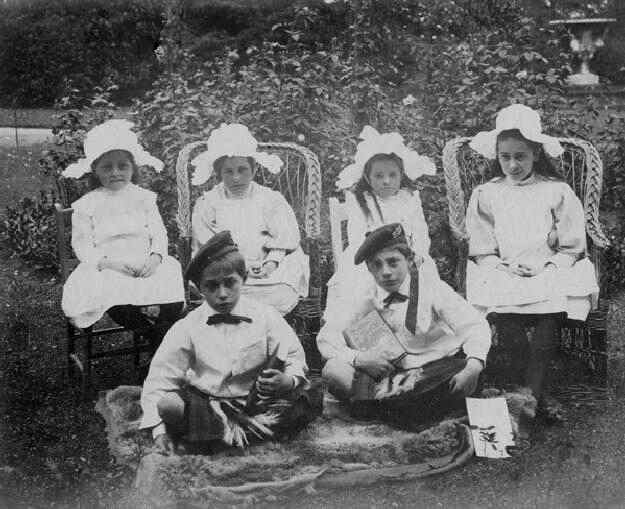
Scottish boys now dress rather much like boys in England and the rest of the United Kingdom. ly little difference between Enland and Scotland, although there was some differences noteable in tghe Highlabnds. The Highland kilt is the garment most associated with Scotland. The Scottish kilt as a child's garment is a relatively recent phenomenon. The modern kilt, in fact, dates from only from the 18th century. Highland boys once dressed quite differently commonly wearing kilts. Lowland boys began to adopted English garments much earlier than Highland boys. Today few Scottish boys wear kilts. Boys from affluent families often have kilts and wear them for church or other special occasions. The Scottish caps associated with the kilt were also worn, but we think various styles of flat caps may have been more common. Another garment widely worn in Scotland, because of the climate, is the sweater. Scottish boys like English boys began wearing short trousers in the early 20th century. They were commonly worn by Scottish boys of all ages through the 1950s. Again because of the changeable climate the amoack was another popuar an utilitarian garment.
We see Scottish boys wearing a range of headwear, both Scottish and the styles common in England. Headwear until after World War II was fairly common, much more common than than is the case tody. We see younger boys wearing broad-brimmed sailor hats. Other kinds of hats seem less common. Caps are another matter. And various types are caps are even identifid with Scotland, known as bonnets. The Glengary has fairly modern origins, the Balmoral is a modern name for style which may have earlier origins. In addtion we see the same type of caps worn in England such as peaked caps and flat caps. Boys wearing these styles look virtually identical in Scotland and England. These are actually more common thnt the Scottish styles. And their are other types of headwear such as tams which have Scottish origins.
Scotland is best known for skirtd garments, more specifically the kilt. The kilr is not th only skirted grment orn by cottish boys, but it is certainly the best known. Younger Scottish boys like other European boys wore dresses in the 19th century. We do not know how common this was and any infgormation about the Higlands (wghere kilts were worn) and the Lowlands. We have virtually no specific information about Scottish dresses at this time. One Scot reports, "In rural Scotland this fashion continued well into the 1930s. Before my first haircut (February 1938, aged 4�) in my frocks and smocks, I looked like a Shirley Temple clone." [Ronald Fraser, The Times, (London) November 29, 2002.] We note Scottish girls and younger boys wearing pinafores in the 19th and early-20th century. Our initial assessment is that the styles and conventions were very similar to those prevalent in England, although our archive is very limnited at this time. This was a style that cut across class lines. We see boys and girls in working-class, middle-class, and upper-class families wearing pinafores. This was a style for pre-scgool boys, but girls of all ages wore them. Mot of the ones we note are white. Styles could vary. We see both very plain ones and fancy ones which might be worn with party dresses by younger girls. The pinafore in Scotland rapidly declined in poularity after World War I. This was the general pattern throughout Europe although we still see some girls oin the continent wearing pinafores into the 1950s. The Highland kilt is the garment most associated with Scotland. The Scottish kilt as a child's garment is a relatively recent phenomenon. The modern kilt, in fact, dates from only
from the 18th century. It's use as a child's garment was largely due to Queen Victoria in the mid-19th century and her infatuation with Scotland. The young Queen, showing the romantic outlook of her younger years, outfitted her sons in flamboyant kilts. I'm not sure if this was actually the Queen'd idea or someone on her staff or even Prince Albert. Nor am I sure weather it was an innovative idea or just a popular fashion the Queen the style--at least among mothers. And it was the mothers that for generations had the virtual absolute disgression in choosing their sons clothes--usually with no consideration of the boys' opinions. The result was a long-lasting dress style for generations of British and American boys. Several variants of the kilts introduced by the Queen developed. The kilt suit was the most ubiqutous. Other styles in which kilt suits were made include sailor and Fauntleroy suits. While kilt suits have passed from the boys' fashion scene, the Scottish kilt continues to be worn today by schoolboys, Scouts, dancers, pipe bands, and participants at various formal occasions such as weddings where ring bearers, attendants, and even the groom might wear kilt. Younger Scottish boys at the turn of the century wore tunics as was common in England and America. The style of tunic is somewhat different than was common in America. HBC know less about tunic styles in England. We do not know how common tunics were in Scotland.
We do not yet have much much information about suits in Scotland, but have begun to collect some information. Our Scottish archive is still very limited. Our information on the 19th century is limited, but we now have some information on on the 20th century. The images we have found show Scottish boys wearing suits that were virtually indistinguishable from English suits. There were the same popular styles as worn in England. We notice a variety of styles. We do have a portrait of an Edinburgh boy wearing a Fauntleroy outfit, but with a cape rather than a jacket. We also see Scottish boys wearing sailor suits like the ones worn by Enflish boys. We also notice Scottish boys wearing the same kind of regular suits worn in England. We see cut-away jackets in the mid-19th century. Boys wore both single- and double-breasted jackets. Some boys from well-to-do families wore Fauntleroy suits. Norfolk jackets seem popular in the late-19th cedntury. The jackets seem the same as those worn in England and America. Scottish suits are a little different than the suits worn in America in that knickers pants seem more common than knee pants. Of course when worn with kilts the Scottish connection is clear. An important factor was age. Suit styles were very different for boys of differenht ages. These differences are now much less notavle.
We see Scottish boys wearing generally small bow ties with Eton collars. A good example is the Lennox boys.
We do not have much information on Scottish shirt-like garments yet. We see blouses, shirt waists, and shirts. Gradually in the 20th century we see casual colarless shirts like T-shirts. A popular 20th century stle was the Rugby shirt. We seem to see more of tese shits in England than Scotland. As far as we can tell, Scottish and English boys with only a few minor differences wore the same styles of shirt-like garments and collars, at least since the 19th century. There may have been differences begore that, at least in the Highlands. Lowland Scotts basically were Anglicized much earlier. After the Highland Clearances (18th century), English fashion began to affect the Highlands as well. With the invention of photography, we are able to follow this in some detail. One of the best ways to follow this is school portraits which had become common by the late-19th century. Many garments are difficult to follow with the children all grouped together. The collars in cotrast are almost always vissible. School portraits have the added advantage that many are dated. We see a lot of detachable Eton collar at the turn of the 20th century. And we even a few large Fauntleroy collars. Gradually detachable collars declined in importance.
HBC does not yet have a good assessment of how common kilts as opposed to trousers were worn in the 19th century. Nor do we know how it varied overtime. We believe that trousers such as knickers and kneepants were more common, especually in the Lowland cities and towns, but we have no confirmation of this. By the 20th century, trousrs were much more common than kilts, although on the many rural villages before World War II many boys did wear the kilt, especially for church and other special occassions. Still pants were much more common for day to day wear and for school. Some of the Scottish boys like English boys began wearing short trousers in the early 20th century. They were commonly worn by Scottish boys of all ages through the 1950s. Scotland being a genrally more traditional area of the U.K., new trends such as loing pants for younger boys and jeans were slower to take hold than in England.
Scotland is located at northerly lattitude, comparable to Labrador in Canada, southern Scandinavia, and Moscow in Russia. The Scottish climate is, however, moderated by the Gulf Stream. There wether is often cool, but Scotland does not experience hard winters and deep snows. It does snow during the winter, but there are rarely serious accmulations, excepyh at high elevations. Scotland's climate is thus quite moderate, although very changeable--in large masure veing surrounded on three sides by ocean areas and the North Sea is not moderared by the Gulf Stream. Occasionally there are hot summer spells and really cold winter days, but these are the exception. There is a Scottish expression, 'there's no such thing as bad weather, only the wrong clothes'. Which brings us to the subject if what are the right clothes. Because of the changeability of the weather, jackets are needed for much of the year and coats for a couple months. A sunny day can turn into a cloudy day very quickly. And without the sun it can be cool. Thus jackets and sweaters are very useful because they can easily be taken off and put back on. Scotland is known for its woolen goods. Some of the finest sweaters in the world are made in Scotland.
While really cold days are limited. Winter is cold enough that you see most of the other standard winter garments: caps, scarves, leggings, knee socks, long stockings, and other cold weather garments. It rains quite commonly in Scotland, one reason like Ireland it is so green. There can be rainy days, but very commonly rain comes as a brief interlude even during a sunny summer day. So you need to be prepared for rain even if it does not look like rain in the morning. An amoack is thus a popuar and utilitarian garment. Another destinguishing featue of Scottish weather is that even thiugh itb is a small country, there can be regioinal differences daily. Just moving a few miles can find completely different conditions. This is all very difficult to predict.
We note Scottish boys wearing a variety of hosiery, including long stockings, knee scocks, and ankle socks. Scotland was a depressed area of Britain and we see a lot of children going barefoot, especially before World War I. We do not note many boys weaing sandals without socks as was common in England. We note boys at a Glasgow school wearing long stockings and going barefoot. Long stockings, however, are not nearly as common as in neigboring Scandnavia. We see many boys wearing knee socks. Knee socks seem more common than in England. This same difference was observeable between northern and southern England. Jere climate was an important factor. Through World War II, knee socks were very common in the early- and mid-20th century. Ankle socks became increasigly common after World War II when long trousers began to become more common. We begin to see this by the 1960s. The same color conventions precialed as in England with white socks mostly being worn by girls. There were some differences in school uniform sock color between england and Scotland.
Scottish footwear as best we can tell basically the same as English footwear. The only difference we can see is economic. Scotland was not as affluent as England as thus we see more barefoot children in Scotland during the 19th and early-20th century. Scottish boys like English boys beginning in the 1920s wore closed-toe sandals, both for school and for play. We see them being commonly worn at school. both the "T"-strap style and the double-strap style. The popularity began to decline in the 1960s after sneakers began to become increasingly popular. Sandals were worn both with and without socks. The most popular style was the standard "T" bar strap. Scotland with all of its rain creates ideal conditions for the Wellington boot or 'wellies' as they are affectionately known in England and Scotland. We note quite a few images of barefoot Scootish children in the early 20th century. These children are working-class children. We notice both street children and children at school who are barefoot. A good example is the Queen Mary Street Public School in 1916. A French reader writes, "Quite strange to see barefoot children. That could shock people here in France. I think it is a cultural question. Even in the poor villages in France, the children in this case were wearing clogs." HBC is unsure how common clogs were in Scotland. We do not see them in the photographic record, but our Scottish archive is still limited.
Thank you for your interest in our site. If using any of our material, partially or in full, we ask that you always provide an active hyperlink to the pages that you have consulted.

Navigate the Boys' Historical Clothing Web Site:
[Introduction]
[Activities]
[Biographies]
[Chronology]
[Clothing styles]
[Countries]
[Bibliographies]
[Contributions]
[FAQs]
[Glossaries]
[Images]
[Links]
[Registration]
[Tools]
[Boys' Clothing Home]
Navigate the Boys' Historical Clothing kilt pages:
[Return to the Main Scottish page]
[Return to the Main kilt page]
[Kilt suits]
[Scottish kilts]
[Scottish school uniform]
[Highland dance]
[Pipeband]
[Irish kilts]
[Irish boys clothing]
[Irish step dancing]
[Greek kilts]