***
United States boys clothes: footwear types sandals
United States Boys' Clothes: Footwear Types--Sandals
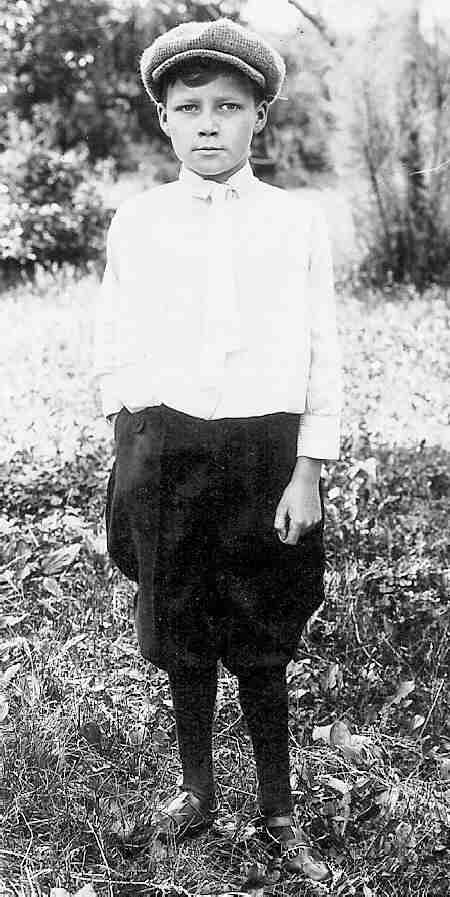
Figure 1.-- This unidentified American boy wears many of the popular styles of the 1910s. This boy looks to be about 8-9 years old. He wears the popular flat cap. He has a white blouse and necktie which he wears with knickers and black long stickings. The one item that was not very common was the sandals. Note that they are being worn with black stockings and for dress wear. The postcard photograph had a AZO stamp box dating between 1904 and 1918. We would guess it was taken in the early 1910s.
There are two basic types of sandals, closed and open toe styles. Most early sandals and strap shoes were closed-toe sandals. We note boys wearing closed-toe strap shoes in the 19th century, but these seem more of a shoe rather than s asndal in the sence of children's wear for play and school. We note boys wearing sandals in the early 20th century. We see many different styles involving the placement and arrangement of the straps. We see them being worn in the early 20th century, but they were not very popular. American boys wore sandals much less than boys in Europe. We note different colors. Tan was a popular color for the first sandals in the early-20th century. Early sandals During the mid-20 century they were still being worn by girls and younger boys. The sandal became popular schoolwear in Britain, but this was never the case in America, We note sandals becoming more popular in the late-20th century, espcially the open-toe styles. There were regional differences. Sandals seemed more popular in California than the East Coast. We see more sandals in the 1990s. Footwear companies broughout the sports sandal. The open-toe sandals did not the image of little boys/girls foot wear and acquired the image of leisure wear for both boys and men.
There are two basic types of sandals, closed and open toe styles. They have varied in popularity over time as well as the conventions associated in wearing them. Most early American sandals and strap shoes were closed-toe sandals. We note boys wearing closed-toe strap shoes in the 19th century, but these seem more of a shoe rather than sandals in the sence of children's wear for play and school. We note both boys and girls wearing sandals in the bery early-20th century. They were often marketed as barefoot sandals. e see them worn both with and without socks. The double-bar sandals seem the most common. The single-bar sandals that became popular in England as school sandals, were less popular in America. After World war I in the 1920s we mostly see girls waring the sandals. This gender difference is very evident in school portraits. For girls the double-bar style seems both a sandal and shoe style. We see many different styles involving the placement and arrangement of the straps on closed toe-sandals. We do not see boys wearing open-toe sandals until well after World War II. They were first worn in Califotrnia and only gradually spread east. The sandals that began to become popular were open-toe sandals in the 1980s. We see some marketed as 'sports sandals'. This was a very casual style and American boys, unlike European boys, did not wear hosiery with sandals.
We note boys wearing strap shoes in the 19th century. We do not note sandals untol the turn-of-th 20th century. And at that tome we note boys wearing sandals in both the photographic record and in period cataogs. They seem to be mostly double strp cloesd-toe sandals. They were referred to as barefoot sandals. They appeared in the 1900s, although the photographic record suggests that they were not widely worn in the 1900s. We think that they were beginning to become popular by the end of the decade. They seem to have been fairly popular in the 1910s. They were commonly worn with hosiery, but we also see them being worn without hosiery. Sandals declined in popularity after World War I in the 1920s. This was especoally the case for boys. We note by the 1930s that virtually no American boys wore sandals. An exceotion seems to be boys from affluent families whose parents were influenced by British fashions. Sandals were worn in america, but almost always by girls. This gender division did not begin to change until after World war II.
Sandals seemed more popular in California than the East Coast. We see more sandals in the 1990s. Footwear companies broughout the sports sandal. The open-toe sandals did not the image of little boys/girls foot wear and acquired the image of leisure wear for both boys and men.
Popularity
We see sandals being worn in the early 20th century, but they were not very popular. American boys wore sandals, but less than boys in Europe. This was especially the case after World War I.
Color
We note different colors. Assessing color, however, is complicated by the black-and-white photography of the early 20th century. Availables imges suggest that sandals were normally done in dark colors. Dark tan or normal shoe color seems to have been a popular color for the first sandals in the early 20th century. The boy here is a good example (figure 1). We soon notice white sandals being worn for dressy occassions like a family portrait. The Keck children in the 1910s are one of the first wxamples of whire standals we have noted. We also notice George Dorsey wearing white sandals in 1923.
We are not yet sure about the age conventions associated with boys wearing sandals in America. Conventions appear to have changed over time. Sandals as opposed to strap shoes appeared after the turn-of-the 20th century. For a short period, cloesed-toe sandals seem to have been popular, at least will families in comfortable circumstances. We note them being worn primarily by pre-teen boys. We note quite a number of younger bous wearing sandals in the 1910s. We note that in catalogs that they were offered in larger sizes. We have found, however, only a few photographs of teenagers wearing them, especially older teenagers. After World War I sandals declined in popularity, at leadt for boys. We rately see school age boys wearing them. Only after World War II do we see boys commonly wearing sandals. We begin to see boys in California wearing sandals in the 1960s. They became associayed with the California beach culture which Hippies picked up on. Thus we see teenagers wearing them, actually more teenagers than younger boys.
Gender
Early sandals During the mid-20 century they were still being worn by girls and younger boys.
Social Class
Social class factors in Amrica affected the wearing of sandals, at least for boys. We see boys wearing closed-toe sandals in the early-20th century. These seem to be be motly boys from affluent families. We do not see working-class boys wearing sandals. We are not entirely sure why this was. It may be that working-clss families did not have the money for a spare pair of shoes for summer war. Many of these boys would go barefoot in the summer, although this was somewhat less common in the larger cities. We note this trend continuing into the 1960s, although by this time only relaribely young boys wore sandals. President Kenndy's som John is a good example. Mrs. Kennedy als liked European fashions. Later when open-toes sandals began to become populr there dies not seem to have been any socil-class connotations,
Usage
Sandal usage was very different in America than Europe. Sanals formost of the 20th century weee not popular schoolwear, at least for Americn boys. The sandal became popular schoolwear in Britain, but this was not the case in America, at least for boys. We do see closed-toe sandals being worn by boys in the early-20th century, This rapidly declined in the 1920s and by the 1930s were increasingly seen as a girls' shoe style. This id not to say that no boys wore them. We see some younger boys waring sandals for play. Here there seem to have been social class and regional factors have play, but the photographic record shows that they were not commonly worn by American boys, especially school-age boys. We note sandals becoming more popular in the late-20th century, espcially the open-toe styles. They were worn as a casual, plsay style. They appeared earlier in California than the rest of the country.
Manufacturers
There were lots of American shoe companies that oprtated in the 1970s and 80s. Most no longer exist. They made great quality leather shoes for children. The companieds included Foot Traits, Fleet Air, Child Life, Child Stride, Walk-In, Baby Deer, Kesco, Willits, and others. Threy made leather closed-toe sandals and T-strap shioes. The only brand of T-straps mafe in America during the 2000s is Amilio. The company is Kepner Scott, in Orwigsburg, Pennsylvania. Everyone else that made quality shoes that didn't closedown (such as Stride Rite, Jumping Jacks, Buster Brown, and others) have moved to the Far East (mostly China). A reader writes, "The quality of their shoes is downright inferior to the point where it is just simply junk."