|
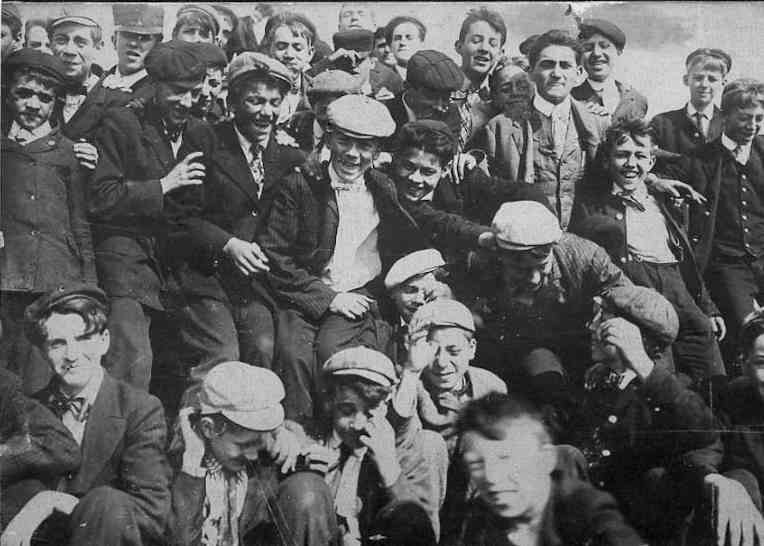
Few headwear styles were as dominant in a given period as the flat cap. Flat caps were also worn in Europe, but were never as popular as in America. American boys at the turn of the 20th century favored flat caps until about the late 1930's. We see them at first being worn by older boys and teenagers, but by the 1910s, all school-age boys were wearing them. They were commonly worn by American boys in the 1920s-30s before baseball caps took over. Boys at the time did not generally wear baseball caps as they were not commonly available in stores and Little League where boys played ball as part of organized, uniformed teams had not yet developed. Most boys wore these tweedy hats or beanies, except during the winter when warmer styles were needed. We notice a variety of variations with both the peak (bill) and the crown. They were made in different colors and material. Some matched suits, but most did not. There were a range of different styles. Some were less flat than others, looking rather like English peaked caps. Flat caps were referred to with many different names, such as golf and newspaper boy caps.
The flat cap was one of the most popular styles of caps for boys, although for a relatively limited period. Few headwear styles were as dominant in a given period as the flat cap. Flat caps were also worn in Europe, but were never as popular as in America. They seem to have been a cap that was popular with boys and acceptable to parents. These caps in Europe seem to have had a working-class association. This does not seem to have been the case in America. We see both working-class boys and middle-class boys wearing them. Boys wore flat caps for casual wear and when dressing up. Some more affluent boys might wear British-styled peaked caps, but this was a relatively small proportion of boys. Some suits even had matching flat caps. We see many snap shots taken during the period with all or most of the boys wearing flat caps. They seem especiallu popular in the 1910s and 20s, butwre also common in the 1900s and early 30s. The declining popularity e of the flat cap seems as much associated with the decline of the cap as the overall decline in boys wearing headwear. Nothing really replaced the flat cap. Essentially boys stopped wearing headwear except for cold-weather caps during the winter.
American boys at the turn of the 20th century favored flat caps. I am not sure when they first appeared. I tink they appeared in the 1890s, but we can not yet confirm that. We know they were worn in the 1900s and were very common by the end of the decade. Interestingly, boys wearing knee pants in the 1900s might or might not wear flat caps, but almost always boys wearing knickers wore flat caps. We are not entirely sure why the two were so closely associated. Flat caps were most common in the 1910s and 20s when virtually all boys wore flat caps.
They were widely available. See for example a Wards's 1926 catalog offering. We also see them in the early 30s, although we do not see them being commonly worn in the late-30s. Their popularity is roughly comparble to that of knickers and in fact the two garments in American are strongly associated. until about the late 1930's. We see them at first being worn by older boys and teen afers, but by the 1910s, all school-age boys were wearing them. They were commonly worn by American boys in the 1920s-30s before baseball caps took over. Boys at the time did not generally wear baseball caps as they were not commonly available in stores and Little League where boys played ball as part of organized, uniformed teams had not yet developed.
Flat caps were worn by all school-age boys. We do not see younger boys who have not yet begun school wearing them, at least not commonly. The various youngest boys in elementary (primary) school might wear other styles but by about grade three we normally see boys wrearing flat caps and they were worn by boys right through the teen years into high school. There does not seem to be a lot of differentiation concerning age levels among schoolboys as regards flat caps. Nor does nor seem to have been any social connotations for boys. We see boys from a wide range of social levels wearing them. They were not the only headwear worn by boys and teenagers, but they were by far the most common. Flat caps were also worn by young adults. Here there were social-class differences. Well estblished adults would wear hats, but we seem working-class men wearing flat caps, at least the younger ones.
Most boys wore these tweedy hats or beanies, except during the winter when warmer styles were needed.
We notice a variety of variations with both the peak (bill) and the crown. They were made in different colors and material. Some matched suits, but most did not. There were a range of different styles. Some were less flat than others, looking rather like English peaked caps.
The flat cap was a flexible garment as boys could wear them with both formal and casual outfits. We see boys commonly wearing flat caps with both suits qs well as more casual outfits likes shirts and blouses and pants--often knee pants or knickers. This mean we see boys dressing up for chirch and school with flat caps abd suits. We also see boys wearing them for casual outdoor activities like baseball. They were worn with other outfits such as the tunic suits that younger boys wore, but this was less common than suits or shirts and pants. This is probably because the flat cap was more common with older boys than younger pre-school boys.
Flat caps were referred to with many different names, such as golf and newspaper boy caps.

Navigate the Boys' Historical Clothing Web Site:
[Return to the Main U.S. cap style page]
[Return to the Main flat cap country page]
[Introduction]
[Activities]
[Biographies]
[Chronology]
[Clothing styles]
[Countries]
[Bibliographies]
[Contributions]
[FAQs]
[Glossary]
[Images]
[Links]
[Registration]
[Tools]
[Boys' Clothing Home]