
United States Boys' Clothes: Individual Experiences in the 1900s
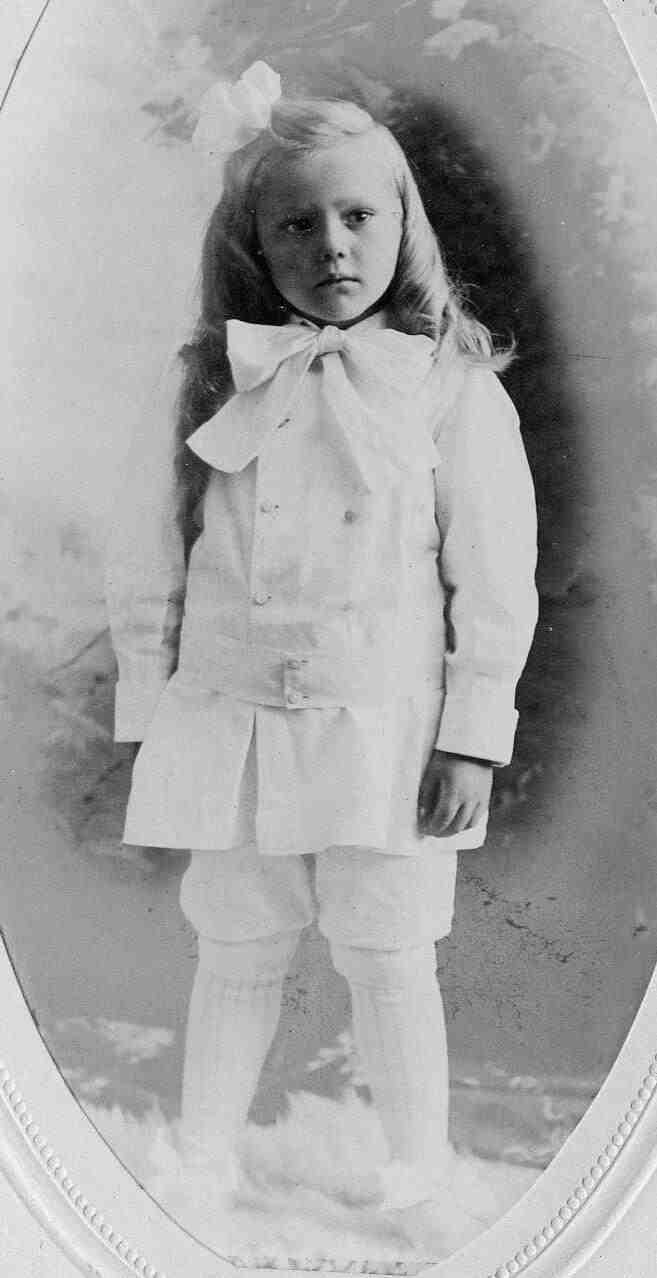
Figure 1.-- Many mothers in the 1900s liked to dress their children in white, like this boy' mothr. Here he wears a white kneepants suit. In all the images we have of him he has long blond hair and wears a hair bow, even in this portrit after breeching. Image courtesy of the RG collection.
|
|
We have collected information about several individual American boys during the 1900s. Because of the time factor, no HBC reader has sent us a personal account of their boyhood experiences. We have noted accounbts in biographies as well as a great deal of photographic evidence. Younger boys were still outfitted in dresses and other skirted garments, but not as commonly as in the 1890s. We have noted many unidentifiedimages showing boys wearing dresses in the 1890s. One example here is Ernest Hemmingway whose mother liked to dress him and his sistr in matcing outfits. One of the most common outfits for yong boys after breaching was the tunic suit. Buster Brown and sailor styles were very popular. Harold Fitzroy-Carrington and the Ohio boy are good examples here. There ar many others. Boys still wore Fauntleroy suits, although sailor suts were much more common. Tom Wolfe wears a popular style of sailor suit. Older boys suits. Norfolk jackets were especially popular. Most boys wore their suits with kneepants or knickers, often with black or other dark-colored long stockings. The Pittsburg brothers are examples here. Most boys had short hir cuts, although shaved heads were rare. Some boys wore longer hair, even ringlets, although this was becoming less common. Even a few older boys, like Tom Wolfe, wore ringlets, but hated them. A few boys even had hair bows.
Ernest Heminway, the noted American novelist, was born in 1898 and raised in Oak Park, Ill. His tough guy, hard boilled style had a profound influence on other American authors. In contrast to this image, he was rather a coddled child. His mother doted on him and outfitted Ernest and his older sister in identical dresses when he was a small boy and insisted he pursue cultural activities such as music lessons and singing. His father, however, encouraged him to pursue outdoor activities such as hunting and fushing. Ernest reveled in the outdoors and secretly turned the music room into a boxing ring, a step even his father would not have approved.
Many images illustrating historic boys clothes are soletary photographs, often anonamous
images that do not show what the child wore when he was younger and older. A fascinating
series of images from the forst few years of the 1900s are available for an Ohio boy, Lawrence Ivan Maicie. The photographs show what Lawrence wore from infanthood to about 10 yeas of age. His doting mother seems to have been particularly fond of tunics and large floppy bows. The sereies gives a good idea of the progression of styles for an American boy in the first decade of the 20th Century.
Here is a composite photograph that pictures a 5 2/3 year old boy (as noted on the back) in various poses wearing his sailor suit. The written notation on the back reads "Dee - 1902 - 5 2/3 years". The photographer (Stecnil?) has signed the photo in pencil under the first photo on the left. The photo was taken in Los Angeles. After the individual photos were taken, the professional photographer made the composite and developed the final photo. The composite was then attached securely and expertly to a fairly thick cabinet card-like material. The boy wears an emaculate white sailor suit without any detailing. He has a darl presumably black scarve. The outfit is a kneepants sailor suit which the noyswears with contrasting black long stockings. A white sailor suit like this would have been for Summer wear. He has a dark reefer jacket which woyld have been worn in cooler weather.
Harold and Phyllis Fitzroy-Carrington were extensively photographed outside what is probably their home in New York in about 1904-15. A HBC contributor has a collection of nine albums of photographs that were taken by the childrens father, an enthusiastic amateur photographer. As a result, there are many charming images beside stiff, formal portraits. Their father was obviously a wealthy man. They had a New York City brick row house and they also had a country home called 'Mallowfield' at Mamaroneck. N.Y. There are approximately 100 photos in each album, many of them of Harold and his siblings playing with toys, pets, bikes etc some in swimming costumes, some playing musical instruments. The collection is a wonderful view of childhood in a wealthy New York family in the years before World War I. believe that Harold was born about 1897 and Phyllis about 1900.
A HBC reader has sent us three portraits of an unidentified boy. Unfortunately we have no information about the images. We believe that they were probably taken about 1905-10. They are clearly America, but we do not know where in America the boy was from. His clothing are an example of just how popular white clothing were for children in the early 20th century. The first portrit shows the boy and his sister at 2-3 years of age. In one he is wearing a white dress. The second portrait is with his Mother. He is still unbreeched and ears a white dress and hat. The third is after breeching. He wears a white knickers suit. In all three images he has long blond hair and wears a hair bow, even in the portrit after breeching.
This portrait taken in 1906 shows two unidentfied boys. They were almost surely brothers. The piortrait was taken in Pittsburgh. It is an excellent illustration of contemporary styles and conventions. Siblings were commonly dresses alike, but often subtle and not so subtle variations to reflect age differences.
Thomas Wolfe was an enormously popular American novelist during the middle of this 20th Century. He left an indelible mark on American letters. His opulent language and unique literary style have elevated his life to legendary status through his four autobiographical novels. Thomas Wolfe was perhaps the most autobiographical of America's major novelists. His boyhood memories provided some interesing insights into boys clothing and hair styles in the first decade of the 20th Century. He particularly remembers the long ringlet curls he had to wear, even after he had started school.
This is a very useful book about childhood in the late-19th abd early-20th century. A HBC reader tells us, "Many years ago, my mother produced a manuscript dealing with the life in that part of Chicago in which she was raised. Its title is "A Mile Square of Chicago" and authored by Marjorie Warvelle Bear (after my father died, my
mother remarried, thus the surname "Bear"). While it won't provide much in the way of photographic material relevant to HBC's objectives, it does provide considerable descriptive material relevant to the children of the era, from the 1870s through the early 1900s. The mile square itself is more or less directly west of
downtown Chicago, and in that era it was home to more or less well-to-do families, and some of their children became famous (such as Walt Disney)." When reading A Mile Square of Chicago, one gains a glimpse into the world of a little girl, her neighborhood in a section of Chicago, and the city at large. This book inspires feelings of wonder that grips the reader by bringing ordinary daily events into a different perspective. The book gives readers a look at some of Chicago's oldest schools, such as Brown School and Old Central High School, and their more distinguished students. It describes the neighborhood, not only through literary descriptions of its sights, sounds, and smells, but also through the poetry, art, inventiveness, and the diverse contributions of its creative denizens. This view of the past is enhanced through the inclusion of over 120 photographs. The readers get a feel for neighborhood stores, industries and parks, and the significant role of the adjacent Illinois Medical Center District. With the immediate neighborhood being rounded out by events that had city-wide effects, such as the Chicago Fire of 1871 and the World's Fair of 1893, this is a book that provides a unique outlook on the history of an important square mile of Chicago.
HBC

Navigate the Boys' Historical Clothing Web Site:
[Return to the Main U.S. individual experiences page]
[Return to the Main U.S. 1900s page]
[Introduction]
[Activities]
[Biographies]
[Chronology]
[Clothing styles]
[Countries]
[Essays]
[Bibliographies]
[Contributions]
[FAQs]
[Glossaries]
[Images]
[Links]
[Registration]
[Tools]
[ Boys' Clothing Home]
Created: 3:59 PM 9/1/2009
Last updated: 3:59 PM 9/1/2009