|
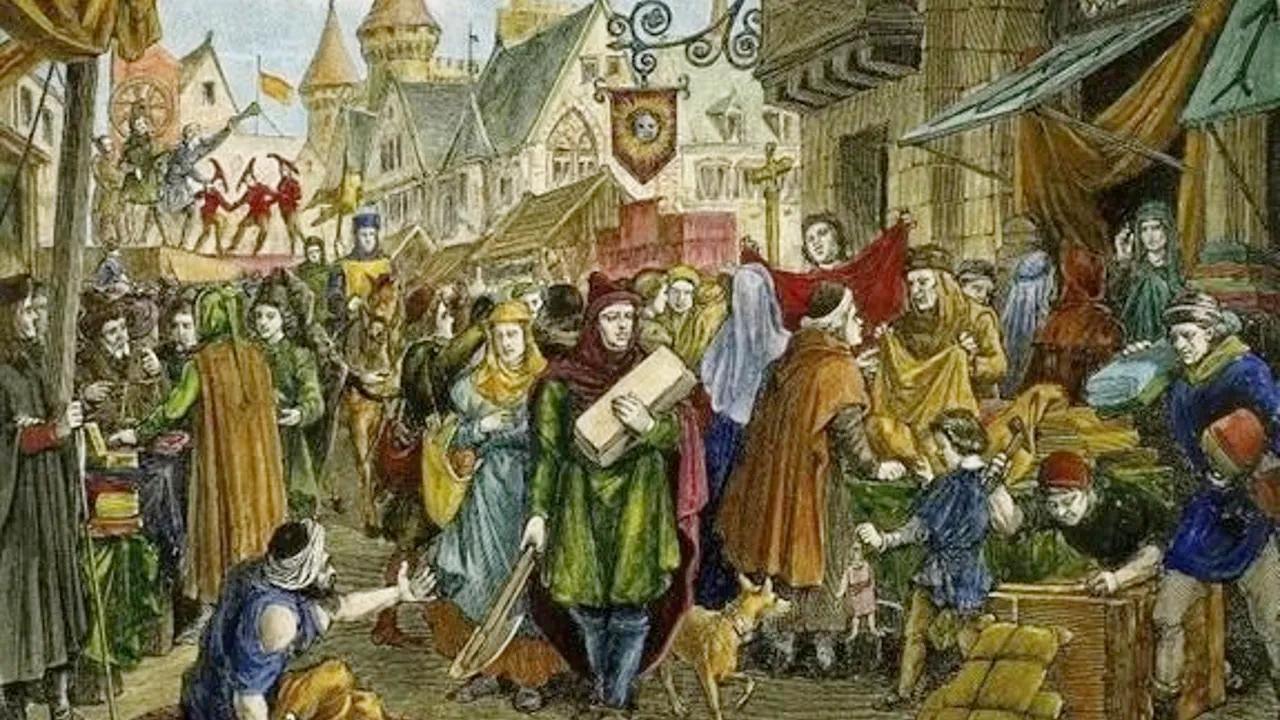
Feudalism was the principal ocial system of Medieval Europe, although it only devlopedslowly after the collapse of the Roman Empire. Overall, it was an era lastingh about a millenium. Fedudalism was more than just an ecomonic system, but a social and political system as well. The great bulk of the opopultion were peasants living on the estates of feudal lords. Within Feudalism the enslaved peasantry gradually evolved from slavery to serfdom. The difference was at first limited, but there were important legal differences. Here the Church was an imprtant factor. Other economic topics considered here are the Silk Road, Crusades, plague, and the Medieval wool trade,anfv the slow acquisition of new technologhies. Change was slow during the medieval era, but it did occur. There were substabntial differences between the early- and late-medieval era. Throughout much of the period, Europe was an economic backwater. Technological advances were in large measure imported from the East through Muslim lands. Only in the late-medieval era do we begin to see the pvce of trade and technological innovation quicken.
As a result of the For nearly two millenia, the Silk Road was a key element in the world econonomy. The history of the famed Silk Road is one of many instances in which clothing and fabrics have played a major role in human history. The story of the silk road is one of military adventures and conquest, adventuresome explorers, religious pilgrims, and great philosophers. While it is silk which is often, naturally enough, most strongly associated with the silk road, the flow of ideas and religion as an almost unintended aspect of the flow of trade may have been one of the most significant impacts. Of course most of the people who traversed the silk road were not great thinkers, but common tradesmen who transported their merchandise at great risk for the substantial profits that could be made. They moved cammal caravans over some of the most hostile terraine on the planet. The ilk road tranversed deserts, mountains and the seemingly endless Central Asian steppe. Some of the great figures of history are associated with the Silk Road, including Alexander the Great, Marco Polo, Genghis Khan, and Tamerlane. Merchandice may have moved over the Silk Road as early as the 5th century BC. The Silk Road is believed to have become an established trade route by the 1st century BC and continued to be important until the 16th century when more reliable sea routes were established as a result of the European voyages of discovery.
Europen feudalism was a decentralized social organization that arose with the collapse of central authority after the fall of the Roman Empire and the breakdown of all social institutions except the Church. Feudalism was the central European social systemgoverning Europe during the medieval era. The caos rought by waves of barbarian invasions throughly destroyed the established order. Gradually Roman institutions were forgotten. Society splintered into large numbers of small, isolated communities. The new institutions which involved in Europe involved a moneyless economy, limited transportation, rstrictive communication facilities, and a complete bsence of effective central government. People turned to local lords to protect them from pilaging neighbors and an even greater thread from war-like raiders such as the Vikings, Magyars, and Saracens. The European response three important ne institutions. Peasants wre organized on manors. Monestaries were organized to support priests and nuns. Social relationships were organized around a new social institition that we now call feudalism.
Christian pilgrims after the Arab conquests of the 7th and 8th centuries had to travel through Islamic lands to venerate the great shrines in Jeruselum and other Biblical sites in the Holy Land. In addition the Ottoman Turks were increasingly encroaching on the Eastern or Byzantine Empire. The Turks apparently preyed upon Christian pilgrims. Byzantine Emperor Alexius Comnenus, perhaps concerned about the plight of the pilgrims, more likely seeking allies against the Turks, wrote to a friend Robert, the Count of Flanders, in 1093. He recounted the alegeded atrocities inflicted on the pilgrims by the Turks. Count Robert forwarded Comnenus' letter to Pope Urban II. Pope Urban like Emperor Comnenus perhaps concerbed about Christian pilgrims, more likely seeing a political opportunity, decided to promote a military crusade to seize the Holy Land from the infidel Turks. European Christians at the time were locked in intractable dynastic wars in England, France, Italy, and other domains, destabilizing large areas of Europe. The Pope sought to redirect the fighting to an infidel adversary. Pope Urban's crusade, the First Crusade, was launched in 1095.
The salt trade has been imprtant since the dawn of civilization. Our modern word salary cpmes from the Romn word salarium--a ration of salt given legionaires. With the fall of Rome, salt became a difficult to obtain and a rare, expenive luxury. In Europe it was available to an extent in costal areas, but not interior areas. Largely land-locked areas like Germany had to do without. This was especially true of areas away from navigable rivers. Some of the earliest roads to be revived in Europe as the medieval era evolved were salt roads, connecting salt sources to towns. This also led to some early canals. Salt was not just a condiment, but an important method of preserving food. This required far larger quantities than simple use as a condiment. Salt was a major trade itemn for the Hanseatic League. Civil authorities began taxing salt, especially during the late.-medieval period. Rulers instituted high tariffs on salt. Some began establishing monopolies on imports and sales.
Historians blieve the plague that raged through Europe began in China. Chinese sources reported an outbreak of bubonic plague some time in the early 1330s. The outbreak was not as severe as what was to come in Europe, perhaps because the disease was not new to China and there was some natural resistance. Also perhaps personal hygine was superior to that in Europe at the time. Plague infests warm blooded mammals, espeialy rodents like rats. The fleas that infest rats carry the disease to people. Other people become affected in the course of normal social interaction. The disease spreads very rapidly in any given population. Plague causes first a fever and then a painful swelling of the lymph glands. These glans are called buboes and thus the diseas became known as the bubonic plague. The plague also causes red spots on the skin that turn black, giving its other name--the black death. China in the 14th cenury was the richest society in the world and commercial contacts existed with the West. Thus the disease eventually spread west. First to western Asia and Europe. One link was Itlaiam merchants that brought goods from Black Sea ports. Merchant vessels arruved in Sicily in October 1347 wih sailors already dying. The disease was quickly established on the island and spread to Italy and then north with incredible speed. It had reached England by August 1348. Doctors had no concpt of what cused the disease or how to treat it. The disease subsided in Winter beacuse the fleas were dormant in the cold weather. Each Spring when the weather warmed and the fleas became more active, the disease returned. Over 5 years at the peak of the epidemic, the plague killed an estimated 25 million people. The European population was much smaller in the 14th and this represented one-third of the population. Beyond the personal tragedies, the economic and social consequences were enormous. The personal tragecies caused many to question the established order. There were severe labor shortages, severly undermining the economic under pinings of te feudal system. Peasants and workers demanded more money. When land lords resisted, peasant revolts broke out in Belgium, England, France, Germany, and Italy. Others began to question the religious order as well. Where was God when the plague raged? Why did he not answer the prayers of the faithful. More people began asking uestions to themselves. The God-centered mind set of the medieval era began to shift toward the human-centered world of the Renaisance.
The wool trade in Europe as late as the 10th century was still a local craft activity. That industry by the 15th century had developed into a sophisticated industrial prouction and international commenrce by the 15th century. England was the great European producer of raw wool. The Lowlands especilly Flanders was the center for high-quality production of finihed woolen goods. English merchants began exporting wool themselves in the 14th century. Previously foreign traders marketed English wool. As the century progress the trade in raw wool began to give way to the trade in raw wool. Inflation in the 16th century affected wool prices. Inflation was in part a result of all the gold and silver flowing into Europe from the Spanish conquests in America, some of which reached England through privetering. The expansion of the wool trade meant more land was coverted to sheep reaing or inclosed. This displaced large numbers of tennant farmers was forced off the land, producing class of wandering, beggars. The Elizabethan poor laws were specifically created to address this situation. The seemingly economic shift had significant political consequences. Inflation reduced the real income of the monarchy because much of its income was fixed sums. The country gentry, however, greatly benefited from the inclosures as well as from the purchase of the lands obtained by closing the monasteries, much o which was also coverted to sheep rearing. The gentry began to use Parliament to asertively protect its wealth from royal taxation.
Just as cotton was at the center of the Industrial Revolution, wool was a key commodity in the Medieval era. Wool was the principal raw material used for textiles in Medieval Europe. It was usually woven to produce cloth, but some was used to produce felt. Wool is produced by sheep. Different breeds produce wool of varying quality. Some sheep have fine silky fleece. Other sheep have a very coarse fleece. High quality cloth required a fine yarn. This required the fleece to be carded, meaning combing with a large iron comb-like tool. The other principal fabric used to produce textiles in Medieval Europe was linen. Linen was produced from flax. Yarn was required to produce textiles. Yarn was produced from raw wool or flax fibers by hand. (The spinning wheels did not appear until the late Medieval era.) The raw wool or processed flax was placed on a drop spindle. A drop spindle was fashioned from wood or bone and weighted on the bottom with stone or metal. The yarn was produced by drawing the fiber out from the spindle and twisting it in the process. This was a tedious, labor intensive process, but only after the yarn was fashioned could the production of textiles begin. The next step was to dye the yarn. The yarn was then woven into cloth on hand looms. The woven cloth was then ironed by pressing with a whale bone (baleen) plaque, glass, or stone smoother which had been heated for the purpose. The final process was decoration by braided cords, tapestry, or embroidery. The center of the European wool trade was Flanders, but the damp Low Countries was not condusive to sheep husbandry. Conditions accross the Channel in England were ideal and sheep flourished there and it was a center of wool production. Thus critical economic ties developed between England and Flanders.
TThe medieval era covered a mennioum. Change over that time was glacial slow, especially duringthe first half, but rangeotechnolofgical cahnges essentially remade the European economy and this was befire thed Colomnban Excahnge resultiung fron the Voyages of Discovery. Many of these innovations were technology immports that came from outside Europe, especailly from China. Important new agriculture tecnologies greatly increased yields, a vital development in an agricultural economy.
Transportation is a vital factor in economics. It was key to to the neolithic revolution. It makes no sence for a farmrer to grow more than he and and his family could consum unless he could transport his surplus to a market. The Bronze Age was not possible unless tin could be transported to where copper was found--the two metals do not occur togrther. The Engkish wood iundustry would nit have developoed without the ability to transport tyhe weool to Flanders. And the imortantbtextile industruy of Flanders would not have develooed without the ability to transport the finished textiles to markets throughout Europe. A factor in the great empires of history was the improvement in transportation. There are two modes of transportation, overland and water transport.
The Persians and Romans were famous for their roads. One reason for the Dark Ages when European economies collapsed was not the vpolitical collapse of Rome, but that the European road networks built by the Roamans were no longer maintained and fell inyo disrepair. The vonce carefully maintained land routes declined into to muddy tracks in rainy periods and bumpy dirt paths at best during dry perriods. The medevial period was one of the longest in human history--about a millenium (5th-15th cenury). And for most of this period there was no road bulding. We see some beginninf efforts (12th century), but only minimal effoets in isolated localities. Roads of course are only boine oart of the land tarnsport story. The other mnajor part is technology. And here there were no advances. Transport by land required leg work, but there is afinite limit on how much a person can carry. Access to horses, mules, donkeys, oxen increased the loads and speed. Carts were used, but the design of the cart was not bonly unchanged during the medival era, but since its invention inm ancvuent Sumeria. And therewere serious costs, including tolls, tariffs, tips, lodging, and food.
The limitations of land transport meant that water travel was the only real way if transportting goods any distance during the medieval era, both riverine and sea transport. Water trnsport was by far the quickest, least expensive, and most efficient way of transporting goods. And the longer the journey, the more advantageous the water option was. And here unlike land transport there were real advances beginning in mid- and high middle ages. This was an imortant reason for the quickening of commerce.
The advnces wre enormous, including the magnetic compass, lateen sail, pintle-and-gudgeon stern-post rudder, and naval architecture. The gradusl soption of these improvement meant a greter conection between the Meditrannean and northern Europe. Ships increased in size and required smaller crews per unit of goods carried. They were able to sail longer distances without intervening port calls. The result was significantly reduced long-distance shipping costs. [Paine] Eventually these advances and improving geographic knowledg would make oceanic voyages possible--leading to the great European Voyages of Discovery. Portugal was the first country to put these adavnces together with invention of the cravl. This made posdible the long voyages down the coast of Africa in an effort to reach India and China. Bartolomeu Dias launched the modern world when he reached the Cape of Good Hope (1488). This was followed by Christoppher Columbus famed voyage (1492). He was alsi trying to reach Asia, but inadvertedkly discovered the merica.
Enrgy is a vital component of any economy. As long as an ecoompmy is limitd to human labor there is only a limitd amount of prodyt that can be produced. minals especoally th horse invreased productivity. The horse wa so importnt that even today, power is measured in horsepower. Actually in Europe, because of the heavy clay soils and precipiation, oxen were more imporatnt in agriculture. The use of the breast harness replacing the collar harness got more power out of horses resulting in faster plowing. We also see an expansion of mechanical energy. Water wheels were known to the Romans, but huge nimbers wre built during medfievl period, so many that the flow of major rivers were affected. Windmills appear to have been imvntes in Persia. They gradually an important presencce on the European landscape. Horizontal windmills were common in Asia with its continental climate. In Europe which is more exposd to the oceans, winds are more variable. AS a result, vertical windmills became more common.
While the tecnology that led Europe out of the medieval era largely came from outside Europe, finace was another matter. What might be called banks existed in ancient Rome, much more sophosticated finanacial institutiins develooed in urope. This process began in the Italian city states and was linked to the Crusades. Crusaders nedded some way of transfering funds to the Levant where the great battles with the Arabs were fought in the Levant. Here the Knights Hospitlelers played an important role. [Bronstein] As economic activity increased in the Middle Ages, the need for money exchange and the conversion of the many different types of coins expanded and had reached a critical level, the time of the crusades. Money changers were beginning to hold and transfer increasingly large sums of money. They were also making loans to the expanding merchant class. And as the medieval economy expamded, so did the need for a range of financial services. These developing early banks appeared which were granting loans, investing, as well as holding deposits -- the credit and transfer functions of a moderrn bank. There was, however, a serious impediment. The Bible prohibits interest and depicts itas an evil in no uncertain terms. There are several passages, the most explicit is "You shall not charge interest on loans to another Israelite, interest on money, interest on provisions, interest on anything that is lent. On loans to a foreigner you may charge interest, but on loans to another Israelite you may not charge interest, so that the Lord your God may bless you in all your undertakings in the land that you are about to enter and possess." [Deuteronomy 23:19-20] There are many other passages, including in Exodus, the earliest book. [Exodus 22:25–27] Because Jews were forbidden to own land or engage in many gainful economic activities, money changers in the Middle Ages were often Jews. The Jews of couese faced the same problem as Christians as these proihibitions are inbedded in the Torah, only the restricvtion focus on loans to other Jews. They appear to have adopted the same conclusions as Christians only earlier and there was the provision that they could chrge interest on foreigners--meaning Christians in the Medieval era. The Church restictions on land ownership and employment drove the Jewish activity in finance. The Church actually actuaslly would eventually lead the way in circumventing this prohibition, basically by redefining intetrest. It all turned on the issue of risk. The Papacy ruled that that interest and collateral were allowed on capital put at risk. And the Biblical prohibition came to mean usery--excessive interest taking advantage of vulnerable people or leading the borrowrs into poverty and destitution. As this change began to filter through European society, efforts began to expel Jews from their previous niche in the medieval meconomy. And major finalcial instiuitions began to proliferate outside Italy, most prominently in the Low Countries--the center of the lucrative textile trade. These were all the prelimimary steps that bwould lead to the invention of capitalism in the early modern period (17th century). The interesting historical question is whybythis occurred in the West rather than the Arab lands, China, and India, all of which had been richer socities than Christain Europe.
The Hanseatic League was a mercantile association of medieval German cities. It was not a clearly delineated with cities joining and withdrawing
from the League and participating to various degrees. The Leagues origins are not well understood. The name of the League app ears to come from the German word Hansa which mean a company or group of merchants merchants trading in foreign countries. The Leafue is strongly associated with the German push eastward in the Baltic and Slavic areas. These were areas populated by peoples without major urban centers. The Germans as he Romans built military and administrative posts which developed into towns and trading centers. Manu important cities in the Baltic today originated with the Teutonic Knights and other Germans pushing easts. The population of these coties was heavily German while the much larger rural popuilation was heavily sergs of Baltic or Slavic origins. Merchant guilds formed in these towns began to form relationships with guilds in other towns. One reason that it was German towns which formed this League was that, unlike other European countries, was not developing a strong
centralized state that could protect their unterests. In addition German merchants were involved in the German push east and found themselves in towns surrounded by large non-German populations.
Bronstein, Judith. The Hospitallers and the Holy Land: Financing the Latin East, 1187-1274 (Woodbridge: The Boydell Press, 2005), 190 p.
Paine, Lincoln. The Sea and Civilization: A Maritime History of the World (New York: Random House, 2013).
Navigate the Boys' Historical Clothing Web Site:
The Silk Road
Feudalism
The Crusades
Salt Trade
The Plague
Wool Trade
Textiles
Technological Change
Agriculture
Transportation
Power/Energy
Finance
The Hanseatic League
Sources
CIH

[Return to the Main economic era page]
[Return to the Main Economics page]
[Return to the Main Medieval page]
[About Us]
[Introduction]
[Biographies]
[Chronology]
[Clothing]
[Disease and Health]
[Economics]
[Environmental issues]
[Feminism]
[Geography]
[History]
[Human Nature]
[Law]
[Nationalism]
[Presidents]
[Religion]
[Royalty]
[Science]
[Social Class]
[Bibliographies]
[Contributions]
[FAQs]
[Glossaries]
[Images]
[Index]
[Links]
[Registration]
[Tools]
[Children in History Home]
Created: February 9, 2003
Last updated: 3:10 AM 2/15/2022