The Cold War: Berlin Air Lift / Luftbrücke (1948-49)
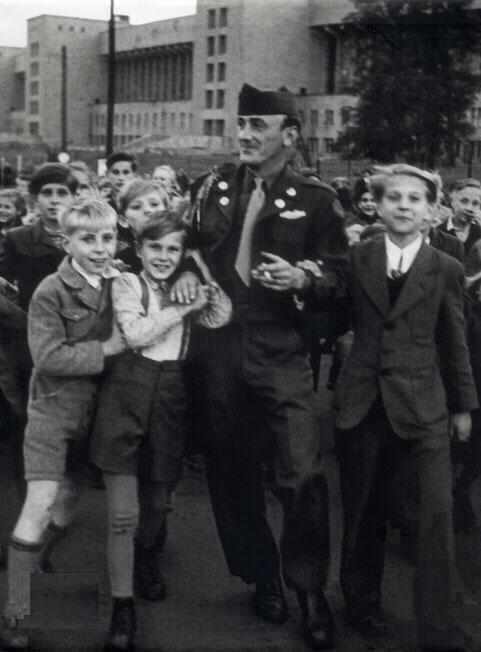
Figure 1.--The Allied military personnel in Berlin became heros to the German children. The relationship is apparent in this unstaged photograph. I believe this was a photograph taken in Berlin during the Aitlift period, but am not positive. The GI seen here looks to be part of the Berlin garison rather than one of the airmen involved in the Airlift. I'm not sure what the buiklding in the background is. Click on the image for more details about this photograph.
Berlin was at the center if the Cold War. Many believe that the Cold War began and ended in Berlin. The beginning would be the Soviet efforts to push the Western Allies out of Berlin. The end was the fall of the Berlin Wall in 1989. Berlin was conquered by the Red Army in savage fighting during the end of April 1945. Stalin was intent on the Red Army taking the prize and lied to General Eisenhower about his intentions. Wehrmacht commanders west of Berlin could not understand why the Americand did not push for Berlin. When the Red Army approached his bunker, Hitler committed suicide. As decided at the Yalta Conference, the three principal Western Allies (Britain, France, and the United States) were given occupation zones in the conquered NAZI capital. As Berlin was located well within the Soviet occupation zone of Germany, all supplies had to pass through the Soviet zone. As a result, the Western allies and the Berlin people were vulnerable to Soviet pressure. This and the symbolic value of Berlin made it the focal point of the Cold War. It was at Berlin that the first major confrontation of the Cold War occurred. Stalin decided in 1948 that he could blockade Berlin and force the Western allies out and the people of West Berlin into submission. Ironically the people of West Berlin were saved by American and British pilots, in most cases the same men that only 3 years earlier had been bombing German cities and had reduced Berlin to ruble. President Truman was determined that the United States would not leave Berlin and a massive airlift was organized and even during the winter, more supploes were reaching Berlin than before tht Soviets had instituted the blockade. One of the pilots was struck by the Berlin children who still lived in desperate conditions after the War. The children of course had little idea of the larger issues involved, but were caught up in the episode when one of the pilots began dropping chocolates in little parachutes when he reached Berlin. Other pilots began doing the same. The Berlin children began calling him Uncle Chocolate and thousands wrote with directions as to how to how the American pilots could hit their homes! Finally with the success of the Airlift, Stalin relented and rail and road links were reopened in 1949.
Center of the Cold War
Berlin was at the center if the Cold War. Many believe that the Cold War began and ended in Berlin. The beginning would be the Soviet efforts to push the Western Allies out of Berlin. The end was the fall of the Berlin Wall in 1989. As the traditional capital of Germany, the symbolic value of Berlin made it the focal point of the Cold War.
World War II
Berlin was conquered by the Red Army in savage fighting at he end of World War II in Europe, the last major engagement (April 1945). Stalin was intent on the Red Army taking the prize and lied to General Eisenhower about his intentions. Wehrmacht commanders west of Berlin could not understand why the Americand did not push for Berlin. Berlin was a primary target of the Allied strategic bombing campaign and was in rubble by the time the Red Army arrived in April. Further destuction occurred during the savage fighting. Hitler had depleted the city's defenses by commiting two SS armoured divisions to the phric defense of Budapest. The defense of the city was in part in the hands of the Volkstrum composed of old men and Hitler Youth boys. Hitler hung on until the last minute as thousands died around him. When the Red Army approached his bunker, Hitler committed suicide with Eva Braun who he had married hour before.
The last war-time conference was held at Yalta in the Soviet liberated Crimea (Februarry 4-11, 1945). It was the final meeting of Churchill, Roosevelt, and Stalin. The Germans were klearly defeated and the victorious allies reached a range of decisiions anticipating the NAZI defeat. As decided at the Yalta Conference, the four principal Western Allies (Britain, France, the Soviet Union, and the United States) were given occupation zones in the conquered Germany and also the NAZI capital of Berlin set bin the Sovier Zone. Stalin objected to a French zone, but eventually yielded the point as long as it was carved out of the American and British zones. The Germans found out about the occuopation zones. It was hoped at the time the Western Allies could harmoniously pursue the occuoation of Germany.
German Children
Many Americans after the War and American military personnel involved in the occupation had very bitter attitudes toward the Germans. The relevations of the Holocaust and other NAZI brutalities has horrified peope. Many American servovemen not only had biddies killed, but had participated in the liberatioin of the concentration camps or other wise experienced NAZI brutalities. Few were inclined to be gentile or firgiving to the Germans. It was the suffering of the German people in the immediate post-War period that changed many attitudes. In particular many GI note the children, bith the lack of food and clothing and their friendly emotional embrace of the GIs that turned many hardened hearts.
West Berlin
As Berlin was located well within the Soviet occupation zone of Germany, all supplies had to pass through the Soviet zone. As a result, the Western allies and the Berlin people were vulnerable to Soviet pressure. The American force in Berlin was part of the Big Red One (1st Infantry Divison. A reader tells us, "I was in Berlin, with Co. L the 3rd Bn 16th Reg. 1st Div. The 16th Reg. of the Inf 1st Div. was active in Berlin, from November 1946-62. I was assigned in 1948, to Co. L 3rd Bn. 16th Inf. Ist Div. until late 1949. I know of no other U.S. Inf unit being in Berlin At this time." [Van Heuvelen]
Czechoslovakia
The Soviets enginered a coup in Czechoslovakia in February 1948. Czechoslovakia was the last Eastern European country occupied by the Soviets that had any semblance of a democratic government. Elections had made the Communists the largest political party, but they did not have a majority and were forced to form a coalition with non-Communist parties. Many Czechs were hooeful that theifr country because of its geographic location and historical links coukld serve as a kind of political bridge between East and West. Stalin was, however, nit interested in bridge building. He wanted a reliable, compliant Czechoslovakia. The Communists armed their supporters and staged street demonstragtions. They were supported by th police because the Ministry of the Interioir was in the hands of the Communists. The army might have supoorted the Government if President Benes had decided to resist, but he believed that Soviet troops would intervene. Czecholslovakia at the time was almost entire surounded by Soviet satellites or Soviet occupied eastern Germanya nd Austria. He therefore yielded to the Communiksts and the country soon had a Stalinist Government. [Hudson, p. 60.] The Soviet takeover of Czecheslovakia in 1948 helped convince the Western Allies to unite their occupation zones. The British and French had already largely done so in 1947, but the French were reluctant. They were insisting on ibnternational control of the Ruhr. Finally agrement was reached in mid-1948. The Soviets objected to this seeing in it the evebntuak creation of a unified West German state.
As agreed to at Yalta. Germany was divided into four occupation zones. And Berlin within the Societ Zone was itself divided into four sectors. It was the Soviets who conqwuered Berlin, but as agreed, the Soviets allowed the Western Allies to enter the Soiviet Zone and occupy their secors of Berlin. A Control Council was created in 1945 to allow the four occupying power to coordinate operations in the four sectors of Berlin. Rail and road access was arranged as well as air corridors. Cooperation between the Soviets and Western Allies was at firstt correct, but from an early stage acrimony began to develop. The Soviets and Western Allies differeed on a range of issues. Cooperation on even the simplist matters broke down and by 1947 virtually nothing could be accomplised. The Western Allies moved to unify their occupation zones, The Soviets also began to gradually escalate harassment of Western rail and road traffic to and from the city through the Soviet occupation zone.
Soviet Walk Out (March 20)
By early 1948 any semblance of a cooperation had largely broken down. General Clay reported a changing attitude anong Soviet officials which he described as "faintly contemoptous, slightly arrogant and ceratinly assured". The Soviet delegates walked out of the Berlin Control Council (March 20, 1948). They subsequently refused to attend further meetings. [Hudson, p. 61.]
The Soviets were opposed to the currency reform in the Western occupation zones. American and German economists determined that the over-supply of currency with little value was impreding the recovery of the German economy. There was considerable debate about this. The Social Democratsists (SPD) in West Germany and the unions were opposed. The Christian Democrats (CDU) agreed with the Americans. The Soviets were unaletrably opposed. This was not because they thought the Americans were correct and did not want the Germn economy to recover. At this stage, the Sovirts still thought that their economic system was superior. The key factor was that they profited from the abiliity to print Recih Marks which could be reddeemed throughout occupied Germany. The Russians had not paid their soldiers to any extent during World War II. Being able to print Reich Masrks meant that the occupation cost them little and they could pay their soldiers at no real cost. Once the Western Currency Reform was in place, the Soviets could no longer print currency thast could be redeemed in the Western sectors. And there was also the problen of the old Reich marks from the Western zones being used in the Soviet sector. Despite Soviet warnings, tThe Western Allies announced a currency reform (June 18) which went into effect June 20. The French warned against it, but went along with it.
Soviet Calculation
It was at Berlin that the first major confrontation of the Cold War occurred. Stalin decided in 1948 that he could blockade Berlin and force the Western allies out and the people of West Berlin into submission. Stalin probably calculated that because of Soviet milirary supremecy on the ground that the Western Allies would not attempt to push through the blockade. [Hudson, p. 61.] He was probably correct as this would have required a huge force and American public opinion would not have supported another war over Berlin. It woul have been an enormously costly enterprise, even if the United States had the military force to achieve which it did not. Stalin saw it as risk gambit to get the Western Allies that seemed certain of success. What Stalin did not anticipate was that Berlin could be supported by an airlift.
Berlin
Berlin was a city of 2 million people, one of thelsargest in Europe. Before the blockade, the Berlin economy had a daily requirement of roughly 4,000 tons (t) of supply. (USAF dat is in short tons meaning 2,000 lb rather than metric tons, 1,000 kg or 2,204.6 lb.) Most of the supplied needed were food and fuel which until the blockade was delivered from the Western occupation zone by road and rail links through the Soviet occupation zone. Large quantities of coal were needed for electrial power generation and during the winter to heat homes. The idea of using airplanes to deliver coal was unheard of.
Soviet Blockade (June 24)
The Soviets wanted to prevent the old currency from entering their zone, where it was still valid. They thus banned travel to and from their zone. European Command (EUCOM) on June 22 directed U.S. Air Forces in Europe (USAFE) to airlift supplies to Berlin. These initial flights were supplies for the U.S. garrison in Berlin. USAFE delivered 156 t in 64 sorties. The Soviets on June 24 suspended all ground travel through their occupation zone which surrounded Nerlin. This cut off all road and rail links in and out of Berlin with the rest of Germany. Stalin apparently decided to use the currency dispute to end the irritant of a free West Berlin.
President Truman
Stalin had also not counted on President Truman's determination to stay in Berlin. The President sat down with his military and foreign policy advisers, men like Robert Levitt, Omar Mradley and Geoirge Marshall. To a man they recommended acceding to Soviet demands and withdrawing from Berlin. They assured the President that there was no way of staying in Berlin. The President listen to each assessment as he went around the table. He then simply said, "We stay. Period." and walked out of the room. [Reeves] Gen. Lucious Clay was comvinced the Soviets were bluffing and wanted to lead an armored column through to Berlin. Truman did not authorize that. He did approve an airlift which had started in an informal way to supply the Allied garisons.
The Berlin Airlift was primarily conducted by the U.S. Air Force (USAF) supported by the British Royal Air Force (RAF). The French air force played only a minor role, flying less than 1 percent of the Airlift flights. Presumably this was becaue they had a smaller air force, but even so the French particiopation seems unusually limited. I do not know the details. The RAF like the USAF made a massive commitment to the airlift. The RAF deployed its Dakotas on June 25 from the U.K. to Germany and flew their its first missions into Berlin, 6.5 t for U.K. garrison. Many at the time had doubts that an entire city could be supported from the air. The USAF began planning a massive air lift as the only alternative to surrender. Supplies would be initially flown in through Templehoff Air Port and plans were rushed to build a second airport at Tegel. The USAF ordered its C-54s (four engine military equivalent to a DC-6) from Alaska, Hawaii, and the Caribbean to Germany to reinforce the airlift. The first U.S. and British cargoes for civilian Berliners arrived June 28. The USAF July 7 delivered the first coal shipments on C-54s. First fatal U.S. crash occurred on July 8, A USAF C-47 crashed near Wiesbaden, killing all three American airmen aboard. The first fatal RAF crash occurred September 19. A York crashed near Wunstorf killing 5 British airmen. The Combined Airlift Task Force (CALTF) merging the USAF and RAF operations was created October 15 at Wiesbaden. The level of supplies needed required a secind airport. CALTF flew the first supplies into the new Tegel Airfield on November 5. The U.S. Navy committed two R-5D (C-54 equivalent) squadrons to the airlift. The USAF effort reached its peak strength of 225 C-54s on January 10, 1949. The Airlift had by bnow proven that Berlin can be sustained by air even during the Winter with its bad weather and demand for increased coal supplies. Not only could West Berlin be adequately be supplied, but shops in West Berlin were better stocked than in Soviet East Berlin. CALTF on April 16 mounts a maximum effort which they called "Easter Parade". It was designed to demonstrate the capacity of the aitlift to the Soviets. CALTF in 1 day reported 1,398 sorties meaning nearly one landing in Berlin every minute. Deliveries totaled 12,940 tons. Overall American, British, and French airmen flew over 278,000 flights dlivering more than 2.3 million tons of supplies, nearly 70 percent of which was coal. The Soviets finally lifted their blockade May 12, but the CLTF does not offically end the Berlin Airlift until September 30.
Berlin Economy
Berlin was one of the great cities of Europe. Berlin after the unification of Germany (1870) became one of the largest and most advanced industrial centers in Europe. A number of major German companies were founded in Berlin, such as AEG, Allianz, Siemens, Deutsche Bank, Edeka, Knorr-Bremse, Lufthansa, Osram, Telefunken, and others. After 1900 the Berlin banking district became a major continental financial center and was home to a number of prominent banks. Supplies in vast quntity were needed to keep this vast city city going. Food and coal were the priorities in the Air Lift. Obviously food was needed for the people. The coal was needed for heating and generating electrical power. There was often less than 100 t capacity left over for industrial supplies, supplies to keep Berlin industries functioning. Despite the difficult conditions, the Berlin Economic Emergency Society attempted to continue production in the city. Thus some of the airlift flights did not depart empty. They carried out products manufactured in Berlin. The economies of East and West Berlin were not yet separated by the Soviets and Easter Germans. This process only began in earnest after the Blockade, especially in 1952 when the East Germans began sealing their borders.
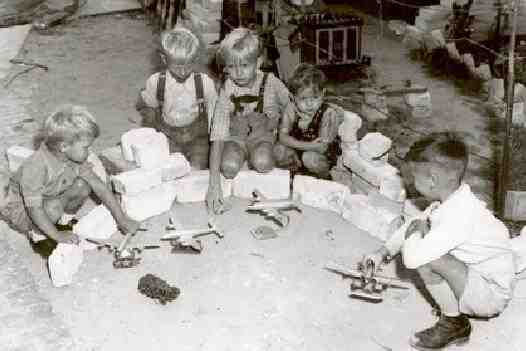
Figure 2.--Berlin children of course did not understand the enormity of what was going on, but they were immeiately fascinated by the frentic activity in the skies and at the airports. Here some boys are playing Berlin Air Lift at a mock Templehoff Airport. And then when candy began falling from the skies, they became very much invested inthe Air Lift.
Berlin's children did not understand the issues involved, but they soon became deeply invested in the Air Lift. Many Germans were uncertin about the americans at first. The Air Lift changed the minds of many Germans, making the Germany a staunch ally in the Cold War. Once candy started falling from the skies, there wereno doubts among Berlin's children. All kids love planes. And from the beginning they were facinted by the extrodiary activity of plane after plane landing attracted enormpis attention, especialy in the summer when the Air Lift began, We see crowds of children gathering to watch the drama unfolding before them. And if that was not attraction enough, an Ameican pilot who began chatting with the children gathering around the air port began dropping candy out the windows of his plane in little parachitte bundles for the candy starved children as he landed. He becme known as Uncle Chocolate or the Cndy Bomber. Other pilots began doing the same. You can imagine the reaction of children who had very little access to candy. Very few German children had ever tasted chocolate, especially the younger ones. Crowds around the airports grew. And then the pilots began planning Christmas parties with gifts and candy, launching Opertion Santa Clause. Most Berlin children stayed in Berlin throughoit the blockade. Some children in poor health were evcuated to make sure they got an especially good diet.
Ironically the people of West Berlin were saved by American and British pilots, in most cases the same men that only 3 years earlier had been bombing German cities and had reduced Berlin itself to ruble. President Truman was determined that the United States would not leave Berlin. The World War II arrangents gave he Westrn Allies every right to be in Berlin. President Truman was not going to start another war over it, but an airlifte was a differebt matter. Stalin did not believe that it was possible to to supply a large city by air. The Americans did not have the military capability of forcing its way into West Berlin. Nor would the American had countenced pulling the trigger. But the airlift changed that dynamic. It placed the onus on Stalin. He would have to pull the trigger to stop the airlift. The airlift thus changed the military calculation. Rather than the Americans having to blast through the Soviet zone to save Berlin, Stalin would have had to shoot down American planes to cut off supplies. Truman ordered the a massive airlift to be organized. At first the Soviets did not believe an airlift could support an entire city. No doubt they remembered the failed Luftwaffe effort to save the German 6th Army in Stalingrad. It soon exceeded all expectations. Even during the winter with terrible flying conditions, more supplies were reaching Berlin than before the Soviets had instituted the blockade. To Stalin's surprise the U.S. Air Force supported by the British and French proved more than campable of supplying Berlin. During the blockade in fact, food was more available in blockaded West Berlin than in East Berlin. Not only did the Allies have far more planes that tghe Luftwaffe transport arm, but he planes they had had far greater cargo capacities. At the beginning of the operation, the planes delivered about 5,000 tons of supplies to West Berlin every day; by the end, those loads had increased to about 8,000 tons of supplies per day. The Allies carried about 2.3 million tons of cargo in all over the course of the airlift. The World War II workhorse had been the two engine C-47. but now the U.S. Air Force had the the four engine C-54 Skymaster. The C-54 had three times the capacity of the C-47.
Even after it was clear that the Airlift would succeed, Stalin was not prepared to risk war by shooting on the unarmed Airlift planes.
Cost
There was a subatantial cost in maintaining the Berlin Airlift. The cost of air freighting food and coal fofr the city wa costly in economic terms. It also cost the lives of 70 American and British flighgt crews. Most of the American casualties were Air Force personnel. Over half of the British losses were civilians. Presumably the RAF contracted civilians. There were also German civiians killed on the ground when planes crashed, estimates vary from 9-12. [USAF] The airlift put a great strain on American and British airmen who often flew planes with very little sleep. The adverse weather conditions, especially during the winter, also caused many accidents. To keep Berlin functioning, however, flying even in bad weather was necessary.
The Berlin Airlift was a major event of the Cold War. The Soviet blockade of West Berlin clarified the Soviet threat to Americans who had during World War II come to think of the Soviets as an ally. The Berlin Airlift was a major turning point in the Cold War. It not only was a action Americns could understand, but it had a major impact on Germans and other Europeans. Even before Stalin lifted the blockade, America had signed the North Atlantic Treaty and there was little opposition in the Senate to raftification. This was a monentous change in American foreign policy. Isolationism was no longer an important force. There would be no withdrawl from Europe as happened after World War I. Stalin expected this, but his own aggressive policies precented it. Soviet actions in Eastern Europe and the blockade of Berlin had convinced many Americans that unlike what occurred after World War I, America had to maintain a presence in Europe to protect the Western democracies. The Airlift sent the message without military action that America and Britain would resist the Soviets. This was clear not only to Berliners, but to West Germans as well. The Berlin Airlift was also a turning point in the post-World War II occupation of Germany. The Soviets were not prepared to return to the Control Council nor am I sure how they would have been received. After the Arlift even the illusion that the victorious World War II Allies were jointly administering a defeated NAZI Germany was dropped. The Soviets and Western Allis would proceed on the path of creating two seprate German states in their respective occupation zones. [Hudson, p. 62.] West Berlin buried deep in the Soviet zone would continue to be the focal point of the conflict between the Soviets and the West in the developing Cold War--in a sence the most dangerous place in the world. Here Soviet and American tanks faced each other and would continue to do so for decades to come. Only the ugly scar that was the Berlin Wall would eventually defuse the situation. The two separate German tates would turn into a test case as to which was the more productive and vibrant system, totalitarian Communism or Democracy and Capitalism.
The Berlin Air Lift is primarily remembered as a remarable logictical undertaking by the U.S. Air Force supported by the RAF. Nothing like it had ever been successfully undertaken. The oblective was not only to keep a surrounded military force supplied, but this time an entire city. The Air Lift was, however, much more than a massive logistical success. It was central step in building modern Europe. The Berlin Air Lift changed te entire course of European history. We say this because German since the fall of Rome has been the key to Europe. What Stalin recognized anf thankfully some American is that control of Germany meant essentially control of Europe. It was still not clear in 1948 where Germany ws headed. The country had been devestated by the War. Ecnomic conditions were still very difficult. The Air Lift kept Berlin allive, but it was only successful because Berliners supported both it and the Allied presence. The Winter of 1948-49 was the key. Beliners had to endure severe power cuts. Fmilies adjusted to living with candles and oil lamps as they had done at the end of the War. Authorities had to ration food. Fresh vegetables in particular became difficult to find. Today it seems obvious that Beliners would support the Allies. It was not that obvious in 1948. It is true that the Soviets had been brutal in their occupation of Germany. The accounts of rapeing were legendary. It is also true that the Allied strategic bombing campaign had been brutal--although not unpresendented after a series of Luftwaffe terror raids. The Wehrmacht showed with their feet at the end of the War that they preferred Allied occupation. The question in 1948 was, however, would the Allies really stand up to the Soviets. Economically conditions in the Soviet and Allied sectors were not all that different in 1948. Job were scarce. Coal and food were still inadequate. Many Germans lived in ruins. Children had t go to school in make-shift buildings. Trees in parks were being cutdown for firewood and cooking fuel. The Airlift demonstrated that the Allies, especially the United Srates, would stand up to the Soviets. The Air Lift caused a sea change in the German mind. The same air forces that had devestated German cities now rescued Berlin. And much more was involved than just Berlin. The entire German people were watching. It was at this time that many Germans began viewing the Allies as actually allies rather than occupiers. The Airlift provided the catalyst for this change. Germans increasingly saw the Allies not only as preferable to the Soviets, but capable of standing up to them militarily. The geographic location of West Berlin of course did not change. Its existence was precarious as it had been, and Berlin became the most dangerous spot of the Cold war. Something monentous, however, had taken place. The German-American alliance was a direct result of the Alilift. This in the final analysis is the full measure of the Allied achievement and Soviet failure. [Botting] The full measure of Belin's and Germany's commitment to the West and democracy can be seen vividly went President Kennedy visited Berlin in the 1960s after the Comminists unable to compere economically erected the Berlin Wall.
Allied Public Opinion
Another change occurred as a result of the Airlift. The public in America and Germany which had been shocked at the NAZI attricities generally felt that Germany should be punished. The Airlift significantly changed public opinion in America and Britain. It was seen as a massive humanitarian effort and the Soviets increasingly replaced the Germans as the great threat to democracy in Europe. The Berlin Air Lift in paticular laid the groundwork for a major shift in American publication. There would be not withdrawl from Europe as was the case afyer World war I. It helped prepare public opinion for the North Atlantic Treaty Organization--the American military commitment to Europe.
Finally with the success of the Airlift, Stalin relented and with no fanfare rail and road links were reopened (May 12, 1949). This ended the 11-month Soviet blockade of west Berlin, one of the early Cold War crises. One issue glossed over in Berlin Air Lift accounts is why Stalin relented and ended the blockade. We have not found a detailed assessment of this issue. A problem here is that most accounts are based almost enforely on westrn sources. We know of not assessment drawing on available Soviet sources. we do not know how Soviet historians explained the end of the blockade. A range of resons have been put forward as to why Stalin ended the Blokade,but as far as we know, he never explained his thinking. Khruschev in his memoirs offers little insight. He says that Stalin did not discuss the blockade with thersn Poliboro, except perhaps Molotov and than says only that 'the capitalists turnd out to be too strong for Stalin'. [Khruschev, p. 192.] We can only speculate. It does not appear that there was any desire to improve relations. He was about to get his first atomic bomb (August 1949) and he was about to unleash the North Koreans (June 1950). There seems to be no clear reason as to why he relented. After all the Air Lift was very expensive to the West, supplying a huge city by air while the blockade cost the Soviets virtually nothing. Some of the reasons suggested include the following.
First, the most common reason is the propganda war. The image of Soviet tanks blockading West Berlin was not one that was helpful for Communist parties in Western European elections which were trying to portry the Soviet Union as aeace loving nation. And down play the idea that the Conninists were repressive. Stalin still hoped that Communist parties in the West, especally in Italy and France might be able to gain power democratically.
Second, the western countr-blockade on East Germany was damaging. As a countermeasure against the Soviet blockade, the Western powers also launched a trade embargo against eastern Germany and other Soviet bloc countries. One author writes, "The East German economy suffered grievously from the Allied counterblockade imposed...against Western zone shipments to the East. Trade with Berlin’s Western sector companies helped reduce the damage of shattered interdependencies and avert collapse in certain key sectors." [Stivers, p. 587.]
Third, Stalin's action came to be seen as alunder, both in the East Block and Germany. this was Khruschev assessment. . Stalin may have thought this as bad for his image and decided to cut bait. Another assessment, "As it was, the blockade was a massive blunder. In German eyes, not only did the Soviet Union appear a most implausible 'friend', but the necessity of seeking security with the West seemed conclusively proved. Economic considerations aside, Soviet supply and trade offers – beginning with the milk offer five days after the blockade began – look like efforts to deescalate the crisis in order to repair political damage." [Stivers, 596]
Fourth, the Air Lift proved to be an ebarassment. Stalin seemed inpotent in the face of American airpower. In addition,the Airlift was so sucessful that food and fuel was soon more available in blockade West Berlin than in East Berlin. It was the first hint even before the German Exonomic Miracle that Comminism was a failure. None if this did Stalin any good.
Fifth, Soviet aggresiveness helped to cement Western resistance. Not only did it convimce the West Germans that America would stand up to the Soviets, but it convinced the American and European publics that united action was needed--leading to the North Atlantic Treaty. Noting could have been more damaging to Soviet security interests.
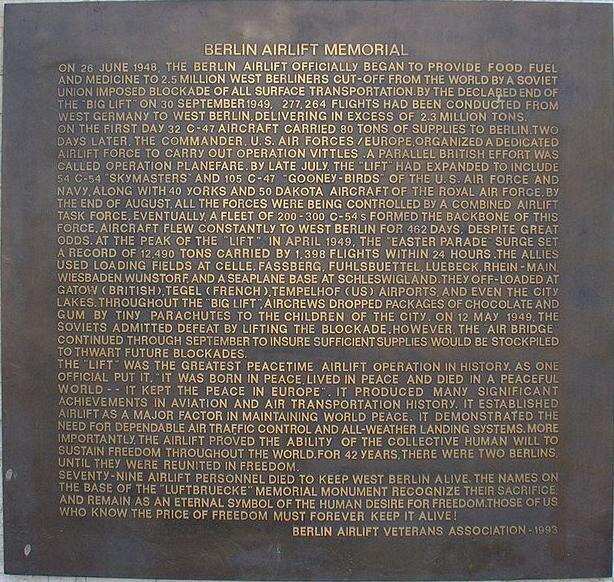
Figure 3.--This is the Berlin Air Lift plaque at Templehof?. It provides a good summary of the Air Lift.
German readers growing up in post-War Germany have written to comment on the Air Lift. The overwealming impression we get that Stalin's opening shot in the Cold War doomed the Soviet Union to failure. He not only ensured that the German people would reject Communism, but crerated a bond between Germans and Americans that would endure throughout the Cold War. One German reader who lived through the Airlift writes, "Thank the American people, the government and the pilots for the support and help to the Berlin population. It is a story that needs to be remembered." Another reader writes, "Yes, I very much agree. I was a very little girl at the time, but I recall it like yesterday. I knew nothing about Americans and Russians. But you see I got my first taste of chocolate. It was heavenly."
Assessment
The Berlin Air Lift is remembered today as a kind of historical footnote. It was much more than that. It is no accident that the Cold War can be said to have begun and ended in Berlin. The Berlin Airlift may be the greatest disaster in Soviet foreign policy after the NAZI-Soviet Non-Aggression Pact. The consequences were staggering for the Soviets. What Stalin thought was a low-risk gambit resulted in a Soviet defeat of staggering proportions.
1) America committed to the defense of Western Europe thrpugh NATO). 2) The Airlift convinced Berliners and Germans as a whole that America would stand with them against Soviet totalitarianism. It was during the Air Lift that Germasns began to see the Americans not as occupiers, but Allies. 3) Soviets actions essentially innoculated Germany from Communism and Germany was the key to Europe. 4) The Soviet actions exposed the true character of the Soviet regime. It severly damaged the reputation of Communist parties in Western Europe, especially in France and Italy where they were close to winning national elections. 5) The American stance in Berlin essentially meant that the Cold War would be fought along economic lines in Europe. And by the 1950s the German Economic Miracle and the economic success throughout Western Europe proved that free enterprise was a far superior economic system culminating in the Berlin Wall--the Soviet admission of failure.
West Germany during the Cold War supoorted the West Berlin economy bith before and after the Berlin Wall was built. Stalin only a few years after the War, attempted to choke off West Berlin's economy through a crippling economy. During the Soviet Blockade, West Brlin children were temprarily flown out of the city because of the food situation. These were humanitarian evacuations. We believe that after the Soviets lifted the blockade (1949) that programs were developed for Berlin children to have vacatioin exoeriences in West Germany. These were continued, however, long after they were needed for humanitarian reasons. With the German Economic Miracle. livong stanfards in Berlin rose to levels compatavle to West, far above libing standards in East Geramny and East Berlin. And this did not change when the East Germns built the Wall (1961). Programs for West Berlin chilfren were more to provide recreatiinal opportunities betond the rstructive kimits of the vity. We have, however, been unable to find much inforrmation on this.
Sources
Botting, Douglas. From the Ruins of the Reich: Germany 1945-1949 (New York: New American Library, 1985).
Hudson, G.F. The Hard and Bitter Peace: World Politics Since 1945 (Praeger: New York, 1967), 319p.
Khrushchev, Nikita. Edward Crankshaw, intro, commentary, and notes. Strobe Talbott, trans. and ed. Khrushchev Remembers (Little Brown: Boston, 1970), 639p.
Reeves, Richard. Daring Young Men (2010).
Stivers, William. “The Incomplete Blockade: Soviet Zone Supply of West Berlin, 1948–49,” Diplomatic History Vol. 21, No. 4 (October 1, 1997), pp. 569–602.
U.S. Air Force, "50: Berlin Airlift, 1948/49/1998-99".
Van Heuvelen, John. E-mail message, April 12, 2006.