|
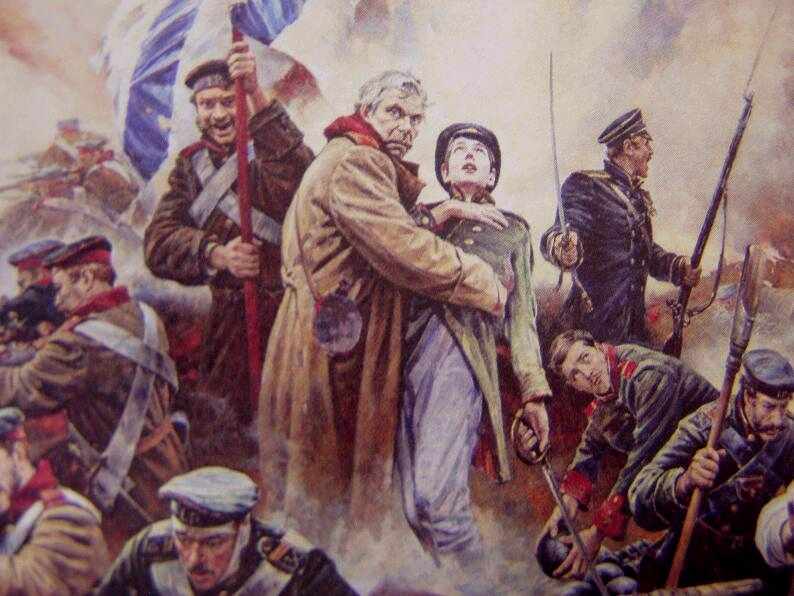
The Crimean War was a belicose interlude in a uncharacteristically long period of peace under which Europe flourished and prospered. The war is one of the least studied of the wars between the main European powers. In the popular mind, the Crimean War is most associated with the Charge of thecLight Brigade and Florence Nightengale, but th Crimean War was neighter a shirt or a marginal war, it ended the consensus of the Congress of Vienna and laid the foundation for the rivalries of the late-19th century. The British and French joined by the Italians and Austrians foughtvit out with the Russians for 4 years, nearly a million soldiers died along with countless civilians. Russian efforts to expand south brought it into conflict with the two great European powers, England and France, to protect tge OttomAn Empire. Ironically, the most significant diplomatic development was Austria entering the conflict late in the War. This set in motion an already simmering rivalry in the Balkans that woukd eventually lead to World War I. Notable is the fact that Prussia abstained from involvement. This was due to Bismark's efforts to separate the Russians and French which was later to lead to German unificatuion. This policy was later was abandoned by Wilhelm II, leading to dissaster in World War I. The Crimean War proved to be the first step in changing Prussia (soon to be Germany) from an English ally to an enemy. The Crimea was the only time the British and Russian's fought--although there was tension growing out of the Great Game in Afganistan and northern India. There was great suffering on both sides. In Russia, war with the European powers brought great strains. Taxes were needed to finance the War. The huge casualties required forced levies. Both mean increased hardship for the already exploited Russian serfs. There were serf uprisings everywhere. Intelectual ferment is oftn stimulated by war and social upheaval. Fashion and art are often affected. It is at this time that Russian blouse styles begin to appear in Europe. Many styles such as balaklava (ski mask), cardigan sweaters, and raglan sweaters coats later appeared. Russia was also affected. The conditions of Russian serfs worsened from their already exploited condition. The aftermath of war and rebelion appears to have enlived the previously rather static artistic life of Russia. It is in this period that the new school of critical realism is founded. The founder of critical realism is Vasily Perov.
The Crimean War was a belicose interlude in a uncharacteristically long period of peace under which Europe flourished and prospered. The war is one of the least studied of the wars between the main European powers. The underlying cause was the aggressibe policies of Tsar Nicholas I toward the Ottoman Empire which posed an obstacle to the realization of Russian imperial ambitions in southeastern Europe. The Ottoman Empire was the "Sick man of Europe". The problem was that the European powers could not agree on how to divide it. Britain and Frabce were concerned about the further expansion of the Tsarist Empire. In this case, a Russian defeat of the Ottomans was seen as threatening by Britain and France. There were other issues involved. Religion was another complicating factor. A young Tolstoy reported on the War from Sevastopl to anaging Tsar Nichols who was increasingly haunted by dream of his religious salvation. One author draws parellels with the modern rivalry beteen the Muslim World and the West. [Figes]
The Great Powers concern over Russian expansion was at the heart of the Crimean War. Religious issues, however,
were not unimportant. The Russians were concerned about the tretment of Orthodox subject of the Sultan. Christian demands for independence were met by Ottioman repression. Mostly this meant the Balkans, but there was also te issue of Orthodox churches in Jerusalem This was complicated with a dispute between Russia and France over the privileges of the Russian Orthodox and Roman Catholic churches in the holy places in Palestine.
Russian efforts to expand south brought it into conflict with the two great European powers, England and France. The Crimean War began as another in a series of wars between an expansionist Russia pushing south against the declining Ottoman Empire which was increasing able to defend its borders. England and France which became known as ther Allies entered the war between Russia and Ottoman Turks on the side of the Turks. Italian forces (Sardinia-Piedmont) eventually joined the war against the Russians. Russia was supporting Christian populations in the Balkans and saw an opportunity to gain control of the Dardanelles. This would have threaten the vital Suez Canal in which both England and France had an interest and wwere this alarmed. For the British, Suez was theie lifeline to India--seen as the "Jewel in the Crown" of their Empire. The Crimea was the only time the British and Russians fought even though there was tension growing out of the Great Game in Afganistan and northern India--the Great Game. This was of course not the case with the French who under Napoleon had been largely defeated as a result of the castrostrophic 1812 invasion of Russia. The French under Emperor, Napoleon III were locked in a dispute with the Russians over the privileges of the Russian Orthodox and Roman Catholic churches in the holy places in Palestine whichbhad affected public opinion.
The notalble absentee from the lost of belingerants was Prussia. Britain's Prince Albert attempted to enlist the support of the Prussians, but they refused to enter the War. This was due to Bismarck's efforts to separate the Russians and French which was later to lead to German unification. When Prussia fought France in the Franco-Prussian War, resulting in the unification of Germany, Russia did not intervene. The Prussian policy of couring the Russians was later was abandoned by Wilhelm II who soon after his accession in 1888 fired Bismarck. Wilhelm's disastrous policies were to play an important role in lauching World War I and Germany's defeat in that war. The Crimean War proved to be the first step in changing Prussia (soon to be Germany) from an English ally to an enemy.
The Great Powers (Britain, France, Austria and Prussia) met in Vienna and drafted a note which they hoped would resolve the developing problems between the Russians and Ottomans. Tsar Nicholas accepted it, but Sultan Abd�lmecid rejected it. Britain, France and Austria proposed amendments to meet the Sultan's onjections. Tsar Nicholas ignored the efforts at further negotiations. Britain and France declined to pursue further negotiations, but Austria and Prussia wanted to continue negotiations. The Sultan declared war (October 23, 1853). The Russian destruction of the Turkish ships was the casus belli. After Russia ignored an Anglo-French ultimatum to withdraw from the Danubian Principalities, the Allied powers (Britain and France) formally declared war (March 28, 1854).
The Crimean War actually began in the Balkans, as did World War I. Fighting began when the Russians insisted on protecting the rights of Orthodox Christians in the Balkan territories of the Ottoman Empire. Tsar Nicholas I of Russia demanded the right to protect Christian shrines in Jerusalem . Palestine at the time was part of the Ottoman Empire. The Russians delivered an ultimatum to the Ottoman Sultan (May 1853). The Sultan rejected the Russian demands and was supported by the British. The Russians launched military operations by launching an offensive into the Ottoman-controlled Balkans. The Allied (British and French) military effort was the war unfolded was largely conducted on the Crimean Peninsula on the northern coast of the Black Sea. Units of Sardinia-Piedmont (the soon to be Kingdom of Italy) etered the War (January 1855). The siege of Sevastopol was finally ended when the French assaulted and seized the Malakhov fortress (September 8, 1855), a key strongpoint in the Russian defenses. The Russians 3 days later the Russians codeeded defeat (September 11). They blew up the forts, sank their ships, and evacuated Sevastopol. Some minor Allied operations were conducted in the Caucasus and in the Baltic Sea. Russia finally sued for peace after Austria threatened to join the Allies.
The treat of Austrian interventiion brought the Russians to the peace treaty. The Russians accepted preliminary peace terms offered by the Allies (February 1, 1856). The actual settlement was negotiated at the Congress (held from February 25 to March 30, 1856). The Treaty of Paris formally ended the War (March 30, 1856),. The Treaty guaranteed the territorial integrity of the Ottoman Empire. Russia agreed to surrender southern Bessarabia, at the mouth of the Danube. The Black Sea was neutralized and the Danube River was opened to the shipping of all nations.
A minor calvary engagement in 1854 was importalized in the Alfred Lord Tennyson poem, "The Charge of the Light Brigade". One of the Tennyson's most famous poems, it dealt with a Crimean War engagement resulting from a misunderstood order during the Battle of Balaklava. A heroic unit of light calvary, made a suicidal charge over open terrain against entrenched artillery.
The Crimean War proved to be a costly venture for both sides in terms of both men and economic costs. Accounts vary, but Russian losses exceeded 100,000 men and the Allies lost more than 90,000 men. Some authors suggest much higher losses, nearly 1 million men and countless civilians. [Figes] The consequenes were profound. Perhaps the most important
was the destablization of the Tsarist Empire. Russia was best prepared to accept the losses of men, but the finacial cost bankrupted the country. While the War itself was of relatively minor importance, the consequences of the War lead to a major realignment of the European ballance of power, including the unification of first Italy and then Germany. Many authors have written cynically of the Crimean War. One historian writes, "The Crimean War seems like the archtypical example of Cobden's view that war is an extended form of aristocratic sport." He goe on to write that the War was the greatest blunder of the century, setting up animosities and alliances that led to World War I and the continuing turmoil of Eastern Europe, the Middle East, and Central Asia. [Wilson]
The Crimean War for England is most notable because it was the first major step in changing Britain's perception of Prussia (soon to be Germany) as a potential ally. There were a variety of other consequences. Rather than an isolated event, the charge of the Light Brigade was in fact symptomatic of the ineptness of both British and French command. Perhaps this was not different than many other European wars. Battlefield casualties accounted for fewer deaths than starvation, exposure to the winter weather, and cholera. Disease in fact was responsible for large mumber of the approximately 250,000 men lost by each side. What was different withbthe Crimean War is that this time the ineptitude was made public by an inquiring press in the person of William Russell a London Times correspondent. Russell is often seen as the first modern war correspondent. Some of his cables reported even more outrageous problems, sduch as supply corps not delivering food to starving soldiers 6 miles away. These conditions and public exposure lead to important reforms in the army. Here Prince Albert played an especially important role.
There was great suffering on both sides, especially among the soldiers. The greatest impact was on Russia. War with the industrilized European powers brought great strains to Russia which still had a largely feudal soiciety and economy. Taxes were needed to finance the War. The huge casualties required forced levies. Both mean increased hardship for the already exploited Russian serfs. There were serf uprisings everywhere. The conditions of Russian serfs worsened from their already exploited condition. The war was to lead the newly crowned Tsar Alexander II to pursue economic and socail reforms that were necessary if Russia was to compete with modern industrailized Europoean natiins. The most notable of these reforms was the emancipation of the serfs in 1861. Despite this and other reforms, he was assasinated in 1881.
Tsar Nicholas I did not believed that the European freat powers would object to Russian annexation of a few neighbouring Ottoman provinces. This was especially the case of Austria because the Tsar has sent Russian troops to supress the Revolutions of 1848, essentially saving the Austrian monarchy. Austria did not enter the War at this time. Nicholas was convinced that because of Russian assistance to Austria during the Revolutions of 1848 that Emperor Franz Josef would support him or at the very least remain neutral. Emperor Franz Josef to the Tsar's surprise not only did not support him, but supported the British-French demand that the Russians withdraw from the contested Danubian provinces. The Austrian position is not fully understood. It seems to have been a fear of allowing the Russians into the Balkans combined with a desire to obtain the Ottoman Balkan territories themselves. Franz Josef did not declare war on Russia, but he refused guarantee thst Austria would remain neutral. The Tsar withdrew from the Ottoman Danubian principalites, largely to placate Franz Josef. The Crimean War broke out when the Russian refused to comply with further Allied demands. Austrian action was critical because unlike the British and French who were deploying an expeditionary force, Austria which bordered Russia could have brought the full weight of its army to bear against the Russians. Austria occupied the Danubian principalities (August 1854). After costly fighting, the Russians finally sued for peace after Austria threatened to join the Allies. While Austria did not enter the War, its diplomacy had a huge impact on subsequent European history. The Russian and Austrian monarchies had a long history of cooperation. They fought together against Frederick the Great and later the Emperor Napoleon. The relation between Austria and Russia was at the center of the reorganization of Europe by the Congress of Vienna, Austrian actions under Franz Josef during the Crimean War irrevocably broke the Austrian-Russian alliance. Chancellor Bismarck would try to repair the damage through his diplomacy, but it was never restored and this would ultimately be a factor in the outbreak of World War I.
The Crimean War while of only minor significance in itself, played a major role in readjusting the European ballance of power. Austria did not become a beligerant, but it had sided with the Allies. As a result, Austria gained territory in the War, but in the next decade would pay a heavy price for that territory. More importantly, however, by siding decisively with the Allies while Prussia remained neutral, Austria earned the emnity of Russia which looked more favorably on the Prussians. The Russians which earlier had cooperated with the austrains in the next decade remain neutral as Austria is assulted from all sides. Austria and France fight a short war (1859) in which Austria loses Lombardy leaving in only Venice in Italy. It is thus poweless to prevent the formation of a united Italy (1861) on its southern border. Russia also remains neutral when tensions rose between Austria and Prussia culminating in the Austro-Prussian War (1866) in which Prussia established its dominance within the German Confederation. A weakened Austria does not intervene when Prussia defeats France in the Franco-Prussian War and creates a new German Empire (1870-71).
The Crimean War was the blodiest chapter in what has been called the Great Game between BritIN AND rUSSIA.
The Great Game was was the strategic rivalry between the British and Tsarist Russian Empires for aimed at entending their infuence into Central Asia. Historians commonly date the rivalry from the Russo-Persian Treaty (1813) to the Anglo-Russian Convention (1907). The British interest derived from the importance of the Raj in India--the most important element of the British Empire. It was in Afghanistant that Russia influence from Central Asia met and competed with British inteests from the Indian sub-continent. The Great Game was one of the reasons that Britain negotiated a Naval Treaty with Japan and help develop the Japanese Navy in the late 19th century. THe Great Game essentially ended when British and Russian concerns over the rising power of Imperial Germany overcame their rivalry in Central Asia. Ironically it came at a time in which the discovery of oil in Persia (modern Iran) upped the stakes of the rivalry. After the Russian Revolution (1917) a repeat of the 19th century Great Game occurred in which the Bolsgeviks restored Russian control of Central Asia. The pgrase "The Great Game" is commonly attributed to Arthur Conolly, an intelligence officer of the British East India Company's Sixth Bengal Light Cavalry. It became an element of common knowledge as a result of Rudyard Kipling's colorful novel, Kim, set in Afghanistan and India (1901).
One of the most important reforms coming out of the Crimean War were led by Florence Nightingale, who not only changed the operation of military hospitals, but almost single handely invented the nursing profession for women. There were others at the time who wanted to have better run military hospitals, not only on the Allied side but also on the Russian side as well. The Nightingale nurses kept being sent home for intemporance and for their unprofessional nursing duties. Meanwhile the Russian nurses were sent home only after suffering wounds from the battle that was about them. I am less sure about French
Military Hospitals, but I have always been led to believe that their care was much beter than Britain's. [Fergusson]
Intelectual ferment is often stimulated by war and social upheaval. Fashion and art are often affected.
The aftermath of war and rebelion appears to have enlived the previously rather static artistic life of Russia. It is in this period that the new school of critical realism is founded. The founder of critical realism is Vasily Perov.
While the Crimean War itself is little remembered today, there were a number of impoprtant fashion inovations resulting from the War. Some of these garments are still worn today. It is at this time that Russian blouse styles begin to appear in Europe. Many styles such as balaklavas (ski mask), cardigan sweaters, and raglan sweaters coats later appeared. The aftermath of war and rebelion appears to have enlived the previously rather static artistic life of Russia.
Fergusson, William. E-mail message, April 29, 2003.
Figes, Orlando. The Crimean War: A History (2011), 608p.
Wilson, A.N. The Victorians (Norton), 724p.

Navigate the Children in History Website:
[Return to Main 19th century conflict page]
[Return to Main war essay page]
[Return to Main military style page]
[Introduction]
[Animals]
[Biographies]
[Chronology]
[Climatology]
[Clothing]
[Disease and Health]
[Economics]
[Geography]
[History]
[Human Nature]
[Law]
[Nationalism]
[Presidents]
[Religion]
[Royalty]
[Science]
[Social Class]
[Bibliographies]
[Contributions]
[FAQs]
[Glossaries]
[Images]
[Links]
[Registration]
[Tools]
[Children in History Home]