|
American troops landed in Japan immediately after the Imperial Government surrendered on September 3. The American occupation was completely unlike the Japanese occupation of the countries that it had conquered. Most Japanese were stunded by the final year of the War and the massive destruction. There was also widespread hunger because the American destruction of the Japanese merchant fleet as well as the domestic transportation system made it impossible to import and distribute food. Many Japanese had been led to expect a brutal American occupation. There were no Batan death marches, slave labor, or mass slaughters like the Rape of Nanking. The United States oversaw an occupation with fundamentally changed the nature of Japanese society, rooting out Japanese militarism and fomenting the development of democratic political regimes and social structures. Militarists were removed from power. The Japanese had to turn in all weapons, including Samari swords, that were often revered family treasures. The swords were not serious military weapons, but they had emense symbolic value to Japanese militarists. The sword was so valued that in the Japanese warrior tradition it had become known as the 'soul of the samari'. Women were enfranchized and labor unions allowed to organize. Among the major accomplishments of the American occupation was a new democratic Constitution.
The Japanese Imperial Government formally surrendered on the morning of September 2, 1945, more that 2 weeks after acceping the Allies terms. The ceremonies overseen by General MacArthur were conducted aboard the battleship USS Missouri, anchored in Tokyo Bay. Japanese officials signed the instruments of surrender under the Missouri's big guns. American troops landed in Japan immediately after the Imperial Government surrendered. Many having experienced fanatical Japanese resistance on Pacific island battlefields, were unsure what to expect.
The Japanese in the territories territories seized in an early phase of its imperial expansion (Taiwan 1894 and Korea 1909) were subjected to a Japanization policy. These countries were not so much occupied as sujected to a fundamental reordering of culture. Some attention was given to education, but instruction was in the Japasnese language. This apparenly was also the plan in Manchuria (Manchukuo), but included colonization by immigrant families. The territories seized in the Pacific War were military occupations. It is unclear what Japan's long-term plans for the new Empire were. Occupation policies depended in part on the political orientation of the population. The Japanese were especiallu severe with the Westerners they found in the occupied territories and the Chinese. There were Chinese comminities in many large cities in the Burma, Dutch East Indies, Indo-China, Malaya, Philippines, and Thailand. The Civilians from Allied countries, which happenedto be the colonial powes, were interned in near genocidal conditions. The Japanese also did not trust the Chinese. Singapore had alargely ethnic Chinese population. The most deadly action was the Sook Ching Massacre. While there were differences among the many mostly European countries occupied, the Japanese pursued some consistent policies.
First all considerations were secondary to the war effort, including the welfare of the occupied people. And as the Japasnese did not bring food for their soldiers with them, this would result in mass starvastion in the Dutch-East Indies and Indo-China and serious local food shortages throughout the occupied areas. In fact, isolated Japanese garrisons throughout the Pacific began to starve.
Second, Japanese civilian occupation authorities had no control overthe military.
Third, every occupied area had to be self-sufficent, including food. Occupied areas were not allowed to import food, includung territiries that berfore the War were dependent on imports.
Fourth, there was no rule of law. When food shortages developed because of Japanese mismanagement, the Japanese Army was freeto go out into the countrtyside and seizefood from the peasantry.
Fifth, the Japanese pursued the propaganda narative of Asia for the Asians. This appealed to some of the nationalists in the European colonies. It was less persusive in the Philippines where the United States was in the process of independence and the Fiipinos already had home rule and Democratic elections. It is unclear to what extent the Japanese would have permitted autonomy after the War. And meaningful independence seems out of the question. Even autonomy is something the Japanese did not allow anywhere in their existing empire, including Japan itself. The military had seized control of the Government. It defies logic to think that the military would have permitted independence when they denied it to their own people. There is absolutely no doubt that the Japanese would have retained control over critical natural resources, especially oil.
Most Japanese were stunded by the final year of the War and the massive destruction. There was also widespread hunger because the American destruction of the Japanese merchant fleet as well as the domestic transportation system made it impossible to import and distribute food. Many Japanese had been led to expect a brutal, if not genocidal American occupation. There were no Batan death marches, slave labor, or mass slaughters like the Rape of Nanking. The Japanese people were unaware as to just how brutal their military had been in other countries and how real attrocities involvung millions of people were. I'm not sure just how seriously the Japanese people had taken the warnings of brutal Americans. They seem to have been widely accepted on Saipan and Okinawa. I'm not sure why this would have been different in Japan itself. I'm not sure to what extent, however, the Japanese were surprised at the conduct of the Americans. Perhaps readers know of some studies which have addressed this subject. Emperor Hirohito certainly was surprised at how the Americans treated him. The Americans for their part, after fighting bloody battles which got increasingly savage as the approsached the home island were not at all sure how they would be greeted when they landed in the Home Islands to begin the occupation.
The Allied occupation of Japan was different than the occupation of Germany. There was no sigificant Soviet, participation except Karafuto Prefecture (southern Sakalin) and the Kuril Islands which the Red Army seized. The Soviets were allowed observers, but had no impact on occupatiomj policies and there was on Soviet military presence on the Home Islands. United States forces the principal occupation power and provided most of the occupation force. President Harry Truman on VJ-Day appointed General Douglas MacArthur as Supreme Commander for the Allied Powers (SCAP) (August 14, 1945). He was tasked with overseeing the occupation. The Allies (not including the Soviets) during the War planned to partition Japan for the purposes of occupation. This is what occurred in Germany. With VJ Day, SCAP was given direct control over the main Home Islands ( Hokkaido, Honshu, Kyushu, and Shikoku) and the immediately surrounding islands. SCAP meaning Gen. MacArthur was not ordered to consult wuth the Allies. And the General showed during the War that unlike Gen. Eisenhowe, he was not a coalition builder. Mac Arthur made the major decesions on his own, often without consulting Washington, let alone London and Canberra. The Allies did participate in the military occupation, but had virtually no voice in occupation policies. Allied participation in the occupation was the British Commonwealth Occupation Force (BCOF). They were not involved in the initial American landing forces (September 1945). Planning for BCOF participation in the Allied occupation of Japan began after VJ Day, but was the details were not agreed for a few months (January 31, 1946). The main body of the 45,000 BCOF troops involved arrived a month later. The BCOF included troops from Australia, Britain, India, and New Zealand. Fortunately for the Japanese people, Allied occupation policies were very different from the barbaric policies the Japanese military and government pursued in the countries and colonies that Japan occupied during the War.
The Allied nations (Britain, the Soviet Union, the Republic of China, and the United States) discussed post-War occupation policies and publically stated thir goals during the War. The Allies in a series of wartime discuss the occupation policies. These discussions included disarmament, colonies (especially Korea and Taiwan), the economy, and how to prevent the remilitarization of Japan aftr occupation. The Potsdam Declaration called for Japan's unconditional surrender. That that objective had been achieved in the Emperor's surrender announcement. The only qestined that remained unsettled was the future of the monarchy. Occupation policy and the future of the country would be determined by SCAP
There were major differences in the American occupation policies pursued in Japan and Germany. The Imperial Government was not dismantled as was the NAZI Government and Japan was allowed to retain the monarchy--the longest line of any monarchy in the world. Emperor Hirahito was allowed to remain on the Crysanthumum Throne. Details on his involvement in the War suggest a participation that was far more extensive than admitted at the time, although he certainly acted with considerable courage to end the War. American occpation officials concluded thar retaining the Emperor would facilitate the peaceful occupation of Japan and the acceptance of the American imposed reforms. [Beatty] As in Germany there were trials of war criminals, mostly Imperial Army officers.
The Allied occupation began September 1945 and lasted through 1952. The Allies set up a Far Eastern Commission made up of 11 members of the victorious coalition. An Allied Council set up in Tokyo was to supervise overall policy. Difficulties with the Soviet Union which wanted to land an occupation force in Japan made the Council unworkable. It was the United States which occupied the country which essentially took control of occupation policy. President Truman appointed General MacArthur to be the Supreme Commander for the Allied Powers (SCAP). MacArthur launched a comprehensive reform program. It proved to be a demanding task. Few Americans knew anything about Japan and fewer still could speak Japanese. For Japan it was also a starling experience. Few Japanese had ever been exposed to Western culture. The American occupation was completely unlike the Japanese occupation of the countries that it had conquered. The United States oversaw an occupation with fundamentally changed the nature of Japanese society, rooting out Japanese militarism and fomenting the development of a democratic political system and social structure. The goal of the occupation was to establish "a peacefully inclined and responsible government." Militarists were removed from power and the country was demilitarized. The Japanese had to turn in all weapons, including Samari swords, that were often revered family treasures. The swords were not serious military weapons, but they had emense symbolic value to Japanese militarists. The sword was so valued that in the Japanese warrior tradition it had become known as the "soul of the samari". Among the major accomplishments of the American occupation was a new democratic Constitution. Women were enfranchized and labor unions allowed to organize. Major changes were made in the economy. Industries with a war-making capability were prohibited.
SCAP began to assess the political and economic future of Japan (1950). SCAP began to consider a peace treaty to formally end both the war and the occupation. The Umited States durung the occupation brought about a remsrkable transformation. In only a few short years, Japan was chabged from a war obsessed aggressor nation to a peace-loving democracy--a spectcular chievement. . The U.S. perception of international threats had changed fundamentally in the immediate post-War period. Most Americans had seen the Axis (Germny, Italy, and Japan) as the major threat to peace. Largely ignored bcause of the role the Red Army played in defeating the Germans was that for nearly 2 years that the Soviet Union was a NAZI ally. It was the NAZI-Soviet Non-Agression Pact Pact (1939) that made World War II possible. Both Germany and the Soviets invaded Poland and together they partitioned Europe (1939). The Soviets proceeded with a series of aggressions comparable to those of the Germans. After the War, the Soviet Union renewed its aggressive foreign policy and effort to dominate other countries. This was done by the Red Army in Eastern Europe and the Soviets sought to use domestic Communist policie in Western Europe. Now Germany and Japan were emerging aspotential allies in the escalating Cold War conflict with the Soviet Union. The Peace Treaty (Treaty of Dan Francisco) which the Japanese Government did help fashion allowed the United States to maintain its bases in Okinawa and elsewhere in Japan. The United States offered Japan a bilateral security pact. Restrictions on the military left the country unavle to dfend itself. A meeting in San Franciso brought together 52 countries to discuss the Peace Treaty (September 1951). Eventually 49 countries sined the Treaty. The Soviet Union and the puppet governments of Czechoslovakia and Poland refused to sign. Their primary objection was the povision to support the Republic of China (by then reduced to Taiwan) and not do business with the People's Republic of China that had intervened in the Korean War. The United States had insisted on this provision. The Treaty went i ti force (April 28, 1952). This formally ending the occupation and restored full sovereignty to Japan, except for the island chains of Iwo Jima and Okinawa, which the United States continued to hold until 1968/1972. The United States and Jaoan exchnged ambassadors and rsumed niormaln diplomatic relations (1952). The Japan Self-Defense Forces were formed with U.S. assistance. Jaopan's Yoshida Doctrine prioritized economic growth over defense spending and relied on an American securiuty umbrella for its defense. Japan's economivc policy of Guided Capitalism led to the Economic Miracle. The United States-Japanese Treaty of Mutual Cooperation and Security formalized the militry relationship (1960). Japan would play an important non-military role in the Cold War.
Japan invaded China (1937) and fighting continued for 4 years even before Pearl Harbor (1941). While huge numbers of Chinese were killed, Japanese casualties were realtively light. In the Pacific War while entire garisons fought to the death, the total numbers relatively small. Larger numbers of soldiers were involved in the Philippines and Okinawa campaign and in the fighting in Burma. The largest numbers of Japanese soldiers were lost in Manchuria after the Soviet invasion (1945). This was not as a result of the fighting, but because most of the POWs disappeared into the Soviet Gulag. Other children lost tgheir mothers and grandparents as a result of the strategic bombing campaign. I am not sure of the numbers of children involved. Other children were involved when the Japanese civilian populations were repatriated from parts of their former empire (Formosa, Korea, Manchukuo, Saipan, and other locations). Again I am unsure about the numbers involved.
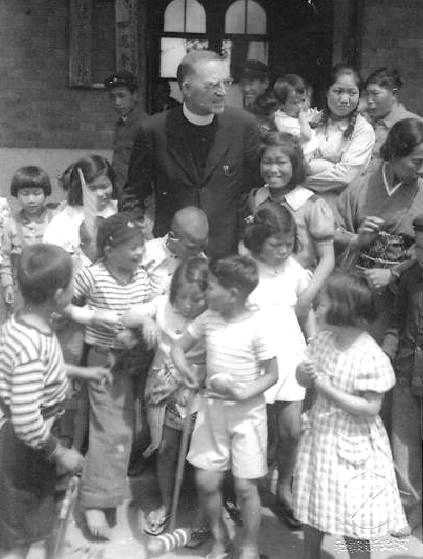
We have not found many accounts of the personal experiences of Japanese children at the end of the War and during the American occupation. Language may be a factor here. As well as the Japanese penchant to see thmselves as victims which dies not fit in with the not only cirrect, but highly bebefucial Americn occupation. It must have been cultural shock ofthe firt order. The children were not being told in school that Japan was losing the War, despite the clear evidence of major cities reduced to glowing embers. . Thy were being prepared to resist the expected American invasion. And they were told that the American werre mnsters tht would rape and kill, including children. They were also not told about the behvior of their own soldiers in countries tht Japan had occupied. So the Emperor's announcement that the country was surrendering was a unimaginable shock. Not only hearing he Emperor's voice for the first time, but what he had to say. Many Jpanese people braced for a brutal occupation. And the children heard terrible accounts of what was o come in the more than 2 weeks after the Empero's announcemrnt and the arrival of the Americas. A Japanese reader Fujioka Keisuke writes, "I am very pleased to hear that you are preparing a section on the post World War II American occupation of Japan. I was born in 1934 in Tokyo. I and my family were in Tokyo during the American bombing. The terror and destruction were overwealming, just like Dresden. I think most Japanese were surprised with American occupation policy. I was second son of a publisher. My father was a socialist in pre-World War II Japan but there were strict Government controls. After Japan surrendered and the American occupation began, father enjoyed freedom to publish Marx, Engels, and Lenin under Macarthur's regulations." [Keisuke] We wonder how many countries enjoyed more freedom under a foreign military occupation than they had enjoyed under their own government.
Developments in China and the Korean War had a major impact on American policy toward Japan. The initial American vision was a demilitarized Japan supervised first by America and then by the new United Nations. In furtherence of this, demilitarization was written into the American drafted, post-War Japanese constitution. "Aspiring sincerely to an international peace based on order, the Japanese people forever renounce war as a sovereign right of the nation and the threat or use of force as means of settling international disputes. In order to accomplish the aim of the preceding paragraph, land, sea and air forces, as well as other war potential, will never be maintained. The right of belligerency of the state will not be recognized." [Article 9] The United States was determined to ensure that there would not be anotgher war as occured in Europe after World War I. This vision, however, proved to be short lived as the secturity situation in the Far East changed dramatically. The Soviet Union after the War rapidly shifted from ally to Cold War adversary. Then Chiang Kai-shek, America's World War II ally, was defeated by the Communists and fled to Taiwan (1949). Then Communist North Korea invaded South Korea, launching the Korean War (1950). As a result, the United States shifted from a policy of imposing de-militarization on a war like nation to seeing Japan as a democrartic ally. And when Secretary of State John Foster Dulles entered the negotiations on the peace treaty with Japan to end the occupation, he sought to convince the Jaopanese to rearm and to conclude a military alliance with the United States. Ironiclly the Japanese were very reluctant to rearm. Tgey finally agreed to a paramilitary National Police Reserve.
Japan was essentially an non-player in the epic battle between the Democratic West and the Totalitarian Soviet Union in the Cold War. In fairness to Japan, it had little choice. The domesions of Japanese brutality and war crimesmeant that the country had no real credibality in the Cold War debates. The Japananese avoided the term alliance when describuing the American relationship. Essentially Japan during the Cold War was a merchant nation persuing its capitalist commercial interests. To an extent America was responsible by drafting a Constitution designed to demilitarize Japan. But for the Japanese it was an extremely beneficial approch. America guaranteed Japan's security. Japan did provide basing rights for American forces, but this of course primarily benrfitted Japan by guaranteeing its own security at no cist. Defennse budgets thus could be small even though they were borderd by the Communist giants, China and the Soviet Union. America even established a buffer state--South Korea in between China and Japan. Japan thus could focus on building its economy. [Pyle] Today the Japanese are reassessing their place in the world and even beginning for the first timre to think about changes in the American drafted Constitution, especially provisions of the Constitutin related to the military and defense.
The Japanese economic recovery after World War II has like the comparable recovery in Germany been described a nothing short of a miracle. Like the German Economic Miracle a completely devestated country over the space of a very few years trnsformed into an economic powerhouse. Observers at the time looking at Japan's flattened cities thought that it would take a generation to recover. In fact, it took less than aecade for Japan to become more prosperous than it was before the War, destroying the militarist beliefs that the country required colonies and apensive military establishment to obtain needed raw materials. Economists point to a range of factors explaining Japan's economic recovery. Fundamentally it amounts to the power of free market capitalism to unleash the capabilities of the Japanese people. The Japanese Government backed by the American occupation authorities prevented the Communists from taking power. And the American occupation in sharp contrast to Japanese occupation regimes operated to found both capitalustas wll as democratic institutions rather than punishing economic reparations. The Americans fiorbade Japan from military expanion while guarantteing security, while art the same time releaving the Japanese Government from costly expenditures. Instead, recovering Japanes Japanese industries on consumer products. The powerful zaibatsus helped finance the recovery. And the Japanese people tolerated great sacrifices while the recovery took hold. While images of Japan devestated cities suggest total destruction, they are in mute testimony to the fact that a country's true power is not in buildings and machinery, but in the character and capability of its people. While the building were destoyed in an acopolyspe of fire, the people survived. Despite atomic attacks, the Japanese actually sufferdcless than the people they had occupied. And the Japanse people with a high quality education system fired by free market capitalism very quickly rebuilt their county and launched upon an amazing economic expansion. Interesting, Japanese economists poinr to a little known American, W. Edwards Deming, as instrumental in their suucess.
Ayao, Okumura. A a Japanese food scholar quoted in George Salt. The Untold History of Ramen. (University of California Press: Berkeley, California. 2014) p. 6.
Beatty, William. Beatty was on MacArthur's staff. After the war he taught anthropology at Fresno State.
Keisuke, Fujioka. E-mail message, February 15, 2003.
Pyle, kenneth. Japan Rising (2007).
Schaller, Michael. Altered States: The United States and Japan since the Occupation, 336 p.
Shigeru Yoshida, Kenichi Yoshida. The Yoshida Memoirs: The Story of Japan in Crisis ( Heinemann: Lond0n), 304p.
Shimbo, Hiroko. The Sushi Experience.

Navigate the CIH World War II Section:
[Return to Main Japanese World War II aftermath page]
[Biographies]
[Campaigns]
[Children]
[Countries]
[Deciding factors]
[Diplomacy]
[Geo-political crisis]
[Economics]
[Home front]
[Intelligence]
[POWs]
[Resistance]
[Race]
[Refugees]
[Technology]
[Totalitarian powers]
[Bibliographies]
[Contributions]
[FAQs]
[Images]
[Links]
[Registration]
[Tools]
[Return to Main World War II page]
[Return to Main war essay page]
[Return to CIH Home page]