|
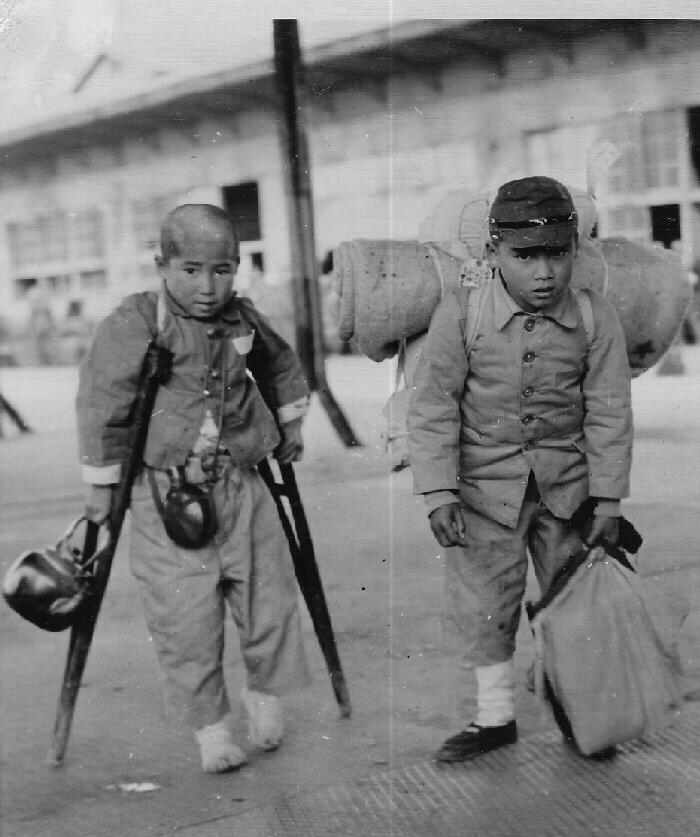
One not extensively discussed topic is the repriation of overseas Japanese following the surrender. Many of the people involved were soldiers. Unlike the Germans at the end of the War, the Jaspanese still held territory throughout the Pacific, Southeast Asia, China (including Manchuria), and Korea. In adition to the military, there were also large numbers of civilians. German civilians repatriated after the War encountered the hatred of people in neigboring countries and suffered terribly. I am less certain about the experience of Japanese civilians. Japan began building an empire with the seizure of Formosa (Taiwan) in 1895 and Korea (1910). Part of Japan's colonial policy involved installing Japanese administrators, but there were also efforts to establish a Japanese population as well as to establish Japanese culture. The local population was, for example, required to learn and speak Japanese. The Japanese Government after seizing Manchuria (1931), promoted Japanese settlement, but with only limited success. I'm not sure about the number of civilians involved or about their interactions with the local population. Wehave noted references to over 4 million people, but this may include the Japanese military as well. Much of the transport was provided by the U.S. Navy. Most of the civilians repatriated came from Formosa, Korea, and Manchuria, but smaller numbers came from other places as well, such as Saipan. The Soviets entered the War after the Americans droped the first atomic bomb on Hiroshima. Thus it was the Soviets who seized Mabchuria and Nortn Korea. Japanese soldiers surrendering to the Red Army suffered for years in the Soviet Gulag. I am not sure how civilians fared.
One not extensively discussed topic is the repriation of overseas Japanese following the surrender. Many of the people involved were soldiers. Unlike the Germans at the end of the War, the Japanese still held territory throughout the Pacific, Southeast Asia, China (including Manchuria), and Korea. The surrender of these forces was complicated by the logistics of getting forces to the various areas occupied by the Japanese that they could surrender to. This was complicated by European coloniasl politucs. There was also the problem of Allied POWS and civilians in Japanese hands. The Japanese soldiers in Southeast Asia, China, and the Pacific were returned to Japan relatively quickly, as soon as transport could be arranged. Some of these countries (North Korea/Manchuria were liberated or partially liberated by the Soviets. Japanese soldiers surrendering to the Red Army suffered for years in the Soviet Gulag.
In adition to the military, there were also large numbers of civilians. German civilians repatriated after the War encountered the hatred of people in neigboring countries and suffered terribly. I am less certain about the experience of Japanese civilians. Japan began building an empire with the seizure of Formosa (Taiwan) in 1895 and Korea (1910). Part of Japan's colonial policy involved installing Japanese administrators, but there were also efforts to establish a Japanese population as well as to establish Japanese culture. The local population was, for example, required to learn and speak Japanese. The Japanese Government after seizing Manchuria (1931), promoted Japanese settlement, but with only limited success. I'm not sure about the number of civilians involved or about their interactions with the local population. We have noted references to over 4 million people, but this may include the Japanese military as well. Much of the transport was provided by the U.S. Navy. Most of the civilians repatriated came from Formosa, Korea, and Manchuria, but smaller numbers came from other places as well, such as Saipan. There were substantial numbers of Japanese civilians in both North Korea and Manchuria. As far as I know the Doviets did not restrict the repasrtristion of Jaspanese civiklians. We hasve little information on the conditions of the repatriation.

Navigate the CIH World war II Section:
[Return to Main Japanese World War II aftermath page]
[About Us]
[Biographies]
[Campaigns]
[Children]
[Countries]
[Deciding factors]
[Diplomacy]
[Geo-political crisis]
[Economics]
[Home front]
[Intelligence]
[POWs]
[Resistance]
[Race]
[Refugees]
[Technology]
[Totalitarian powers]
[Bibliographies]
[Contributions]
[FAQs]
[Images]
[Links]
[Registration]
[Tools]
[Return to Main World War II page]
[Return to Main war essay page]
[Return to CIH Home page]