World War II: Guerilla Campaign in the Balkans (1941-44)
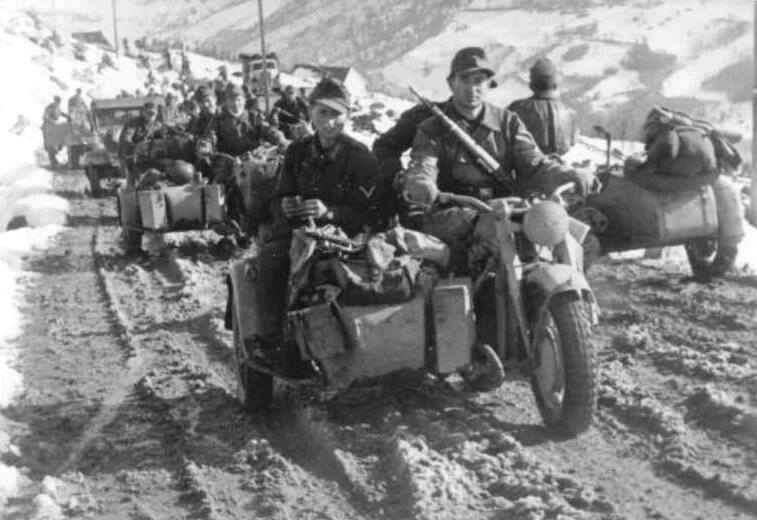
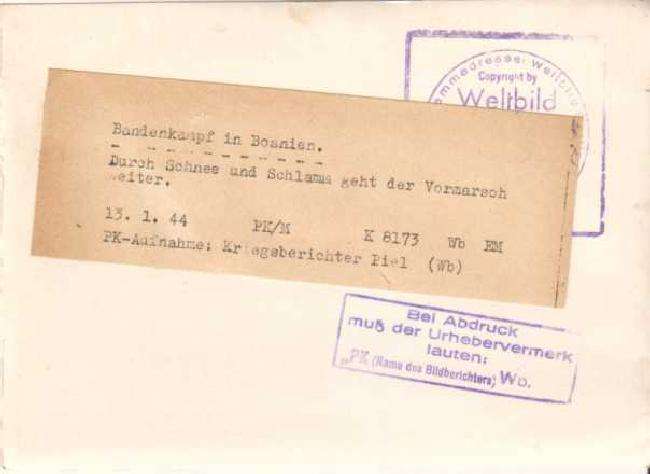
Figure 1.-- Here we see a youthful German soldier involved in a Balkans operation. This German military photograph was taken on January 13, 1944. The mud and snow shows the difficulties the Germans faced in operations against the guerillas. Note the MG-34 and the Kubalwagen scout cars in the background.
|
|
The NAZI conquest of Yugoslavia took inly a week with the lost of 100 men. What happened afterwards was anything but bloodless. A guerilla war began began between the NAZIs and Italians the two Yugoslavians partisan groups (Tito and Mihajlovic) and the Greek guerillas. This was a very complicated struggle. Croat national forces joined the Germans as did Muslims in Kosovo. Tito the communist was a Croat and Mihajlovic was a Serb. The ethnic disputes had begun before the War and with NAZI encouragement, Yugoslavia became a vast killing field. The Yugoslav and the Greek guerillas managed to tie down almost 1 million German soldiers. It proved to be a costly diversion for the Axis, causeldy largely by Mussolin's miscalculation. The Mihaljlovic partisans became known as the Chetniks. They gradually became reluctant to attack the NAZIs, in part because of the horendous reprisals and also hostility to Tito's partisans. Because of this reluctance, the Allies gradually lot faith in the Chetinks and began supporting Tito's partisans. Mihaljlovic's partisans saved over 500 American airmen in Operation Halyard and got them back safely to the Allies. The NAZIs were shooting 100 civilians for every German soldier killed. A HBC reader, tells us, "My friend John Roberts who was saved by the Serbs when his B-24 was shot down. John told me his story how the Serbs hid him and later was put on a boat in the Adriatic sea and was picked up by a US Navy ship. After the war John contacted the Serbs who help him and was told about one hundred civilians from that village were shot to death. John past away a few years ago and he was one of the 500 airmen that were saved in the Operation Halyard pipeline."
The Balkans
Germany's famed statesman, the Iron Chancellor Otto von Bismarck, had insisted that the Balkans was "not worth the bones of a single Pomeranian grenadier." The Balkans were critical for the NAZI war effort. Conducting the War required enormous quantities of petroleum. Germany did not have oil resources of its own. It was developing an industry to convvert coal to oil which was to play an important role in the War. As part of the NAZI-Soviet Non Agression Pact (August 1939), the Soviets began delivering petroleum to Germany. The major source of petroleum for Germany was the Romanian oil fields. There were other resources in the Balkans (chrome, copper, magnesium, and other materials), but the most important was the Romamaian petoleum. Without that oil, Germany could not wage any prolonged war. For Hitler, the great prize in the War was not regaining the territories lost in World War I, it was rather expanding east into Poland and the trackless steppe of Russia and the Ukraine. He did not hide this objective. It is described at some length in Mein Kampf. This of course ment war with the Siviet Union. Thus the Balkans took on greater strategic importance because to mose east against the Soviets, Germany's southern flank needed to be sevured.
Hitler had hoped to avoid commiting the Wehrmacht to the Balkans and made considerable progress toward that goal. Mussolini undid Hitler's carefully laid plans by invading neutral Greece through its Albania bases (October 28, 1940). Mussolini's 1940 invasion of Greece complicated Hitler's time table for Barbarossa. The invasion was not coordinated with Hitler in advance. (The Axis partners never coordinated their operations like the Allies.) Mussolini announced it when Hitler arrived on a visit. "Führer, we are on the march." The Italian troops were beaten back and the Greek troops overtook over one third of Albania. Greece had a Fascist Government that could have possibly brought into the Axis or at least would have remained neutral. Instead Mussolini turned the Greeks into a British ally. The British sent about 50,000 troops to help Greece, which they had to deplete from Egypt. This was important bercause critical to the German invasion was access to the Romanian oil fields. Germany had been relying on Soviet oil deliveries to supplement its synthetic oil production. The Soviet deliveries would end of course when Germany invaded leaving the Germans dependant on Romanian oil until the Soviet Caucauses could be seized. Greek successes against the Ilalians had created an Allied belingerant that could provide air fields to attack the Romanian oil fields. Hutler thus saw a German intervention to seize Greece and secure Germany's southern flank would be necessary. As a result, German forces in Romania were reeinforced and efforts were made to bring Yugoslavia into the NAZI orbit so that the Panzers could move through that country to attack Greece. Hitler had forced Yugoslavia to join the other AXIS Balkan partners, but the Government was overthrown necessitaing a full sacle German invasion. Hitler had to come to the rescue Mussolini. The Germans invaded Greece and Yugoslavia simultaneously on April 6, 1941. Belgrade was subjected to Luftwaffe terror bombing for rejecting an alliance with the NAZIs. The Germans swept through Yugoslavia and Greece and took Crete with a daring, but costly parachute assault. (Hitler never again allowed a parachute assault.) Greece was defeated on April 27, 1941. Despite the success of the German invasion, it proved to have been a strategic dissaster. The Balkans diversion delayed Operation Barbarossa by at least 6 weeks. If Hitler had started his invasion to of the Soviet Union May it seems highly likely that they would have seized Moscow if not have defeated the Red Army. As it was the Wehrmacht was stopped on the outskirts of Moscow in December, 1941.
Guerilla Strugle
The NAZI conquest of Yugoslavia took inly a week with the lost of 100 men. What happened afterwards was anything but bloodless. A guerilla war began began between the NAZIs and Italians the two Yugoslavians partisan groups (Tito and Mihajlovic) and the Greek guerillas. This was a very complicated struggle. Croat national forces joined the Germans as did Muslims in Kosovo. Tito the communist was a Croat and Mihajlovic was a Serb.
Overview
The history of the Balkans campaign is often presented in simplistic terms. This was certainly the case of Tito's Yugoslavia after the War. History became essentially propaganda which depicted the struggle as good (the Partsans) against evil (the NAZIS, Chetniks, and Ustace). Even in the West, this approach was not absent because any one fighting the NAZIs were seen as the just forces. The actual situation, however, was much more complicated. It is true that the Chetniks at times cooperated with the NAZIs, but this was not because they had the same goals as the NAZIs, but because they were afraid of what the Communisyts would do if they seized control of the country. And what Tito did do after the War show that their concerns were well founded. In fact what happened in Yugoslavia was that the NAZI invasion discredited or actually destroyed the old social order and the fragile spirit of accomodation and ethnic and religious tolerance that had existed in the Balkans since the desplacement of the Ottomans. The Balkans were perhas the most ethnically and religiously diverse corner of Europe. With the old social order swept away past resentments, historical resentments, and national passions rose to the surface. The results became endless attacks and retribution among clans, villages, etnic, and religious groups. The NAZIs stirred the pot with attacks on Jews, Gypseys, and Serbs. Into this mix the Ustache eagerlly participated. While the primary domestic conflict was between Orthodox Serbs and Cathloic Croats, the actual situation was much more complicated. The SS organized Muslim units. The Hungariabns wanted to join Hungary and expel Serbs. And their were ethnic Volk-Deutsche. It is true that the Chetniks moved close to the NAZIs, but Partisans units times made accomodations with the NAZIs as well. [Pavlowitch] All in all the outcome prove a nightmare not only for the people of Yugoslavia. It proved to be adisaster for the NAZIs as well who eventually had to commit more than 1 million badly needed troops to the Balkans.
Various parts of Yugoslsavia were occupied by different Axis invading armies. The bulk of the actual fighting was done by the German Wehrmacht and Luftwaffe. But Germany's Axis parners were awarded a share of defeated Yugoslavia. The Germans occupied Serbia and Slovenia. The Italians took parts of Croatia (Dalmatia), Montenegro and Slovenia. The Bulgarians took Macedonia. The Hungarians occupied Vojvodina. The later tried to enter Croatia but were expelled. The Croatians declared their independence (April 10) and occupied much of Bosnia. A Fascist Croatia was acceptable to the NAZIs and Italian Fascists. The Italians in particular had been supporting the Croatian Ustache before the War against the Yugoslav government. The NAZIs did the same in Czechoslovakia where they recognized Slovakia as another slavisly pro-NAZI puppet state. Thus the occupation of Yugoslavia, Greece, and Albabia by the different Axis armies was a complicated unndertaking. Each of the different countries had their own national interests and persued a range of policies in the occupied areas. The Germans attempted toncoordinate policies with varying degrrees of success.
The NAZIs permitted the extreme nationalist Ustaša to form the "Independent State of Croatia" (NDH). The Ustaša had been supported by Italian Fasciasts as a way of destabilizing the Yugoslav Government. The Ustaša also received NAZI support because they were so virulantly anti-Serb. The Croats were Slavs, but were Roman Catholic rather than Orthodox like the Serbs. Hitler awarded them the status of "honoary" Aryans. The Croatian state included Bosnia and Herzegovina, but lost Dalmatia to the Italians and the regions of Baranja and Meimurje to the Hungarians. The Croats provided the bulk of the pro-Fascist forces in Yugoslavia. They faced resistance, however, from Serbian population in Bosnia and the Croatian anti-Fascists. The Ustaša and their German and Italian patrons established concentration camps all over Croatia where hundred of thousand of Serbs, Jews, anti-fascist Croats and others were murdered. The reasons varies. Some were targeted for resisting the invasion and Croatian puppet regime. Others were targeted for racial or religious reasons.
Muslims
Yugoslavia was one of the few European countries at the time with a Muslim population, the resut of centuries of control by the Ottoman Empire. Most Yugoslav Muslims were located in Bosnia and Kosovo. Croatia declared its independence (April 10). Part of the territory they wanted was Bosnia-Herzegovina, the former Austro-Hungarian province. The Croatians did not get what they wanted as Italy insisted on taking some areas the Croatians wanted, especually Dalmatia. Croatian was cimpensated with much of Bosnia. Bosnia Herzegovina was an polygot ethnic and religious mix, populsated with Catholic Croatian, Orthodox Serbs, and a small number of Jews. Added to this mix was Muslim Croatians. NAZI SS Chief Heinrich Himmler was particularly interested in Islam and conceived the idea of forming Muslim SS units. These Muslims Croats were the focus of the NAZI recruitment efforts. AS NAZI military power flaged, Himmler began to dilute the racial parameters for the SS, making it possible to recruit in the Balkans. Himmler appears to have had a lot of fanciful ideas about Muslims. Having read about the Crusades, he saw Muslims as fanatical fighters fired by the Islamic faith. In addition he thought or convenietly forgot tht the Croats (boh Slavs and Cristians) were not Slavs.
(The Croats for their pat seemed to have ignored NAZI racial theories about Slavs.) Also the NAZIs were attracted to the idea that they could rally the Muslim world to their side, an idea that was a little late by 1943. Hitler approved the project a few days after the fall of Stalingrad (February 13, 1943). Croatian Poglavnik (Führer) Ante Pavelicn and his goivernment who were ardebtly Catholic were not at all enthusiastic about the idea. The deteriorating military situiation and NAZI insistence, however, decided the issue. Pavelicn signed off on the project (March 5, 1943). The divisional strength soon reached the required 26,000 men (mid-1943). The Muslim division was given the the number "13"--the "13 SS Frei.Gebirgs Division (kroatien). The full name "13 Waffen-Gebirgs-Division der SS 'Handschar' (kroatische Nr. 1)" was finally assigned (May 1944). It became knwn as the Handschar (Handzar) Division. A Handschar is the curved Muslim sword, normally referred to as the Scimitar in English. It was also the historic symbol of Bosnia. The Division was to have two Infantry Regiments, an Artillery Regiment, a Reconnaissance Company, a Panzerjager Company, a Flak Company, a Pioneer Battalion, and various support units. The SS designated it a "mountain" division. The Division's first commander was SS Standartenfuhrer Herbert von Obwurzer (March-August 1943), Oberfuhrer/Brigadefuhrer Karl-Gustav Sauberzweig (August 1943-June 1944), and Oberfuhrer/Brigadefuhrer Desiderius Hampel (June 1944-May 1945.
Ethnic Killing
The ethnic disputes had begun before the War. Yugoslavia was a nation created after World war I around the Kingdom of Serbia and the Serbs dominated the country politically. The Croats in particular resented te Serb dominance. There were several other ethnc hroups in Yugoslabia, but the principal ethnic division was between the Serbs and Croats. The Germans saw the Serbs who they had fought in World War I as a dangerous population. They thus favored the Croats, many of who had
greeted them as liberators. Crosts were given the status as honorary Aryans. The Croat Ustasha militia became one of the most murderous groups in the War. As in other countries, the Germans, but not the Italians began killing Jews. Very few Yugoslav Jews survived the War. And they were killed before the death camps in Poland were operatrional. This began almost immedistely. This was, however, just the beginning of the killing. The Crots and Serbs began killing each other and Muslims as well. Yugoslavia became a vast killing field.
Several organized militry and militia forces operated in Yugoslavia during the War. The Yugoslsav Army collspsed under the German Blitzkrieg onslaught (April 1941). The Bulgarians, Hungarins, Italians, and Romanians participsted in the German overseen occupation and partition of Yugosalvia. The Germans helped organize and arm colaborating Croat and Muslim units. The two main resitance forces orgnized to resit the Germans were the Royalist Chetniks loyal to the Yugoslav Governmennt in Exile in London and the Communist Partisans basically associated with the Soviet Union. Resistance groups formed throughout NAZI. The bulk of the population was shocked with the stunning NAZI victories. Most saw no choice but to collaborate, even France. Armed resistance was not possible in most of Europe because it was so highly developed without large forrests and mountaneous areas where armed resitance groupos could operate as in the Soviet Union. Yugoslavia was different. There were large ares where forest and mountain areas guerilla groups could operate and it would take a massive German deployment to root them out. And with the German invasion of the the Soviet Union the Germans and their Axis allies simply did not have the men and material to do this. They could control the cities and many areas of Yugoslavia. hy could not control the whole country. Yugoslavia was also different from the rest of the Europe in that it was so divided by ethnic and religious groups so bitterly opposed to each other. As a result, in Yugoslavia, it was not only the Germans doing the killing, but Yugoslavs were killing each other. It would become one of the most killing fiel of the War and the Partisans introduced an ideological component into the wiches brew that made Yugoslavia such a deadly part of World War II.
The Fascist occupiers, especially the NAZIs, instituted terrible reprisals on the civilian population for resistance attacks. The Wehrmacht sometimes killed up to 100 civilians for every Wehrmacht soldier killed. The targets included men, women, and children. A Serbiabn reader from Kragujeva tells us about an incident in her town where some German soldiers were killed and wounded by a resistance attack. The German commander applied the standard German formula: 1 wounded German solders = 50 Serbian people executed and 1 dead German Solder = 100 Serbian people executed. The Germans at Kragujevac rounded up about 5,000 people. A secondary school was also included in the reprisal. All the pupils were boys. The teachers stayed with their students even though the Germans had the quota. All were executed. Our reader tells us that her grandfather escaped this because he was sick and kept at home that day. Two cousins were teachers at the school and they were executed with their pupils. Many incidents kike this punctuated the terrible guerrila campaign in the Balkans. This was a factor in the unwilingness of the Chetniks to launch attacks on the Germans. It did not stop the Partisans. At the time of the NAZI invasion, opposition was concentrated in the cities where people were more politically concious. People in rural areas tended to be more apathetic. The viciousness of the NAZI reprisals tended to generate wide-spread opposition to the occupiers. The Partisans managed to achieve widespread support, despite the fact that relatively few Yugoslavs were Communists.
The Germans were not the only ones guilty of terrible attrocities in Yugoslavia. The Partisanswere also guilty of attrocities. This subject is not well documented, in part because it was Tito's partisans who took over Yugoslavia after the War. And of course partisan attrocities were a subject that was not permitted to be even discussed. Some of the worse partisan attrocities appear to have occurred early in the War. This was a time when the partisan network was not yet organized and consisted of militia groups that began to organize locally. There was no central control and little discipline. At this time quite a number of local vendettas and ethnic conflicts played out. As Tito expanded his control over the partisan units , he supressed the ethnic conflict, and partisan violence became more targetted on political enemies. This included not only the occupying Axis forces, but the Royalist Chetnkiks as well. There was also some bloody incidents at the end of the War. These were attacks on forces that has opposed the partisans. This meant largely Chetnik groups which by the end of the War were fighting with the Germans. Some of these groups attempted to flee with the retreating Germans. Civilians were involved because many of the men attempted to bring their families with them. Two of the best know incidents ovccurred at Bleiburg And Foibe. With the NAZIs collaapsing, the Croatian Army and civilians were withdrawing north westwards through Slovenia in an effort to reach the Western Allies so they could surrender. Most were unarmed civilians, perhaps as much as a third of the Croatian people. They were afraid to surrender to the Partisans, now essentially the Yugoslav Army. The Partisans forced the Croat POWs and civilians on death marches. Many were shot aling the way (May-June). The partisans also shot ethnic Italians associated with Fascism at Foibe. There were also incidents in Vojvodina, an area with a Hungarian ethnic minority whch Hitler had given to Axis ally Hungary during the War. The partisans killed quite a number of etnic-Hungarians at Bačka. [MacDonald]
Yugoslavia and the Soviet Union were the only two countries which were the Resistance was able to carry out sustained military opertiojs against the NAZIs. The Partisans initiated small-scale attacks on the occupiers (July 1941). They achieved some localized success and liberated areas of western Serbia (October 1941). They declared the Republic of Užice. The NAZIs launched an offensive to restablish control of the area (November 1941). Much of the Partisan force managed to escape into Bosnia. At this time the tenous cooperation between the Parisans and Chetniks to disolve into actual fighting.
The Partisans formed the 1st Proletarian Brigade (December 22). This was the "regular" unit capable of conducting operations outside their own immediate area. Gradually the Partisans grew in strength and organized more roubstv forces capable of larger-scale attacks. These and other regular units and partisan detachments merged into the PLA/PDY (NOV i POJ) (1942). The partisans in Dalmatia even a naval unit using the many fishing boats (September 1942). They were eventually able to launch atacks on the Italian Navy and Kriegsmarine as well as limited amphibious operations. The Partisans launched air attacks (May 1942). Two NDH pilots (Franjo Kluz i Rudi Cajevec) defected to the partisans in Bosnia. The limited facilities in Partisan controlled areas made this a short-term action. Partisans were later able to launch sustained air operations (1944). The British Royal Air Force provided aircraft, equipment and training. The NAZIs became increasingly focused on the growing Partisan strength. The Chetniks began to see them as a greater threat than the NAZIS and Italians. The NAZIs launched seven major anti-partisan Offensives. The most important were combined Wehrmacht, the SS, Fascist Italy, Ustaše, Chetniks and Bulgarian operations. These included the 4th Offensive, the Fall Weiss (Plan White) or the Battle of Neretva and the 5th Operation, Schwarz (Black) or the Battle of Sutjeska. NAZI defeats outside the Balkans undermined the German militaqry situation in Yugoslavia during 1943. The Soviet victory at Kursk (July 1943) allowed them to regain the Ukraine and then prepare an offensive into the Balkans.
The Allies invaded Italy (September 1943). The Italians surrendered. The NAZIs seized control of Italy and resisted the invasion. They also seized control of the Italian occupation areas in Greece, Albania, and Yugoslavia. Before accomplishing this, some Italian units went over to the Partisans or provided them substatial quantities of arms and supplies. This meant that the Wehrmacht occupation forces were mre severly strached than ever abd facec a much netter armed Partisan force. The military situation in the Balkans changed dramtically (1944). The Soviets liberated Romania and Bulgaria. This put them in position to attack into Yugoslavia. NAZI reverses on the Eastern Front and the D-Day landings in the West forced the Wehrmacht to begin withdrawing from Greece and Yugoslavia. The Allied victories in Italy also provided air bases which could support the Partisans. Much of the Partisan struggke had been fought in Bosnia since fall of the Republic of Užice in 1941. The Partisans began the liberatiin of Serbia (mid 1944). A joint Partisan-Red Army offensive liberated Belgrade (October 1944). The Patisans soon controlled eastern Yugoslavia (Serbia, Vardar Macedonia and Montenegro, as well as parts of Croatia--the Dalmatian coast (December 1944). This left Slovenia and much of Croatia in NAZI hands. The Partisan's final offensive defeated the combined Ustaše and Wehrmacht forces, The Partisans broke through at Syrmia. They took Sarajevo (April 1945). The remainder of Croatia and Slovenia fell (mid-May 1945). They then liberated Rijeka and Istria which had been part of Italy before the war. Finally they moved on Trieste, arriving a day before the Allies. Trieste would prove a bone of contention in the post-War settlement.
Impact
The Germans managed to chuve their immediate goal of securing the southern flank of the Barbarossa campaign for the time that they had a real chance of destroying the Soviet Red Army (June-December 1941). Of course thuis was only accomplished by a two-month forray into the Balkans (April-May 1941). This forcd the Germans to delay Barbarossa which may wll hve been the difference beteen success and failure. The Germans also succeded in obtainingg some limited reources from the region.
The other major impact of of spcifically the guerrila campaign following Barbarossa is that the Yugoslav and the Greek guerillas groups managed to tie down almost 1 million German soldiers. This is a substanyil number for a military that was perpetually short of men and facing Allied forces with far greater men and resources. It all ir proved to be a costly diversion for the Axis, caused largely by Mussolin's miscalculation and the deterination of Greeks and Yugoslavs not to bow to Axis military power. The Balkan people paid a high price and at the nd f the War, the region was devestated. The Germans also paid a high price and in the War if ttrition that World War II bcme, itws a oruice ghey culd not afford to npay. Not only did the guerrila forces tie down substntial German forces, but , German casualties from disease, chiefly typhoid, dysentery, and malaria, were unusually high, as were losses from direct physical exhaustion. Anti partisan operations necesitated long marches and movements over rough terrain. The Balkans was a low priority for the Germans, thus the equipment was not the best or the newest. And the majority of the German personnel used for occupation duties were of the older age cohorts. And except for the mountain units, had had little or no experience in conducting anti-partisan activities. They were capable of conducting reoprisal actins in town and villages, but hunting down determined guerill a firces in the countryside was another matter. One source estimates that that about 1 out of 7 soldiers in German unirs (including many non-Germans) was a casulaty by the end of the campaign. [Lanz and Gaisser ] At the time of the the NAZI surrender, thousands more German troop fell into Yugoslav Partisan hands. At the time thy were trying to get north to surrender to Allied forces in Italy or Austria, but many did not succed in doing so. .
The Allies would have preffered to work with both, but it very quickly became clear that the two grouos would not work togeher and saw each other as enemies every bit as threatening as the Germans, if not more so. To be effective they needed arms. And only the Western Allies were in a posiution to supply arms. British Prime Minister Winston Churchill after the fall of France (June 1940) had few options available to fight the Germans. So he set out to 'set Europe ablaze' meaning to support resistance grouos fighting the Axis, primarily the Germans. The British formed the Special Operations Executive (SOE) to help organize abd support the resistance throughout occupied Europe. The SOE sought to make trouble for the Germans wherever possible. The Americans soon joined the effort after Pearl Harbor (December 1941). The American version of SOE was the Office of Stratehic Services (OSS). The Allies inserted agents behind enemy lines and provided arms and oher supplies to resistance groups and coordinated operatuions to fight the NAZIs. There were limitations as to what could be done. Western Europe was heavily urbanized. Thus there were not large forrest/mountaneous areas in which guerillas could operate. So in most countries, rather than setting Europe ablaze, the SOe and OSS primrily focused on intlligence gathering. Nor were most of the occupied countries willing to tolerate the savage reprisals the Germans threatened for open rebellion. Other than the Soviet Union, the only armned resistance occured in the Balkans (Yugoslavia and to a lesser extent Greece). The Mihaljlovic Royalist Chetnik partisans, however, gradually became reluctant to attack the Germans, in part because of the horendous reprisals and also hostility to Tito's partisans. Because of this reluctance as well as open collaboration with the Germans and Italians, the Allies gradually lost faith in the Chetinks and switchjed support to Tito's Partisans. The first Big Three Conference (Churchill, Roosevelt and Stalin) was held at Teheran (1943). One of the decisions taken was to regognize the Partisans as the legitimate national liberation force. This was tatamount to hosing the post-War government of Yugoslasvia. The Allies established the RAF Balkan Air Force at the instigation of Brigadier-General Fitzroy MacLean. This played a role in expanding the delivery of supplies and even some tactical air support.
Allied Air strikes at Balkan targets had to overfly occupied Yugoslavia. Air crews shot down in the targetted countries had little chance of rescue. This was different in Yugoslavia. Not only were Allied aircraft shot down over Yugoslavia, but many planes damaged in the attacks on Ploesti and other Balkan targets went down in Yugoslavia. As there was not only a strong resistance movement, but a growing guerrilla war, there was the possibility of getting the airmen back, especially planes that went down in Serbia, the part of Yugoslavia where the resistance movement was strongest. The Balkan guerrilla war, however, was a tremendoudly complicated and bloody part of World War II. The groups involved variously fought each other and both fought and cooperated the Germans and Italians. It is further complicaed because of a lack of central control, especially among the Chetniks. Here Mihailovic had only nominal control over many Chetnik units who often were more concerned with local feuds and situations. Some of these local Chetnik units turned Allied airmen over to the Germans and others protected them. The Partisans had greater central control and were more reliable in helping Allied airmen. The largest single rescue operation (Operation Halyard) was, however, carried out by the Chetniks (June 1944).
Italian Surrender (September 1943)
The Italian Fascist Grand Council removed Mussolini after the fall of Sicily to the Allies (July 1943). The new government under Field Marshall Bodaglio pledged to coninue the War, but in fact began secretly negotiating with the Allies.
German Takeover
Hitler was not fooled when the Italians pledged to stay in the War and ordered the Wehrmacht to prepare for an Italian surrender. When it occurred (September), the Germans were prepared, moving south to prepare for the Allied invasion. The NAZIs not only seized control of Italy, but they also seized control of the Italian occupied zone of Yugoslavia. This had two major military consequences. One, it streached the German occupation even thinner than it had been before the occupation. Two, some of the Italian forces turned their arms over to the partisans. This meant that the thinly streached Germans faced a much better armed partisan forces. A non military consequence was for the Jews in the Italian-occupied zone. The Italian commander had refused to participate in the Holocaust and turn over Jews to the Germans. The Germans upon seizing control began rounding up Jews.
Istra and Dalmatia
German Withdrawl
Post-War Developments
Yugoslavia was one of the two European countries that were liberated in part because of Communist-dominated partisan forces. This of course was possible because the Red Army advances to the borders of the Reich posed the danger of cutting off German forces in the Balkans znd thus the Germans were forced to withdraw. Albania was the other country linerated by parisans, in te case of Albania aided by Yugoslav partisans. This of course determined the post-War course of Yugoslavia. The partisans received support from both the Soviets and Western Allies (British and Americans). The Western Allies a first supported the Chetniks, but later shifted their support when the Chetniks refused to fight the Germans and began cooperating with them.
Tito unlike the other Eastern European countries took over a country that was not occupied by the Soviet Union. He conducted a vicious campaign against political opponents, especially those associated with the Chetnkiks. He set up Soviet-style concentration camps in which large numbers of people were killed. Despite Allied assistance during the War, he took a hard line approach to the Allies. Several Allied air craft were shot down and the bordr closed. Stalin was, however, not entirely satisfied and attempted to gain control of Yugoslavia as he had in the rest of Eastern Europe (1947-48). It looked for a while that Stalin might order the Red Army to launch a military invasion, but he never did so. The outcome was the Tito-Stalin rift. The Western Allies began courting Tito. There was even talk of NATO membership. Closer relations were disrupted, however, when a crisis developed over Trieste (1953). The death of Stalin and Khruchev's de-Stalinization campaign made it possible for a resumption of relations with the Soviets, but on the clear basis of Yugoslav independence (1956). Ironically this was also the year the Soviets supressed the independence movement in neighboring Hungary. Gradually Tito and Yugoslavia adopted a non-aligned foreign policy and a mixed economy, the first Communist country to experiment with market reforms.
Sources
MacDonald, David.B. Balkan Holocausts? (Manchester 2003).
Pavlowitch, Stephen K. "Neither Heroes nor Traitors: Suggestions for a Reappraisal of the Yugoslav Resistance," in Brian Bond and Ian Roy, eds. War and Society: A Yearbook of Military History (Croom Helm: London, 1975), pp, 227-30.
Lanz, Hubert and Karl Gaisser. "German antiguerrilla operations in the Balkans, (1941-1944)," This study is a continuation of Department of the Army CMH Pub 104-18, "The German Campaigns in the Balkans" (Spring 1941), of November 1953. The U.S. Army was not directly involved in the campign and thus used Axis personnel to prepare this history. They were General der Gebirgstruppen (Lieutenant General) Hubert Lanz, former commander of the XXII Mountain Corps and Polizeioberst (Colonel of Police) Karl Gaisser, German technical adviser to the Croatian Police.
CIH -- WW II

Navigate the CIH World War II Section:
[Return to the Main World War II campaign page--first phase]
[Return to the Main World War II campaign page--second phase]
[Return to the Main Yugoslav World War II page]
[Biographies]
[Campaigns]
[Children]
[Countries]
[Deciding factors]
[Diplomacy]
[Geo-political crisis]
[Economics]
[Home front]
[Intelligence]
[POWs]
[Resistance]
[Race]
[Refugees]
[Technology]
[Totalitarian powers]
[Bibliographies]
[Contributions]
[FAQs]
[Images]
[Links]
[Registration]
[Tools]
[Return to Main World War II page]
[Return to Main war essay page]
[Return to CIH Home page]
Created: 1:54 PM 2/25/2006
Last updated: 7:06 AM 6/30/2018