World War II German Western Offensive: Collapse of the French Army (May-June 1940)
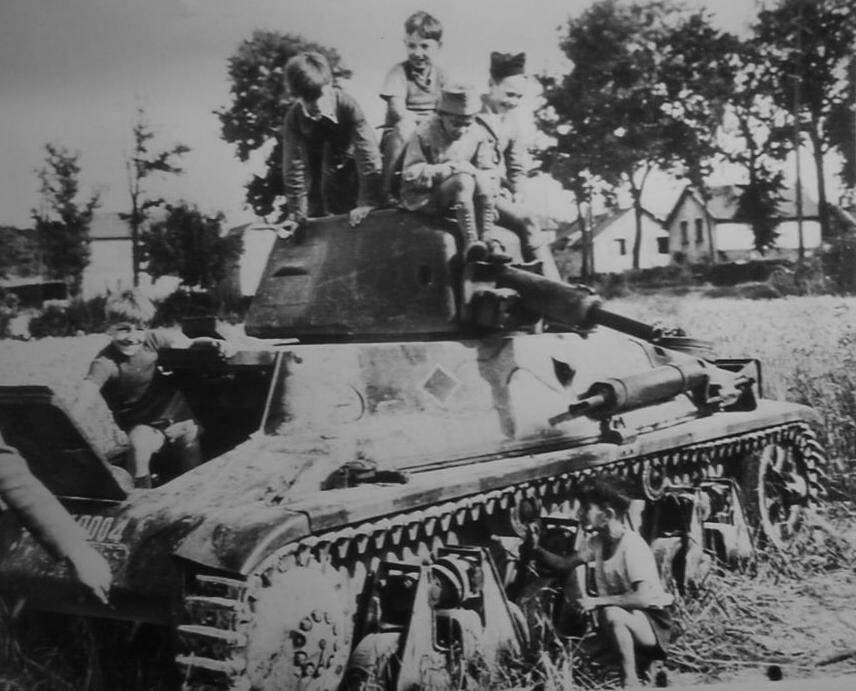
Figure 1.--In the aftermath of the German victory, the French Army's defeat was blamed on the superority and greater numbers of Lutfwaffe planes and Whermact tanks as well as well as Socialist-bread anti-war spiirit. The Army-dominated Vichy regime did not want to admit that the Army itself had failed. Military historians now widely ascribe France's defeat not to superior German weaponry, but to a flawed tactical doctrine and the use and deployment of the weapons. Here French children in August 1940 play in a disabeled French tank. At the time, the fate of France was being decided across the Channel in the skies over Britain by the ally that France had abandoned.
The Wehrmacht in 1940 was known to be a powerful force. The real shock was that the French Army which many military experts had considered to be the most powefull force in Europe proved to be a hallow shell. It was the French Army which stopped the Germans in 1914 and which the Allied front in the West was largely structured around in World War I. When the War broke out, Britain had only a small professional army. Many believed that the Allied war effort during World War II would largely be based on the French Army again. Thus the French collapse within a few weeks was such a momentous outcome. Some French units fought with destinction, but whole French divisions surrendered en masse. Soldiers layed down their arms with fighting and started the long treck east to German POW camps where they would spend 5 years while France's future was decided by other countries. This was the great shock of 1940. Historians today still debate what happened to the French Army. It is relatively easy to chart out the factors which led to the destruction of French arms and almost the French nation. Less clear is the relative importance of these various factors. Some have stressed superior German arms and tactics. This was certainly a factor. Petain and his supporters wanting to defend the honor of the French Army tended to lay the debacle to years of left-wing ideologists .
The Wehrmacht in 1940 was known to be a powerful force. The Wehrmacht was in the mind of many military historians the finest military force in modern history. The Wehrmact entered World War II with an effective military doctrine-Blitzkrieg. This was essentially the primciples of modern war. And the campaign in Poland (September 1939) enabled the Wehrmacht to test out its theories and perfect them. The French learned little from the Polish campaign. The French reaction was that the Poles were not a creditable opponent.
World War I (1914-18)
It had been the French Army which stopped the Germans in 1914 and which the Allied front in the West was largely structured around in World War I. When the War broke out, Britain hasd only a small professional army. So much of the early fighting was conducted by the French who made up the bulk of the Allied force during the early years of the War. The French Army this played a key role in the Allied war effort. The Germans set out to destroy the French Army at Verdun (1915-16). They partially succeeded. After Verdun, the French Army was no longer capable of major offensive operations. Unfortunately for the Germans, the French also inflicted massive casualties on the Germany, severely damaging the German Army. And while the Germans hammered the French, the British built a massive army, finlly introducing conscription. Worse still for the Germans, the Kaiser and his advisers decided to reintroduce unrestricted sub-marine warfare, brining Anerica intgo the War. The Kaisers ministers assured the Reuichstag, that America woukd never be able to transport an army to France. The million Americans that reached France with more on the way, played a key role in cracking the German front and forcing and end to the War. France was part of the victorious Allied coalition, but the huge losses affected the psyche of the French people and the determination tgo avoid another war.
The real shock when the Wehrmacht struck was that the French Army which many military experts had considered to be the most powefull force in Europe proved to be a hallow shell. The Germans proceeded to conquer virtually all of Western Europe. After a few months of the "Phony War", France's turn came. The Germans struck on a wide front against the neutral Netherlands, Belgiym, and Luxemburg. The terror bombing of Rotterdam convinced the already hard-pressed Dutch Army to surrender. The British Expeditionary Force (BEF) rushed north to aid the Dutch. The Germans then struck in the Belgian Ardenes which allowed them to avoid the formidable Maginot Line. The French and Belgians considered the Ardenes impassable to tanks. The Germans managed to easily penetrate the rough terraine, crossed two substantial rivers, and the XIX Panzer Corps rapidly reached the English Channel--cutting the BEF off from the French and rendering the Maginot Line uselss. The French entrenched behind the Maginot Line simply could not cope with the exposive highly mobil style of Blitzkrieg warfare. The Panzers surrounded the Belgian Army which King Leopold III surrendered. The BEF was within Hitler's grasp. The Panzers were only a few miles south of Dunkirk and facing no serious opposition. Hitler ordered the Panzers to halt. Some believe that he hoped this gesture would help convince the British to comes to terms, other believe that is was just as it was described at the time, aneeded pause to regroup and prepare for a more coordinated assault. [Davidson, p. 408 and Fest, p. 630.] What ever the reason, this 48-hour respite allowed the British to organize a defensive perimter around Dunkirk and begin an almost miraculous withdawl. Nearly 340,000 men were evacuated from Dunkirk, including French and Dutch soldiers.
Collapse of the French Army (June 1940)
Many believed that the Allied war effort during World War II would largely be based on the French Army. Thus the French collapse within a few weeks was such a momentous outcome. Some French units fought with destinction, but whole French divisions surrendered en masse. Soldiers layed down their arms with fighting and started the treck east to German POW camps where they would spend 5 years while France's future was decided by other countries. This was the great shock of 1940.
Comparison with the British
Most accounts report that the British Expeditionary Force (BEF) fought better than the French Army. Here accounts vary. A HBC reader writes, "It is easy for people with no understanding of the war to blame the French alone, for the early collapse. The British were not prepared for war. The BEF was so small, that it is hard to say whether it was outfought or not, but I believe that, had the entire French army been replaced by similarly equipped British troops, the only difference would have been a (possible) change in the timing of defeat. The British army had not been so adversely affected in morale by communist propaganda as had the French, which might have encouraged them to fight a little harder and longer, but they would still have lost." Other accounts report a more significan difference. There were, however, no mass surrenders of British units as was the case for the French. Here a factor must have been that the BEF was largely made up of the pre-War professional British Army while the much larger French Army was a conscript force. There was also the Channel and the British soldier must have realized that the fall of Britain was not yet imminent.
Causes
Historians today still debate what happened to the French Army. It is relatively easy to chart out the factors which led to the destruction of French arms and almost the French nation. Less clear is the relative importance of these various factors. Some have stressed superior German arms and tactics. This was certainly a factor. Pétain tended to lay the debacle to years of left-wing ideologists.
World War I
World War I was a cataclysm for Europe. The result was the virtual destruction of a generation. The French Army stopped the Germans, but casualties as the War progressed were stagering. The German strategy as developed by German Commander General Eric von Falkenhayn was to break the French Army by bleecing it at Verdun (1916). He planned Operation Judgement to attack Verdun at the corner of the French lines where they would be forced to fight in narrow confined and commit firces in a piece-meal manner. Falkenhayn came closer to his objective than they realized. Verdun held, but the losses on both sides were apauling. French morale plummeted. There were mutinies, a fact that German intelligence failed to puck up and exploit. Petain was called in to revitalize the French Army. He succeeded through a combination of court marials and more humane treatment of the average soldier. The French Army was ruined, however, as an offensive force. When victory came it was British and American forces that cracked the Hindenburg Line (1918). This feeling of malaze and defeat carried over into post-War France and affected the French Army and it conscripts.
German tactical superiority
The reason for the French defeat is commolnly attributed to the superiority of German arms, especiallaircraft and tanks. The superiority of German arms was a factor in the French collapse, but the German superority was not all that great. It was the German tactical dictrine and deployment of its forces that proved decisive. The Luftwaffe dominated the battlefield which can demoralize to ground troops. Tragically, while the battle for France was being decided in the northeast, French air squadrons in the south played no role in the battle. The German armor was not as clearly superior, but the German tactical doctrine of Blitzkrieg, focusing a massive force on the key area of the bsttkefield, was in essence modern warfare and far superior to French tactical doctrine. The French sporwad out their air firce, fearing German attacks, and dispersed their armor. The Germans focused the Luftwaffe and Panzers on the crossing of the Muse and breakout at Sedan. The widely dispersed French Army could not cope with with the c=focused assault.
Maginot mindset
The French minful of the terrible losses of World War I were unwiiling to fight pitched battles with the Germans as they had done in World War I. A reader writes, "The French before the War concluded that a battle around well armed forts would stop the Germans just as the Battle of Verdun did. So the high cost in men in the French Army of World War I from this battle led directly to France's quick defeat in World War II." The French strategy was to dig in behind the Maginot Line and let the German expose their infatry to artilley and machinegun fire. The Maginot Line, however, did not strach to the Channel, but ended at the French border. The Germans simply went around it. And the French proved incapable of fghting a mobile war with the German panzers. The French still used motorcycle couriers. The German advamce was so swift that that often orders from the high command would arrive after a position had fallen or a unit surrendered. French tanks were not equipped with radios. The best trained and equipped French units had been sent nort to aid the Dutch and Belgians. When the Panzers broke through to the coat, the French lost their most effective formations and armored units.
Leftist/Pacifist idelogy
One still debated issue is to what extent left-wing ideology undermined the French will to resist. There has always been a pacifist or anti-war ele,ent in socialist thought. Marx described war as the eventual outcome of competing capitalist/imperialist powers. Even the socialist parties, however, generally supported their governments in World war I. After World War I, socialist parties generally came to see the war in iddological terms and oppose military spending. This was one reason Hitler so hated the socialists in Germany, in addition to the fact hat they had been respobsib;e for the "November Crime". The one socialist party tht did not share this view was the Bolsheviks which especially under Stalin began building a massive military force. As Moscow gradually gained control over national Communist parties, their orders was to preach peace and oppose military spending. This began to change with the rise of Hitler to power in Germany and the formation of the National Front. Still the anti-war element was so ingrained in leftish thought that the Ntional Front (1936-39) was a largely ineffectual response to the NAZIs. And when Stalin approved the NAZI-Soviet Non-Agression Pact (1939), the Communist in France and other countries again opposing preparadness and military spending. Pétain after the French surrender to the Germans spoke a great deal about how leftist thought had undermined the French fighting spirit.
The French people did not want another war. And as France was a democracy, elected French Governments reflected these views. The Germans (at least Hitler) of course did want another war. Socialism and pacifism thus played a major role in the French defeat. It is interesting that the French Left before the War staged rallies against war (before 1933), but even after Hitler's rise to power they were still demonstrating against war. You can;'t fight a war with a people opposed to war. Pétain after the fall of France wanted to establish Vichy as the legitimare French Government. He also wanted to deflect the responsibility of the French Army for the defeat. One effort in this effort was "le procès de Riom" (the Riom trial). Pétain was the hero of World War I. He was also a arch Catholic conservative who hated the socialists. The rigged trials were designed to blame socialists leaders like Léon Blum for the defeat. Vichy officials in the show trials called many French generals who railed at the socialists. They also claimed that the defeat was not the Army's fault, but that of the Armée de l'Air (French Air Force). The generals also claimed that the British, especially the Royal Air Force, had pulled out of the fight.
Sources
Davidson, Eugene. The Unmaking of Adolf Hitler (Univesity of Missouri: Columbia, 1996), 519p.
Fest, Joachim C. Hitler (Vintage Books: New York, 1974), 844p.