|
Hitler and the NAZIs after the fall of France thought that the War was won. For Hitler this meant that he could now proceeed with one of his most cherished objectives--thecseizure of Lebenraum in the East. This meant the invasion of the Soviet Union. Operation Barbarossa was planed as a massive stroke which would destroy the Red Army with one massive stroke, just as Poland, France, and the other occupied countries had been crushed. The Soviet Union proved a much more difficult undertaking. For the first time, massive German casualties were experienced. The Germans after the huge losses before Moscow (December 1941) found themsleves needing to look for additional manpower. One of the populations the Germans looked for recruits among was among Muslims. Here they found many willing recruits both in the Soviet Union and Yugoslavia. Both the Wehrmacht and SS formed military units with Muslim recruits. For the Germans, Muslim recrits were especially useful. Because of the SSove atheist campaign they bitterly resented the Stalin's Communist rulke. And they also tended to be anti-Russian because of the long hitory of Russin incursions into the Cauucasses and Central asia. And there was the added dimension that most we anti-Semitic as well. The Germn foreign policy iniative in the Middle asr played upon Arab resentment against the British and French. The British and Jew hating Grand Mufti made propagada broadcsts for the Germans as he srt most of the War in Berlin. He also hgelped the Grmans organize Muslim miitary units in the Balkans. He incouraged the Germans to kill ven more Jews. In addition, none other than SS-Reichführer Heinrich Himmler took a particular interest in Islam.
Reichsführer SS Heinrich Himmler (1900-45), the most ntorius of the top NAZIs came from a devout Bavarian Catyholic family. Despite his hatred of non-Aryan oeoples made up of 'inferior races', he admired Islam. This despite the fct it was the creation of the very Semitic Arab peoples a people as closely relted to the Jews ethically as possible. Himmler greatly admired Islam which he called 'Mohammedanism'. He considered it a warrior's religion. He noted that under Islam there will be 'beautiful women in paradise for those who die in battle'. He also said that "Islam is a practical and sympathetic religion for soldiers." An author studying Himmler points out, "Many of today's suicide bombers – often sexually frustrated young males – have also deluded themselves into believing that 72 smiling "Huris" or virgin beauties are waiting for them in paradise." [Vermaat] One of Himmler's closest associates, his Finnish masseur, devoted an entire chapter in his book to Himmler and his infatuation with Islam. [Kersten]
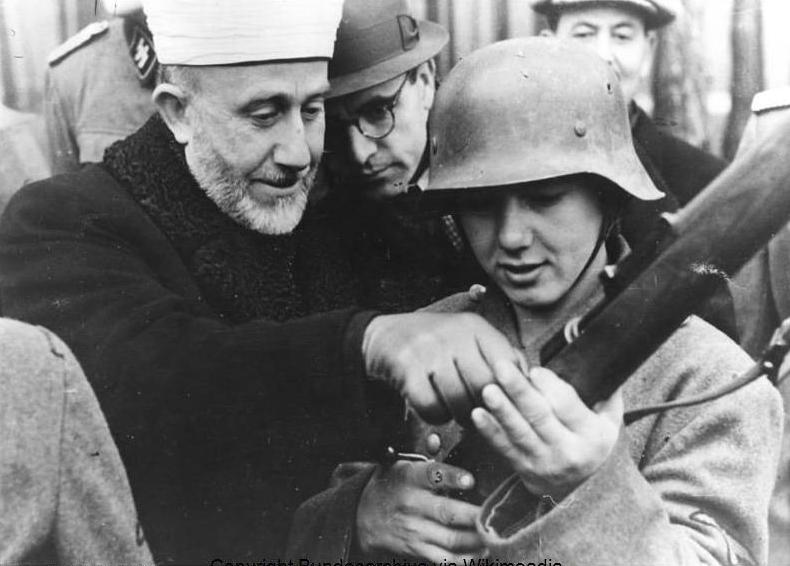
The Grand Mufti of Jerusalem, Haj Amin el-Husseini, played an important role in the formation of several of tese units. His role varied from unit to unit. The Mufti helped form Muslim Waffen SS and Wehrmacht units in Bosnia-Hercegovina, Kosovo-Metohija, Western Macedonia, North Africa, and NAZI-occupied areas of the Soviet Union. He was especially active in Bosnia and Kosovo-Albania where he had contacts made before the War. Defeats in the East created a need for manpower. The Wehrmacht had formed Muslim units in the Soviet Union. Reichsfuehrer-SS Heinrich Himmler had an interest in Islam and decided that the SS should also form Muslim units. The assignment was given to Gottlob Berger, head of the SS Main Office in control of recruiting. Himmler made the Mufti a part of the SS apparatus and give an office in the SS main office (May 1943). From here he was deeply involved in recruiting Muslims for SS units and operations. The Grand Mufti assisted in the formation of Muslim formations in both the Waffen SS and Wehrmacht.
Hitler nd the Grand Mufti met (November 28, 1941). It was at a critical point of history, although neither Hitler and the Mufti knew it. The Mufti has spent the years before the War trying to stage a Kristalmcht in Palestine aided by the NAZIs. The goal was to kill the Jews and drive out the British. He then tried to do the same in Iraq and escaped to Iran whn the British intervned. He tried to launch an nti-Jewish and anti-British risung in Iran, but was forced to flee and reached Itly before trveling to Brlin where he would spend the War. By the time the two met, NAZI Einsatgruppen has murdered over 1 million Jews as pat of the Barbarossa campaign (June 1941). THe Mufiti either knew about this this or would soon learn because of the close reltionship he devloped with Reichführer-SS Hinmrich Himmler. At the time, the Wehrmacht was deep in the Soviet Union beseiging Lenningrad and moving to surround Moscow. The Japanese were preparing to attck Pearl Harbor. The next few days would essentially decide the War and the fate of Western Civilization. Most observers were predicting the emminent collpse of the Soviet Union. Both the Mufti and the Führer wereconvinced thst victory was at hand. As a result, their conversation priarily dealt with how the Arabs could contribute to thst victory. The Mufti opened the conversation by declaring that the Germans and the Arabs had the same enemies -- “the English, the Jews, and the Communists". He wanted to be part of the NAZI war effort. There was not a hint of recognition tht ht it would mean for the Arabs if the NAZIs won the War. He does not seem to have understood where the Arabs figured in the NAZI racial hierarchy or how the Germans exploited the countries over which they seized control. The Mufti assming the defeat of the Soviets was agiven advocated an Arab revolt across the Middle East to destroy the Jews there and to overthrow the English and French colonies there. Wht he does not seem to have understood is that Hitler needed no help from the Arabs once the Soviets wre defetated. The Mufti also wanted to form an Arab Legion, meanung an Arab Army. He wanted Hitler to use the Arabs that had been fighting as part of the French Army and now in POW camps in the Reich. Again the Mufti was totally unaware that nothing could have been further from Hitler's thinking. With the Soviets defeated he not only did not need the Arabs and in fact had no desire to arm them. And armed Arab Legion would have interfeared with his desire to seize and exploit the Arab resources, namely the oil. The Mufti also asked Hitler to declare publicly, as the German government had privately, that it favored 'the elimination of the Jewish national home' in Palestine. Hitler’s reply to the Mufti made it clear thtt Germany's prewar policy bof expelling Jews rather than killing them was already a thing of the past before that meeting. And hitler made it clear that as to the Jews, thy were in sgreement. A primary war goal was to kill Jews. He explined thst the Reivc's “fundamental attitude was clear: Germany stood for uncompromising war against the Jews. This obviously included the “national home” in Palestine. He explained that “Germany was at the present time engaged in a life and death struggle with two citadels of Jewish power: Great Britain and Soviet Russia.” In ideologucal terms the war was “a battle between National Socialism and the Jews." He assured the Mufti that Germany would of course help others involved in this “war of survival or destruction.” He openly explained that he “was resolved, step by step, to ask one European nation after the other to solve its Jewish problem, and at the proper time to direct a similar appeal to non-European nations as well.” [U.S. Department of State, et. al.] Thee German Foreign Office sent the Mufti a letter which stated that Germany was holding no Arab territories and understood and recognized the aspirations to independence and freedom of the Arabs, just as she supported the elimination of the Jewish national home. The Mufti accepted the NAZI commitment to Arab independence and freedom as a real assurbce when no rtional person in the world still believed that on could trust Hitler's assyances.
Hundreds of thousands of Muslims fought in the War, many on the NAZI side.
Germany did not have a Muslim population. Several of the countries occupied by the Germans did have Muslim populations. They were a populations that was safe for the Germans to recruit because they were for a variety of reasons hostile to the government of the country they lived. This was especially true in the Soviet Union because of Stalin's athiest campaigns. Yugoslvia was the other country where Muslims were recruited. Here the ethnic and religious animosities meant that again the Muslims were a population that the Germans could recruit. The SS recruited Muslims extensively in the Balkans and here thre Mufti was especially involved. There were two Bosnian Muslim Waffen SS Divisions, an Albanian Waffen SS Division (in Kosovo-Metohija and Western Macedonia), the 21st Waffen Gebirgs Division der SS ìSkanderbegî, a Muslim SS self-defense regiment (in the Rashka--Sandzak region of Serbia. Many other units were formed, especially in the Soviet Union. Other Muslim units fighting with the NAZIs included: the Arab Legion (Arabisches Freiheitskorps), the Arab Brigade, the Ostmusselmanische SS-Regiment, the Ostturkischen Waffen Verband der SS made up of Turkistanis, the Waffengruppe der-SS Krim, formations consisting of Chechen Muslims from Chechnya,Ý and a Tatar Regiment der-SS made up of Crimean Tatars, and other Muslim formations in the Waffen SS and Wehrmacht, in Bosnia-Hercegovina, the Balkans, North Africa, and Nazi-occupied areas of the Soviet Union. The Mufti's involvement in the formation of these units varied.
Albania was occupied by the Italians just before the outbreak of World War II (1939). Mussolini used it as a springboard for his aborted invasioin of Greece (1940). This was ultimately a factor in the German invasion of Yugoslavia abd Greece (1941). Albania and Koso were in the Italian occupation zone. After the Italian surrender to the Allies (September 1943), the Germans attempted to occupy the Italian zone. By this stage of the War, Germany was desperately short of man power. The SS thus began recruiting Muslims in Albania as it had aklready begun doing in Bosnia. The result was the 21st Waffen-Gebirgs-Division der SS Skanderbeg, Albanian 1st Division. The Divisiomn was never fully trained or formed. The bckgrojund of the Diviosion begn with the Italian invasion of Albania (April 1939). This was befire Hitler and Stalin launched World War II. After invading Albania, Mussolini began forming Fascist and Blackshirt organizations. The goal was to turn Albania into an Italian province. After entering the War, Italy invaded Greece (October 1939). It prived disaster. Hitler had to rescue the situation after Yugoslavs rejected an alliance. A German invasion quickly seized Yugoslavia and Greece. The Italians were given Kosovo, Albania, and Croatia as an occupation zone. They combined Albania and Yugoslav Kosovo as Greater Albania. Communist Enver Hoxha forms a Partisan resitance group and lunches guerilla operations with a force of about 20,000 fighters. The Italian occupation forces basically abandon the countryside only garrison major towns. After the arrest of Mussolini, the Italian Government headed by Gen. Badoglio surrender to the Allies and switch sides. The Italian Firenze division surrenders en masse to the Hoxha's partisans. This provides the Partisans quantities of modern weapons for the first time. When the Italian surrender the Germans rushed to seize control of Italy and the areas of Yugoslavia Italy had occupied. Hitler had expcted the the Italian surrender. Thus they were prepared, although by this stage of the War theur resources were declinung. The German 1st Jäger and 297th Infantry Divisions were assigned to seize control of Albania and to pacify it. They did not, however, have the capbility of operations in the countryside against a now well armed guerilla force. Himmler ordered the formtion of an lbnian SS division to assisr with pacification effort (April 17, 1944). Recruiting began in Kosovo, at the time part of Greater Albania. The SS commnd ordered I Battalion of Regiment 28, 13th Waffen-Gebirgs Division Handschar to Pristina to serve as the nucleus of the newx division.
Elements of the new division participate in guard operations at Gjakova. The Italins had not riunded up Jews. The new Division found 281 Jews and deported them to concentration camps (May 1944). Some 9,000 Alkbnians reportdly volunteered for service. About 6,000 were accepted by the Germans (June 1944). The Division with little training paricipted in Operations "Draufgäger" against Yugoslav partisan 2nd, 5th & 17th divisions in Andrijenica, southern Montenegro (July 1944). THe Division was ssigned to guarding Kosovo chrome mines (August 1944). Albanian partisan overrun chrome mines, some of the Skanderbeg troops desert (August 19). The security situatiin in lbania begins to deteriorate. German-appointed Albanian puppet leader Fikri Dine seeing what was happening resigns (August 29). The peak strength of the Division was some 6,500 men (September 1944).
It was assigned anti-partisan duties, but took casualties as ghe partisans were well armed. German Army Group E report describes the Division as of 'no military value'. Some 1,000 men from Waffen-Gebirgs Division der SS Regt. 50 desert. The itution in the Bakns continue to derteriorate for the Germans. Soviet troops enter Bulgaria and Bulgaria switches sides and declares war on Germany (September 8-9). As it becomes clear tht the Germns are evcuting the Blkans, mass diseryions occur, some 3,500 men. This was more thn half the Division nd most of the Aklbnnisns-Kosovars. There is no percesise ccountm but it kleft th Dividion ith somnthing like 1.500-2,000 combat-ready men. .The Germans decide to withdraw from Albania (October 3). Bulgarians/Soviets troops enter Nis October 14). Himmler decided to incorporate 3,800- 4,000 Kriegsmarine sailors from the dissolved Aegean Sea fleet into the unit (Ovtiber 15). Partisan and Soviet troops capture Belgrade (October 20). It is at this time tht the Division fights its major action. The remsining elements of the Skanderbeg division, along with other German units, hold off Soviet/Bulgarian troops at Kumanovo (October 23). The action enabled 350,000 German troops to retreat from Greece and Albania into Bosnia (October 23). The Division was disbanded (November). The surviving elements were incorporated into Prinz Eugen 14th Regiment. They retreat into Bosnia. Other members may have fought with the Bulgarisches Waffen-Grenadier Regiment der SS in Vardar against Soviet troops and Yugoslav Partisans. The Germans abandon Skopje (november 11) and Pristina (November 19). Some of the division's former Naval personnel from the Aegean Fleet seem to have been transferred to the SS replacement depots. (eEcember 1944). Most were assigned to the 32nd SS-Freiwilligen-Grenadier-Division "30 Januar", a new composit unit including boys from SS schools (January 1945). Most of the Division was destroyed in the Battle fir Berlin (Aoril 1945). ).
While the NAZI grand design foir the Caucasus and Middle East collapsed, the Germans still had Muslim populations in the areas they controlled which could be recrited for military service. The losses in Stalingrad creasted a desperate need for additioinal msanpower. It must have discouraged many Muslims from volunteering, but even so quite a number did join the Germans such was their hatred of Stalin and the Communists. Many Turkestanis in particular joined the Germans. The first NAZI Muslim military formations were formed by the Wehrmacht with Hitler's full approval. An imoressed Reichsführer SS Heinrich Himmler decided to recruit Muslims for the initiall racially pure SS. Several German Muslim units were formed as both combat and labor battalions. They saw combat on the eastern Front, the Balkans, Italy and France. They were widely employed for operations against partisans.
Perhaps the nost notorious of the German Muslim divisions was the 13th Waffen Mountain Division of the SS Handschar (1st Croatian). It was a Waffen-SS mountain infantry division. It was committed to the anti-partisan campaign in German occupied Yugoslabia (Bosnia and Croatia) during March-December 1944. This ws a time in which German military force ws collapsing and the Red army was enterijg the Balkans. The Division helped cover the German withdraw from Greece and the Balkans (September-December 1944). Croatia was a Fascist state and German-ally which declared its independence from Yugoslavia and included much of what is now Bosnia (adter the Italian surrender) as well as part of Serbia. Handschar was a traditional combat knife or sword carried by Ottoman policemen who occupied the Balkans for several centuries. While the Whermact has begun using Muslims soon after the Barbarossa invasion (June 1941), the Handschar Division was the first non-Germanic Waffen-SS division. Its formation marked the expansion of the Waffen-SS into a multi-ethnic military force, a sign of how desperate the race obsssed Germans had become. The SS recruited Bosnian Muslims (ethnic Bosniaks) and some Catholic Croats. German and Yugoslav Volksdeutsche (ethnic German) served as officers and non-commissioned officers. The men took an oath of allegiance to both Adolf Hitler and the Croatian leader Ante Pavelić.
After the Germsns invased and dismembered Yugoslvia (Aoril 1941), Italy was assigned to occupy Kosovo. It had already invaded and occupied Albania. The two were combined a Greater Albania. After Italy surrendered to the Allies (Seotember 1943), German occupied Albania and Kosovo. They attempted to recruit a SS Muslim division. This effort is described in the Albania paragraph a32nd SS-Freiwilligen-Grenadier-Divisionbove.
The SS was not precisely an organization prepared to accept cultural diversity. Thre thus were a range of problems the Germans officers assigned to lead the Muslim divisions had with their Muslim recruits. With Muslims the SS had to chang somewhat. This was not an easy adjudstment.
There were mutinies which were severely supressed. Some adjustments were relatively easy, such as eating pork and drinking alcoholic beverages. Himmiler ordered SS officers, "... I hold all commanders and other SS officers, responsible for the most scrupulous and loyal respect for this privilege especially granted to the Moslems. They have answered the call of the Moslem chiefs and have come to us out of hatred for the common Jewish-Anglo-Bolshevik enemy and through respect and fidelity for he who they respect above all, the Fuehrer, Adolf Hitler. There will no longer be the least discussion about the special rights afforded to the Moslems in these circles.... Heil Hitler! (signed) H. Himmler". (August 6, 1943)
Kersten, Felix. Totenkopf und Treue (1952). Felix Kersten (1898-1990) was not only Himmler's personal masseur, but a close confidant. Kersten publishhis astonishng memoirs Totenkopf und Treue (Deathhead and Loyalty) 7 years after the War (1952). For some reason the chapter 'Begeisterung für Islam'(Enthusiam for Islam) was ommitted in the English translation. Some authots believe that some of Kersten's claims are exaggerated, but parts of his memoirs seem to be reasonably reliable. And perhaps no one was as personally close to Himmler as Kersten. Important Himmler biograhers (Roger Manvell and Heinrich Fraenkel) insist that Kersten 'became the most powerful influence in Himmler's life after the death of Heydrich.'
Vermaat, Emerson. "Heinrich Himmler's remarkable rdmiration For Islam: "It promises beautiful women in Heaven" (2009).
U.S. Department of State, the British Foreign Office. and the French Government. R.J. Sontag, ed. Documents on German Foreign Policy 1918-1945, Series D, Vol XIII (1964)

Navigate the CIH World War II Pages:
[Return to Main German military organization page]
[Return to Main Non-German German military forces]
[Return to Main German World War II page]
[Return to Main World War II Islam page]
[Biographies]
[Campaigns]
[Children]
[Countries]
[Deciding factors]
[Diplomacy]
[Geo-political crisis]
[Economics]
[Home front]
[Intelligence]
[POWs]
[Resistance]
[Race]
[Refugees]
[Technology]
[Totalitarian powers]
[Bibliographies]
[Contributions]
[FAQs]
[Images]
[Links]
[Registration]
[Tools]
[Return to Main World War II page]
[Return to Main war essay page]
[Return to CIH Home page]