|
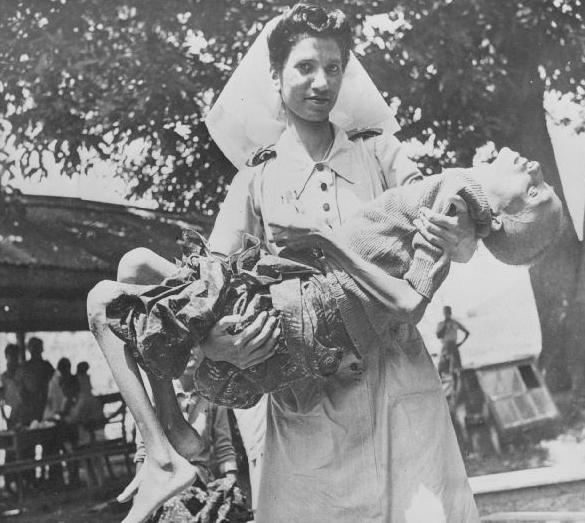
The Andaman Islands were part of the British Raj. British authorities used the Viper Chain Gang Jail on Viper Island was reserved for difficult prisoners during the colonial era. Because of its isolation, it was used to jail important independence activists. The Japanese after launching the Pacific War with the attack on Pearl Harbor were able to dominate the Pacific Ocean and for a brief period the Indian Ocean. A powerful Imperial Navy cruiser squadron and the light carrier Ryūjō, seized the island (March 23, 1942). The purpose was to secure the Japanese Army's seaward flank as it completed the occupation of Burma. The Islands proved of little value to the Japanese, especially after Midway (June 1941) when Japan's naval dominance ended. The Imperial Navy concentrated its forces for the battles with the U.S. Navy around the Solomons in the South Pacific. And the Japanese no longer committed important elements for Indian Ocean operations. Ryūjō survived Midway, but was sunk in the Battle of the Eastern Solomons (August 1942). The Japanese used the Islands as a submarine and seaplane base. Given the minor importance of the Andamans, the British with limited available resources did did not attempt to retake them. The Japanese used the Islands for propaganda p
urposes. Japanese authorities placed the Islands under the nominal control of the Arzi Hukumat-e-Azad Hind (Provisional Government of Free India--PGFI) under the leadership of Netaji Subhas Chandra Bose. Bose did visit the Islands and renamed them as Shaheed (Martyr) & Swaraj (Self-rule). With Japanese cameras rolling, Bose raised the flag of Indian independence (December 30, 1943). This was of course a fiction as the Japanese were in total control. Much of the British Sikh garrison joined Bose's Indian National Army (INA). INA General Loganathan was appointed Governor of the Andaman and Nicobar Islands which had been annexed to Bose's PGFI. It would be virtually the only part of India that the PGFI would ostensibly control. The Japanese during their occupation committed terrible atrocities. The British commander was brutally tortured and then beheaded. The Japanese commander had not the slightest idea that Japan could lose the War. Most of the Japanese atrocities during the occupation were committed against the local population as few Britains lived there. The PGFI was not responsible for the atrocities, but as they had no real authority, were unable to protect the local population from the Japanese. And the racial and cultural make up of the poplation may even have affected their sesire to protect the local. As on other islands, the Japanese occupied, food became very scarce and the garrison's primary activity was finding food. This became an increasingly serious problem as the Japanese naval and merchant shipping losses made it increasingly difficult to supply isolated naval garrisons, even strategically important ones. And the Andamns were perhas the least strategically placed island group the Japanese possessed.
Royal Navy units targeted Japanese facilities on the Adamans and intercepted supply ships which the Japanese were forced to send without escorts. (1944-45). The Japanese as a final atrocity rounded up and executed 750 civilians in the Port Blair area. This seems largely designed to eliminate witnesses to their occupation atrocities. The British after the Japanese surrender (August 1945), had many colonial possessions to reoccupy that took
higher priority, including Malay, Singapore, and Hong Kong with POWs in terrible condition. The primary problem was the shortage of shipping. Thus the British reoccupation of the Andamans was delayed (October 7-10, 1945).

Navigate the CIH World War II pages:
[Return to Main World War II island territory page ]
[Return to Main World War II Japanese attrocities and war crimes page ]
[Return to Main World War II country page ]
[Biographies]
[Campaigns]
[Children]
[Countries]
[Deciding factors]
[Diplomacy]
[Geo-political crisis]
[Economics]
[Home front]
[Intelligence]
[POWs]
[Resistance]
[Race]
[Refugees]
[Technology]
[Totalitarian powers]
[Bibliographies]
[Contributions]
[FAQs]
[Images]
[Links]
[Registration]
[Tools]
[Return to Main World War II page]
[Return to Main war essay page]
[Return to CIH Home page]