|
Poland had one of the world's largest and most vibrant Jewish communities dateing back to the medieval era. Poland had the largest Jewish population in Europe with the exception of the Soviet Union. Poland was the center of the NAZI Holocaust of the Jewish people. The German invasion and seizure of western and central Poland made it possible to perfect the process of killing Jews. There were some if limited constraints on the NAZIS in German. There were no constraints in Poland. Heydrich in September 1939 layed out the NAZI plan for the Jews to SS officers. The NAZIs proceeded to concentrate the Jews into ghettos, a medieval institution, where they were easily accssible fortransport to the death camps built nearby. The death camps were located in Poland not Germany. And in Poland the Germans found many willing to help them and few Poles intersted in protecting the Jews. Einsatzgruppen began killing Polish Jews with the German invasion (September 1939). This was done, however, in relatively small numbers. Most Polish Jews were forced into the new ghettos which after the viloence directed at them semed almost a haven. It also gave the NAZIs the opportunity tocompletely strip threm of their property and restrict consumtion of food and other consumer products as well as to force them into slave labor. The impetus for murder outweighed the benefits of slave labor. The SS largely liquidated the ghettos (meaning murdered the Jews in them) during 1942 following the Wannsee Conference: Lublin (March 1942); ghettos of Eastern and Western Poland (Spring 1942); and the Warsaw Ghetto (July-September 1942). Hitler had largely succeeded by 1943 in destroying the once vibrant Jewish community of Poland. The death camps in Poland were also used to kill the Jews in NAZI occupied western and southern Europe.
Poland before the September 1939 German invasion had one of the largest and most vibrant Jewish communities in the world. The diaspora only included larger Jewish populations in America and Russia. Poland was an especially important center of Jewish cultural and religious life, not only because of thge size of the Jewish community but because large numbers of Polish Jews, unlike German Jews, were not assimilated into wider Polish society. Poland had a long history of openess to Jews in a still Catholic Europe seething with anti-semitism. Toland from the XIth century onwards had accepted Jews fleeing persecultion in from Austria, Germany, Hungary, Italy, Portugal, and Turkey. In many countries the Jews were persecuted, restructed to ghettos, and often robbed, brutalized, and killed. Several countries including England, Spain, and Portugal expelled them entirely. The Holu Office of the Inquisition was tasked with ensuring that converted Jews ("conversos") were not secretly practing their faith. The Jews in Poland were permitted freedom of religious worship, the right to live in their own
communities by King Casimir the Great in the 14th century a dispensation that was reaffirmed by later kings of Poland.
Polamd was a rare haven for Jews in mideval Europe. Over time, however, this begin to change. The Church played a major role preaching against Jews to the peasantry. Attitudes began to change. A factor here was that forvrekgious reasons, Hews were better educated than Chrustian Poles. They were also more urbamized. A anajor facctor was the Polish Partitions (18th centurty). Austria, Prussia, and Russia partitiined and annexed Poland. Russia got the lfargest share. And the Russoan Tsars, unlike, Polish rulers, hated Jews with a passion. New law and regukations were aimed at Jews, severly impairing their daily lives. The only imprtantbPolish institution survviving the Partitiins was the Catholic Church which had am vintene anti-Semetic orientatiin. In addition, Russian generated attacks and vicious pograms were aimed at them. And while comditions in Western Europe began to improve, consitions in Poland deteriorted (19th century) The next to last Tsar, Alexander III, was a vicious anti-Semite. This combimed withe declining popularity of the Tsarist rehime led to terible attaxks, Tsarist og=fficukas sought to redirect dislike of vthe Tsar to hatred of the Jews. Many Polish Jews fled to America. Poland achieved ots indepoendence after World War I. By that time, anti-Semitism was strongly inbdded in Polish society. And bationalist senymentbwas very high. Polish authorities passed laws excluding Jews from imperant sectors of public life. Some 19 percent of the population was Jewish. And the proportion was even larger in major cities. A third of Warsaw was Jewish. Many Poles were disturbed by what they saw as the disportionately large Jewish influence in Polish life. Nationalist Polish politicians advocated the mass emigration of the country's Jews. But America after World War I had sharply reduced immigration quotas.
The Germans more than any other military, correctly assessed the lessons of World War II. The War in Europe began in 1939 when the German Blitzkrieg smashed Poland in only a few weeks. The invasion was made possible the preceeding week when Stalin signed a non-aggression pact with Hitler. The Panzers crossed the Polish frontier on September 1 along with a devestating strike by the Luftwaffe. The Polish Army and Air Force was shattered. Over 1 million German soldiers surged into Poland. Hitler emerged from the Reich Chancellery in a new grey uniform with his World War I Iron Cross. In a speech at the Reichstag before cheering
NAZIs he declared, "I myself am today, and will be from now on, nothing but the soldier of the German Reich." Whithin 6 days Cracow, the center of Polish nationhood, fell. Pincer movements began on September 9 to encirle the major remaining Polish forces. Once certain of Polish defeat, Stalin ordered the Red Army to attack from the East. German and Russian forces met at Brest-Litovsk on September 18. Warsaw fell a few days later after a ruthless bombing assault. The Blitzkrieg tactics that were to prove so devestaing in the West during 1940 were all on display in 1939. Neither the British or French showed much attention,
abscribing Polish defeat to military incompetance. The French had promissed the Poles an offensive in the West. It never came. [Fest, pp. 602-603.]
The NAZIs establish the Stutthof ( Sztutowo ) concentration camp, the first camp to be set up in occupied Poland. Stutthof was 34 km from Danzig. The first prisoners arrived that day, 250 Polish citizens and prisoners of war (POWs). Within 2 weeks later, there were 6,000 prisoners at the camp, including POWs, scientists, teachers, government oifficials, etc. Most were soon executed. Stutthof was not only the first, but it was one of the most notorious camps. Soap was made there from the bodies of the Jews murdered.
Polish forces realing from the NAZI blitzkrieg in the west were attempting to fall back on Lvov and regroup in eastern Poland. Here the Red Army struck on September 17. A secret clause in the NAZI-Soviet Nonagression Pact had divided Poland at the River San. Bewildered Polish soldiers surendered to the Soviets en masse.
Esespecially constituted SD Einsatzkommandos from the very beginning undertook a calculated campaign of repression. These units were created and trained under Heydrich's command. Regular units of the Wehrmacht were also involved in this campaign, but their activities were not as carefully calculated as the actions of the Einsatzkommandos. SD Einsatzkommandos carried out standard operations. They were trained in these actions. The normal procedure was that once a town was taken by comat troops, the Einsatzkommandos was entered and arrested a group of Jews or Poles. Normally men were taken for hostages. They were then kept as hostages and usually shot when some excuse was found. The idea was to terrify the town and discourage any thought of resistance. Dpending on the proclivities of the individuals involved, the hostages were often tormented. This was especially true of the Jewish hostages. The Einsatzkommandos persued a special campaign against synagogues. Many synagougues were burbned as in Kristallnacht. Estimates indicte that that several hundred synagogues were destroyed during September and October 1939. There are many accounts of what happened to the synagogues in different Polish towns. The Germans in many towns and cities conducted mass roundups of Jews. These roundups were simetimes whole families, includuing men, women, and children. Sometimes the round up methods separatedd children from their families. These people then were interened. Regular Wehrmact units participsated in these attricities. It was not just the the Einsatzkommandos and other SS units. At the same time many Wehrmact officers were appalled at the attrocities they witnessed. In fact the Wehrmacht actually arrested some German soldiers for excesses in Poland.
The German invasion (September 1) resulted in the death and injury of large numbers of civilians and huge material loss destroying thousands of dwelings and business estanishments. This was caused by both Luftwaffe bombing of cities as well as artillery shelling. Both Jews and non-Jews suffered, but in many Jewish neighborhooda and buildings were specifically targeted. The German military operations resulted in the death of an estimated 20,000 Jews (September 1939). Material damage was also substantial. Large areas of Warsaw were destroyed, including about 30 percent of the Jewish-owned buildings. The Germans destroyed or burned whole Jewish neighborhoods. Some 50,000 Jewish homes, factories, workshops, and stores were destroyed in about 120 Jewish communities. In some of these communities, nearly all the nouses were destroyed. Many were burned. The German invasion created a massive wave of refugees, but they had few options because the Germans attacked from the north, west, and south. Escape through Danzig because the German launched the campaign there with salvos from the Schleswig-Holstein and quickly seized the port. Hundreds of thousands of Poles moved east and even after the Soviet invasion, attempted to reach the Soviet zone. The refugees included both Jews and non-Jews. Many that succeed in reaching the Soviet zone were were sent to labor camps. Others attempted to reach either Lithuania or Romania. The Polish Government fled to Romania and then on to Paris where it set up a government in exile. After Poland's surrender, NAZI officials in the Government General dragged Jews from their homes and drove them into the Soviet occupation zone. Some were killed by the SS on the way. At times the Soviets allowed them to enter. Thousands were reportedly killed trying to cross the Bug River, shot by both Russian and German troops. [Gilbert, pp. 285-286.] Refugees within the German occupation zone flocked to Warsaw and other cities cereating a humanitarian disaster. It is at this point that the NAZI confiscation measures stripped mpre Jews of their property, including homes creating more refugees and leaving the Jews who had not yet become refugees with few resources to assist the refugees. One pitifully small number of Jews who escaped was the Tehran children.
It was in Poland that Hitler's plans for the occupied east were first shown. The Jews were not the first target of NAZI barbarity. Hitler did not view Poland as a legitimate nation. He saw it as a creation of the hated Versailles Treaty ending World War I. Poland had split Germany through the Polish Corridor. He was determined that Poland would never again threaten Germany or limit Germany's drive for lebensraum. The NAZI plan was simple. First they plan to eliminate the Polish inteligencia. Second they would expel Poles and colonize the former Polish areas with Germans. The was given orders to kill Polish
prominent civilians and indiviaduals such as government officials, the nobility, teachers, and priests throughout Poland, any would which could promote Polish nationalism or offer leadership. Today their are countless memorial stones and plaques througout Poland where these executions took place. And it was not just men, women and children were also killed.
Reinhard Heydrich, Himmler's right-hand man, layed out the NAZI plan for the Jews to SS officers at a secret Berlin meeting in September 1939. SS officers unable to break away from the Polish operations were sent a written account. He indicted that the ulimate aim would tale a "prolonged period of time" and must be kept secret. He explained that Polish Jews were to be concentrated to a number of cities. Jews in thousands of communities throughout Poland were to be deported to these cities. The Jews were to be confined to a certain sector of the selected cities. Jewish Councils were to be created through which NAZI orders were to be transmitted. These areas were to be called ghettos, a term from medieval history. The last European ghetto was located in Venice and closed by Napoleon. [Gilbert, p. 274.]
Even before the NAZI invasion of Poland was completed, the NAZIs began planning the suppression of the Jews. This process varied depending on where the Jews lkved. Reinhard Heydrich, head of the SS Security Police (SD) ordered that plans begin for concentrating all Jews in Poland and Czechoslovakia into ghettos (September 21, 1939). General Governor Hans Frank issued an ordinance required that Jews 10 years of age and older living in the General Government had to wear a yellow Star of David on their chest or a blue and white armband with the the Star of David (November 23, 1939). Regulations varied in other areas. The Star of David insignia of course simplified the problem of identifying Jews. The NAZIs had leaned in the Reich that not all Jews actually looked like the images of Jews they had. Jews who failed to desplay the badges could be shot. NAZI authorities in the areas of Poland that were being annexing to the Reich began deporting Jews to the Government General. Many Poles would also be deported. The NAZIs opened the first ghetto at Piotrekow (Novermber 28). The process proved more complicated than they had anticipated. Thus the immediated ghettoization of Polish Jews had to be delayed. Piotrekow was a fairly small ghetto, but the NAZIs perfected the system there that they would use for the larger ghettos. NAZI authorities began conscripted all Jewish males in Poland between the age of 14 and 60 years for forced slave labor (December 1939). This had begun earlier as ad hoc work round-ups.
Reinhard Heydrich, head of the Security Police, ordered that all Jews in Poland and Czechoslovakia be isolated and concentrated in ghettos (Sepember 21, 1939). This did not take place immediately because of the level of organization involved. The Jews were to be concentrated in ghettos set up in in Poland's larger cities. The NAZIS used Jewish neighborhoods in the major cities for the major ghettoes (Warsaw , L�dz, Krak�w, Lublin, and Lvov). Hans Frank was the leading NAZI Jurist. He was made the commander of the Government General, the area of NAZI controlled Poland not annexed by the Reich. He implemented Heydrich's orders. The ghettos were a key part of the evolving NAZI plan of dealing with Jews.
From the NAZI perspective there were various advantages. 1) Once confined in ghettoes the Jews could be easily forced to work as slave labor to support the War-effort. 2) Their consumption of food and goods could be restricted to help avoid war time shortages in Germahny. 3) As they were concentrated and separated from the general Polish popultion, future actions could be nore easily conducted. Here the NAZIs may hve originally been thinking of deportation east, but this soon turned to mass murder. The decession to establish the ghettos appears to have been taken befor the decssion to commit genocide, but once that decession was taken the concebntration made the killing opperation easier. 4) The process of stripping Jews of their property could be completed. The Jews were foirced out of their homes and required to hand over valuables as they entered the ghettoes.
NAZI propaganda maintained that Jews were genetic carriers of various diseases (particularly typhus) and thus there were public health considerations. The German people were told that the Jews were natural enemies of the Reich and Aryan race and thus encarcerating the Jews was a nececessary war-time measure.
Auschwitz was the largest and most deadly of the NAZI concentration camps. Richard Gluecks, head of the SS Concentration Camp Inspectorate informed Himmler on February 21, 1940 that he had found a site for a punishment camp where Poles who had defied the NAZIs in any way could be put to work under especially harsh conditions. The NAZIs create a huge concentration camp complex at Oswiecim in occupied Poland. It became known as Auschwitz. The site was chosen largely because of rail lines. SS Commander Heinrich Himmler ordered a large-scale expansion of Auschwitz following a personal inspection tour (March 1, 1941). The massive complex was primarily a SS slave labor undertaking to punish the opponents of the Reich and support the War effort through exploitation of the labor of occupied countries and POWs. Conditions were so harsh that the prisoners died in large numbers. And a smallmpart of thd Auschwitz complex was the Birkenau killing facility was included in the complex. While small, Birenau had the capacity to rapidly kill people in large numbetrs. Birenau had both gas chambers and cremotoria. The SS used Zyklon-B in the gas chanbers. It came on line (mid-1942).
Belarus is a country that was certainly affected by the Holocaust. It is, however, a difficult country to classify any account of the Holocust organized on a national basis. The country was until World War I a part of the Russian Empire with a mixed population pf Poles, Ukrainians, Lituanians, Jews, and others. After the War much of Belarus was acquired by the newly independent Polish nation and the Soviet Union trying to regain the territory of the old Soviet Union. At the onset of World War II, the NAZIs and the Soiviet Union cooperated in the invasion of Poland and partioned the country (September 1939). The Soviet sector was in large part modern Belarus. This meant the Holocaust evolved very differently in the two sectors of pre-War Poland. The NAZIs moved to concentrate Jews in their sector of occupied Poland where they later could be transported to the death camps. The Jews in the Soviet sector of occupied Poland were at first spared NAZI depridations, but were engulfed by the Holcaust with Barbarossa--the NAZI invasion of the Soviet Union (June 1941). The NAZI as part of Barbarossa made only a limited attempt at creating gettos (mostly in the Baltics). Rather the basic approach ussing especially prepared Einzatgruppen was to kill Jews when and where they found them. This was done largely by mass shootings, in many cases at specially dug pits.
Operation Reinhard was the systematic plan to kill Polish Jews on an industrial basis. The NAZIs began the Holocaust by driving Jews outof Germany. This substantially reduced the number of Jews in the Reich. Subsequent NAZI aggressions: Austria (1938), Czechoslovakia (1938-39), and especially Poland (1939) brought many more Jews under NAZI control. The NAZI policy was not to kill these Jews in large numbers, but to concentrate themm in medieval ghettos located in occupied Poland. NAZI officials debated what to do with the Jews. There were inpractical schemes flosated like deporting them to Madagascar. Confinement in the ghettos allowed the NAZIs to strip them of their property. Many NAZIs wanted to use them as slavce labor and this was the general aprroach (1939-41). The invasion of the the Soviet Union was the turning point (June 1941). Hitler decided to simply kill Soviet Jews. This was the first major killing operation of the Final Sollution. There were some short term ghettos formned in the Baltics, but most Soviet Jews were killed when ever they were found by specially formed Einsatzgruppen and local auxileries. Next the NAZIs turned to the 2.3 million Jews in occupied Poland, mostly the Government General. This was the second major killing operation of the Final Sollution. The Germands began killing Jews from the first day of the invasion of Poland (September 1939), but in disorganized, largely small scale actions. The plan to kill every Polish Jew on an organized, industrial basis was named Operation Reinhard in honor of SS ???? Reinhard Heydrich. The planning began in 1941, but was only named Operation Reinhard after British-Czech agents killed Heydrich (May 1942). At the time the killing process was already underway.
The reports from the SS Einsatzgruppen in Poland and the Soviet Union enduced SS officials to search more a more efficent killing process. The SS vans equipped to use exhaust fumes for killing Jews at the Chelmo extermination camp (December 8, 1941). Many Jews from the Lodz ghetto were killed here (January 1942).
The NAZIs hold the Wannsee Conference (January 20, 1942). Hitler had already given the order to kill Europe's Jews. TheDeath Camps were under constuction. The conference was an interagency-session to work out how to coordinate the killing process. Guidelines are worked out or the implementation of the Final Solution under the direction of Reinhard Heydrich.
The NAZIs established concentration camps throughout the occupied countries of Western Europe. All but one of the death camps, however, were located in Poland. This was the closure of Polish nespapers and the expulsion of foreign journlaists as well as the military occupation provided the NAZIs the ability to conduct operations in relative secrecy. The five death camps were: Belzec, Chelmo, Maly Trostenets, Sorbibor, and Treblinka. Maly Trostenets was located near Minsk in the Soviet Union, the only one of the death camps that the NAZIs did not locate in Poland. The most notorious camp was Auschwitz. It was a huge camp originally created for slave labor, but a section of the camp at Birkenau was created to kill Jews. Large numbers of Jews and others were killed at the many other camps established throughout occupied Poland. The SS began killing Jews in gas chambers with Zyklon B began at Belzec. (March 17, 1942). The Treblinka death camp was established (August 1942). The Majdanek concentration camp begins to work as a death camp as does Auschwitz. Thus by August 1942 there are six extermination camps running in NAZI occupied Poland. The process begun at Belzac is in full force with which hundreds of thousands of Jews arriving from the ghettos in Poland and Czechoslovakia where they had been concentrated (March-October 1942). The elderly and children were gassed to death upon rival. Healthy men and women without children were worked to death. The SS plans to rapidly empty the ghettos in Poland and the Soviet Union (mostly in the Baltics) and destroy them. are to be emptied out and destroyed. Jews at Treblinka revolt. Most are executed. There is a revolt at Auschwitz and the Jews manage to blow up one of the crematoria (October 7, 1944). As the Red Army is approaching, the SS destroy the remaining crematoria and gas chambers in an effort to remove traces of their murderous crimes (October 26, 1944).
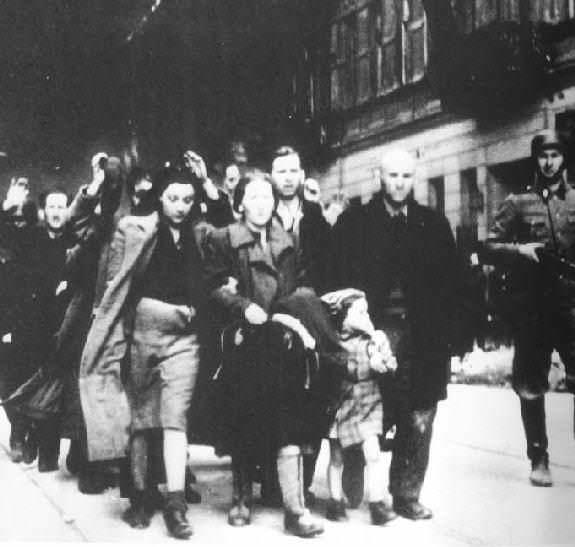
As soon as the death camps were operational in the summer of 1942, the NAZIs began orgainizing transports from the ghettos. About 0.3 million Jews from the Warsaw ghetto were transported to the camps, primarily Treblinka.
Polish readers have written to HBC maintaining that it is incorrect to refer to "Polish death camps" rather references should say NAZI or German death camps in Poland. The difference being that the NAZIs built the camps in occupied Poland and they were not camps that any Polish government was in any way responsible. We are inclined to agree here and will make this change if we find any such reference. Unlike many other areas of occupied Europe, the NAZIs could not find Polish Quizlings to form a puppet regime. In addition, the NAZI goal was to destroy the Polish nation and Polish nationalism. Thus the comments from our readers are well founded. This issue, however, is somewhat more complicated then symantics. While no Polish governmental agency had any connection with the death camps, individual Poles did work in the camps and did assist the Germans in rouding up and killing Jews. There were also documented pograms in Poland. Polish villigers at Jedwabne massacred hundreds of Jews (1941). [Gross, Neighbors.] The action had earlier been attributed to the NAZIs, but Gross' account was conformed by an official governmrnt historical commission. Polish scholars tend to down play the number and importance of such incidents. At this time, however, we do not yet have a definitive assessment of the involvement of Polish civilians in the operation of the NAZI death camps or actions against Jew in Poland. And the issue is very sensitive in Poland.
German authorities even before the death camps becam operational issued redicts forbidding Poles to aid Jews, especially Jewish fugitives. Edicts were issued forbidding Jews to leave their designated areas which increasingly meant ghettoes. The penalty was death. This was not unusual. Essentially any German could kill any Jew without any legal consequences whatso ever. And the same was true of Poles. Here there were no actual regulations. SS-men were arrested by the Wehrmacht for attrocuities during the Polish campaign. They were subsequently pardoined by Hitler. The legal precedent was thus estyablished from the top down, but not actual lw was passed. And Germans did not need to find a legal violation to justify killing a Jew. Even assisting a Jew became a crime. Governor General, Hans Frank, in the Government General issued a decree that anyone found deliberately or indirectly assisting Jewish fugitives would also receive the the death penalty (date unknown). The decrees also specified that the meer attempt to help would be 'punished in the same way as an accomplished deed'. District chiefs and lower level officials published a series of warnings and prohibitions in various newspapers and magazines warning of the repercussions for aiding Jews. These warnings suggest that Poles were helping Jews, but this is difficult to estimate. We also do not know how many Poles were arrested and executed for aising Jews. Dr. Ludwig Fischer, was the Govenor of the Warsaw District undern Frank. The Warsaw Ghetto was thus in his administrative district issued a proclamation repeatong that the death penalty would be administered to anyone who would 'provide refuge or any other kind of help' to Jews in hiding (November 10, 1941). By this time the ghttoes had been established and Jews were trying to escape the deteriorating conditions. Fischer also specified in the proclamation
that anyone who informed on Jews or Poles aiding Jews to the police would be rewarded. These warning were repeated in publications, suggesting that Poles continued to aid Jews. An example is this warning,"Unfortunately the fact remains that the inhabitants of the rural areas secretly persist in helping Jews, this disloyal attitude harms the community as a whole and thus people involved in such action. Through various illegal routes, the rural community by using all the cunning at its disposal, evades express orders, delivering foodstuffs to the local Jewish population. .... Country people must, once and for all, sever all contacts with and disassociate themselves from all Jewry, they must break the seriously anti-social habit of aiding the Jews." [Lmoro Journal]
Jews had few opportunities to resist in NAZI-occupied POland, but small groups began to form soon after the German invasion.Issac Zuckerman a charismatic 24-year old founded the Jewish Fighting Organization. Simha Ratheiser served s his 15-yearold bodyguard. Ziva Lubetkin was aeading fenale figure. They smuggled arms, operated covert printing presses, organized underground schools, robbed banks, executed collaborators, and fought in the two major uprisings, both in Warsaw(1943 and 1944). They would go on to found Israel afyer the War. [Brzezinski]
One reason that the question of Polish complicity in the Hololcaust is especially sensitive in Poland is that the NAZIs engaged in wide-scale killing in Poland beyond only killing Jews. And Poles tend to believe that the non-Jewish victims are largely forgotten. This is a difficult qiestion. To some extent it reflects Polish anti-Semitism. Some Poles have never regarded Jews as real Poles and less interested in their fate, or even glad to be rid of them. On the other hand, Poles are correct, that the number of non-Jewish Poles who were killed by the NAZIS are not fully understood. The NAZIs killed about 3 million Polish Jews, 90 percent of the Jewish population. Although the percentage of non-Jewish Poles is much lower, the total was another 3 million Poles. Far to many people associate the Holocaust only when Jews. It is true that Jews were the highest priority target. But the campaign against the Jews was just the beginning of the eugenics and ethnic cleasing program the NAZIs planned. Also high on the NAZI target list were the Slavs. And the NAZIs as they occupied Poland at the beginning of the War had ample time to carry out actions in Pooland aimed at: 1) destroying Polish nationhood by destoying the Polish inteligensia and 2) deporting Poles in western Poland so as to make room for German colonists.
|
After most of the Warsaw Ghetto Jews had been transported to their grisly deaths at Treblinka, the remaining Jews began organizing an uprising. Few doubted the outcome, but they were determined to fight. The ressistance was rganized by Zydowska
Organizacja Bojowa (Jewish Fighting Organization--ZOB). The Jews in in the Warsaw Ghetto rose up on April 19, 1943 when the SS began a final round up of the remaining Jews in the Ghetto. They only had a few light weapons that they had managed to smuggle into the Ghetto. The poorly armed Jews incredibly held out for almost a month against heavily equipped German troops, until May 16. The ZOB and the Jewish Military Union battled trained and heavily armed formations of the Nazi police, SS and Wehrmacht. The Jews launching the uprising fully understood, there was no possibility of success. The forces the Germans had at their dispossible were still awesome and still capable of mounting a massive offensive against the Red Army. A few lightly arm Jews posed no danger to the Germans. The rising was a cry of outrage, protesting the barbarous murder of an entire people. The remaining Jews in Warsaw had decided to die a dignified death. It was heroic and tragic end to Polish Jewry.
The horrors of NAZI rule left millions displaced throughout Europe. Many were left displaced within the Reich because of the huge number of foreigners brought into the Reich, many by force, to work in the war industries. Thus displaced persons (DP) camps were opened to assist these people. In some cases, the camps were open at te former NAZI concentration or labor camps. Special facilities were opened for the most tragic of all the displaced persons--the children. We know less about what occurred in Poland. (A substantial part of what is now Poland was German territory before the War or annexed by Germany during the War.) Few Polish Jews survived the Holocaust and in particular few children survived. We note an unidentified center for diplaced Jewish children, but have no details at this time.
Liberation did not end the problems Jews faced in Poland. Jews that attempted to return to their homes experienced attacks abnd other abuse at the hands of their Polish neigbors. There are differences of opinion as to the extent of these attacks. It is a subject that was generally covered up by Poland's post-War Communist givernment and a general public desire to paint the nation as victims and heros in the struggle against the NAZIs. We certainly do not want to suggest that Poland did not bravely stand up to Hitler and play an important role in the struggle. And there was relatively little colaboration in Poland with the NAZIs, with the exception of the Holocaust. And there does seem to be some truth to the claims that many Jewish survivors were attacked or otherwise abused by Poles after the War. [Gross, Fear.] The publication of Dr. Gross' book descriving the abuse of Holocaust survivors has resulted in great controversy in Poland. Polish historians refute few of the facts in the book. Tghey do tend to accuse Gross of inscholarly, intemperate language. It is probably fair to say that Gross does not fully sketch out the very complicated and divisise situation in Poland after the War. Pre-War Poland was a diverse country with substantial minorities of Jews, Germans, Ukranians and others. Jews were not the only targets of Polish nationalists and the whole situation was further complicated by the fact that Stalin moved the entire country west. He annexed eastern Poland to the Soviet Union and eastern Germany to Poland. There were large-scale forced population transfers. Stalin ordered the removal of Poles from the area he annexed and Germans, Ukranians, and others were expelled from the areas that became Polsnd. Of course this does not justify attacks on Holocaust survivors, but the post-War sitution should be discussed in assessing what occurred.
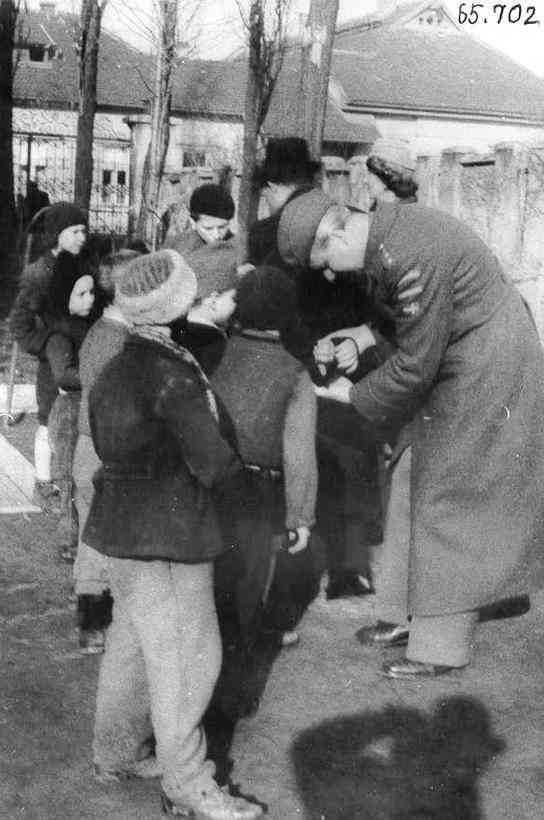
Almost all Jewish in Poland perished in the Holocaust. It was difficult for adults, virtually impossible for children unless someone hid them. Children are more subject to illness and more easily affected by stesses like malnutrition. Some adults in rural areas managed to escape and hide in wildreness arwas. Children unavle to fend for themselves or hike long dustances were unable to do this. But even beyond their biological vulnerability, children were especially targeted by the NAZIs who saw them as non-producers. Healthy adult Jews or youths were sometimes spared for a time for labor. Children on the otherhand were not useful for work. This is why children and mothers with children were selected for immediate murder when they arrived at camps like Auschwitz-Birkenau. A children few did and have left of moving accounts as to their childhood experiences. We also know about Poles who protected Jews. But the vast majority of Polish Jewish children were murdered. In many cases we know where they were murdered and when. Often they just disappeared, leaving no trace except a few haunting photographic images.
The Jewish community in Poland before the German invasion totalled about 3.5 million people. Almost all of this vibrant community disappeared without trace in the Holocaust. Fewer thn 0.3 million POlish Jews survived. Almost no Jews remain in modern Poland. Most of the Jews tht survived emigrated from Poland after the War. Most emmigrated to Israel and America. Perhaps 10,000 Jes remin in Poland tday. There are about 16 Jewish congregations.
Brzezinski, Matthew. Isaac's Army: A Story of Courage and Survival in Nazi-Occupied Poland (2012), 496p.
Gilbert, Martin. A History of the Twentieth Century Vol. 2 1933-54 (William Morrow and Company, Inc.: New York, 1998), 1050p.
Gross, Jan T. Fear (2006). Gross is a Princeton University scholar. He is a Polish Jew who emigrated from Poland during the Cold War. The Communist Government facilitated the emigration of the country's Jews.
Gross, Jan T. Neighbors (2001).
Ligocka, Roma with Iris von Finckenstein. Translated from German by Margot Bettauer Dembo. The Girl in the Red Coat: A Memoir (St. Martin's, 2002), 292p.
Opdyke, Irene. In My Hands.
Padfield, Peter. Himmler: Reichsf�hrer-SS (Henry Holt: New York, 1991), 656p.
Lmoro Journal. This was a NAZI publication printed in the Polish language in Galicia.

Navigate the CIH Holocaust Pages
[Return to Holocaust country page]
[Return to Main Holocaust page]
[Return to Main NAZI occupation of Poland page]
[Main Holocaust page]
[Allies]
[Biographies]
[Children]
[Concentration camps]
[Decision]
[Denyers/Apologists]
[Displaced persons]
[Economics]
[Eisatzgruppen]
{German Jews]
[Ghettoes]
[Impact]
[Justice]
[Literature]
[Movies]
[NAZIs]
[Occupied Poland]
[Process]
[Propagada]
[Resistance]
[Restitution]
[Questions]
[SS]
[Special situations]
[Targets]
[Wansee Conference]
[World War II]
[Main mass killing pagel