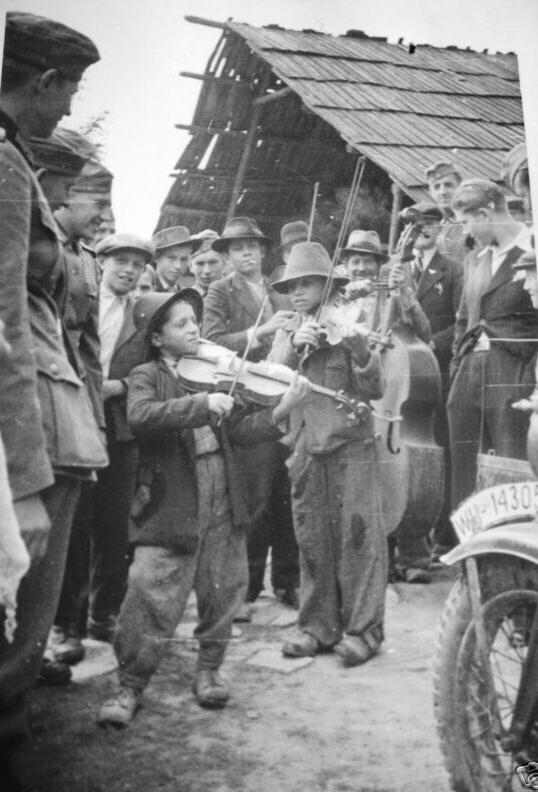
|
The Germans more than any other military, correctly assessed the lessons of World War II. The War in Europe began in 1939 when the German blitzkrieg smashed Poland in only a few weeks. The invasion was made possible the preceeding week when Stalin signed a non-aggression pact with Hitler. The Panzers crossed the Polish frontier on September 1 along with a devestating strike by the Luftwaffe. The Polish Army and Air Force was shattered. About 1.8 million German soldiers surged into Poland. Hitler emerged from the Reich Chancellery in a new grey uniform with his World War I Iron Cross. In a speech at the Reichstag before cheering NAZIs he declared, "I myself am today, and will be from now on, nothing but the soldier of the German Reich." Whithin 6 days Cracow, the center of Polish nationhood, fell. Pincer movements began on September 9 to encirle the major remaining Polish forces. Once certain of Polish defeat, Stalin ordered the Red Army to attack from the East. German and Russian forces met at Brest-Litovsk on September 18. Warsaw fell a few days later after a ruthless bombing assault. The Blitzkrieg tactics that were to prove so devestaing in the West during 1940 were all on display in 1939. Neither the British or French showed much attention, abscribing Polish defeat to military incompetance. The French had promissed the Poles an offensive in the West. It never came.
Hitler had promissed Chamberlin "Peace in our times" if he was given the Sudetenland. The Allies (Britain and France) acquiesed and Czecheslovakia which was prepared to fight was dismembered. Churchill was apauled. Only a few months later in total violation of the Munich Agreement, Hitler seized the rest of Czecheslvakia (March 1938). It was clear to the Allies that Hitler was prepared to make one demand after another. Although facing a rearmed Germany with an unrivaled air force, British and French leaders and increasingly the public in those countries realized that there was no choice, but to confront the NAZIs.
The Germans more than any other military, correctly assessed the lessons of World War II. Tacticians like Erwin Rommel and Hans Guderian conceived the use of mobile formatuions, motorized infantry supported by tanks and close air support to drive gaps into enemy lines and avoid the debilitating trench warfare of World War I. The principles the Germans adopted would not begin to be fully adopted by the British until El Alemain (July/October) and the Americans after the disaster at Kaserine (February 1943).
Hitler in total violation of the Munich Agreement, ordered the Wehrmacht to seize the rest of Czechoslovakia. German troops cross the border without resistance and enter Prague (March 16, 1939). This was aotal violation of the Munich Accords. Britain and France only complained diplomatically. One result, however, that arch appeaser Prime Minister Chamberlain now understood that Hitler was intent on making war and could not be appeased. With all of Czechoslovakia under his control, Hitler began to plan his subgegation of Poland. Hitler met with Colonel General Keitel, chief of the High Command of the Armed Forces (OKW) and Colonel General von Brauchitsch, commander in chief of the Whermacht, and informed them that the time had come to settle the Polish problem by military means. The following week he presented a strategic outline for an attack on Poland with a deadline no later than September 1, 1939. Within days Hitler issues demands for the surrender of Danzig and the "Polish Corridor". The Poles reject the German demands (March 22). The German press began to intensify attention to the German minority in Poland as they had done with the Germans in Czechoslovakia.
The Germans during the inter-War period took an encoding machine used by the Railway System to create an effective secure military communications system--Enigma. The British and French decided that it was unbreakable and made no real effort go crack it. Although unknown at the time, the Poles had cracked the German Enigma machine. They thus had access to the German military communications fir several years. Upgrades to Enigma froze the Poles out in the months leading up to the German invasion. The Poles gave the astonished British and French Enigma machines (July 25). These machines were the beginning of a massive Allied Ultra code breaking operation which would come play a critical role in Allied operations.
The NAZIs aware that a large part of the German people did not want another world war, decided to mount a propaganda campaign to put he onus of the war on Poland. The tone of the German media and the number of anti-Polish articles suddenly changed. The same had occurred concerning Czechoslovakia before the Munich Crisis. We are not sure precisely when this change occurred, but it was in full sing by August. Propaganda Minister Goebbels began promiently featuring articles reporting Polish mistreatment of ethnic Germans. Poland had a German minority, especially in western areas of the country, including areas of the Polish Corridor and other areas that had been part of Germany before World War I. The NAZIs formed Selbstschutz units to create incidents. There were some attacks on Germans, but mostly AFTER the Germans invaded Poland (September 1). Finally the SS staged a Polish attack that could be used to justify the invasion (August 31). SS men dresssed concentration camp inmates in Polish uniforms to 'attack. the German radio station at Gliewitz along the Polishh border. The SS selected concentration camp prisioners and outfited them in Polish uniforms before shooting them. The bodies were used as evidence of the Polish attack in German newsreels. Goebbels prominenbtly featured the incident and claimed that Germany had been attacked. We are unsure just how many Germans actually believed the German press accounts, but manybapparently did.
The War in Europe began in 1939 when the German blitzkrieg smashed Poland in only a few weeks. The invasion was made possible the preceeding week when Stalin signed a non-aggression pact with Hitler. NAZI Foreign Minister Ribbentrop and newly appointed Soviet Commissar for Foreign Affairs Molotov on August 23, 1939, signed the Nazi-Soviet Non-Aggression Pact. At the time of the signing, British and French delegations were in Moscow trying to reach an understanding with Stalin. He was convinced, however, that they were tring to draw him into a war with Hitler. The two countries which until that time had been bitter foes, pledged not attack each other. Any problems developing between the two countries were to be delt with amicably. It was last for 10 years. The Pact shocked the world and the purpose was immedietly apparent. It meant that Germany could attack Poland without fear of Soviet intervention. Thus after defeating Poland, Germany did not have to fear a full-scale European war on two fronts. What was not known at the time was that there was a secret protocol to the pact which in effect divided Eastern Europe betwen the two countries. This protocol was discovered after the end of the World War II in 1945. The Soviets continued to deny this protocol until 1989. The
NAZIs 8 days after signing the Pact invade Poland on September 1, 1939, launching World War II. Although the Soviet's did not enter the War against Britain and France, the Soviets were virtual NAZI allies as they provided large quantaies of strategic materials, especially oil. Communist parties in Britain and France opposed the war effort. The Communist Party in America opposed President Roosevelt's efforts to expand defense spending and assist Britain and France.
American journalist, William Shirer, just before the German invasion, went to Danzig from Berlin. He found the Poles prepared to fight regardless of tge cost. There was no thought of giving in to the Germans. [Shirer] There would not be a second Czechoslovakia. Poland and Britain signed a common defense pact against Germany (August 25). Polish commanders disperse their small, largely obsolete air force to small camouflaged airfields mostly around Warsaw (August 27).
The Germans more than any other military, correctly assessed the lessons of World War II. The German invasion of Poland was Operation Weiss. The World War I German battleship Schleswig Holstein beiung used as a naval training ship fired the first salvo of World War II when on the morning of September 1 they began shelling s the Polish naval base at Westerplatte. The Schleswig-Holstein was on a "good will visit to Danzig. The German invasion began 1 hour later at 4:45 am. NAZI Panzers poured accross the 1,500 mile Polish frontier with Germany. The Wehrmacht invasion was accompanied with a devestating strike by the Luftwaffe. The German Panzers were closely supported by Junkers Ju87 ("Stuka" -- Sturzkampfflugzeug) dive-bombers. The German tactical operations were after Poland styled Blitzkrieg or Lighting War by Goebels. The small, largely obsolete Polish Air Force was shattered on the first day and the Army stunned. There was no way the Poles could resist such overwealming force, especially as the Allies (Britain and France)m took no real action in the West. The Polish defensive strategy in addition was deeply flawed. The Poles attempted to defend their borders everywhere. And by defending everywhere they were in effect defending effectively nowhere. And mobilization orders went out to slow. Some units arrived at the front only to surrender as they got off the train tarnsports. About 1.8 million German troops surged into Poland from the north, west, and south. The Polish Army and Air Force was shattered.
Primeminister Chamberlain before the German invasion of Czechoslovakia (March 1939) may have cooperated in German diplomatic efforts to reclaim territort lost in the World War I peace settlement. Further territorial adjustments were mentioned, but not specified in the Munich Agreements. After the German invasion invasion of Czechoslovaklia, even Chamberlain had to admit that Hitler could not be trusted and that war was inevitable. And this time with the Poles, Hitler did not even make an effort at diplomacy. He was determined that he would not be denined the war he had wanted over Czechoslovakia a year earlier. Hitler emerged from the Reich Chancellery in a new grey uniform with his World War I Iron Cross. In a speech at the Reichstag before cheering NAZIs he declared, "I myself am today, and will be from now on, nothing but the soldier of the German Reich." Hitler was setting out to make himself the greatest war leader in German history. He finally had the war he had always wanted, but never admitted to the German people. And he was determined to persue his war with a severity that he thought was lacking during World War I. He was, however, surprized when the British and French declared war. He did not think tjhat they would.
England and France at 9:00 am with the Panzers drivingb into Poland issued an ultimatum to Germany to witdraw from Poland or face war (September 1). The two Allies when the Germans ignored their ultimatum and continued their invasion of Poland, reluctantly declared war on Germany (September 3). Often lost in World War II histories is that vit wac Britain and France that declared war in Germany, not the reverse. [Taylor] A sober Prime Minister Chamberlain, the champion of appeasement, told the British people on the radio, "This morning the British Ambassador in Berlin handed the German Government a final Note stating that unless we heard from them by
11 0'clock that they were prepared at once to withdraw their troops from Poland a state of war would exist between us. I have to tell you now that no such undertaking has been received, and that consequently this country is at war with Germany." Earlier he had told Parliament, "This is a sad day for all of us, and to none is it sadder than to me. Everything that I have worked for, everything that I have hoped for, everything that I believed in during my public life, has crashed into ruins. There is only one thing left for me to do; that is, to devote what strength and powers I have to forwarding the victory of the cause for which we have to sacrifice so much. I cannot tell what part I may be allowed to play myself; I trust I may live to see the day when Hitlerism has been destroyed and a liberated Europe has been reestablished." Hitler who felt cheated after Munich now had his war. After speaking to the nation on the radio, Chamberlain offered Winston Churchill a post in government--First Lord of the Admiralty. Within hours, Churchill was at the Admiralty. He later wrote, "Once again defense of the rights of a weak state, outraged and invaded by unprovoked agression, forced us to draw the sword. One again we must fight for life, and honour against all the might and fury of the valiant, disciplined, and ruthless German race. Once again! So be it." Churchill's brave words were not matched by action on behalf of the British or French Government. Hitler was surprised by the British and French action. He had expectd another Munich. But even if it had expected a declaration of war, it would not have disuaded him. He wanted a war. Some historians believe the Allies were foolish to declare war. One historian argues that declaring war was an irrational step, driven by outrage and fear. [Stone] We disagree. The Allies had no choice but to go to war, even though they were unprepared, they had adequate forces if properly led to stop the Germans. And with the Luftwaffe deployed in Poland, they could have blasted the Ruhr where Germany's war industries were concentrated. But while they declared war, Chamberlain and Reynaud had no desire to actually fight a war. They had no reralm choice. France was clearly next on Hitler's targets.
The Wehrmacht invaded Poland on three fronts: from East Prussia in the North, Germany in the West, and Slovakia (seized from Czecheslovakia) in the South. Hitler accurately assessed Allied intentions. He was able to focus the full weight of the Whermacht on Poland without fear of an Allied offensive in the West. The French had promissed the Poles an offensive in the West. As Hitler had forseen, it never came in force. [Fest, pp. 602-03.] The Wehrmacht deployed 2,600 tanks against Poland's 180. The Poles had few anti-tank guns and anti-tank infantry weapons had not yet been developed. Poland was alsocompletely outmached in the air. The Luftwaffe deployed over 2,000 modern aircraft against Poland's 420 planes, many of which were obsolesent. The stunded Polish Army unwisely deployed to defend the whole country was unable to stop the Germans anywhere. The Panzers slized through the Polish front lines. Whithin 6 days Kracow, the center of Polish nationhood, fell (September 6). The Polish General Staff abandoned Warsaw (September 6). The Polish Army launched a counterattack between Lodz and Warsaw surprising the Germans and achieving some local success (September 9). The battle continues for 3 days, but overwealming German superiority in men and material prevails (September 12). Wehrmacht pincer movements began to encirle the major remaining Polish forces (September 9). The German 4th Panzer Division reaches the suburbs of Warsaw, but is stopped (September 9). Hans Guderian, the mastermind of Blitzkrieg tactics commanded the German XIX Panzer Corps. The Wehrmach armored thrusts surrounded Warsaw (September 14). Polish resistance stiffened. Warsaw prepared to resist the Wehrmacht. Panzer units were stopped at Kutno. Remnants of the shattered Polish Army attempted to regroup behind the Vistula and Bzura rivers. Poland's fate was sealed on September 17, when the Soviets invaded Poland from the east (September 17).
The NAZIs demonstrated from the onset that they were going to conduct a new kind of war, unseen in Europe since the religious wars of the 17th century. Each day terrible attrocities were conducted in the wake of the German advance. The German attrocities in Poland that came to be called 'crimes against humanity', began at the very onset, and regular Whermacht units were involved from the onset. This showed at the very beginning of World War II how Hitler's war was to be very differentv than traditional European wars. It was all there, the slaughter of the Polish intelectuals and elite and savage treatment of the Jews more tjham a year before the death camps were built. [Rossino] As soon as the Germans entered Poland they began to build concentration camps to enforce their new order and pursue their racial and ethnic cleansing campaign. The Germans began constructing the Stutthof concentration camp (September 2). Stutthof would eventually be equipped with gas chambers in which thousands of Poles would be murdered. German troops at Truskolasy rounded up and shot 55 Polish peasants (September 4) German troops at Bydgoszcz murdered a thousand Poles, including several dozen Boy Scouts. The Germans lined the Polish civilians up against a wall and shot them. The German shot 19 Polish officers who surrendered after resisting a tank attack near Mrocza (September 6). The Germans at Bedzin burn 200 Jews alive in a synagogue. They then blameed Poles with the crime and executed 30 in a public sqaure (September 8). The Germans at Piotrkow forced several thousand Polish POWs, including Jews, to relieve themselves in the synagogue and to clean the mess up with Jewish sacred objects (September 23). Many of these attrocities were conducted by regular Wehrmacht troops and not SS units or Einsatzgruppen. SS units were given the task of finding and arresting Polish officials and intelectuals as part of a campaign to destroy Polish national identiity. Some were executed almost immediately others were interned in concentration camps. Einsatzgruppen executed 800 Polish intellectuals and leaders at Bydgoszcz. (September 24)
Aircraft played only a minor role in World War I. It was mostly dashing yoing men fighting it out in dog fights over the trenches of the Western Frnt. Air warfare would play auch darket role in world War II with massive strategic bombing. And it all began in Poland. The Luftwaffe launched World War II with an attack on the town of Wieluń, near Łódź--at the time in southeastern Poland. The town was virtually obliterated and more thn a thousand civilins klled. The Luftwaffe was in 1939 the most powerful air force in the world and struck from the North, East, and South making any Polish air defense impossible. The Luftwaffe was an important component of the Blitzkrieg tactics that the Germans unleased on Europe. The Me-109 fighter and the Ju-87 Stuka dive bomber would dominate the air campaign. And combined with fast-moving Panzer forces, the Polish Army was quickly defeatted in sweeping pinzer movements. The small Polish Ait Force put up a valiant defense, but did not have the planes to resist the Luftwaffe or support the beligered Polish Army. They did manage to bloody the Luftwaffe, shooting down nearly 300 planes. A year later in the skies over Britain, Polish pilots would show what they were capable of when flying modern fighters. The Poles put up a stiff resisance for a few days, but after the first week, the Polish Air Force was destroyed and no longer a factor in the campaign. the Luftwaffe could then focus entirely on the battered Polish Army. There were ground support actions as well as terror attacks. The Lufwaffe would end the Polish campaign wth the nassive terror bombing of Warsaw, confirming the worse fears of the European public as aesult of the bombing of Spanish cities. The Germans later in the War would complain bitterly about Allied bombing of their beautiful meieval cities, but beginning with the Polish campaign the Germans wer convinced that the mighty Luftwaffe could bomb cities throught Europe at will and no bombs would fall on their own cities. Only when the bombs began falling on German cities did their attitude toward bombing civilians began to change.
The SD before the War organized Selbstschutz (Self Defence) Units in Poland among the ethnic Germans. Members were trained at secret sites in the Reich. When the Germans invaded Poland, the Selbstschutz units coducted aange of activities to disrupt the Polish defense. This included sabatoge and attacks on Polish positions and rail lines as well as attacks on Polish civilians. SS officers oversaw the operations. Gustav Berger was the overall commander. As the Wehrmacht advanced district commanders appointed in West Prussia, Upper Silesia and Warthegau--all areas to be annexed. Individual Selbstschutz Units remained under the control of local ethnic Germans who both obeyed orders from head quarters as well as conducted actions on their own initiative.
The Selbstschutz set up concentration camps for Poles. Some of their camps were set up independently. Others were set up where the Wehrmacht or German police commands were setting up camps. The Selbstschutz camps included: Bydgoszcz (Bromberg), Brodnica (Strasburg), Chełmno (Kulm), Dorposz Szlachecki, Kamień Krajeński, Karolewo, Lipno (Lippe), Łobżenica, Nakło (Nakel), Nowy Wiec (near Skarszew), Nowe (over Vistula), Piastoszyn, Płutowo, Sępolno, Krajeńskie, Solec Kujawski (Schulitz), Tuchola (Tuchel), Wąbrzeźno (Briesen), Wolental (near Skórcza), Wyrzysk (Wirsitz). The great majority of the Poles arrested and detained in these camps were murdered within weeks. But few survived the War. The Poles targeted by the Selbstschutz were Polish intellectuals (writers, journalists, artists, composers, university professors, teachers, etc.), nationalists, priests, Jews, Roma, and even Catholic Germans, ethnic Germans married to Poles, and Poles denounced for personal reasons). In addition to theor on actions, the Selbstschutz worked closely with the newly formed SS Einsatzgruppen--mobile killing units.
Reinhard Heydrich, SD Chief, formed six Einsatzgruppen for the Polish campaign. Five were theoretically attached to the invading Wehrmacht forces. In fact they operated largely independently. The sixth was assigned to work specifically in the Posen (Poznan) district. About 2,700 men were involved. These were the first para military Einsatzgruppen were deployed for the first time for the invasion of Poland (September 1939). The orders in Poland were not as focused on Jews as they woukd be in the Soviet Union. Here they were ordered to arrest the elite of Polish society, including both political and cultural figures, the politically unreliable. This included authors, priests, composers, and other groups. The Einsazgruppen were the instrumnets of Opperation Tannenberg. This was Heydrich's plan to render the 'upper levels of society' harmless by killing 61,000 Polish civiklians. [Rossino, pp. 15 and 30.] Here he was carrying out Hitler's orders who phrased it succintly, '... only a nation whose upper level are destroyed can be pushed into the ranks of slavery." Mallman, Böhler, and Matthãus, p. 57.] The Einsatzgruppen also confiscated of weapons, conducted police intelligence, and oversaw various actions against Jews. Lists had been were prepared for arrest, but various ruses were used to arrest groups like university professors. Some of those arrested were shot. Others transported to concentration camps were few survived the War. Some Jews were arrested and killed, but the numbers were relatively small. The killing of Jews at this time seems to have been conducted on the iniative of Einsatzgruppen and junior Wehrmact commanders rather than on specific orders by Heydrich, although he seems to have given general instructions. One Eisatzgruppe was ordered to terrorize, generating such fear that as many Jews as pssible would flee to the east and the the Soviet sector. [Snyder, p. 127/] One estimate suggests 500 towns and villages were burned and over 16,000 people were executed by the Einsatzgruppen in Poland (September 1-October 5). The Wehrmacht actually arrested and was prepared to court martial both Wehrmacht and SS members who committed attrocities in Poland. Hitler pardoned each man arrested. No one was ever punished for exceeding orders. (And there would be no further Wehrmacht actions against its members for killing Jews and civilians.) The numbers killed were still in the thousands, not the hundreds of thousands. Rather than immediate killing operations, Polish Jews were confined in Ghettos, although this took longer than the Germans anticipated.
Large numbers pf Polish children were displaced as a result of those invasions and the wide spread distruction. Substantial numbers of Polish children were displaced by the initial NAZI and Soviet occupations. Not only were children dispossed, but several million Polish families were left with out the means of basica survival. Father were lost as the Polish soldiers not killed and badly wounded were interned as POWs. And fatherswere the principal breadwinners. Some children lost mothers as well. The destruction and abolition of the Polish state meant that efforts to care for these children were limited. Tragically this was only the beginning of the Polish tragedy and the plight of an increasing number of displaced children. And all of this began even before the organized actions against the Jews began. Less widely known is the degree to which the Germans targeted the other Polish people as well.
The shattered Polish forces fall back east and attempt to organize a new defensive line. Once certain of Polish defeat, Stalin seeing that the Polish Army was unable to resist the Germans and that the British and French were not intervening, ordered the Red Army to attack from the East (September 17). A Red Army force of 1 million men entered Poland, Soviet propaganda claims it was necessary to "protect it's Byelorussian and Ukrainian population." This was an attempt to follow the NAZI success at claiming to protect the German minority in Czexhoslovakia and Poland. The demoralized Polish Army which valiantly fought the Germans, offers little resistance to the Soviets. The Soviets take 240,000 Polish soldiers and 15,400 officers prisioner German and Russian forces met at Brest-Litovsk (September 18). World War II accounts usually focus on the NAZI invasion and occupation of Poland. In fact the Soviet occupation was also horific, although it did not include the biological genocide of the NAZI occupation. Stalin like Hitler, however, was at this stage of the War intent on destroying the Polish nation. The Soviets set about moving large numbers of Poles in an effort to Russify areas of eastern Poland. (This area had been a matter of a territorial dispute and war between Russia and Poland following World War I.) Some estimates suggest that 2.0 million Poles were deported to Siberia and other areas in the Soviet Union. Many children were caught up into the mass relocations as Poles were moved into Central Asia and Siberia. There are many tragic accounts. One Polish boy, Stefan Wassilewski, remembers being dragged from his bed in the middle of the night by a Russian soldier, herded onto a crowded refugee train along with his mother and younger brother, and transported thousands of miles across Europe to Kazakhstan. He was separated from him family and never saw threm again. [Hicyilmaz]
Once certain that the Poles had been defeated, Stalin ordered the Red Army to attack Poland from the East. This had an unexpected advantage. World bnewspapers focvuded on the German invasion and gave little attention to the Soviet invasion. Thus the great weight of western oproprium was dircted at Hitler and the NAZIs rather than his ally, Stalin and the Soviets. Realizing that resistance was futile, ,Polisdh Armyn units were ordered not to resist the Soviets. German and Russian forces met at Brest-Litovsk (September 18). Ironically thi wsas where the Bolshcicks in World War I had been forced to sign a humiliating peace. Warsaw fell a few days later after a ruthless bombing assault. The Whermacht Blitzkrieg tactics that were to prove so devestaing in the West during 1940 were all on display in Poland during 1939. Brutish and French military staffs chose to largely ignopre them, thinking that the defeat was the result of Polish ineptitude rather than the German tactics.
the Polish Home Army or Armia Krajowa (AK) was formed in Warsaw during the Luftwaffe terror bombing (September 26).
Esespecially constituted SD Einsatzkommandos from the very beginning undertook a calculated campaign of repression. These units were created and trained under Heydrich's command. Regular units of the Wehrmacht were also involved in this campaign, but their activities were not as carefully calculated as the actions of the Einsatzkommandos. SD Einsatzkommandos carried out standard operations. They were trained in these actions. The normal procedure was that once a town was taken by combat troops, the Einsatzkommandos was entered and arrested a group of Jews or Poles. Normally men were taken for hostages. They were then kept as hostages and usually shot when some excuse was found. The idea was to terrify the town and discourage any thought of resistance. Dending on the proclivities of the individuals involved, the hostages were often tormented. This was especially true of the Jewish hostages. The Einsatzkommandos persued a special campaign against synagogues. Many synagougues were burned as in Kristallnacht. Estimates indicte that that several hundred synagogues were destroyed during September and October 1939. There are many accounts of what happened to the synagogues in different Polish towns. The Germans in many towns and cities conducted mass roundups of Jews. These roundups were sometimes whole families, includuing men, women, and children. Sometimes the round up methods separated children from their families. These people then were interened. Regular Wehrmacht units participsated in these attrocities. It was not just the the Einsatzkommandos and other SS units. At the same time many Wehrmacht officers were appalled at the attrocities they witnessed. In fact the Wehrmacht actually arrested some German soldiers and SS men for excesses in Poland.
The NAZIs and Soviets on September 29 sihn the German-Russia Treaty of Frontier and friendship at Moscow. The treaty provides for the division of Poland and establishes the new boundaries.
The Polish garrison on the Hel peninsula finally surrendered on October 2. The Polesie Defence group, fighting on two fronts against both German and Soviet forces, surrendered October 5. The last remaining Polish ground troops surrender on October 6. About 140,000 Polish soldiers were killed in the fighting. About 25,000 civilians were killed in the fighting--many in bombing raids. The NAZIs rounded up an executed another 10,000 prominent Poles and professionals as well as an unknown (but still relatively limited number) of Jews. About 0.7 million Polish soldiers were taken prisoner by the Germans. Few survived the horendous conditions in the NAZI concentration camps. The Soviets take about 0.2 million prisonors. About 0.1 million Polish soldiers manage to escape. These forces while small in number were to play gallant roles in the Allied campaigns in the West. Other Poles were to fight with the Red Army when Hitler launched Operation Barbarossa (June 1941).
The Blitzkrieg tactics that were to prove so devestaing in the West during 1940 were all on display in 1939. Neither the British or French showed much notice, abscribing Polish defeat to military incompetance. The Poles had in fact reamianed in the field twice as long as the Allied War Plan had anticipated. They were to inflict more casulties on the Germans than the combined British and French forces were able to accomplish in 1940. Polish anti-tank guns in particular proved highly effective and were superior to French and British guns. The Germans lost 50,000 men, 697 planes and 993 tanks and armoured cars.
The French had promissed the Poles an offensive in the West. The Allied War Plan was for the Poles to fight a defensive campaign for 2 weeks during which time the Allies would launch an attack in the West. It never came. [Fest, pp. 602-603.] The 92 French divisions manning the Maginot Line took no serious action against the 35 weak German divisions facing them.The French military was built for a defensive operation around the Maginot Line. They had little offensive military capability. Although the French did have armored forces, their air force in particular was weak as was to be seen when the Germans struck west with their Western Offensive in May 1940.
The occupation of Poland was one of the most brutal in European history. Occupation aithorities, especially the SS, were under no legal or moral constraints as regards their conduct and the execultion of occupation policies. Poles had no recourse. The NAZI set out to eliminate the Polish intelgencia and reduce the rest of
the country to a vast population of slave labor. It is estimated that a quarter of the population of Poland perished during the occupation. Hitler did not view Poland as a legitimate nation. He saw it as a creation of the hated Versailles Treaty ending World War I. Poland had split Germany through the Polish Corridor. He was
determined that Poland would never again threaten Germany or limit Germany's drive for lebensraum. The NAZI plan was simple. First they plan to eliminate the Polish inteligencia. Second they would expel Poles and colonize the former Polish areas with Germans. The was given orders to kill Polish prominent civilians and indiviaduals such as government officials, the nobility, teachers, and priests throughout Poland, any would which could promote Polish nationalism or offer leadership. Today their are countless memorial stones and plaques througout Poland where these executions took place. And it was not just men, women and children were also killed. The invasion of Poland brough a much larger area an numbers of foreigners under German control (September 1939). Himmler had asigned the Main Office
for the Consolidation of German Nationhood (SS-RKF) the task of preparing a plan for Germanizing Poland. The Chief of SS-RKF Department II (Planning) SS-Oberführer Professor Dr. Konrad Meyer was responsible for preparing the plans. An important part of the program for the program was to reclaim as much suitable generic material as possible which meant kidnapping Polish children and raising them as Germans.
The Poles formed a government-in-exile. Wladyslaw Raczkiewicz served as President and General Wladyslaw Sikorski as Prime Minister.
Hitler and the NAZIs perpetrated the lie that it was Poland abnd the Allies that launched World War II. It is difficult to believe how ordinary Germans processed this. There are indications that many Germans believed that the Poles were responsible and only if thy had made a few minor concessiins thare would have been no war. Even the nst basic reading of Mein Kampf shows tha this is absurd. Hitler did not just want a small chunk of Poland or even all of Poland, he wanted all of the East. That becamne obvious even to the arch appeaser, Prime Miniter Neville Chamnberlain, when Hitler invaded Czechoslovakia (March 1939).Even so, after the German invasion of Poland (September 1), it was Britain and France which declared war on Germany (September 3). This has given rise to a range of revisionist views of the War. They are always formed by cherry-picking history. Using this device you can come up with any historical, economic, or scientifc result so desired.
Ciano, Count Galeazzo. Hugh Gibson, ed. The Ciano Diaries, 1939-1943 (Garden City Publishing: Garden City, 1946), 582p.
Fest, Joachim C. Hitler (Vintage Books: New York, 1974), 844p.
Gilbert, Martin. A History of the Twentieth Century Vol. 2 1933-54 (William Morrow and Company, Inc.: New York, 1998), 1050p.
Hicyilmaz, Gaye. And The Stars Were Gold (1997).
Overy, Richard J. The Air War: 1939-1945 (London, Europa Publications, 1980).
Rossino, Alexander. Hitler Strikes Poland (2003)
Rumpf, Hans. The Bombing of Germany (New York: Holt, Rinehart and Winston, 1962), 256p.
Shirer, William. Berlin Diary (1941).
Stone, Norman. World War Two: A Short Hstory (2013).
Taylor, A.J.P. The Origins of the Second World War (1961). Taylor in an other wise flawded book stresses the point that it was the British and French who declared war. Hitler would have been content, at least for a time if his invasion had been a German-Polish war.
Tumińska, Olga. Obrona przeciwlotnicza Warszawy Air-defence of Warsaw (Institute of National Remembrance).
Zalonga, Steven J., Ramiro Bujeiro, and Howard Gerrard. Poland 1939: The Birth of Blitzkrieg (Osprey Publishing, 2002).

CIH World War II Section:
[Return to Main World War II European campaign page]
[Return to Main Polish World War II page]
[Return to Main German World War II page]
[Return to Main Soviet World War II page]
[Biographies]
[Campaigns]
[Children]
[Countries]
[Deciding factors]
[Diplomacy]
[Geo-political crisis]
[Economics]
[Home front]
[Intelligence]
[POWs]
[Resistance]
[Race]
[Refugees]
[Technology]
[Bibliographies]
[Contributions]
[FAQs]
[Images]
[Links]
[Registration]
[Tools]
[Return to Main World War II page]
[Return to Main war essay page]