
World War II: Hitler Decides on War (March-August 1939)
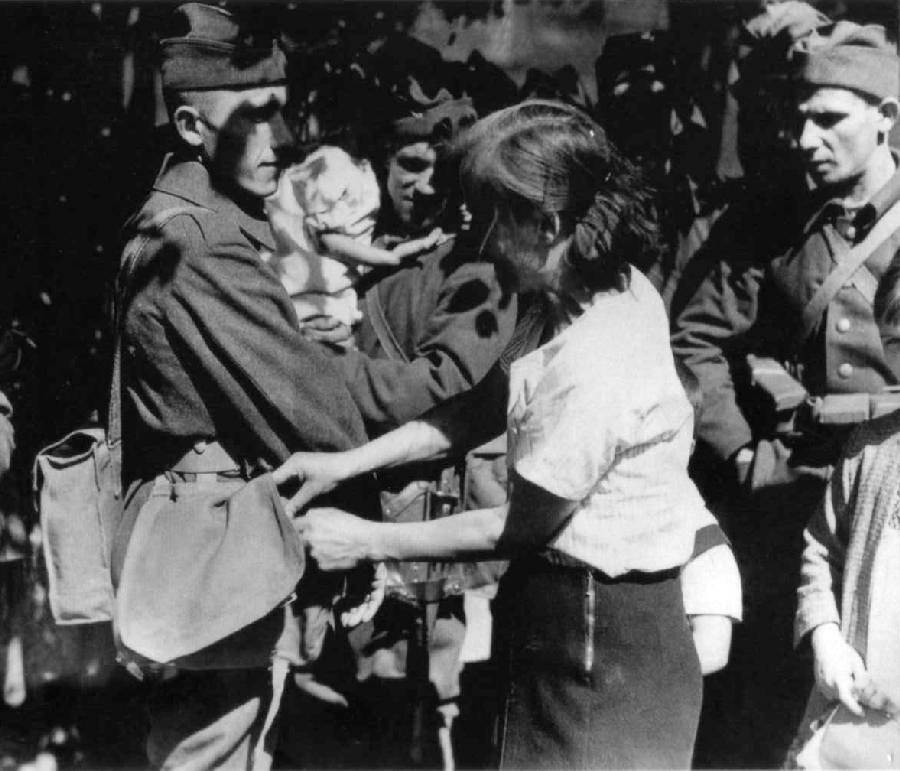
Figure 1.--Poland was the first country to defy Hitler and paid a heavy price for it. Poland mobilized its army to defend the country. Here reservists prepare to report for duty. Notice the wife tenderly slipping something into her husband's knapsack. Few of these men reporting for duty would survive the War. Some died on the battlfield. Some were shot after surrendering. More died in horrendous NAZI and Soviet prison camps. Source: Imperial War Museum. HU5490.
|
|
Hitler in total violation of the Munich Agreement, ordered the Wehrmacht to seize the rest of Czechoslovakia. German troops cross the border without resistance and enter Prague (March 16, 1939). This was aotal violation of the Munich Accords. Britain and France only complained diplomatically. One result, however, that arch appeaser Prime Minister Chamberlain now understood that Hitler was intent on making war and could not be appeased. With all of Czechoslovakia under his control, Hitler began to plan his subgegation of Poland. Hitler met with Colonel General Keitel, chief of the High Command of the Armed Forces (OKW) and Colonel General von Brauchitsch, commander in chief of the Whermacht, and informed them that the time had come to settle the Polish problem by military means. The following week he presented a strategic outline for an attack on Poland with a deadline no later than September 1, 1939. Within days Hitler issues demands for the surrender of Danzig and the "Polish Corridor". The Poles reject the German demands (March 22). The German press began to intensify attention to the German minority in Poland as they had done with the Germans in Czechoslovakia.
Munich (September 1938)
Europe came very close to war over Czechoslovakia. Hitler was determined to obtain the Sudetenland as the first step in destroying independent Czechoslovakia. The Allies had pledged to defend Czechoslovakia. Hitler was sure that the British and French would back down and he was right. He correctly judged Chamberlain's character. Chamberlain flew to Munich, determined to appease Hitler. Hitler promissed Chamberlin 'Peace in our times' if he was given the Sudetenland. The Allies (Britain and France) acquiesed and Czecheslovakia which was prepared to fight was dismembered. Churchill was apauled.
Only a few months after guaranteeing Czechoslovakian independence and in total violation of the Munich Agreement, Hitler seized the rest of Czecheslvakia (March 1939). Here there was no longer the pretext of rescuing Germans. Hitler had assured Chamberlsin that "I want no Czechs". Now it was clear even to arch-appeaser Chamberlain that Hitler was hoing to build a NAZI empire. It was now clear to the Allies that Hitler was prepared to make one demand after another. Although facing a rearmed Germany with an unrivaled air force, British and French leaders and increasingly the public in those countries realized that there was no choice, but to confront the NAZIs.
German Planning
With all of Czechoslovakia under his control, Hitler began to plan his subgegation of Poland. Within days Hitler met with Colonel General Keitel, chief of the High Command of the Armed Forces (OKW) and Colonel General von Brauchitsch, commander in chief of the Whermacht, and informed them that the time had come to settle the Polish problem by military means. The following week he presented a strategic outline for an attack on Poland with a deadline no later than September 1, 1939. Within days Hitler issues demands for the surrender of Danzig and the "Polish Corridor". The Poles reject the German demands (March 22). The German press began to intensify attention to the German minority in Poland as they had done with the Germans in Czechoslovakia.
Escalating German Demands
After seizing the rest of Czecheslovakis in March 1939, the NAZIs began escalating propaganda attacks on Poland. Hitler demanded the Free City of Danzig be returned to Germany. Danzig located between the Polish Corridor and East Prussia was not part of either country. Danzig is now the Polish city of Gdansk. Creating a free city was a compromise developed after Wotld WAr I because Danzig had a mixed Polish-German population. Hitler also demanded a land route through the Polish Corridor (which separated East Prussian from the rest of Germany be established. Both the Free City of Danig and the Polish corridor as well as Poland itself were creations of thge Versailles Peace Treaty.
Allied Reponse
Even Prime Minister Chamberlin could clearly see that the new German demannds were simply apretext for new conquests rather than as he continued to claim an attempt to right greviences. Hitler had pledged to Chamberlin that the Seudetenland was Germany's last teritorial conquest in Europe. The British signed a mutual asisstance treaty with Poland. Ominouly an attempt to involve the Soviets, even to only guasrantee Poland's eastern border failed. [Freidel, p. 314.]
Diplomacy
Britain and France commit to guaranteeing Poland's defense (March 31). Poland and Britian sign a mutal-assistance pact (April 6). Hitler renounced the Non-aggression Pact between Poland and Germany (April 28). Stalin demanded permission to deploy The Red Army in Poland. This would have led to a Soviet take over as it did in the Baltic states (1940). Poland rejected the Soviet demands (August 14). Hitler garanteed the neutrality of Belgium, Netherlands, Luxembourg, Denmark and Switzerland (August 26). Even by this late point, Hitler did not believe that Britain and France would go to war over Poland. The Italian Foreign Minister Count Ciano offers us an insight into Hitler's thinking at the time. He spoke extensively with German Foreign Minister Von Ribbontrop just before the German invasion. "'Well, Ribbontrop,' I asked, as we were walking together in the garden, 'what do you want? The Corridor or Danzig?' 'Not that any more,' he said, gazing at me with his cold metalic eyes. 'We want war!" Ribbontrop also assured himn that the Bruitish and French as with Czechoslovakia would not fight. Ribbentrop was so sure that he insisted on a bet, an Italian painting for a suit of German armor. Ciano related that Ribbontrop never paid off his losing bet. p[Ciano, p. 580.] Ribbontrop was one of the toadies with which Hitler surronded himself. Hitler made him Foreign Minister just for that reason. He did not want a skilled diplomat to advise him, he wanted a loyal subordinate to carry out orders. Once Hitler had expressed himself on a matter, this becane Ribbontrop's fixed opinion. Thus we can be sure that his opinion about the British and French reflected Hitler's thinking. He was prepared to fight the British and French, but was sure they would not fight. His opinion had been irevocably set by Chamberlain's obsequious efforts to avoid war during the Munich crisis. Hitler was oblivious to the impact that violating the Munich Agreements had made on the British.
NAZI Press
The press campaign against Poland reached a feaver pitch in August 1939. German newspaper charged that Germans in Poland were being subjected to "ruthless terror". [Freidel, p. 318.]
NAZI Foreign Minister Ribbentrop and newly appointed Soviet Commissar for Foreign Affairs Molotov on August 23, 1939, signed the Nazi-Soviet Non-Aggression Pact. At the time of thesigning, British and French delegations were in Moscow trying to reach an understanding with Stalin. Hewas convinced, however, that they were tring to draw him into
a war with Hitler. The two countries which until that time had been bitter foes, pledged not attack each other. Any problems developing between the two countries were to be delt with amicably. It was last for 10 years. The Pact shocked the world and the purpose was immedietly apparent. It meant that Germany could attack Poland without fear
of Soviet intervention. Thus after defeating Poland, Germany did not have to fear a full-scale European war on two fronts. What was not known at the time was that
there was a secret protocol to the pact which in effect divided Eastern Europe betwen the two countries. This protocol was discoered after the end of the World War II in 1945. The Soviets continued to deny this protocol until 1989. The NAZIs 8 days after signing the Pact invaded Poland on September 1, 1939, launching World War II. Britain and France declared war September 3. Poland's fate was sealed on September 17, when the Soviets invaded Poland from the east. Although the Soviet's did not enter the War against Britain and France, the Soviets were virtual NAZI allies as they provided large quantaies of strategic materials, especially oil. Communist parties in Britainand France opposedthe war effort. The Communst Party in America opposed President Roosevelt's efforts to expand defense spending and assist Britain and France.
Hitler's Decission
Hitler was not to be denied his war this time. He had concluded that Munich had been a mistake. This time he would not negotiate with the Allies. He was determined to deal with the Poles directly. He informed his aids that Poland woud be invaded by the end of August and a conclusion of the campaign by mid-October. Hitler did not believe the British and French could intervenbe effectively. He dimissed any suggestion that he had to be concerned about the Americans. [Freidel, pp. 318-319.]
Sources
Fest, Joachim C. Hitler (Vintage Books: New York, 1974), 844p.
Freidel, Frank. Franklin D. Roosevelt: Rendezuous with Destiny (Little Brown: Boston, 1990), 710p.
Hicyilmaz, Gaye. And The Stars Were Gold (1997).
CIH -- WW II

Navigate the Boys' Historical Clothing Web Site:
[Return to Main early German aggressions page]
[Return to Main World War II German Invasion of Poland page]
[Return to Main World War II campaign page]
[About Us]
[Aftermath]
[Biographies]
[Campaigns]
[Children]
[Countries]
[Deciding factors]
[Diplomacy]
[Geo-political crisis]
[Economics]
[Home front]
[Intelligence]
[POWs]
[Resistance]
[Race]
[Refugees]
[Technology]
[Totalitarian powers]
[Bibliographies]
[Contributions]
[FAQs]
[Images]
[Links]
[Registration]
[Tools]
[Return to Main World War II page]
[Return to Main war essay page]
[Return to CIH Home page]
Created: May 21, 2003
Last updated: 2:51 PM 12/5/2011