|
"When we think of new territory, we must think of Russia. History itself points the way there. .... This colossal Empire in the East is ripe for dissolution. And the end of the Jewish domination in Russia will also be the end of Russia as a State. We are chosen by Destiny to be the witnesses of a catastrophe which will afford the strongest confirmation of the nationalist theory of race." -- Adolf Hitler, Mein Kampf (1925).
"Increase [of] our peasant population is the only effective defense against the influx of the Slav working-class masses from the East. As six hundred years ago, the German peasant's destiny must be to preserve and increase the German people's patrimony in their holy mother earth battle against the Slav race." -- Heirich Himmler.
The Battle of Britain in many ways changed the course of the War. An invasion of Britain was impossible without air superiority. Hitler, fearing a cross-Channel invasion, decided that the only way to force the British to seek terms was to destroy the Soviet Union. He began shifting the Wehrmacht eastward to face the enemy that he had longed to fight from the onset--Soviet Russia. The nature of the War changed decisevely in the second half of 1941. The Germans invaded Russia in June 1941, launching the most collosal military campaign in all of history. It is estimated that on the eve of battle, 6.25 million men faced each other in the East. The Soviets were surprised and devestated. Stalin ignored warnings from the British who as a result of Ultra had details on the German preparations. Stalin was convinced that they were trying to draw him into the War and until the actual attack could not believe that Hitler would attack him. The German attack was an enormous tactical success. The Soviets were surprised and devestated. The Soviet Air Force was destoyed, largely on the ground in the irst week. The Germans captured 3.8 million Soviet soldiers in the first few months of the campaign. No not knowing the true size of the Red Army, they thought they had essentally won the War. German columns seized the major cities of western Russia and drove toward Leningrad and Moscow. But there the Soviets held. The Japanese decission to strike America, allowed the Sovierts to shift Siberian reserves and in December 1941 launch a winter offensive stopping the Whermacht at the gates of Moscow--inflicting irreplaceable losses. The army that invaded the Soviet Union had by January 1942 lost a quarter of its strength. Hitler on December 11 declared war on America--the only country he ever formally declared war on. In an impassioned speech, he complained of a long list of violations of neutality and actual acts of war. [Domarus, pp. 1804-08.] The list was actually fairly accurate. His conclusion, however, that actual American entry into the War would make little difference proved to a diasterous miscalculation. The Germans who months before had faced only a battered, but unbowed Britain now was locked into mortal combat with the two most powerful nations of the world. The British now had the allies that made a German and Japanese victory virtually impossible. After the Russian offensive of December 1941 and apauling German losses--skeptics began to appear and were give the derisory term " Gröfaz ".
The Battle of Britain in many ways changed the course of the War. An invasion of Britain was impossible without air superiority. Hitler, fearing a cross-Channel invasion, decided that the only way to force the British to seek terms was to destroy the Soviet Union. He began shifting the Wehrmacht eastward to face the enemy that he had longed to fight from the onset--Soviet Russia. Stalin beginning May 1937 began a drastic purge targetting all potential political opponents. The Army because of its potential power was a priority target. Stalin's purge decimated the officer corps and greatly impaired the morale and efficiency of the Red Army. So confident was Hitler of success in the Battle of Britain that on July 21, 1940 he told his top military commanders in great secrecy that he planned to invade the Soviet Union, perhaps motivated by Stalin's annexation of the three Baltic Repyblics on that day. He ordered General Enrich Marcks the next day to prepare the attack paln. World War I had shown the Germans that they lacked the resources for a long drawn out campaign. The Royal Navy's command of the seas allowed them to import resources from America and its overseas Dominions. The NAZI conquest of Western resources had provided Hitler with substantial new resources and industrial capacity, but it was only in the East (Russia) that Germany could obtain the resources to fight a protracted war. Economic factors were also involved. Not only were the resources of the East needed by the German war machine, but it was extremely costly to maintain Germany's immense army. After the fall of France and te expulsion of Briatin from the Continent, this army had sat largely iddle. An army of this size was a huge drag on the economy of the Reich. Mussolini attacked Greece October 28, 1940 through Albania. Although often ommitted in studies of the World War II, this was to prove perhaps the greatest blunder of the War by the AXIS. Mussolini's 1940 invasion of Greece had two serious consequences. First it complicated the time table for Barbarossa. Second it resulyed in tieing down substantial AXIS forces in the Balkans, estimates run as high as 1 million men, that could have been employed in Barbarossa. The nature of the War changed decisevely in the second half of 1941. The Germans invaded Russia in June 1941, launching the most sweeping military campaign in history.
Hitler assembled what Goebbels claimed was the greatest concentation of forces in world history. They were correct. The Germans invasion force totaled 153 divisions and more than 3 million men. It was the high point of the NAZI war effort. It was a much more powerful force than had struck in the West. And Hitler would never again be able to assemble a force of such magnitude. The Axis divisions were equipped with 600,000 million motorized vehicles, 3,580 tanks, 7,184 artillery pieces, and 2,740 air planes. Finish, Hungarian, and Romanian divisions accompanied the Whermacht and were soon joined by Italian divisions and the Spanish Blue Dvision. Hitler had wanted the French to participate, but Petain had refused. Even so, it was the most powerful military force ever assembled up to that time. And the heart of the force were the German Panzer forces, capable of rapidy driving deep into enemy lines and surrounding string points. The Luftwaffe was at the time the most powerful air frce in the world. The Barbarossa strike force included 2,000 planes. The Luftwaffe was, however, to be less of a factor on the vast battlefield in the East. There the Luftwaffe's size meant that it would not prove as critical as it had on the smaller battlefields in the West. The NAZI force, however, had an even more serious weakness. Despite the superb Panzer divisions, the Germans did not have a fully motorized army. And the trucks and other vehicles cobbeled together from all over Europe werevof many different types, greatly complicating logistics and maintenance. Even worse, many units were not not yet motorized. Entering the Soviet Uniion with the Germans were 750,000 horses. Horse power still played an importat role in the Wehrmact, both for transport and artillery. And as the weather turned cold, the Germans discovered that their horses did not have the stamina for the rigors of the Russian winter.
There were two basic concepts associated with Barbarossa. First was the military strategy and tactics. Second was the was the pursuit of annihilation, the most brutal and barbarous crime in modern history. Hitler's basic military concept was, "All we have to do is kick in the door and the whole rotten structure will fall like a house of cards." At the end of the War, the top German generals headed for the Western Allies/ The Americans and British interrogated them. They also wrote books and their unanimous theme was it was all Hitler's doing. The idea they pushed was that it was all Hitler' fault -- they could have won the War if Hitler had not interfered. The Americans and British officers and many historians bought that narrative. It was a bold-faced lie. It is true that Hitler made the decision invade the Soviet Union. It is not true that the generals tried to dissuade Hitler. Intoxicated with their stunning successes in the est, the German generals had little doubt that could quickly succeed in the East as they had in the West. Hitler did not draw up the Barbarossa invasion plan--the generals did. (Gen. Frederich Paulus who would command in Stalingrad was a primary author of Barbarossa.) They believed that their military professionalism and Blitzkrieg tactics could destroy the Red Army. Except for the logicians, there were few doubters within the Wehrmacht. This was also the case with the pursuit of annihilation. Hitler wanted the land and resources of the East, he did not want the people. NAZI crimes are commonly associated with the destruction of the Jews. That was part of what Hitler wanted to accomplish the East, but only part of it. Hitler was planning the destruction of the entire Slavic population of the East. For this the Jewish Holocaust was only a small-scale dry run. Unlike views on the material campaign, here the generals varied. Some were in agreement with Hitler, like Field Marshal Walter von Reichenau. Most simply were not concerned, there primary interest was exculpating their military prowess. All were aware of what Hitler was planning, not least because of the orders they received. Generals like Erwin Rommel explained it as a 'political' matter and not their concern. (Rommel of course was executing Blitzkrieg on a small scale in North Africa, but he was aware of what was happening. After the War, the German generals spun the myth of the 'Clean Wehrmacht'. It was of course was a myth--an abject lie. Most historians focus on the military campaign and see the war of extermination as a secondary--a kind of footnote. It Hitler's mind, however, it was a central aspect of Barbarossa and the overall Ostkrieg as it developed. With the full complicity of Hitter's generals. Without a full understanding of the NAZI barbarity and murderous aims, Barbarossa cannot be fully understood.
[Fritz]
Hitler in conceptualizing Barbarossa was strongly influenced by a series of spectacular military victories: Poland (September 1940), Scandinavia (April 1940), the West (May-June 1940), and finally the Balkans (April 1941). Rommel's victories in the Western Desert (March-June 1941) only confirmed his opinions. The fall of France was especially important in Hitler's mind. As was Red Army incompetence in Finland (!939-40). Hitler had been a soldier on the Western Front during World War. This formed Hitler's mind set. He witnessed Germany throwing its young men against the Allied trenches for 4 years in a a futile effort to break through. Now he was in possession of a military that could seemingly do the impossible--crack the vaunted Western Front in France wide open in a month. And because of the disastrous Winter War, he saw the French Army as a much more powerful force than the Red Army. He was thus convinced that the hole Soviet Union would as he put it 'collapse like a house of cards' in another brief summer campaign. Like Stalin he refused to listen to any advise to the contrary. To plan Barbarossa, only officers that accepted this scenario were accepted. Anyone who asked awkward questions was reassigned. Hitler's concept of the campaign was based on a long list of optimistic, but deeply flawed assumptions. 1) The Red Army military equipment was grossly inferior.
2) The damage sustained by the Luftwaffe in the Battle of Britain had not been significant. In fact given the immense expanses of the Soviet Union, the Luftwaffe was more important in the East than the West. Fortunately for the Soviets, Luftwaffe Chief Göring had neither the knowledge or the inclination (mowing it would mean a dispute with Hitler) to point this out. 3) German technology because of racial superiority was superior to all otter countries. The British demonstrated only a year after the War began that this was not the case. And to Hitler's horror the 'backward' Soviets did the same. 4) The large Jewish population of the Soviet Union had fundamentally weakened the country which already suffered from Slavic racial inferiority. 5) German planners assumed that the Red Army could be destroyed in the western periphery of the Soviet Union. Here Stalin was Hitler's best asset. He moved substantial forces from well prepared defenses into the western territories seized from Poland, the Baltics, and Romania. The Wehrmacht generals believed that there was a logistical ability capable of supporting an advance 300 kilometers into the Soviet Union. [Tooze, p. 453.] Hitler was not convinced that this was a real constraint and in any case was convinced that this would be enough. He ignored the primitive infrastructure of the Soviet Union and did not understand how the improved roads of the Netherlands, Belgium, and France played a key role in the German victory. 6) Counting on a quick summer victory, the planners were not allowed to consider the impact of the Autumn rains or the winter snows and frigid temperatures--both of which undid the greatest German asset--mobility. 7) The Soviet Union as Russia in World War I did not have an adequate industrial base to fight a war with Germany. Another major factor pushing Hitler to invade was America. Hitler thought it was only a matter of time before America would declare war and join Britain. The United States had alreadtybegun to rearm. Hitler was determined to defeat the Soviet Union and secure his eastern frontier before this occurred.
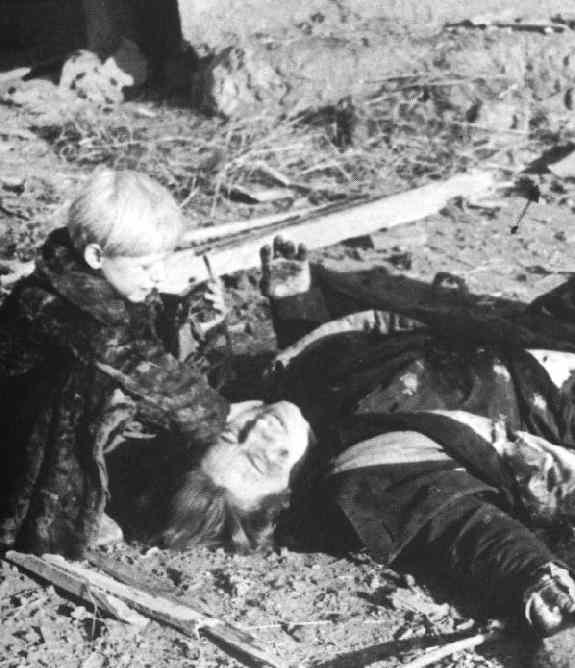
Hitler made it very clear that the campaign in the East would be conducted differently than any other modern campaign--it was to be a war of extermination. Mass executions of Jewish men, women, and children as well as Communists were carried out. Four SS Einsatzgruppen were responsible for most of the killings, together with local collaborators, but the numbers of Jews encountered was so large that regular Wehrmacht units also participate in the killing. It was not just the Jews that were killed, but also Communist Commissars in the army army and Communist officials. Eventually large numbers of Slavs were to be killed to clear land for German colonization. In the end this war of extinction may have doomed Operation Barbarossa because it precluded the effective utilization of anti-Communist Russians and Ukrainians to fight the Red Army. The German Army in Belgium executed 6,000 civilians and was acquired a reputation for brutality that lasted the entire war. British propaganda intensified actual incidents. Hitler and the NAZIs not only lived up to their World War I image, but far exceeded it with horrific acts from the first day of the War. The Wehrmacht and paramilitary formations killed about 100,000 civilians in Poland (1939). Operation Barbarossa was to be something even more terrible. It would be unlike any other campaign in modern history. Hitler made it very clear that the campaign in the East would be conducted differently than any other modern campaign--it was to be a war of extermination. Mass executions of Jewish men, women, and children as well as Communists were carried out. Four SS Einsatzgruppen were responsible for most of the killings, together with local collaborators, but the numbers of Jews encountered was so large that regular Wehrmacht units also participate in the killing. It was not just the Jews that were killed, but also Communist Commissars in the army army and Communist officials. Eventually large numbers of Slavs were to be killed to clear land for German colonization. In the end this war of extinction may have doomed Operation Barbarossa because it precluded the effective utilization of anti-Communist Russians and Ukrainians to fight the Red Army.
The Soviet western frotier after wars with the Baltics and Poles was established (early-1920s). This border was heavily fortified and became known as the Stalin Line. It consisted of concrete bunkers and gun emplacements. It was the same basic comcept as the French Maginot Line, but not nearly as elaborate. And it wss not a continuous line along the whole border. Rather it was a network of fortified positions with the idea of channeling potential invaders into designated corridors where they could be destroyed. Cooperation with Hitler allowed Stalin at little cost to acquire emense territory and move the Soviet bordee substantially west at the expense of Finland, Estonia, Latvia, Lithuania, Poland, and Romania. Coopderation with Hitler had thus returned emense dividends. Stalin rejecting the advise of his generals and began moving out of the Stalin Line and building new defensive positions along the new border and =fir the fitst time having duirect contact with the Germans, both in their shgare vof occupied Polans abnd in Romania which had joined the Axis.
Stalin against the advise of his generals began deploying substantial elements of the Red Army along the new western border without the benefit of prepared defeneses. Construction on new defenses to be called the Molotov Line began (early-1941). This left important elments of the Red Army especially vulnerable to the Wehrmacht. Not only because of lack of defensive enplacenments, but because they were so close to the border. A Barbarossa expert writes, "... Soviet deloyments in their first strategic echelon opposite Arny Group Centre were set vwell forward, with inly the most rudimentary of preoared defenses and, owing to Stalin;s intrasigence, receiving no warmning oif the impending invasioin until it was literally underway." [Stahel, p. 153.] Stalin even refused to allow defensive preoarations by front line troops afraid of provoking the Germans. The only steps Stalin took on the advise of his generals was to mobilize reserves in rear areas. Stalin received warnings from British intelligence as well as Soviet inteligence. He was convinced that Hitler would not be so foolish as to invade and that British intellience was trying to draw him into a war with the NAZIs. As a result, Stalin avoided any kind of action that might bring his cooperation wiyth the NAZIs in question. After the war, Churchill wrote, "War is mainly a catalogue of blunders, but it may be doubted whether any mistake in history has equaled that of which Stalin and the Communidst Chiefs were guilty when they ... supinely awaited or were incapable of realizing, the fearful onslaught which impended over Russia." There are claims that Stalin was preparing to attack the Germans. A Soviet defector hs mnade this claim. [Suvorov] There is no evidence to support this, at least in 1941. Mist historina discount the idea. And the ample German information om German preparatiions for Barbarossa offer no inf=diucatioin tthat bit was in response to Soviet preparatioins. Hitler made claer his goals in the East in Mein Kampf (1924). One historian writes, "... in 1941 the Red Army was undoubtedly mobilizing for war against Germany, just not a war in 1941. We can only speculate that in May 1941, when plams for a prevenative strike against German forces massing on the border were considered, that Stalin deemed -- in many ways correctly -- that the Red Army was simoly not ready for such an operation." [Hill, p. 197-98.]
The NAZI invasion came as a huge shock to Stalin. This was not because he was not warned or the German preparations detected. Warnings came from multiple sources. Never before in history did a country have such detailed infprmation and so many creditable warnings about an impending invasion. Barbarossa was a massive undertaking. Given the dimmensions of Barbarossa, it was impossible to hide. The Soviet did ask, but the Germans claimed that they were moving forces east out of range of British bombing, an absurd response. Soviet intelligence was the best intelligence operation in the world, both the NKVD as well as military intellience (GRU). They obtained substantial information on NAZI intensions and preparations. They made these reports at great personal risk. Stalin had no illusions about Hitler's intenions and character. He knew the attack was coming eventually. And he was feeverisly attempting to prepare for it. He convinced himself, however, that it was not imminent because Hitler had insisted that a two-front war was why Germany had lost World War I and a two-front-war must be avoided at all cost. Stalin was thus positive Hitler would not attack with Britain still in the war. Stalin maintained this view even though a torrent of warnings reached him in Moscow. Stalin became enraged as more and more warnings reached him. And his rage was directed not at the Germans, but at any one who dared submit warnings, accusing the people involved of being spys and German and or British agents. So many warnings arrived that Stalin threatened to arrest those submitting them. Beria issued orders not no to submit these warnings. Some very brave, patriotic people continued to submit the reports anyway. Beria toddy that he was stopped delivering them to Stalin. The Soviet commanders on the border were so frightened of their own side, but they couldn't push the issue because they feared being arrested by the NKVD on Stalin's orders. Stalin so teroruzed the military to stop reporting on German preparations that one Red Army commander famously called his headquarters saying, "We are being attacked! Do we have permission to return fire?" The failure was not the military or the intelligence services, it was entirely at the top--Joseph Stalin. The Red Army reported on the German build up, The NKVD and GRU both reported on the build-up and the plans to invade. Soviet spy Richard Sorge gave the Soviets the exact date of the invasion. Stalin orderd the Red Air Force not to conduct reconisance flights over German positions. He also ordered the Red Air Force not to oppose Luftwaffe reconisance flights over Soviet territiy. He wanted the Germns to see that the Red Army were in defensive positions. And both President Rooevelt and Prime-Minister Churchill warned Stalin. America Magic intercepts of Japanese diplomatic traffic revealed details on NAZI intentions and preparations. Japan's Ambassador in Berlin (Oshima Hoiroshi) was close to Hitler and other NAZI luninaries and his reports to Japan were decoded by the Americans. Göring briefed Ambassador Oshima on the NAZI plans and provided him details on the number of planes as well as the divisions being readied. [Boyd, p. 21.] British Ultra also picked up numerous messages to and from the Gemn units massing along the Soviet frontier. Churchill like Roosevelt also ordered that Stalin be informed from sanitized Ultra-decrypts. Stlalin who dismissed them as efforts to draw the Soviet Union into a war with Germany. Stalin was so sure of his infallibility that he convinced himself that the reports reaching him were British disinformation designed to create a rift between him and Hitler.
We do not yet have full details as to the timing of Barbarossa. Given how close the NAZIs came to taking Moscow, the timing seems critical. We are not yet sure if a firm earlier invasion date was set. Of course the Germans had to wait for good weather. It does seem they could have launched the invasion in late May or early June. Military historians generally agree that given a few more weeks of good weather that the Germans could have taken Moscow which would not only have been of propaganda impotannce, but was a critical coomunications center. Many historians point out that the need to invade the Balans to resolve the mess created by Mussolini delayed the invasion 6 critical weeks. This may have well been the case, but some historians cintend that the Germans did not really plan to invade muchearlier anyway.
The nature of the War changed decisevely in the second half of 1941. Hitler invaded the Soviet Union on June 22, 1941, launching the most sweeping military campaign in history. The 3 million Germans struck in the early hours before dawn. Some 0.5 million allies would subsequently join the Germans. The Panzers led the onslaught. It was a total surprise. A last minute Red Army alert went out in some sectors. Most units, however, unders orders to hold their fire. This was Stalin's doing, thinking that renegade German units might seek a provocation to ignite a war. Stalin was convinced that Hitler would never stike until the British were dealt with in the West. Panzers quickly penetrated deep into Soviet territory. Stalin ignored warnings from the British who as a result of Ultra had details on the Germna preparations. Stalin was still convinced that the British were trying to draw him into the War and until after the actual attack could not believe that Hitler would attack him. The attack was an enormous tactical success. The Soviets were surprised and devestated. The Luftwaffe in carefully planned strikes destroyed most of the Red Air Force, largely on the ground. The Luftwaffe destroyed about half of the 10,000 Red Air Force planes on the first day. [Fest, p. 648.] Much of the the rest were destoyed by the end of the week. This gave the attacking German army groups near total air superiority for the opening phase of the conflict. Only the vast straech of the front prevented this from having the same impact it had in the West. German armies slashed into the Soviet Union in three gigantic formations. Army Group North from East Prussia attacked into the former Baltic Republics aiming for Lenningrad. They were supported by the Finnish Atmy to the north attempting to regain the territory seized by Stalin in 1939. Army Group Center, the strongest German formation, moved through what was formerly eastern Poland toward Moscow. Army Group South moved into the Ukraine headed toward the Don Bas and the oil rich Caucasus.
Hitler's invasion of the Soviet Union fundamentally changed the character and nature of the War and in several ways. First the British (and Dominios) were no longer fighting the Germnans alone. Until the invasion the British were facing a much larger German Reich which controlled much of Europe. After the invasion the tables were reversed. It was the Germans who faced countries with larger populations, ;arger industrial sectors, and with acess to all of the reources needed to make war. This meant that the totalitarian powers no longer pssessed the domomant power base as the totalitarians were now split. Second, the invasion set a clock ticking. The Germans if they were going to win the war would have to win it fast. If they did not win in 1941, there changes of winning would be significantly reduced as the Soviets and Anglo-Americans geared up for War. The German rearmament program led to a ssignificant edge by 1939. If the Germans did not win in 1941, that edge would have been lost. Third, the dimensions of the conflict were substaially increased. Hitler launched 3.0 million Germans and 0.5 million German allies into the Soviet Union. The Army totaled nearly 5 million men at the time of Barbarossa. Another 30 million men would be mobilzed to fight the Great Patriotic War. Fourth, twas the nature of the war in the East. Hitler made it a brutal, genocidal war of extinction. The nature of the NAZI onslaught meant that the conflict would be a fight to the finish with no posibility of a peaceful finish. Fifth, the outcome of the War was largely determined by the fact that while Hitler decided to break the NAZI-Soviet alliamce. The Soviet-Western akliance would hold fast despite stresses and different war aims and ideolgy. hsmks largely to Hitler, this unlikely alliamce held togther until until the NAZIS, Facists, and Japanese miltarists were totally defeated.
The NAZIs invaded the Soviet Union on June 22, 1941. Radidly the Baltic Republics (occupied by the Soviets in 1940) and large areas came under NAZI control. The NAZIs employed the same ruthless tactics developed in Poland, but on a far larger scale. Heydrich in 1941 ordered the Sicherheitsdienst (SD) (SS Security Service) in 1941 to begin the necessary planning for the Germinization of occupied territories in the Soviet Union. The Reichs-Sicherheitsdienst (RSHA) (Reich Security Head Office). The initial report submitted in November 1941 by the RDHA estimated that 31 million peole should be "evacuated". The SS-RKF was ordered to extend its planning for the Germinization to the occupied area of the Soviet Union. [Padfield, p. 363.] There were differences of opinion within the SS and between the SS and Alfred Rosenberg's Ostministerium (Ministry for the Occupied East) over how to claim the East. There was agreement that large numers of Slavs had to be removed to Siberia. There were differences as to the extent to which forcible evictions should take place. Given the scale of movement involved, such discussions probably were not relistic. [Padfield, p. 363.] The NAZIs looked on the people of the Soviet Union in starkly racial terms. They were willing to work with the native Baltic population and some in the Baltics were willing to work with the NAZIs. The NAZIs were determined that the Slav population in Russia proper and the Ukraine would have to be substantially reduced. Some Slavs would be kept, at least for a while to serve as a slave population to do mannual labor, at least until the region could be Germanized.
Hitler predicted, "The world will hold its breath." He was correct. The Luftwaffe scored a major victory in essentially destroying the Red Ait Force during the first 2 days of the Operation Barbarossa. German panzer armies penetrated deep into Soviet lines, moving rapidly into the Soviet Union and taking large numbers of prisoners. The Germans drove toward Kiev and the Dnieper in the south and the Baltics and Leningrad in the north. Stalin was at first stunned and did not even speak on Radio to the Soviet people. Stalin announced a scorched earth policy to confront the NAZIs in a radio broadcast (July 3). The most important of the German Panzer comanders, General Guderian, presses the attack of Army Group Center. General Kluge attempted to restrain him. The Germans cross the Dnieper River (July 10). Driving toward Moscow, they seized Smolensk (July 15). Another 300,000 Soviet soldiers are taken prisioner--over 40 Soviet divisions. Hitler concerned about the lack of progress in the south took control of Barbarossa away from the generals. He was convinced that he understands tactics and strategy better than the generals. He ordered Guderian to drive south toward Kiev. The Germans achieve a spectacular success in the south, taking Kiev and 650,000 Soviet prisoners. The delay buys time for the Soviets. Stalin placed Marshall Zukov in charge of the defense of Moscow. The Japanese decide to strike at America rather than coordinating an attack on the Sovoiets with the Germans. Siberian troops rushed west mount a massive Winter offensive which not only stops the Germans, but devestates the Wehrmacht.
NAZIs prppaganda attempted to make Hitler's invasion of the Soviet Union into a crusade by civilized Europe against Bolshevism. He attempted to get Vichy France and Franco's Spain to joint tge crusade. Both refused, although Franco did authorize a volunteer division to be raised. Mussolini did joint the campaign. Finland joined, but with the limited goal of regainningthe territiriy seized by Stalin in the Winter War (1939-40). NAZI allies in central Europe joined (Hungary and Romania), although Bulgaria refused. The NAZIs also raised units made up of Fascist volunteers in the occupied countries.
The Ukraine was one of Hitler's primary objectives when he unleased Barbarossa. He saw the Ukranine as the future German breadbasket and a needed area for Lebensraum. Army Group South was assigned the task of seizing the Ukraine. The Germans, however, encountered problems in the south. Several factors were involved. There were important Soviet formations deployed there, some armed with the new T-34 tank which shocked the Germans when they first enountered it. In addition, the Romanian allies proved less reliable than hoped. Hitler, anxious to lay his hands on Ukranian resources, diverts powerful Panzer units driving on Moscow from Army Group Center. The results are a spetacular victory at Liev, but in the end the drive toward Moscow fails. Soviet forces badly maul the Romanians at Odessa. The NAZI Eisatzgruppen begin the wholescale murder of Jews. They also suppress Ukranian nationalists and begin mass killings of non-Jewish Ukranians.
Soviet citizens were stunned at the news of the NAZI invasion. The Soviet Union was a multi-national state. Stalin as a result of the pact with Hitler has significantly expnded Soviet boundariess west. And in these new territories the NKVD and Red Army had carried out a ruthless campaign to purge the population of anti-Soviet elements, meaning not only people desiring an independent state, but whole classes of people who tended to have nationalist aspirations. This was the cse in the Baltics. Civilians attitudes in eastern Poland/Beylorussia were more mixed, but in the western Ukraine the Germans were
seen as liberators. Thus the first people who the Germans encountered were not at all hostile and in some cases genuinely pleased to see the Germans. And there were other peoples, especially in the Caucuses that were hosytile to the Soviets. It was a different matter in the Soviet Union's Russian heartland. Here the population remined staunchly loyal, not so much for Communism, but for Mother Russia. Civilians volunteered in large numbers to build anti-tank barriers and other defensive works. Here there was sometime as it took the Germans time to reach the Russian ethnic areas of the Soviet Union. And the Russians rallied to the cause before the genocidal nature of the NAZI invaders was fully understood. This would not be known until the Red Army offensve before Moscow (December 1941) would take back villages occupied by the Germans. One interesting view of Soviet civilians are the photographs taken by German soldiers who compiled many scrapbooks of their exploits. We are not entirely sure how to interpret these images. After the disaster before Moscow, Hitler reassessed attitudes toward the Russians and allowed the Whermacht to organize a Russian Liberatin Army. Amost all of these men, however, came from German POW camps.
The stunning German victories netted emense numbers of Soviet prisoners of war (POWs). The Germans captured 3.8 million Soviet soldiers in the first few months of the campaign. [Hoffman, p. 131.] It is easy to see why the Germans and Hitler were at first so confident of victory. No not knowing the true size of the Red Army, they thought they had essentally won the War. German columns seized whole Soviet armies and the major cities of western Russia in giagantic encirclements. Neither camps or supplies exxisted to handle the huge numbers of captured Russian soldiers. The Germans in the East at Hitler's orders were not to follow the internatioanl conventions they had generally adhered to in the treatment of POWs in the West. Admiral Canaris, head of the Abwer, attempted to interceed with Keitel. [Hoffman, pp. 336-337] Keitel knowing fullwell Hitler's plans did not pass on Canaris' concerns to Hitler.
Soviet Dictator Joseph Stalin was stunned by the German attack. He had been convinced that Hitler, afraid of a two-front war, would never attack until the British had been defeated. He had been warned by Churchill who had detilas from Ultra intercepts as well as his own inteligence service. After the attack, Stalin was silent for 12 days, apparently stupified by the force of the German attack and dessimation of Red Army forces. Finally he spoke to the nation and it was not about Communism, but the defense of the Russian motherland. The lengendary Great Patriotic War had begun. Stalin also began to deal ruthlessly with Soviet commanders who would not fight or performed poorly. He considered commanders and soldiers who surrendered deserters. Commanders who retreated or deserted faired little better. A series of defeated Red army commanders were shot in July. [Davidson, p. 438.]
Churchill was awaken at 8:00 am with news of the NAZI invasion. (He had standing orders that he not be awaken earlier unless Britain was invaded.) He immediately announced he would speak to the nation that evening. Churchill spent day working on his major addresses. This time he only had hours. He began by reminding the British people of a lifetime of opposition to Communism. Then he expalined, "But all this fades away before the spectalewhich isnow unfolding .... Can you doubt ehat our policy will be? .... We are resolved to destroy Hitler and every vestige of the NAZI regime. From this nothing will turn us--nothing. .... Any man or state who fights on against Nazidom will have our aid. ... It follows, therefore, that e shall give whatever help we can to Russia and the Russian people." President Roosevelt was at first uncommital. Some of his advisers urged him to rush support to the Soviets. His militay advisers, including General Marshall, were convinced that the Soviets could not withstand the NAZI onslaught. They advised against rushing aid to the Soviets when America's expanding new army was still not equipped and Britain still in danger. [Goodwin, p. 255.]
One of Hitler's major goals in the invasion of the Soviet Union was the muder of Russian Jews. Preparations were laid formurdering Jews as part of the invasion. The NAZIs in 1939 had not yet worked out what was to be done with the Jews. As a result, while there were many killings, most were rounded up and confined into ghettos. The success of the
Wehrmacht in 1939-40 had convinced Hitler and other NAZIs that they could begin the mass slaughter of Jews. There ws no written document, but Hitler some time in late 1940 or early 1941 must have ordered Himmler to prepare for mass killings with the invasion of the Soviet Union. The NAZI genocide had not yet been perfected and large scale gas chambers were not yet operating at Auswitz and other Polish concentration camps. The SS created four Einsatzgruppen to accompany the Wehrmacht and kill Jews in large numbers. Full details are not available, but we know from the similarities in many of the killing actions that the Einsatzgruppen were well trained and procedures developed for maximum efficency. Heydrich was in overall command of these killing machines and he was known for his meticulous planning.
The Resistance was especially important in the Soviet Union where guerrila groups disrupted German supply lines. The Soviets created the largest and most important Ressistance effort. This was possibly primarily because of the genocidal NAZI policies in the East. Ironically, the Soviet Union was the one country that the NAZIs invaded where they could have developed considerable popular support. The early successes of the Germans staggered the Red Army and Soviet society as a whole. Red Army soldiers surrendered in staggering numbers. Only slowly did anti-NAZI partisan units begin to form. Many of the partisans units were formed from men left behind as the Red Army retreated east. Later the Soviets dropped men and supplies to reinforce the partisan units. Other partisan units were formed by civilians. They Soviet partisans were an important part of the Great Patriotic War. Partisans killed thousands of German soldiers, but the major contribution was in disrupting Wehrmacht supply lines. Not only did this make supplying front line troops difficult, but it forced the Wehrmact to deply an important part of its combat strength in rear areas to secure supply lines. This was especially important in 1941-43. As the tide turned on the Eastern Front, the importance of the partisans declined as the Red Army became an effective fighting force. The partisans even in the later phases of the War was still significant and were a cotinuing drain on the Wehrmacht as it retreated west.
The German Wehrmacht that entered the Soviet Union was an experienced and highly professional force. Much more experienced and professiinal that the Red army it encountered. In many ways the Red Army was similar to the Polish Army in 1939 and British, French, and smaller (Norwegian, Dutch, and Belgan) armies in 1940. They were all inexperienced peace time armies unprepared for war in general and Blitzkrieg in paticular. What was different in the Soviet Union was the size of the Red Army and the scale and conditions of the Soviet battlefield. The Soviet Union presented the Wehrmacht with a battlefield unlike anything it had experienced in Poland or Westrern Europe. The campaigns in Poland and the West had been fought within about 150 miles of the borders of the Reich or occupied areas. In fact, a great deal of the fighting took place within areas that until 1918 had been German territory. The terraine and geography was very familiar to the German officers who planned and conducted the battles. They had fought there before and war gamed battles on the terraine. The rivers and mountains were well known as were the best crossings and passes Dtailed maps were readily available. In addition there were excellent, well maintained road systems over which the Germans could quickly move their panzers and other vehicles. Maps were readily availabkle. [Citino, p. 296.] The small area over which the battles were fought allowed the Wehrmacht and Luftwaffe to concentrate overwealming force. Eveeything about the Soviet Union was different. The Wehrmacht rapidly penetrated deep into the country and thus xwere fighting at great distances fromm the Reich. The Luftwaffe could no longer operate from well prepare fields. The Panzers no longer were ooerating on modern roads. Maps were not available and those that existed were often out of date or inaccurate. The Germans began to encounter major rivers that they were unfamiliar or totally unknown. And the size of the battlefield made it difficult to ammas forces capable of destroying the Red Army as they had the smaller adverseries in the west. The Wehrmacht was experiencing significan problems well before the October rains and November frost.
Given the surprise with which the Wehrmacht struck the Soviet Union, it might be assumed that German intelligence was superior to that of the Soviets. It was not. In fact Soviet intelligence had provided Stalin early warning of Barbarossa. He refused to believe it. One of the weaknesses of Barbarossa was German inteligence. The Germans has fairly good inteligence along the border as the Luftwaffe conducted recoginase flights which the Soviets allowed as as not spark an incident that would led to a German invasion. The Germans had very effectively estimated the strength of front line Red Army units and located these units and their defenses. The attacks on ther opening of Barbarossa devestated these units. German tactical intelligence through Luftwaffe reconisance was excellent. The German strategic intelligence capability wa, however, very weak. They nd they failed to accurately estimate the strength of Russian reserves in the rear. [Glantz, p. 23.] Nor did they accuately assess how rapidly the Soviets could create and deploy new divisions. The Germans by the end if Barbarossa had killed or captured more Soviets soldiers thst they believed were in the entire Red Army. German intelligence estimated a force of 300 Soviet divisions. After the German invasion the Soviets mobilized 5 million reservists. By the tome of the struggle before Moscow, the Soviets had deployed 600 divisions. [Citino, p. 296.] The great German victories of the summer had destoyed about 100 divisions, but the Red Army was still a formidable force. No other army in the world could have survived such reverses. And it was the Red Army that launched the offensive tht otally suprised the Germans. It would be one of several such surprise attacks.
Stalin's purges of the Red Army and German successes in the initial months of Barbarossa had resulted in the losses of huge numbers of trained officers. Stalin's refusal to allow a ratioanl deployment of the Red Army and insistence that there be no retreat were also major factors in the stunning German victories. In the end it was the stuborness and tenacity of the average Red Army soldier that manged to stop the better trained and more professional German Wehrmacht before Lenningrad and Moscow. The savagery of the German assault and appeals to Russian patriotism were major factors in the stiffening of Russian resistance.
The NAZIs on the Eastern Front did have allies. NAZI propaganda sought to depict the invasion of the Soviet Union as a modern European crusade against Bolshevism. Unsaid of course was that the invasion was not only against the Bolsheviks, but an imperialistic war to seu=ize German Lebensraum and a genocidal campaign to muder millons of Slavs. Hitler did have allies or his campaign. The most important were Italy, Hungary, and Romania. The Romanians to curry Hitler's favor provided the largest contingent. All of these forces proved unreliable in combat, in part because the Germans did not properly equip them. The Spanish volunter Blue Division proved effective but was only one division. There were other allies. The Germans recruited men from the occuoied countries. Most were members of local Fascist parties or youths who were recruited from Fascist youth groups. At the time of Barbarossa the NAZI victory looked assured. As the war progressed that victory proved increasingly unlikely and volunteers more difficult to recruit. The Germans also recruited anti-Bolchevick Soviets, but here were limited because of their genocidal policies.
The Ally that as Barbarossa bogged down, the NAZIs most wanted was Japan. Germany's Axis ally in many ways held the key to the success or failure of Operation Barbarossa. It was not immediate apparent to Hitler and the Wehrmacy OKW such their euphoria with the early successes of Barbarossa. The NAZIs assumed that the Japanese would evenbtually join their anti-Communist campaign. Hitler hinted to Japanese diplomats in early 1941 that war was likely with the Soviet Union. Japanese diplomats gave Hitler reason to believe that the Japanese would join him if war broke out. Foreign Minister Matsuoko visited Germany and met with Hiter several times (March 27, 1941). Hitler hinted at war with the Soviets. Matsuoko offered his personal opinion that he could not conceive of Japan not striking at the Soviets if war broke out. [Boyd, p. 19.] The Japanese situation, however, became more complicated when Matsuoko return home from Berlin signed a neutrality treaty with the Soviets (April 13). Although there were informal diplomatic exchanges, the AXIS partners never coordinated their strategy. Hitler did not consult with the Japanese about invading the Soviet Union and the Japanese attack on Pearl Harbor came as a surrise to Hitler (and the Japanese diplomats in Berlin). Ambassador Oshima in Berlin was briefed in detail about the progress of Barbarossa. He met with Hitler in his Rastenburg Headquarters and visited the Eastern Front. Oshima reported the progress of Barbarossa to the Foreign Ministry. The reports contained an accurate picture of the extent of the German victories. Japan did not, however, take advantage of the opportunity presented to strike north and deliver the coup d'grace to the Soviet Union. This decession appears to have been taken before the extent of the Soviet debacle was clear. The Japanese replaced Foreign Minister Matsuoka (Who favored a strike at the Soviets) with Admiral Toyoda Teijiro (who favored the southern advance) (mid-July 1941). Ambassador Oshima urged Tokyo to strike at the Soviets from Manchukuo (occupied Manchuria). Tokyo did not answer many of the Ambassador's queries. Because of Magic intercepts, America code breakers were reading these messages. We do not fully understand why the Japanese decided to strike south (against America and Britain) rather than north against the Soviets. We suspect that the Army generals who dominated the Japanese government did not after the 1939 border war were not anxious to engage the Soviets again. The British looked weak after a series of defeats at the hands of the Germans. Japan's leaders were highly insular men. Most looked on America as spirtually weak and unwilling to resist Japan in a major war. Another factor may have been the Roosevelt Administration's policy of resisting Japanese aggrssion in China and Indo-China. The diplomatic measures and boycotts had a limited affect, but America was standing up to Japan while the Soviets were silent. I do not yet know, however, of a detailed study of the Japanese decession making process that led to Pearl harbor.
Japan and the Soviets fought pitched battles along the Manchrian border in 1939. An offensive by Marshall Zukov forced the Japanese to ask for an armistace. Still the Soviets kept important forces on the border. Japan in late 1941 was poised for a military strike to take advantage of the fighting in Europe. There were two basic options: strike north at the Sovierts or South at the resources of Southeast Asia. The decission was to strike south. Here the only force to oppose the Japanese was the U.S. Pacific fleet at Pearl Harbor. A Japanese carrier taskforce on December 7, 1941, executed a surprise attack on the American Pacific Fleet at Pearl Harbor. It was a brilliant tactical victory for
Japan, but perhaps the greatest mistake in modern military history as it brought a suddenly united America with its vast industrial capacity into the War.
The Japanese decission to strike America, allowed the Sovierts to shift Siberian reserves. A Japanese spy in Tokyo had informed Stalin well before the actual attack on Pearl Harbor. These troops, well trained in winter warfare, on December 6, 1941 launched a winter offensive stopping the Whermacht at the gates of Moscow--inflicting irreplaceable losses. The Wehrmacht was stuned at the extent of the Soviet offensive, assuming that the staggering victories in the Summer had crippled the Red Army. There were no preparations made such as winter clothing or assessing the performance of weapons in extemely cold winter conditions. Hitler had assummed that the camapign would defeat the Soviets in a summer campaign before the onset of Winter. Hitler demanded that the Whermacht stand and fight. This probably saved the Wwhrmach from an even greater dissater than what ocurred. An entire Germany Army, the 16th Army of more than 90,000 men, was essentially cut off and only supplied with an enormous effort by the Luftwaffe. A land corridor was not restablished until April 1942. The massive Axis army that invaded the Soviet Union had by January 1942 lost a quarter of its strength amd huge quantities of tanks, artillery, and supplies. These losses of men and material by the Wehrmacht were especially grevious and Germany did not have the manpower resources or industrial capacity to fully repace and reequip a new army. Most accounts of World War II point to Stalingrad as the turning point of world war II. The Soviet stand before Moscow may have been the decisive action of the War. It certainly meant that Germany had lost its best opprtunity to destroy the Soiviet Union and Red Army. What many historians fail to note is that while the Wehrmct had occupied large areas of the Soviet Union, they were still, on the perifery of Russia. What they had occupied was the Baltics, Poland, Belarus, and areas of the Ukraine. Russia, much of the Soviet arms industry, and key resources like oil was still in Soviet hands.
The Soviet Union had the largest Army in the world and massicesumms wewre devoted to equipping it. One of the many weapon programs was armored vehicles. Ironically befor the rise of the NAZIs, the Germans and Soviets through the Rapallo Treaty cooperated in developin armored vehicles and tactics. The Soviertt built a wide range of light, medium, anf heavy tanks. The light tanks proved ineffective. Some of the heavy tanks proved virtually indestructable, but difficult to deploy. There were also special series like the massive KV-1s and KV-2s. Itvwas, however, the T-34 medium tank that proved to be the perfect balance of mobility (wide tracks, excellent speed), firepower (76mm or 85mm cannon) and armor protection (low profile and inovative sloped armour) needed for mobile warfare. Many assessments of World War II focus on the German Panzers. The NAZIs assumed that the Soviet Union was a backward country incapable of producing the same high quality as Aryan supermen. The appearance of the T-34 tank on the battlefield was a shock to the Wehrmacht as it was in fact superior to the German Panzers. The T-34 tank in fact is considered by many to be the finest tank of the War. The Soviets adopted the T-34/76 medium tank (December 1939). The key innovation was designed to make the T-34 "shell proof" by welded 45mm frontal armor sloped at 60 degrees. The Soviets unlike the Germans designed their tanks aiming at simplicity so they could be mass-produced and easily maintain iand repaired in the field. This as much as the armor was critical on the battlefield. The Soviets had begun to produce the T-34 before the German invasion--about 1,200. And only a few were deployed. It was totally unknown to the Germans. The Wegrmacht were shocked at the effectiveness of the T-34 when they first encountered it. But because only a few wwre deployed and the Soviets had not perfected effectivectabk tactics, it did not at first have a significant impact. The T-34 tank was also relatively inexensive to build and easily mantained. This was in sharp contrast to the much more complicated German tanks. Unbeknown to the Germans, even as the Wehrmacht was driving into the Soviet Union during the Summer of 1941, T-34 tanks were rolling out of production lines in far greater numbers than German tanks.
Stalin had built an industrial base capable of produycing war material on amn immemse level. The Germans were not aware of the full Soviet potential, neither the quantity or the quality of Soviet production. The Soviets managed to pack up and move whole factories east, where they could not be reached by the Luftwaffe's tactical bombers. Production at many of these factories were not back to full production until 1943. Even so the output of these Soviet factories alone exceeded German production. Thus when British and American production were added, it is clear to what extent Barbarossa had changed the strategic ballance. And it was not just uin quantatative terms. Soviet war productin was rationalized. Production of osolete weaponsas terminated and that of more effective weapons like the T-34 tank expanded. Soviet artillery was of a high standard. While the Red Air Force was devestated at the onset of Barbarossa because of obsolete planes, new planes like the Yak fighters (Yak 1, 7, and 9s) and the IL-2 Stormovek were high quality planes that in capable hands could and fid taken on the Luftwaffe. These planmes were also produced in enormous numbers. More than 37,000 Yaks were produced by the Russians, more than any other fighter in the War. As the Allied air assualt on Germany intensified in 1943 and the Luftwaffe had too pull back to defend German cities, the Germas also began loosing their advantage in the air that they had during Barbarossa.
Perhaps the fatal wakness in Barbarossa was Hitler himself. His racial hatred and penchant for mindless viloence turned large numbers of Soviet citizens who hated Stalin and the Comminists and were potential allies against the Germans. Millions of Russians and Ukranianns embraced the Wehrmact viewing them as liberators. Many Russian soldiers willingly surrendered to the Germans. Hitler's barbaric plans for the occupied East were soon evident to these potential allies. Hitler's War was not just a war against Communism, but in fact war against the Soviet people themselves. Hitler's avarice was another factor. Soviet resources offeered so much to the German war effort that Hitler kept changing his priorities. The Panzers made graet progress in moving rapidly toward Leningrad and Moscow. When victory may have been within his grasp, he tirned the Panzers south toward the resources of the Ukraine. Then he focused on Moscow again, but the weeks lost were just enough for the Soviets to organize a defence before the onset of Winter. (Hitler's inability to set reasonable goals and priorities and stick to them would also doom his 1942 Summer offensive.)
NAZI Germany's primnayr weakness in World War II was its lack of needed raw material, especially, but by no means limited to oil. The Soviet Union had everything Germany need to wage endless war. Noy only raw nmaterialsm but extensive agricultural land, and the Lebensraum he discusses in Mdin Kampf. But even after the fall of France, Germany still lacked what it needed to conduct a long war. And American support of Britain meant that a Cross Channel Invasion was beyond Gernany's capability. This critical shortcoming could be solved by seizing the reesources of the East--meaning the Soviet Union. But as in World War I, Germany best shot was a an overwhealingly invasion and a quick victory. Germany lost World War I because the French Army did not break and the War turned into war of attrition--an economic struggle that Germany could not win. Now Hitler after his great triumphs in the West faced the same set of circumstances. His best chance of winning World War II was an ovewhealing invasioin which would break the back of the Red Army. But if the Wehrmmacht failed, as in 1914, Germany would face the superior econimic resources of the Soviet Union and Western democracies. Hitler preopared the largest invasion force in all of human history--Operation Barbarossa. He told his intimates and military commanders that the Soviet Unioin would collapase 'like a house of cards, amother short, victoirious war with light casualties. A Barbarossa expert explains what happended when the battered Red Army did not break, "Of course Germany was still capable of major offenses on certain secors of the front and could achieve impressive successes at the operational level, but none of this could change the fundamental disparity between Soviet staying power and German offensived strength. As soon as Germany ceased to threaten a knockout blow and a longer, grinding war ensued, economic factors came into play which favoured the allied war effort even before the direct entry of the United States inti the conflict." [Stahel, p. 23.]
We find a fundamebtal misunderstanding of both Barbarossa and the Ostkrieg in genreral. The general consensus is that the Ostkrieg was the decisiv campain of Wirld War II. This is absolutely correct. Whoever prevailed in the East was going to win the War--excluding a considertion of nuclear weapons. This is absolutekly correct. It is also true thatr Hermany committed the bulk nof its manpower in the East and sustauned the bulk og its casualties in the East--ovr 75 percent. All this is absolutely correct. The problem is the belief that the resources the Germans expended to support the Osstheer were commenserate with the manpower commitment. They were not. Hitler sent the Ostheer east on foot with bhirse-dtawm vehicks. Some 80 percent of the OIstheer wasunmotoirized infabtry. Abd after Brbrossa, the vhicle compsition of Panzer and motorized infantry was reduced. In fact, the Ostheer was vry poorly supplied and supported. The bulk of the Reuch's considerable war industrius were used ti support the war in the West. It does not take much industry to build horse casrts, it dos to build shipps, planes, and the various secret weapons. The Ostheer was decvisevely defeated by the Rd Army, but not fully understood is that the diversion of materil anbd resources to ge war in the West as part of the reason that the Ostheer was so poorly supplied bnd supported.
Hitler on December 11 declared war on America--the only country he ever formally declared war on. In an impassioned speech, he complained of a long list of violations of neutality and actual acts of war. [Domarus, pp. 1804-08.] The list was actually fairly accurate. The NAZIs had considerable reason for believing that America was a hostile country. Despite neutrality laws, President Roosevelt had not been neutral and had taken a series of steps to take on the isolationists and assisst Britain. His conclusion, however, that actual American entry into the War would make little difference proved to a disasterous miscalculation. This was a step that many historians mention in passing as a footnote of Pearl Harbor. It was an act of breattaking incompetence. After having failed to defeat Britain, a country which with the Empire held substantial resources, Hitler had now failed in his attemot to defeat the Soviets and the Wehrmct was falling back in disaray before a massive Red Army offensive. Now instead of a quick sharp war, it should have been abundantly clear that the war was evolving ingo a struggle of attrition which would be decided by superior economic mobilization of resources. How in such a circumstance Hitler could have declared war on the the most powerful industrial and agricultural power on earth with vast material and manpower resources defies all logic. And unlike NAZI Germany, the management of those resources would not be placed in the hand of Party hacks.
The Germans who months before had faced only a battered, but unbowed Britain now was locked into mortal combat with the two most powerful nations of the world. The British now had the allies that made a German and Japanese victory virtually impossible. After the Russian offensive of December 1941 and apauling German losses--skeptics began to appear and were give the derisory term " Gröfaz ".
Barbarossa had achieved some starteling successes. Panzer arimies had spaerheaded ememse encircling maneuvers that had killed or taken over 6 million Red Army soldiers. Great quantities of military equipment had been destroyed or captured. An emense swath of European Russia was in German hands. Even so, it had failed in its principal objective. It did not destroy the Soviet Union. The Red Army had not been destroyed and Russian war industries continued to produce. As a result. The Wehrmacht by the beginning of 1942 had been seriously weakened. It was the failure of Barbarossa to destroy the Red Army in a swift, Summer campaign that doomed NAZI Germany. Htler's strategy was to destroy his opponents piecemeal before they were prepared and before an effective coalition could organize. The Soviets by defearing Barbarossa accomplished three critical goals. First, more than anything they bought time. This allowed them to move critical war industries and begin to set up for expanded production. Second, they succeeded in badly mauling the Wehrmacht. Third it helped the Red Army begin to learn how to fight the NAZIs. Once the Wehrmacht was bogged down in Russia, the Western Allies (principally the United States, Brirain, and Canada) had the time to build an effective military that could enter the European continent and attack NAZI Germany from the west. Not only did Hitler now face the prospect of a two-front war, but a war against opponents with far great resources than the Reich. The failure of Barbarossa also left the Wehrmacht in aposition to launch a much less powerful offensive in 1942, one that could only be conducted with force in the South and which culminated at Stalingrad.
Boyd, Carl. Hitler's Japanese Confidant: General Oshima Hiroshi and Magic Intelligence, 1941-1945 (Lawrence: Kansas University Press, 1993), 271p.
Bullock, Alan. Hitler: A study iun Tyranny (Harper & Row: New York, 1962).
Citino, Robert M. The German Way of War: Frim the Thirty Years' War to the Yhird Reich (Lawrence: Kansas University Press, 2005), 428p.
Davidson, The Unmaking of Adolf Hitler (The University of Missouri Press: Columbia, 1996), 519p.
Domarus, Max. Hitler Reden und Proklamationen 1932-45 Vo. 1-2 (Neustadt a.d. Aisch: Velagsdruckerei Schmidt, 1962-63).
Fest, Jaochim C. Hitler (Vintage Books: New York, 1973).
Fritz, Stephen G. Ostkrieg: Hitler's War of Extermination in the East.
Gilbert, Martin. A History of the Twentieth Century Vol. 2 1933-54 (William Morrow and Company, Inc.: New York, 1998), 1050p.
Glantz, David M. Soviet Military Deception in World War II (F. Cass: London, 1989).
Goodwin, Doris Kearns. No Ordinary Time: Franklin and Eleanor Roosevelt: The Home Front in World WarII (Simon & Schuster: New York, 1994), 759p.
Hitler, Adolf. Mein Kampf (1924).
Hill, Alexander. The Red Army and Second World War (Cambridge University Press).
Hoffman, Joaquim. Die Geschichte der Wlassow-Armee (Verlag Rombach: Freilburg, 1986).
Reese, Roger Roi. "The Red Army and the Great Purge," in J. Arch Getty and Roberta Manning, eds., Stalinist Terror: New Perspectives (Cambridge: Cambridge University Press, 1993), 198-214.
Reese, Roger Roi. Stalin's Reluctant Soldiers: A Social History of the Red Army, 1925-1941 (Modern War Studies), 272p.
Stahel, David. Operation Barbarossa and Germany's Defeat in the East.
Suvorov, Victor. Icebreaker: Who Started the Second World War? (1987).
Tooze, Adam. The Wages of Destruction: The Making and Breking of the Nazi Ecnomy (Penguin: New York, 2006), 800p.

Navigate the CIH World War II Section:
[Return to Main World War II campaign page]
[Return to Main Great Patriotic War page]
[Return to Main military style page]
[About Us]
[Biographies]
[Campaigns]
[Children]
[Countries]
[Deciding factors]
[Diplomacy]
[Geo-political crisis]
[Economics]
[Home front]
[Intelligence]
[Resistance]
[Race]
[Refugees]
[Technology]
[Bibliographies]
[Contributions]
[FAQs]
[Images]
[Links]
[Registration]
[Tools]
[Return to the Main World War II page]