|
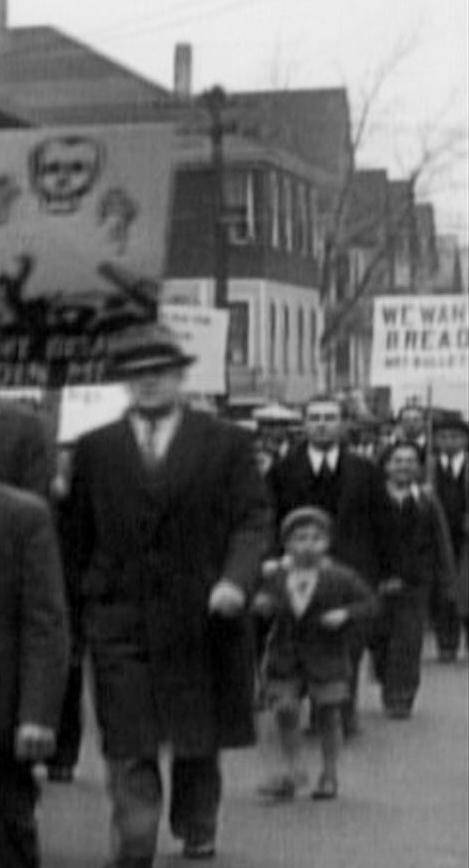
Despite the strong national consensus for isolationism, President Roosevelt saw the dangers from the NAZIs and Japanese militaists. A great national debate began. This is arguably the most important struggle America engaged in during World War II. The two leading figures in the debate were President Roosevelt and popular aviator Charles Lindbergh--the most formidable American Firster. Many Americans today see President Roosevelt as the New Deal leader who brought America out of the Depression. In fact, President Roosevelt and the New Del failed to end the Depression. His place in history which he did not fail at was his formidable war leadership. The Isolatinists protrayed the President as an eneny of free speech. Some in the military were opposed to his pro-British policies, especially sending Britain arms the Army lacked. The President authorized wire taps and authorized a British intelligence and propaganda operation in the United States the beginning of a connction that would lead to the first American secret inteligence and spy operation. [Olson] The President with great determination and political courage managed to, not only support Britain in its hour of maximum peril, but with considerable political skill managed to push through Congress measures that would lay the ground work for turning American into the great Arsenal of Democracy. The President as early as 1935 began to resist the public clamour fos a policy of strict neutrality and moved by 1941 to an undecalred, but shooting war in the Atlantic. The President also layed the ground work for producing a tidal wave of equipment and supplies not only for the American military, but for our Allies as well in quantities that no one--especially the AXIS believed possible.
The isolationists were a large, vocal, and poweful challenge to President Roosevelt's efforts to fight the dictators. The isolationists were men and women from every walk of Americam life. The core of the movement was the Republican senators, many of which were from the progressive movement. There were also Democrats, but the most prominent isolationists were Sentate Republicans, men like William E. Borah (Idaho), Robert Marion La Follette (Wisconsin), Hiram Johnson (California), Arthur Vandenburg (Michigan), and Burton K Wheeler (Montana). The most vocal Senate Republican was Gerald Nye (North Dakota) who was the most fervant Senate spokesman for the American First Committee (AFC). The isolationist movement and the AFC obtained celebetity converts, especially famed aviator Charles Lindbergh who claimed to have technical competence in evaluating air forces. Notably absent, however, was Hollywood support. The isolations included both vicious anti-Semites like Father Couglin and racists like Senator Theodore Bilbo (Mississippi) as well as the more genteeel anti-Semitism of Lindbergh and Nye. There were also men fundamentally opposed to anti-Semitism and racism like Norman Thomas. Some ethnic groups like the German-American Bund were isolationists. Until the NAZI invasion of the Soviet Union (June 1941), the Communists were also involved. There were both important industrialist like Henry Ford and Robert Wood as well as critics of big business like Nye and Socialists like Thomas. It is difficult to imagine a more diverse group. They had varying motivations. Groups like the German-American Bund and Comminists were politically motivated. Others had a viseral hated of President Roosevelt. For the vast majority the primary motivation was an opposition to war. Here there was both a moral statement as well as a fear of war, especially a fear of NAZI Germany. What most did not understand and President Roosevelt did that Hitler and the NAZIs along with the Japanese militarists represented a fundamental challenge to Western civilization. The isolations could delay American entry into the war, but the delay would mean America would face an increasingly powerful Germany and the prospect of fighting a two-front war with Germany and Japan without allies.
President Roosevelt and German Chncdellor Adolf Hitler took office withon weeks of each other (January-March 1933). At the time American public opinion was that participation in World war I had been aistake and that the United States should never again become involved in European War. At the time this was not an issue. Americnse entirely focused on the Depression and the efforts of the new Administration to fight the Depression. Hitler for his part was focused on seizing control of Germany and establishing the Nationl Sicialist F�hrer state. As a result although secretly launching a massive rearmament program, he projected an image of moderation in foreign policy. Only after announcing rearmament (1935) and beginning a series of aggressive mloves with the remilitarization of the Rhineland (1936) did the issue of isolation and neutrality begin to rise to the surface in American politics. Even after Hitler launched World War II, most Americans wanted to stay out of the War. The turning point was the fall of France when it became apparent that Anmerica must aid Britain. President Roosevelt is perhaps most associated with the Depression. The New Deal ironically nevered ended the Depression. It is the President's masterful political performance in the life or death struggle with the Isolationists that he earned his status as the greatest president of the 20th century.
President Roosevelt saw from a very early point the dangers posed by Hitler and the NAZIs as well as the Japanese militaists. There was at first little that he could do to support the forces of democracy in Europe. The isolationists were a powerful force throughout the 1930s. The President with great skill and political courage managed to not only support Britain in its hour of maximum peril, but with considerable political skill managed to push through Congress measures that would lay the ground work for turning American into the Arsenal of Democracy. Actions by the President played a major role in supporting Britain after the war began in Europe in September 1939.
NAZI Germany and Soviet Russia launched World War II by invading Poland. What the world had feared, for some time, another world war began when the Germans invaded Poland (Sptember 1, 1939). Britain and France declared war (September 3), but provided no effective support or aid to Poland. The Soviet Union, as provided for under seceret protocols of the NAZI-Soviet Non-Aggerssion Plan, selaed Poland's fate when they attacked from the east (September 17). The war triggered provisions of the Ameican Neutrality Act which meant for severalmonths, the United State could not support its World War I allies.
Aginst the background of war in Europe, President Roosevelt who did see the dangers from the NAZIs and Japanese militaists, with great skill and political courage managed to not only support Britain in its hour of maximum peril, but with considerable political skill managed to push through Congress measures that would lay the ground work for turning American into the Arsenal of Democracy, producing a tidal wave of equipment and supplies not only for the American military, but for our Allies as well in quantities that no one especially the AXIS believed possible. President Roosevelt saw American national interest differntly fom most Americans who determined to avoid involvement in another world war. From the onset of war in Europe, President Roosevelt set out to transform America from an isolationist neutral nation into a technically non-beligerant country waging an undeclared naval war in the North Atlantic.
Aginst this backdrop, President Roosevelt who did see the dangers from the NAZIs and Japanese militaists, with great skill and political courage managed to not only support Britain in its hour of maximum peril, but with considerable political skill managed to push through Congress measures that would lay the ground work for turning American into the Arsenal of Democracy, producing a tidal wave of equipment and supplies not only for the American military, but for our Allies as well in quantities that no one especially the Axis believed possible.
Some authors are extremely critical of these actions by the Roosevelt Administration. Roosevelt was a contoversial president and while loved and admired by the vast majority of Americans, inspired intense critiscism from consevative stalwarts. One writer claims, "Most historians now recognize that Roosevelt knowingly and deliberately lied to the American people. At the very time he was assuring them of his intentions to stay out of the European conflict, he was making secret commitments to England to help
maintain the British Empire in the Far East. He was doing his best to goad Germans submarines into attacking American vessels. And he ultimately found the "back door" to war by goading the Japanese in the Pacific. [Hornberger and Richman] Franklin D. Roosevelt lied his way to reelection. And the result was another American intervention into a European war." [Hornberger] We are not at all sure that President Roosevelt "lied his way to reelection", but he did certainly skirt the truth and did conduct secret diplomacy. If reelection had been his main goal than he would have not persued the policies he did to aid the Allies. Clearly he put American national interest in front of his reelection. A more balanced view is that the President effectively and appropriately used presidential leadership to help guide public opinion so that Americans came to understand the mortal dangers from totalitarian dictators and did everything he could to increase military preparation for a war he knew would eventually reach America. A key to the survival of Western democracy was to keep Britain in the fight. Here critics are probably right that he was in essence goading Hitler into war, but this is a biased way of looking at it. Hitler more than any other leader in modern history used war and the threat of war as a tool of foreign policy. He needed little goading. He was all to ready to wage war when he felt the curcumstances favorable. Roosevelt's policies actually caused him to declare war against America when it was not advantageous for Germany and at a time that viable allies still existed for America. After all, America was not bombing German cities or invading Germany, but rather supporting convoys to sustain Britain who Hitler had forced into the War and was attempting to bomb into submission through a strategy of terror bombing. No reputable historian doubts that if Britain and the Soviets had fallen America would have been next and without these allies the cost and even prospects for success would have been dire indeed. Concerning Japan, the Administration policy can be seen as goading Japan into war, but that was not the only option given Japan. The other option was to stop making war. That the intrinsic nature of the Japanese militarists saw this as an unacceptable option should indicate why the war had to be fought.
Freidel, Frank. Franklin D. Roosevelt: Launching the New Deal (Little Brown: Boston, 1973), 574p.
Gilbert, Martin. A History of the Twentieth Century Vol. 2 1933-54 (William Morrow and Company, Inc.: New York, 1998), 1050p.
Hornberger, Jacob G. "Repatriation: The Dark Side of World War II, Part 1" Freedom Daily (February 1995).
Hornberger, Jacob G. December 7, 1941: The Infamy of FDR.
Olson, Lynne. Those Angry Days: Roosevelt, Lindbergh, and America's Fight Over World War II, 1939-1941 (2012), 576p.
Richman, Sheldon. "Pearl Harbor: The Controversy Continues" Freedom Daily December 1991.

Navigate the Boys' Historical Clothing Web Section:
[Return to Main World War II American isolationist page]
[Return to Main United States World War II page]
[About Us]
[Biographies]
[Campaigns]
[Children]
[Countries]
[Deciding factors]
[Diplomacy]
[Geo-political crisis]
[Economics]
[Home front]
[Intelligence]
[POWs]
[Resistance]
[Race]
[Refugees]
[Technology]
[Bibliographies]
[Contributions]
[FAQs]
[Images]
[Links]
[Registration]
[Tools]
[Return to Main World War II page]
[Return to Main war essay page]