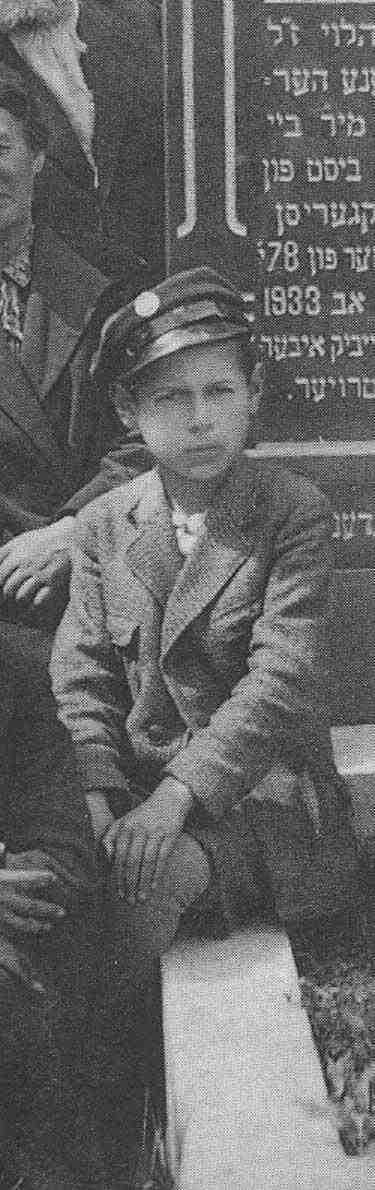
Figure 1.--This photograph shows a Jewish Polish boy (about 11 years old) sitting in front of the newly unveiled tomb of his family. I think the name of the family is Samuelson, and the boy seems to be a close relation. The family seems to have been quite affluent. He wears schoolboy clothes--a tweed short trousers suit with long tan stockings and peaked school cap. The photo was taken at Piotrkow Trybunalski (obviously in a Jewish cemetery) in 1933.
Poland before the September 1939 German invasion had one of the largest and most vibrant Jewish communities in the world. The diaspora only included larger Jewish populations in America and the Soviet Union. Poland was an especially important center of Jewish cultural and religious life, not only because of the size of the Jewish community but because large numbers of Polish Jews, unlike German Jews, were not assimilated into wider Polish society. Poland had a long history of openess to Jews in a still Catholic Europe seething with anti-semitism. Toland from the XIth century onwards had accepted Jews fleeing persecultion in from Austria, Germany, Hungary, Italy, Portugal, and Turkey. In many countries the Jews were persecuted, restructed to ghettos, and often robbed, brutalized, and killed. Several countries including England, Spain, and Portugal expelled them entirely. The Holu Office of the Inquisition was tasked with ensuring that converted Jews ("conversos") were not secretly practing their faith. The Jews in Poland were permitted freedom of religious worship, the right to live in their own communities by King Casimir the Great in the 14th century a dispensation that was reaffirmed by later kings of Poland.
Antiquity
Jews have alomg history in Poland. There is, however, no record that we know of about Jews as far east in Europe as modern Poland during classical times. This was of course far beyond the reach of the Roman Empire. Jews first arrived in Europe during the Roman Empire. They were never persecuted like Christians. At first there was no real problem, even after Constantine first legalized and then adopted Chrstianity as the official religion of the Empire. Few Jews ventured outside the confines of the Roman Empire. As a result, after the Roman supression of the Jews in Palestine and the resulting Diaspora, most Jews were found in urban areas of Western Europe and North Aftica. Christian Jewish rekations at forst if not cordial were not hostile. This gradually changes as the Christan church eliminated the various cults and eliminated paganism. The only other religion tolerated was Judaism.
Poland had a long history of openess to Jews in a still Catholic Europe seething with anti-semitism.
It is unclear when the first Jews arrived in Poland. It appears that some Jews had reached Poland (10th century). The earliest Jews appear to have been merchants rather thn settlers. The first known account comes from Spanish scholars. Spain at the time was the most culturlly advanced, not unrelated to the relatively tolerant atmosphere. Ibrahim ibn Jakub was a Jewish merchant and diplomat from Tortosa,Spain. He writes about a journey east which includes a description of Krakow. It is at this time that a Polish state was beginning to form. Ibrahim's account mentions the first Duke of Poland--Mieszko I (965). Ibrahim was surely not the first Jew to visit Poland, but he was the first to write about it. He does not describe any ill-feeling toward Jews. Presumably other Jews at this time were traveling and tradeing in Piast Poland. Surely some hd begun gto settle in Poland at this time. They would have primarily been involved with commerce and crafts. With the onset of the Crusades in Europe, the Christian West became increasingly hostile toward the Jews in their midst. Country after country banished Jews. Many of these Jews sought refuge in the east, especially Poland.
Poland from the 11th century onwards accepted Jews fleeing persecultion in from Austria, Germany, Hungary, Italy, Portugal, and Turkey. In many countries the Jews were persecuted, restricted to ghettos, and often robbed, brutalized, and killed. Several countries including England, Spain, and Portugal expelled them entirely. The Holy Office of the Inquisition was tasked with ensuring that converted Jews ("conversos") were not secretly practing their faith. The Jews in Poland were permitted freedom of religious worship, the right to live in their own communities by King Casimir the Great in the 14th century a dispensation that was reaffirmed by later kings of Poland.
Jewish Homeland: The Polish-Lithuanian Commonwealth (15th-18th centuries)
European Jews, driven from the Christian kingdoms of the West (14th-16th centuries), gravitated east during the Medieval era where they were welcomed by Polish kings into the Polish-Lithuahnian Commonwealth (1384�1795).
One historian writes, "Jews were the only signidicant non-Christian group tolerated in Western Christendom, and they florished in Polish-Lithuanian Commonwealth." [Polonsky] This area of Eastern Europe becamne a kind of Jewish homeland, the world center of Jewish life. The Jews lived here for half a millenium constructing a vibrant community within Christian lands. [Polonsky] Toleration and the political situation varied over time. Poland and the Grahnd Duchy of Lithuania had earlier dynastic connectionsm but united formally (1569). This brouught the Ukraine under the control of Lituania to Polabnd. Italso opened the Ukraine to Jewish emigration. Polish colonization of the Ukraine followed (16th-17th centuries). Jews helped Polish nobels turn their new lands into profitable estates. It is at this time that the shtetl emerges. This was a private town owned by a nobelman--a kind of company town in modern parlance. It was largely outside royal control and allowed to manage its own affairs. These were largely stable times in which the Jews could live and develop a destinct culture. Here the major trends inn Jewish religious and community life emerged. Jews prospered under the Commonwealth and were largely free of discrimination. The Commonwealth was a kind of aristocratic republic dominated by the landed aristocracy. This had the impact of marginilizing the two groups politically that were most likely to discrimate against Jews: the Christian burghers of the city and the Catholic Church. Jewish political autonomy thus became an integral part of Polish Commonwealth. Jews selected their own rabbis and communal councils. These authorities collected taxes, both for the community and the Commonwealth. Jewish councils had direct relationship with high officials of the Commonwealth. There was thus a critical relationship with the Commonwealth. Reverses felt by the Commonwealth had serious consequences for the Jews. Bohdan Khmelnyts'kyi led a Cossack rebellion against Polish colonization of the Ukraine (1648). The Cossocks kilkled some 13,000 Jews in the Ukraine at this time. [Polonsky] As the power of Tsarist Russia increased and that of Poland declined, much of the area where these Jews lived came under the control of Tsarist Russia and to a much lesser extent Prussia ahnd Ausrtria. The final step was the Polish Partitions (1772-95). As Tsarist Russia gained control over both the Ukraine and Poland, a state without Jews abd hostile to them became the largest Jewish state in the world. Tsarist rule proved much less benign than Polish rule.
Cultural Diversity
Poland because of its openess and tolerance attracted attracted Jewish immigrants during the medieval era and as Europe moved into the modrn era had the largest Jewish population in Europe. Thus Poland became an important center for Jewish leaning and culture. Poland became the major center for Ashkenazi Jewery (central and eastern European Jews). There were also Sephardi Jewery (southern European Jews), especially after the expulsion of Jews from Spain and Portugal (1492-96). This and earlier Jewish immigration from soutern Russia and the Near East resulted in a wide range of religious and cultural diversity.
Polish Anti-Semitism
Anti-Semitism was more limited in Poland than the rest of Euyrope, but it should not be thought that it did not exist. Polish anti-Semitism had its roots as in the rest of Europe with the Church. Church teachings led to dark thoughts about the Jews. Priests spread rumors of Jewish ritual murder of Christian children. The idea had been ridiculed by Polish authorities. These and other calumies fed into an atribute of humanity that all tom often, but not always , the fear and often loathing of people who are different. And the Church was veryinfluential with the peasantry. When supported by religious teachings this can become dangerous. We see this in many Muslim countries today. Another group which came to resentv theJews were the Christian burghers of the cities. These were people who sometimes found themselves competing with Jewish merchants. These were groups that helped drive the Jews from Western Europe.
What made Poland different was that the landed nobility which contrilled the Commonwealth in effect suppressedthe political ambitiins of both these groups and prevent them from using state power to supress or curtail Jewish life. It was with the decline of the Commonwealth that Polish anti-Semitism began to intensify. After the Polish Partitions someJews faced with the reality of Tsarist rule supported Polish nationalist resistance. This did not prove productive. Not only did Tsarist authirities throughly supress natiinlistv risings, but efforts of Polish patriots tonorganize peasants and workers often had the impact of mobilizing traditional Christian prejudices inplanted by the Church. Ahd the Jews underTsarist rule faced this rising tide of prejuduce without the protection of the now defunct Polish-Lithuanian Commonwealth. And the new Russian authories often truly believed the lies about Jews such as participation in ritual murder.
Hasidism
Almost all of the important movements in Jewish life until the 20th century emerged from the Jewish himeland in Eastern Europe, especially Poland. This it is understandable that Hasidism developed and florished. After the toleration of the Polish-Lithuanian state was replaced by the hostility of Tsarist officials, Hasidism florished. Often a minority comes to see itself as they are viewed by the larger, dominahnt majority group. This happened with Eastern European Jews. Many came to see themselves not as a religious group , but as a separate people or nation. This is why Christian Polish emigrants to Ameruica udentified themselves as Poles, while Jewishn emigrants saw themselves as Jews. As this identity confiormned with the Hasidic outlook, Hasidism florished in Poland. [Polonsky]
Modernity
18th Century
The Jewish community in Poland flourished. Poland's Talmudic religious academies were famed throughout Europe. Orthodox hasidism first appeared in the 18th century in the area of Podolia and spread to much of southeastern Poland. The hasidic sect produce generations of illustrious families who remained apart from Polish society to practice their religion. Chassidim, a movement for religious renewal, appeared. Another
movement sprung from was Podolia (in the modern Ukraine) and was led by Baal-szem-tov (1700- ). There were also progressive movements influenced by the Enlightenment. The most important was the Maskilim who promoted assimilation. All of this occurred within the back drop of the Polish state and its evebtual disappeance in the Polish Partitions (1772-95). Most of Poland becane part of the Russian Empire with smaller parts going to Prussia and Austria. Russia before the Polish Partitions had only a small Jewish population. And as the Tsarist Empire expanded, Jews were either expelled or masacred. The Polish Partitions broufht large numbers of Jews under Russian control. The answer as to how to deal with the new Jewish subjects was the Pale of Settlement. created by Tsarina Catherine the Great (1791). The original Pale was gradually expanded.
19th Century
Jewish communities throughout Europe in the 19th century moved toward assimilation. Gradually they achievd citizenship and civic rights. The situation for Polish Jews differed because the country was split between Russia, Prussia, and Austria and thus faced varying policies and legal stuctures. Many Jews welcomed the opportunities afforded. Other clung to their religious traditions. Jews played an important role in the economic development of Poland. Jewish entrepreneurs, bankers, industrialists, and merchants were important in helping to develop an industrial economy. Several Jewish families played especially prominant roles: the Kronenbergs, Natansons, Epsteins, Toeplitzes, Wawelbergs, Rotwands, Fajanses, Reichmans. Jews were prominant in developing modern banking, industry, and commerce. Jews were heavily involved in the sugar refining, textile, paper, and mechanical industries. They were also involved with transportation, railways and river traffic on the Vistula. The Wawelbergs and Rotwands founded one of the first polytechnic colleges in Poland. Jewish literature flourished in Poland during the 19th and early 20th century. Some of the leading writers were Isaac Loeb Peretz, Sholem Asch, Yitzyk Mander and the subsequent Noble Prize winner, Isaac Bashevis Singer.
Polish Independence Movement
Jews were actively involved in the various movements to regain national independence following the Polish Partitions. A colonel in the Polish Army, Berek Joselewicz, formed a Jewish cavalry regiment took part in the Kosciuszko Insurrection resisting the Third Partition (1794). Colonel Joselewicz was finaled killed during the battle of Kock (1809). Jews were involved in the November Insurrection against the Russians (1830-31) following the Napoleonic Wars. Jews were also involved in the January Insurrection (1863) and the 1905 Revolution.
Tsarist Repression
World War I (1914-18)
Poland was a major battlefield of World War I. Poles were split as whether to support the Allies or Central Powers. Many Polish Jews enlisted in the warring armies. Tsarist Russia had obtained most of Poland in the Polish Partitions, including Warsaw (18th century). Portions of westtern Poland were occupied by the Germans and Austrians which did not enforce many Tsatrist proscriptions on Jews. This was a complicated decesion. The Western Allies were democracies which supported to a degree the nationalist aspirations of some of the ethnic groups in the Austro-Hungarian Empire. This became a major issue once America entered the War and President Wilson proclaimed his Fourteen Points. On the other hand, Russia which were a major part of the Allied coalition, was an autocratic state which not only had aide range of anti-semetic laws and regulations, but fomented vicios pogroms against Jews. Thus when the German Army occupied Poland (1915), many of the Tsarist restrictions on Jewish life were lifted.
Poland before the September 1939 German invasion had one of the largest and most vibrant Jewish communities in the world. The diaspora only included larger Jewish populations in America and Russia. Poland was an especially important center of Jewish cultural and religious life, not only because of the size of the Jewish community but because large numbers of Polish Jews, unlike German Jews, Many Polish Jews were not assimilated into wider Polish society. Polish Jews were concentrated in urban areas, including cities and towns. Many city Jews were assimilated in the sence that they cuilturally similar to other Poles, although they did not mix with Christian extensively with Christian Poles, in part because they were not widely sccepted. Few Jews lived in the countryside, but there were many Jews living in rural villages--the stetl. Here we find many Jews that were not at all assimilazted with Chritian Polish society. As a result, many Polish cities had a strong Jewish influence. Thr capital Warsaw had a population that was 40 percent Jewish.
The status of Poland's Jews improved after World War I and the end of Tsarist rule. Poland achieved its independence after World War I. The status of Jews was a major issue in the new Polish Republic. Marshal Pilsudski rejected anti-Semitism. There were improvements after the 1926 coup. The military government granted legal status to Jewish communal organizations, the kehilot (1927). The communal groups became the channel by which Jewish institutions and social services were funnded. Marshal Pilsudski died (1935). Without his moderating influence, Polish politics and economics became increasingly ethnic-nationalist.
A network of Polish cooperative stores, foir example, was establish in Western Galicia so that ethnic rural Poles would not have to deal sith Jewish shopkeepers. The Jews were not the only target of rising Polish nationalism. Another important minority in eastern Poland were the Ukranians. The rise of Fascism in Europe with its ultra-nationalist message did not leave P{oland unaffected. The intensified nationalist stridency led toward the the marginalization of Jews. There were political leaders who struggled against this trend, but they were a minority. Government-sponsored anti-Semitism began to take on a more virulent character in the late 1930s. Polish anti-Semitism received significant religious legitimacy from the Roman Catholic Church. This came from the Polish Catholic hierarchy and not just individual priests. Cardinal August Hlond, the newly appointed primate of Poland, issued the POLISH Church's prescriptions against Jews in a very widely disseminated pastoral letter (!936).
Until the NAZI invasion in September 1939, Jews were an important part of the life of Poland and other eastern European countries. Some Jews assisimalted into main-stream Polish society. Others Jews lived apart in the rural steltls. The chidren and adults had their own destinctive clothing and haircut styles. That culture has been wondefully documented in Children of a Vanished World, a stunning record of moments, frozen in amber, of children in the European ghettos of the 1930s, before their culture and ultimately their lives were so ruthlessly destroyed. The book includes photographs, music, and poetry, in English and Yiddish. The book's author, Roman Vishniak, took the photos, some with his camera hidden, between 1935 and 1938 in Poland and Russia, Romania and Hungary. Most Polish Jews, especially in the shtetls, spoke Yiddish (J�disch).
Isaac Leib Peretz, Sholem Aleichem, Sholem Asch and Isaac Bashevis Singer all wrote their books in Yiddish, however, they are printed in Hebrew script.
World War II
No country suffered during World War II more than Poland. Of all the terrible situations during World War II, Poland was the worst place to be and the Polish people suffered terribly. Poland was part of an alliance with Britain and France that confronted the NAZIs in World War II. Both Poland and France were defeated and occupied. Unlike the French, Poland continued to resist and was a valiant and valued ally throughout the War. World War II began with the German invasion of Poland (1939). The Soviets of course also invaded Poland in 1939, but Britain and France wisely only declared war on Germany. About 100,000 Jewish soldiers found themselves in the ranks of the Polish Army at the start of World War II in September of 1939. Many were killed and wounded on the battlefield. For the duration of the war, many Jews were in the Polish Armed Forces in the West, in the Polish People's Army formed in the Soviet Union, as well as in civilian resistance movements and guerrilla detachments. Many lost their lives or were wounded; very many received the highest combat distinctions.
Poland had one of the world's largest and most vibrant Jewish communities dateing back to the medieval era. Poland had the largest Jewish population in Europe with the exception of the Soviet Union. Poland was the center of the NAZI Holocaust of the Jewish people. The German invasion and seizure of western and central Poland made it possible to perfect the process of killing Jews. There were some if limited constraints on the NAZIS in German. There were no constraints in Poland. Heydrich in September 1939 layed out the NAZI plan for the Jews to SS officers. The NAZIs proceeded to concentrate the Jews into ghettos, a medieval institution, where they were easily accssible fortransport to the death camps built nearby. The death camps were located in Poland not Germany. And in Poland the Germans found many willing to help them and few Poles intersted in protecting the Jews. Einsatzgruppen began killing Polish Jews with the German invasion (September 1939). This was done, however, in relatively small numbers. Most Polish Jews were forced into the new ghettos which after the viloence directed at them semed almost a haven. It also gave the NAZIs the opportunity tocompletely strip threm of their property and restrict consumtion of food and other consumer products as well as to force them into slave labor. The impetus for murder outweighed the benefits of slave labor. The SS largely liquidated the ghettos (meaning murdered the Jews in them) during 1942 following the Wannsee Conference: Lublin (March 1942); ghettos of Eastern and Western Poland (Spring 1942); and the Warsaw Ghetto (July-September 1942). Hitler had largely succeeded by 1943 in destroying the once vibrant Jewish community of Poland. The death camps in Poland were also used to kill the Jews in NAZI occupied western and southern Europe.
Jews were incredably the target of violent attacks after World War II. Many of thge small number of Holocaust survivors did not want he NAI World War II Holocaust essentially suceeded in destroying Poland's once large, vibrant Jewish community. Many of the pitifully small number of survivors did not want to returned to their pre-War homes and destroyed communities. And some of those who did return were increbably attacked by their Polish neighbors. This occurred in the immediate aftermath of the War (1946-47). The Communists and Soviets were responsible for many attrocities in Poland. There are differences of opinion as to the extent of these attacksand who if anyone inspirted them. It is a subject that was generally covered up by Poland's post-War Communist givernment and a general public desire to paint the nation as victims and heros in the struggle against the NAZIs. We certainly do not want to suggest that Poland did not bravely stand up to Hitler and play an important role in the struggle. And there was relatively little colaboration in Poland with the NAZIs, with the exception of the Holocaust. And there does seem to be some truth to the claims that many Jewish survivors were attacked or otherwise abused by Poles after the War. [Gross, Fear.] The Polish Government immediately following the War, opened its borders to allow free Jewish immigration. While the post-War Polish Jewish community was a fraction of its former self, it played a role in Cold War politics, primarily because of the Doviet desire to gain Arab support in the Middle East.
Families
We do o yet have much information on Polish Jewish familie. We do note the Admor family in 1935. The family patrirch was rabbi. They were an urban family living in what looks like a suburban neighborhood.
Sources
Polonsky, Antony. The Jews in Poland and Russia 3 volumes (2012).