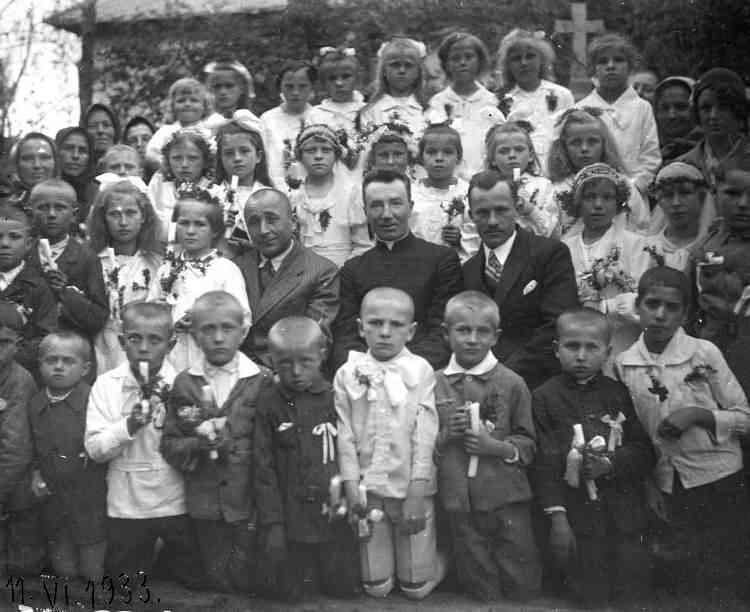
Figure 1.--Poland is a largely Catholic country. The Catholic Church has played a major role in the country's history. Here we see Polish children taking their First Communion in 1933. Notice that most if the boys have cropped hir. |

|
Polish family images are very useful because they put boys clothes into the context of what the whole family was wearing, the parents and sisters, at the time. Much of our HBC discussions are based on individual portraits without any wider context beyond the background, but before the 20th century this was mostly studios backdrops which are not very informative. These family images arranged chronologically provide fascinating grimes as to how family clothing changed over time and how boys' fashions changed with those of adult men and the rest of the family. With the 20th century and family snapshots we often get to see the family cars (until after World War I mostly dealing with America) and homes (both inside and out) and all kinds of details about family life. These family images also provide interesting insights into family relationships as well as family trends over time. This offers all kinds of fascinating sociological insights. This level of information provides this kind of detail on families around the world for the first time in human history. Until the 20th century, anthropologists an sociologists could only guess about such matters. With Poland we notice the importance of the Catholic Church. Also Polan was a largely agricultural country well into the 20th century, impacting family life. This brings out a weakness in photography. The level of coverage is impacted by income. Thus we have lots of images of well to do urban families and relatively few of poorer rural families.
Geography has played a major role in shapeing Poland. The country's location on the northern European plain has left it open to invasion fro both east and west. And that plain has left the country without easily defenseable frontiers which also left its borders clearly defined. Poland was in the early Medieval period a land without central control, racked by warring tribes. Prince Mieszko I was baptised in 966. Mieszko and Roman Catholic Christianity provided stability and cohesion for the first time. Poland had by the 17th century had become the largest state in Europe. It played a major role in stopping the expansion of the Ottoman Empire into Europe, helping to save Vienna. An elected kingship and the power of the nobility significantly impaired the development of a strong national state. Despite important reforms in the late 18th century, Poland was partioned between Austria, Prussia, and Russia and the Polish monarchy ended. Napoleon was aided by Polish nationalists in his campaigns against Austria and Prussia, but his devestating defeat in Russia, ended any hope of a restored Polish monarchy as the peace was dictated by the very powers that had partioned Poland. Poland did not reappear until after World War I destroyed the three great European empires (Austria-Hungary, Germany, and Russia). It was Poland that first stood up to Hitler and the NAZIs and payed a terrible price. Poland after World War II had to endure a Stalinist dictatorship. While absorbed into the Soviet Eastern European empire, Poland proved to be a very troublesome acquisition. And with the advent of Solidarity, it was in Poland that the Soviet empire began to unravel.
Divided Germany and Korea during the Cold war were test cases for the relative merits of Socialist and Capitalist economics. The prosperity brought by capitalism was telling. In the same sence, the economic experiebces of Poland and Russia are anoyher test case. Russia never gave capitalism a chance after the fall of Communism. Poland did. It not only privatized the economy, but created a legal system and democratic political system to support it. The two countries shared many similarities, although Poland does not have the oil resource that Russia has to keep the economy alive. The first years of the transition were very difficult as inefficent Communist-era concerns were closed. People lost jobs. There was also the enormous environmental damage that had to be addressed. The results, however, have been starteling. The Polish economy is becoming a high income economy. It is one of the success stories of the post-Soviet era. Poland is now the sixth largest economy in the European Union and unlike many of its EU partners, a fast growing economy. And also unlike its partners, Poland wethered the 2008-09 recession without a drop in GDP. Percapita income (PI) is still below that of Western Europe, but the gap is narrowing. Comparison by international groups (World Bank, International Monetary Fund, and others) vary. Some suggest that the Polish and Russian PI is comparable, others that the Polish PI is somewhat higher. This is misleading, however, because a substantial portion of Russian production comes from oil exports. If the extraction center is sepsrating from the profuctive sectors, Poland's PI is much higher than Russia and that gap is widening.
Poland has played a crucial role in the history of Europe. Poland was for centuries the most powerful kingdom in eastern Europe. It was Polish forces that saved Vienna from Ottoman armies in the 17th century. Yet in the 18th century, Poland disappeared from European maps, partitioned by three powerful empires: Russia, Prussia, and Austria. Yet through two centuries of foreign domination, Poland remained alive in the hearts of her people. The idea of Poland was maintained by language, culture, and the Catholic church. Poland and Ireland, two conquered peoples, became the most Catholic countries in Europe. Poland was reborn after the horrors of World War I, but conqured again by the NAZIs on 1939. The NAZIs sought to destroy the idea of Poland with finality, attacking Polish culture and the church. A new Poland was reborn in 1945, but moved east by the Soviets and subjected to a Stalinist dictatorship. Modern democratic Poland was reborn in the 1980s as the Solidarity trade union movement succeded in freeing the country from Communist rule. These political trends have significantly affected fashion trends in Poland.
We have very little information at this time on the garments worn by Polish boys. Polish boys wore many of the same fashions worn by other European boys. We note Polish boys wearing broad-brimmed sailor caps. Sailor suits seem to have been very popular despite the fact that ther was no Polish navy. As in the rest of Europe, the sailor suit was a popular fashion for boys in Poland during the late 19th century and early 20th century. This was true despite the fact that Poland was not an independent country until 1919 and had no navy. Few details are avilable to HBC on destinctive Polish fashions or the popularity and styles of various garments. We have seen boys wearing cossock-inspired Russian blouses-- especially with folk costumes. As in other European countries, boys commonly wore short poants in Poland until the 1970s. Long stockings were worn until about the 1970s when tights became more popular. Polish boys like German boys wore long stockings well after they went out of style in many other European countries. Polish readers inform HBC that tights were also common, although we do not know when they first appeared. As in East Germany, they appear to have replaced long stockings. Polish boys in the 1980s commonly wore tights. Tights continued to be widely worn by boys in the 1990s although perhaps not quite as commonly in the 1980s.
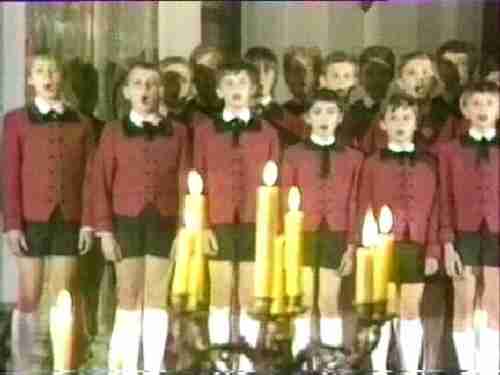
Here we will archive information on the activities persued by Polish boys and the destinctive costuming associated with those activities. Some clothing is specifically associated with specific activities. This has become more common as Polabd became more affluent in the 20th century. There are schoool, work, and play clothes as well as dress up outfits. This will include information on Polish choirs, dancing, music, schools, sports, and other activities. We also have developed some information on Polish youth groups. Many of these outfits seem similar to clothing worn in other countrues, especially Germany and Russia. Germany has probably had more influential in the early 20th because of cultural affinities, especially Catholocism. This may have changed after World War II when Poland disappeared behind the Iron Curtain. But even here East Germany continued to be an important influence.
|
We do not have much information about Polish boys' hair styles at this time. As far as we can tell, Polish boys had hair styles very similar to Russian and German boys as Eastern European boys in general/ Most of Ploland in the 19th century was part of the Russian Empire, but smaller regins were part of Germany and Austria-Hungary. We note many boys in the late 19th and early 20th century with close-cropped hair. Boys from affluent families were more likely to have hair long enough to comb. A good example is two Polish brothers in 1918. These close cropped cut continued in Poland even after World War I and independence even though they became less common in neighboring Germany. Close cropped hair does seem to go out of fashion after World War II. A Polish reader explains how Hippies introduced long hair styles in Poland. After Khrushchev launched the de-Stalinization campaign, Poland gradually gradually began to liberalize. It was still a Communit police state, but not a Stalinist one, leaving room for even small Hippy movnrnt and gudgingly, long hair. Many of Poland's Hippies now have impotant government posts.
Polish family images are very useful because they put boys clothes into the context of what the whole family was wearing, the parents and sisters, at the time. Much of our HBC discussions are based on individual portraits without any wider context beyond the background, but before the 20th century this was mostly studios backdrops which are not very informative. These family images arranged chronologically provide fascintating glimes as to how family clothing changed over time and how boys' fashions changed with those of adult men and the rest of the family. With the 20th century and family snapshots we often get to see the family cars (until after World War I mostly dealing with America) and homes (both inside and out) and all kinds of details about family life. These family images also provide interesting insights into family relationships as well as family trends over time. This offers all kinds of fascinating sociological insights. This level of information provides this kind of detail on families around the world for the first time in human history. Until the 20th century, anthropologists an siocialogists coul only guess about such matters. With Poland we notice the importnce of the Catholix Church. Also Poland was still a largely agricultural country into the 20 century, impacting family life. This brings out a weakness in photography as a sociological indicator. The level of coverage is impacted by income. Thus we have lots of images of well-to-do urban families and relatively few of poorer rural families.
We do not yey have much information on individual or contributions from our Polish readers concerning their own clothing and experiences. We do note the Witak brothers in 1927.
Large numbers of Poles emigrated during the 19th ad early-20th century. Smaller numbers emigrated during the later-20th century.
This is a little difficult to follow, because at the time that the largest nymbers emigrated during the late-19th and early-20th century, mPoland did not exist as a nation. Poland had been partitioned among the three great European empires (Austria-Hungary, Germany, and Russia). Most of the emigrants came from the Polish territories of Russia and Austria. Emigration from the German area of Poland was largely internal, seeking jobs in the industrial cities of Western Germany. Apparently 3-4 vmillion Poles emigrated duringv this period. Most went to America, probably about 2.6 milliom Poles. The Poles were mostly Catholic, but large numbers of Polish Jews fled the Russian-controlled area of Poland.
We note boys in rural areas wearing a range of regional folk costumes. We do not note any destinctive Polish garments, but tese folk styles have influenced detailing on Polish clothing. Our infrmation here is limited. We note peasant shepard teenager from the Zakopane area of Poland in the Carpathian Mountains.
Polish minority groups have varied substantially over time with the rise and fall of the the fortunes of the Polish state. Poland emerges as a European state as the Polonia, a Slavic tribe becomes premenent (10th century). Poland for a time was a vassal state of the German emperor, but after unuin with Lithuania became a major power including many nationalities (Germans, Jews, Lithuanuians, and others). The success of the Polish nobility in undermining the monarchy destroyed the Polish state which disappeared with the Polish partitions. At this time the Jews were the principal minority. Poland emerged as an independent state after World War I (1914-18) and in the war with the Bolshevicks gained large areas in the east populated with Balts, White Russians (Belorussians), Russians, Ukranians, and others. The NAZIs largely destroyed Polish Jews in the World War II Holocaust. The Poland recreated and moved west into German territory by the Soviets after World War II was a much more purely Polish ethnic state.
we do not have much information on Polish charity institutions. Througout Europe, the Christian Church was the only provider of charity. Civil government was not signinificantly involved in charity, although some rulers were known to give alms. Poland for much of its modern history was a part of the Russian Tsarist Empire, a Catholic enclave in a largely Orthodox Christian realm. As far as we know virtually all charity work done during the Tsarist era the work of the Catholic Church. The Polish Woman's League, a charitable and patriotic organization, was orgnized even before the undependent Polish state (1913). [Appelbaum, p. xx.] This Church's dominant role largely continued after World War I and the reserection of an independent Polish state (1918). We do note the establishment of the Polish Red Cross, a secular charity. The American Relief Administration operated a massive relief effort to save starving Polish children after World War I and during Polish-Soviet War. The NAZIs during the World War II occupation allowed the Polish Red Cross to operate on a limited basis, a rare Polish instituion allowed to operte. At the end of the War, The United Nations Relief and Rehabilitation Administration (UNRRA), at the time meaning the United States and Catholic charities provided aid to a devestated nation. The Communist Party took over most charity institutions. In most of Eastern Europe they sucessfully did that, and in Poland suceeded with groups like the Red Cross and Polish Woman's League. The Polish Church proved more resiliant. The Government restricted fund drives and access to children which limited the work the Church could do. The coal of the Communist Party in addition to an atheist campign was to control all aspects of civil society.
We have not yet archived any Polish catalogs in the HBC archive. We know there were some, but at this time we have virtually no information. We have some items from the early-20th century. At the time, most of Poland was part of the Tsarist Empire. A reader has sent an illustration from an unidentified 1904 catalog with an outfit for a boy and girl. The catalog was punlished in Polish. The items pictured could have been from any European country. We have also found a catalog page from a the Lev Rubasskin store in Lodz during 1912. The fashions here also look similar to the styles worn throughout Europe. Lodz was part of the Tsarist Empire. Lodz was a city largely populated by ethnic Poles and Polish speakers with a substantial Jewish population. The catalog was published in Russian. We have no information at this time on the inter-War era when Poland had achieved its independence. We think that there wsere catalogs. After World War II the Soviets imposed Communism and a socilaist economy on Poland. As far as we know thee were no mail order catalogs in Poland during the Communist era. We think this was a common phenomenon in all Communist countries. The inefficencies of socialist economics meant that there were huge shortages of consumer goods, thus there was no need for either advertising or mail order catalogs to facilitate sales. Polish socialist enterprises were unable to satisfy consumer demand through brick and motar stores, let alone mail morder dustribution. The problem for Communist Poland as supply was inadequte was to limit, not increase demand. This is part of the reason that Communist countries and socialist economies always fail. Those that survive only do so because they are police states.
We do not yet have much information on Polish photography. At the time photographt was developed, Poland had been partioned by the the three great European empires (Austria, Prussia/Germany, and Russia). Most of Poland had been absorbed into the Tsarist Empire. Thus photographic developments were strnly ffected by the photographic industry develoopments in those countries. We do not know of any techical innovations from Poland, but news of the ealy developments reaced Polad very quickly after the develomnts mostly in England and France. There were repoty published in important journals and aklmost immeduated interested indiciduals began experimenting. The first Daguerreotypists wre more like scientists or event artists than commercial photographers. They experimented with Talbotypes (calotypes) and Daguerrotypes. Andrzej Radwański is believed to have produced the first Daguerrotype (1839). Polish Dags are rare, but they are generally much less common throughout Europe than was the cse of America. The painter artist Marcin Zalewski in Warsaw was a noted Daguereotypists and considered to be the father of art photograpgher. Other importaht Daguerreotypists included: Jozef Gloisner in Lwów, Jan Stefan Kuczyński in Kraków; and Jan Moritz Scholtz. Scholtz was a respcted lithographer and published lithographic prints from his Daguerrotypes. Ambrotypes seem less common. Maksymilian Strasz, the Kielce district's head engineer, published a photography handbook (1856) that became a ind of Bible for Polish photographers. Dags dominated the industry into the 1860s when as in other countries, the albumen process and CDVs became the dominant format. And unlike Dags, they were done in substantial numbers, especially in western areas of Poland which were part of the German and Austrian Emmpires. Warsaw in the sarist section of Poland was also important. Tghe single most important Polish photographer during the 19th century was Karol Beyer. Polish photographers were active throughout the Tsarit territries, including St. Petersburg. We notice Polish photographers from an early point in in Ukranian citiesas well as far to the east in Siberian cities. his is interesting because it suggests that the Poles were a conduit for Western technology. Soon cabinet cards also appeared, but CDVs remained common until the turn-of-the 20th century. Then we begin to see snapshots, although the relative low incomes of many Poles meant that cameras and photogaph was not as prevalent as was the case in Western Europe, especially Germany. Even so we begin to see snpshots for the first time (1900s). e have not yet archived very many Poush snapshots, but we begin to see more after World War I in the 1920s.
The 1900s: Isaac Bashevis Singer
????: Walter Otto Fergusson Tepper
The 1940s: Along the tracks
Appelbaum, Anne. Iron Curtain: The Crushing of Eastern Europe (Doubleday: New York, 2012), 556p.
Davies, Norman. God's Playground.
Rulikowski, Józef Kazimierz. Bartoszewicz, J (editor) 1862, Urywek Wspomnień Józefa Rulikowskiego (Memoirs),( G Gebethner & R Wolff, Warsaw, 1862. This is an extensive memoir written by Józef Kazimierz Rulikowski (1780-1860). It
contains extensive information on Polish social customs, clothing and education. The text is available to download via Google Books. it has been used extensively by Polish historians on a whole range of topics. Unfortunately we do not have Polish language capability. We would welcome any imformation from the memoir that readers may be able to provide.

Navigate the Boys' Historical Clothing Web Site:
[Return to the Main European country page]
[Introduction]
[Activities]
[Biographies]
[Chronology]
[Clothing styles]
[Country]
[Photography]
[Bibliographies]
[Contributions]
[FAQs]
[Glossaries]
[Images]
[Links]
[Registration]
[Tools]
[Boys' Clothing Home]
Navigate the Boys' Historical Clothing Polish pages:
[Polish choirs]
[Polish movies]
[Polish orphanages]
[Polish school uniforms]
[Polish sailor suits]
[Polish youth groups]
Navigate the Boys' Historical Clothing Web Site:
[Return to main country page]
[Australia]
[Canada]
[England]
[France]
[Germany]
[Ireland]
[Italy]
[New Zealand]
[]
[Scotland]
[United States]