
America Immigration: Polish Immigrants
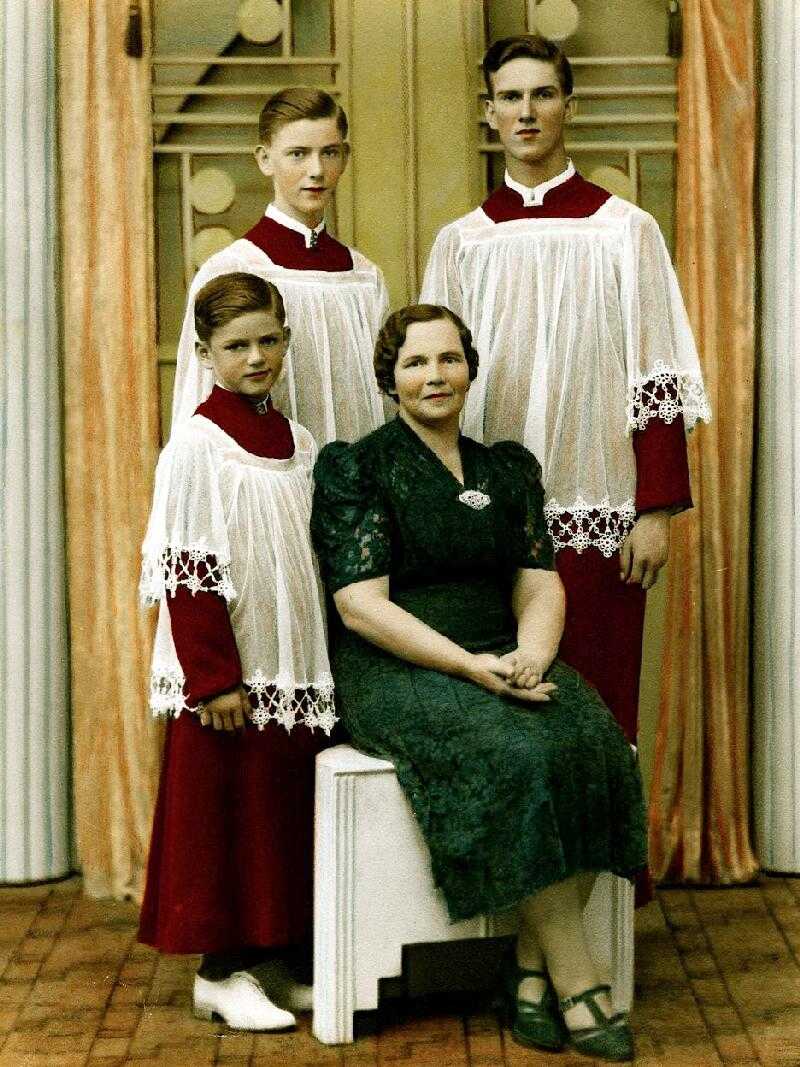
Fifure 1.--This is an unidentified Polish-American family from Detroit, one of the industrial Mid-western cities with large Polish populations. The colorized portait was taken in the 1930s. The Catholic Church was a very important part of the Polish communities shich forfmed in the Mid-Western cities. Here all three of her sons served as altar boys.
|
|
After the Irish and Italians, the Poles were the largest group of Catholic immigrants from Europe. At the time they arrived, however, Poland did not exist. Most Polish immigrants came from Russian-controlled Oland and to a lesser extent Austro-Hungarian-controlled Poland. Polish immigration to America exploded in the late 19th century. A range of factors were involved, including both economic factors and the Tsarist's regime's steps to promote Russification of the ethnic minorities in the Empire. Exact numbers do not exist as Poland did not exist at the time and emmigration records were based on the country of origin, meaning mostly Russia. Census records are the best available source ad by 1910 about 0.9 million Poles had reached America. Polish immigration declined after World war I, both because Poland gained its independence and the United States resticted immigration. Available estimates suggest that 2 million Poles had immigrated by the 1920s Many Poles came to Ameica intending to return with a nest-egg saved up. In fact most Polish immigrants stayed. The fact that until after World War I, there was no independent Poland. Today one finds the descendents of Polish immigrants spread all over America. One researcher working on immigration describes how in a private conversation he first addressed the priest in Panna Maria in standard Polish and he was amazed to hear his own Annaberg (Silesia) dialect spoken in return. The name Panna Maria was given to the colony in honor of St. Mary's Church in Krakow. [Olesch] We note ??? Woycik who looks to be a second generation Polish-American boy. Another good example is John Czechatowski in 1928.
Importance
After the Irish and Italians, the Poles were the largest group of Catholic immigrants from Europe. More than 3.6 million people Poles are believed to have emigrated from what might be called Polish territories (1870-1914). Most are about 2.6 million reached the United States. Today about 10 million Americans identify themsledces as Polish-Americns.
Complications
At the time they arrived, however, Poland did not exist. Most Polish immigrants came from Russian-controlled Pland and to a lesser extent Austro-Hungarian-controlled Poland. This of course resulted from the Polish Partitiions (18th century). So Polish immigrants were registered from these countries. Another vfactor was that many immigrants from Poland were Jews. Many of these people thought of themselves as Jew rathers than Poles as did many of the Catholic Poles. And these Jews are generally described as Russian Jews rather than Polisgh Jews because Polabd at the time was part of the Tsarist Empire.
Very few Poles immigrated to the United states durfing the early- and mid-9th century. Polish immigration to America exploded in the late-19th century, mostly after 1880. A major factor was thge abolition of serfdom providing greater mobility to the rural population. They described themselves as "za chlebem" ("for bread") immigrants. country of origin, meaning mostly Russia. Census records are the best available source and by 1910 about 0.9 million Poles had reached America. Polish immigration declined after World war I, both because Poland gained its independence and the United States resticted immigration. Available estimates suggest that 2 million Poles had immigrated by the 1920s. There were two subsequent waves of Polish immigration, but with smaller munbers.
Poland suffered terribly during World War II. About 6 million of its 35 million people were killed, about half Jews. Enormous damade was done to the country, cities tows and villzages were destroyed are badly damages. Most busineeses were no longer functioning. If that was not bad enough, the Soviets proceeded to deport Poles in former eastern Poland. The Soviet Union then proceeded to install a Communist goverment. The KGB arrested and executed many Poles who had fought the NAZIS. Many Poles who had escaped NAZI occupztion and fought with the West were relictant to return to a Communist dictatorship with good reason, although a clear understanding of Communist policies was often not available. Enough was availzble to cause caution. Some families also got out before the Iron Curtain went up. Individuals varied on their understanding of the dangers. The people who came to America at this time included both the Poles who had fought in the West and solme who were able to escspe Communisdt Poland. They included
surviving political prisoners, dissidents, and intellectuals who were cared for in refugee camps all over Europe. Unlike the first wave, many were very well educated. Many when they arrived were more interested in assimilating into American culture than joining working-class Polish ethnic communities. A third wave of Polish immigrants came in the 1980s. The Communist Polish Government to prevent a Soviet invasion, declared martial law (December 1981). They were another groupm of highly educated immigrants. Some entered the country illegally.
Causes
A range of factors moltivated the great wave of Polish immigrants to the United States. Surely economic conditions were the most important. Ecom\nomic conditions in Poland, espedcially Russian-controlled Poland were poor with very limited opportunities. Many of the immigrants were illiterate and unskilled laborers. There were also political and religious reasons. The Tsarist's regime's steps to promote Russification of the ethnic minorities in the Empire focused on Poland more any other non-Russian group. Exact numbers do not exist as Poland did not exist at the time and emmigration records were based on the
Origins
Most Polish immigrants in the late-19th and cearly-20th century came from southern and Southeastern Poland (Carpathian and Tatra Mountains, Krakow and Rzeszow areas). These areas at the time were very poor and overpopulated. Few opportunities existed for Poles frfom poor families. This began to change in thr 20th century when the tourism industry began developing, but by this time the first World War I (1910s) and then U.S. immigration laws (1920s) closeing off large-scale immigrstion.
Returns
Many Poles came to Ameica intending to return with a nest-egg saved up. This was the same for Italians. Unlike many Italiahs, however, most Polish immigrants stayed. We are
unsure why this difference developed, but we suspedct that the fact that until after World War I, there was no independent Poland and Tsarist administration was increasingly repressive is a major factor.
Settlement
Today one finds the descendents of Polish immigrants spread all over America, but the primary Polish-American population centers are the industrial cities of the mid-West. Relatively few Polish immigrants attempted to farm. We are not erntirely sure why that was, but the inexpensive land in fertile areas was less available by the time the Ples began arriving in large numbers. ASt the same time, Americamn industry after the Civil War (1861-65) experience a period of rapid growth. Thus jobs in the expanding industrial cities of the Mid-west were available. As a result, about 90 percent of Polish immigerants settled in cities. Companies recruited Polish immigrants to work tghroughout the industrial Mid-West. This was especilly true of the Pennsylvania coal mines and the heavy industries (especially steel mills and slaughterhouses) of the Great Lakes (Chicago, Pittsburgh, Detroit, Buffalo, Milwaukee and Cleveland). This occurred in part because there was little access to schools in Russianp-controlled Polznd and thus many Polish immgrants were illiterate. This meant that industrial labor were the primary jobs opoen to them. Chicago came to be thde largest Polish city outside of Poland.
We are not entirely sure about Polish-American attitudes on European entanglements before Hitler launched World War II. There are a range of different often oposing threads among Polish Americans. Most were blue collar workers, many of which joined unions where left-wing influences were important. Poland after World War I fought a war for its national survival with the Bolsheviks--the Polish Soviet War (1919-21). Thus Polish-American workes were less suspetable to Communist propaganda than workers of other ethnic groups. Politically they were strongly Democratic and President Roosevelt was very popular. The Catholic Church was an important element in Polish national life and Polish immigrant communities. And the Church was strongly anti-Communist. Poles tended to view the Soviet Union as the greatest threat until the Munich Accords began to change the map of Europe (September 1938). We are not sure how Poles viewd the struggle between the Roosevelt Administration and the Isolationists in the late-1930s. Most Americans were strongly opposed to involvement in another European war. We are not sure to what extent Poles shared the genertal feeling, especially because Poland was not at first Hitler's target. A great deal has been written about Poland's impiortant contribution in the Allied victory. We have found, however, little information about Polish-American attitudes before the War. Polish-American attitudes are well known, of course, with the German invasion of Poland (September 1939). Polish-Americans became strongly anti-German and pro-interventionst. The Soviet Union also invaded Poland, but the American press primarily focused on the Germans. A complication here was that there was a strong strain of anti-Semitish among both Poles and Polish Americans. Childhood reminices tend to describe fights after school between Jewish and Polish boys. Generally the Poles were the agressors. While reports of attacks on Jews began appearing in the press, there was little reporting on the horrendous German and Soviet occupation policies directed at Christian Poles. The discovery of the mass graves of Polish officers in the Katyn Forrest confirmed the worst fears of Polish-Americans, although it was not at first clear who was responsible.
Individuals
One researcher working on immigration describes how in a private conversation he first addressed the priest in Panna Maria in standard Polish and he was amazed to hear his own Annaberg (Silesia) dialect spoken in return. The name Panna Maria was given to the colony in honor of St. Mary's Church in Krakow. [Olesch] We note ??? Woycik who looks to be a second generation Polish-American boy. Another good example is John Czechatowski in 1928. we notice an unidentified Polish-American boy also in his First Communion suit in 1929.
Sources
Jacobson, Matthew Frye and David Roediger. Special Sorrows: The Diasporic Imagination of Irish, Polish, and Jewish Immigrants in the United States.
Olesch, Reinhold. "The West Slavic Languages in Texas with special regard to Sorbian in Serbin, Lee County" in Glenn G. Gilbert, ed. Texas Studies in Bilingualism (Berlin: Walter de Gruyter, 1970).
HBC

Navigate the Boys' Historical Clothing Web Site:
[Return to the Main national origins page]
[Return to the Main U.S. immigration page]
[Return to the Main Polish page]
[Introduction]
[Activities]
[Biographies]
[Chronology]
[Clothing styles]
[Countries]
[Essays]
[Bibliographies]
[Contributions]
[FAQs]
[Glossaries]
[Images]
[Links]
[Registration]
[Tools]
[ Boys' Clothing Home]
Created: 6:50 AM 9/19/2006
Last updated: 4:56 PM 10/1/2013