|
Polish family images are very useful because they put boys clothes into the context of what the whole family was wearing, the parents and sisters, at the time. Much of our HBC discussions are based on individual portraits without any wider context beyond the background, but before the 20th century this was mostly studios backdrops which are not very informative. These family images arranged chronologically provide fascinating grimes as to how family clothing changed over time and how boys' fashions changed with those of adult men and the rest of the family. With the 20th century and family snapshots we often get to see the family cars (until after World War I mostly dealing with America) and homes (both inside and out) and all kinds of details about family life. These family images also provide interesting insights into family relationships as well as family trends over time. This offers all kinds of fascinating sociological insights. This level of information provides this kind of detail on families around the world for the first time in human history. Until the 20th century, anthropologists an sociologists could only guess about such matters. With Poland we notice the importance of the Catholic Church. Also Polan was a largely agricultural country well into the 20th century, impacting family life. This brings out a weakness in photography. The level of coverage is impacted by income. Thus we have lots of images of well to do urban families and relatively few of poorer rural families.
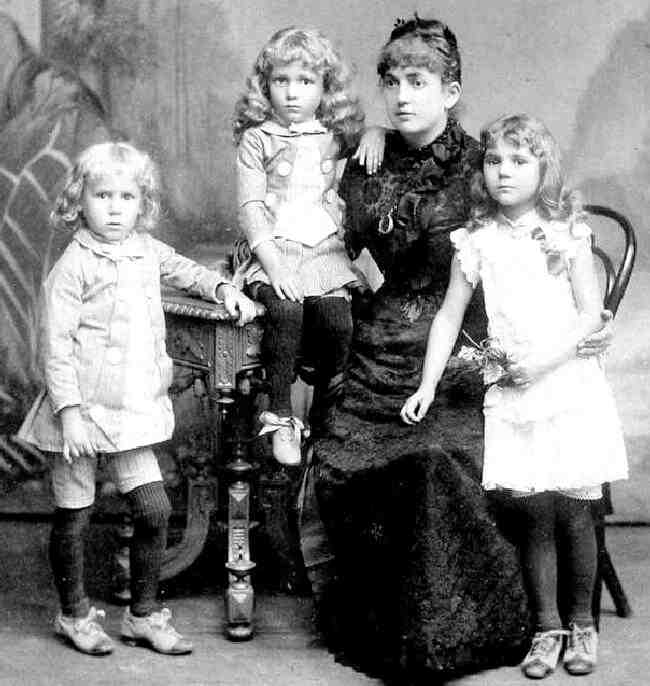
Here we see a Polish family about 1891, although the name sounds German. They lived in Olmütz which was in the Austrian or Prussian area. The young mother wears a black dress, perhaps she is in morning. She has three children, two boys and a girl. The girl wears a short-sleeved white dress. The boys wear a curious outfit. It looks raher like a tunic suit made to look like a jacket with large buttons. With it they wear kneepants and long black stockings. Their two-tone shoes are rather destinctive. While the boys and girls are dressed differently, they wear the same long stockings and shoes. Note the bows on the shoes. All of the chikldren have long hair. The boy in the middle has the longest hair. It looks to have been done in a wave, but is not done into ringlets.
Here wee see an unidentified family from Ciechocinek, a town in central Poland on the Vistula near Warsaw. We see a Polish mother with her two children, a boy and a girl, in 1908. The children look to be about 4-8 years old. The clothes look very similar to what German children would be wearing at the time. Notice the wde-brimmed sailor hats. The boy wears a sailor suit. The girl wears a plain white dress. Mother has a voluminous dress.
Here we have a family that is diificult to describe in nationality terms. The family is a mixed English-German marriage, in fact involving two aristocratic families. The family owned estats and coal mines in Silesia which became Polish after World War I. The German father became a Polish citizen. We do not know much about the boys, but the two oldest boys served with British and Poolish forces fighting the Germans during World War II.
The Jaroszynscy family was one of the ricest in the Tsarist Empire. Karol Lucjan Jaroszyński (1877-1929) was born in Babin, the family estate. He made his fortune in sugar refining and branched out into many other areas such as babking and tranportation there were three boys. A portrait by Kazimierz Mordasewicz is a good example of the artidst's upper-class clients was a portrait of Antoni Jozef (Jontek) and his brother Karol Benedykt (Karlo) in 1912 when they were, respectively 7 and 5 years old. The boys wear Fauntleroy outfits and elaborately styled hair. The suits are identical, with open neck lace collars. You do not see this in the Fauntleroy era (1885-1905), but we have seen similar outfits during the 1910s. While their suits ar identicl, their hair is done differently. The Jaroszynscy family was one of the richest in the Tsarist Empire. Their father made his fortune in sugar refining. This was painted just as Europe was going to explode in World War I. The family survived, but lost much of their fortune. World war II wiuld bring a far greater tragedy.
Here we see an unidentified Polish family. We do not know where the portrait was taken. We guess it was probably in Russian Poland. We do know that it was taken in Summer 1914. This would have been just before World War I broke out. The boys have Dutch boy bobs and wear sailor-styled square-neck shirts and white knee pants. Their sister wears a white dress with embridered trim at the hem. All three children are barefoot.
We see a photograph of the the Szliferszteins with family on vacation in 1916. This was during World War I, but you can't tell by the photograph. The family looks rather prosperous. They are at Ahlbeck, a beach resprt on the island of Uznam during 1916. From left: Julia Szlifersztein her daughters Halinka and Zosia, Julia's nephew Janek, sister Apolonia Gurcman with Marysia Szlifersztein in her arms, Julia's husband Jakub. We assume that they are aJewish fmily. Poland did not yet exist as a country. This photograph was taken during World War I. Poland was a major battlefield of the War in 1914 and 15. The Germans by 1916 has conquered most of Poland. I am not sure if Uznam was in German hands at the beginning of the War, but it would have been in 1916 when this photograph was taken.
Here we have what looks like a European post-card back portrait. The portrait shows a mother reading to her two young sons. The boys look to be about 2-5 years old. The back has a faint hand stamped purple ink photographer's logo. It is difficult to read, but it is in Polish. The boys' sailor suits are fairly standard, but the way the scarfe is tied suggests that they are European as suggested by the stamp. We believe that that the portrait was taken in the 1910s, but of course that could have been during World War I. We are not sure studios would have used Polish language stamps during the Tsarist era. So it could have been taken in the late-10s or early-20s. The Germans occupied Warsaw (1915) and the Polish Republic was established at the end of World War I (1918). Thus Russian restictions on the use of Plish ended in the mid-1910s. The curious thing is that at the bottom of the card is written in English "Mrs. Petre & Boys". Thus while the portrait seems to have been taken in Poland, the boys may have been English. Petre is an English name, but we think not exclusively English. The was also used on the continent. The English language enscription, however, suggests that they were English. Thus while the portrait appears to have been taken in Poland and the boys wear European sailor suits, we are not sure about their nationality.
This plain postcardback portrait shows a solid middle class family. Plain postcards means those with just one vertical and three or so horizontal lines on the right side with no other printed matter. We see those mostly in eastern and central Europe, mostly during the inter-War era. Zamość is a lovely Renaissance town in southeastern Poland near Lodz. There is some writing on the back, but we are not sure what it means. Hopefully Polish reades will translate it for us. We can date the image to the 1920s, primarily because of the mother's helmet-style hat. It is decorated in flowers. The father is a mustacheod man wearing a suuit and exhibiting solid beaering. The two children look to be about 3-8 yeras old. They are both dressed in white. The boy wears what might be called a sailor suit, in part because of his cap. The girl wears a plain white dress. We are not sure what to make of her headwear.
Here we see the Chciuk family in Drohobycz (Drohobych) in the early 1920s, probably 1921. It is hard to imagine a more land-locked area of Europe, but the boys all wear matching sailor tunics with long short pants. They were probably had sewed by mother. One might guess the stripes were blue. Note the close-cropped hair cuts. Their sister wears a white dress with ruffles. Her hair is cit in bangs. All the children are barefoot. I think that was quite common at the time. I'm not sure how to assess the family's social status, but the fact that the boys are wear fashionable matching outfits, we suspect that they might have been reasonably comfortable.
This family snapshot shows the Admor family in 1935. They were an urban Jewish family, although the city where they lived is not known. Given the style of their house, we would guess smewhere in western Poland. They appear to be a comfortable middle-class family The family patriarch is a rabbi. The family name and date is written on the front of the snapshot in Hebrew. The pose suggests that they are al iving together. Rabbi Admor's grandson is included in the photograph. He looks to be about 8-9 years old and seems to be wearing is school clothes. Polish school boys before the War often wore German-style school caps. We have been unable to find any detils about the family. As with most Polish Jews, they were unlikely to have survived the Holocaust.
This Polish family is unidentified. We do not know where they lived in Poland. All we know for sure is that the portrait was taken in 1953. They look to be an affluent urban family. Poland was devestated by the war and economic conditions were still very difficult in 1953. We are guessing that the father might be a Communist or Governmnt official. There are two children in the family. They look to be about 5-7 years old. The boy has somewhat longer hair than we have seen in most period photographs. In fact the children have their hair done very similarly with bangs. He wears an open-collar shirt and sleeveless shirt. The girl has a large hair bow and wears what looks like velvet dress with a Peter Pan collar.
This is a family photo taken somewhere in Poland during 1956. The occasion is a national holiday of some sort--referred to in Germany as a "Feiertag"(i.e., a national holiday set aside to promote national dignity). The term is generic and does not refer to any particular holiday--just a national day off from work. It was customary on such
days for middle-class families to get formally dressed up and have their pictures taken. Note the boy in the front row on the left (about nine years old) who wears a short trousers suit with long tan or light brown stockings. The boy sitting on the right appears to be wearing knickers because of the way the material of his trousers shows folds.
Here we see four children, presumably brothers and sisters, in 1966. The family is unidentified. They look to be in their backyard. The children looks to be about 3-8 yeats old. The scene seems to come from a small tpwm. The irises tell us that the photograph was probably taken in May. It still seems to be chilly. The younger children their older sister is hilding wear snow suits. The little girl wears a large white hair bowwhite dress, and white kneesocks. The older boy wears a sweater, shirt with string tie, short pants, kneesocks and sandals.

Navigate the Boys' Historical Clothing Web Site:
[Introduction]
[Activities]
[Biographies]
[Chronology]
[Clothing styles]
[Countries]
[Photography]
[Theatricals]
[Bibliographies]
[Contributions]
[FAQs]
[Glossaries]
[Images]
[Links]
[Registration]
[Tools]
[Boys' Clothing Home]
Navigate the Boys' Historical Clothing Polish pages:
[Polish choirs]
[Polish movies]
[Polish orphanages]
[Polish school uniforms]
[Polish sailor suits]
[Polish youth groups]
Navigate the Boys' Historical Clothing Web Site:
[Return to the Main Polish page]
[Australia]
[Canada]
[England]
[France]
[Germany]
[Ireland]
[Italy]
[New Zealand]
[Scotland]
[United States]