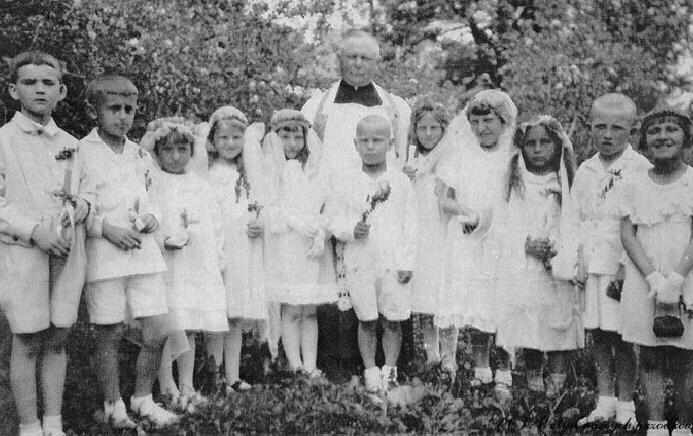
Figure 1.--These Polish children in 1934 are posing for a First Communion portrait in their white outfits. Not all Polish boys in the 30s wore white outfits. |

|
Here we will archive information on the activities persued by Polish boys and the destinctive costuming associated with those activities. Some clothing is specifically associated with specific activities. This has become more common as Polabd became more affluent in the 20th century. There are schoool, work, and play clothes as well as dress up outfits. This will include information on Polish choirs, dancing, music, schools, sports, and other activities. Poland like many countries of Eastern and Central Europe has undergone
cataclismic political changes in the 20th Century. The resulting political changes
have significangtly affected the educational system which of course
affected school uniform and dress.>We also have developed some information on Polish youth groups. Many of these outfits seem similar to clothing worn in other countrues, especially Germany and Russia. Germany has probably had more influential in the early 20th because of cultural affinities, especially Catholocism. This may have changed after World War II when Poland disappeared behind the Iron Curtain. But even here East Germany continued to be an important influence.
We know little about Polish gfolk dancing. At his time we know nothing about folish folk dancing in Poland. Until 1919, Poland was under te control of Austria, Germany, and Russia. The language, culture, and other national aspirations were supressed to varying degrees by those empires. We are not sure to what extent this extended to folk culture like dancing. After 1919 the Polish government presumably promoted folk culture like dancing, but again we have few details. The NAZIs tried even more viciously to stamp out Polish cultural traditions, including music and dance. Persumably these were revived by both the Communist Government installed by the Soviets and todays democrtaic government. Hopefully one of our Polish readers will provide us some background information. Poland appears to have a Polish State Folk Song and Dance Ensemble called Mazowsze, but we do not know to whay extent their is a youth dance program in Poland. We do not know, for example, if there were school programs. Much of the limited information we have comes from Polish dance groups in the various countries to which Poles have migrated such as Australia, Canada, the United States, and many other countries. Often Polish churches played an important role in maintaining traditional custons in immigrant communities. We note that Park Secondary School in Dagenham, England had a dance program. It was apparently promoted by the Ford Foundation. We do not know if the members were of Polish extraction or how common such programs were in Britain.
The known history of music in Poland begins with the Christian era. There surely must have beem some kind of music tradition with the Celts and Germans, the people which pre-date the Slavs in what is modern Poland. Nor do we know about the music of the early Slavs. We have little information at this time on pre-Christian Slavic music. What has survived is the folklore of Poland, although it differs regionally. The traditional music of Mazovia (central Poland) is often seen as the standard Polish form of folk music with its accompanying dance forms, including mazurkas, obereks, polkas, etc.). The distinctive songs and instrumental music surviving in the Tatra Mountains (Gorale music), and in the lake district in the North-Western Poland (Kurpie region) are of some interest, not only because they may give some insight into early Polish music forms, but also because of their continuing cultural vitality. They do not seem to have the next phase of Polish musical history--the Church music which became the foundation of modern Polish music. What we now know as Polish music began with the Christianization of the Poles by the Germans at the point of the sword (10th century). The first known Polish music thus begins with the liturgical chants of the medierval Latin Church. This Gregorian Chant reached Poland from Rome through neighboring Bohemia (the modern Czech Republic). The appearance of this new cultural tradition resulted in a virtual outpouring of Church music/ A great deal of thid music focused on the praise and worship of the Virgin Mary. 'Bogurodzica' (The Mother of God) surely was not the first Polish hymn, but is the earliest suriving hymn notated in Polish. It is believed to date to the 13th century, but earliest surviving copy is from the 15th century. It is a beloved chant. Not only is it important in the history of the Polish language as, but is considered to be the country's earliest national anthem. Bogurodzica was reportedly sung by the Polish army in defensive wars with the Knights of the Cross, famously at battle of Grunwald (1410). While chants honoring the Virgin Mother is a fixture in Polish Church music,there are also chants and later hymns written to raise praise to revered Polish saints, including St. Adalbertus and St. Stanislaus. One of the most beloved is 'Gaude Mater Polonia' (Rejoice, Mother Poland). It continues to be sung at official university events, such as
the start of the academic year. The growing heritage of religious music is , preserved in richly ornamented manuscripts. Some of the important early Polish composers included Waclaw z Szamotul (1524-1560), Mikolaj Zielenski (17th century, , and Marcin Mielczewski (????-1651) among others. and many others. These composers were part of a vibrant European musicalm culture. This era was a time of prosperity in which Poland was an important Europeann power. It is often seen as Poland's Golden Age (16th and 17th centuries). It was during this period that Polish art and music flourished. Vocal polyphony (choral music) appeeared as did dances for the court, and various types of singing for solos and choirs. HBC has developed a choir page. Poland set in the middle of Europe was exposed to the arts and music of many other countries. This included bothb Church as well as secular music. Musicians from Hungary, Italy, France, and Germany were employed in the royal court (Wawel Castle in Krakow, Cracovia), aristocratic courts, and in churches. The 18th century was for Poland a time of wars and internal instability, culminating in the 1790s with the partition of the country among Austria, Russia and Prussia. Culturalm life declined, including music. Polish composers like Jan Wanski continued, however, to create music. The most beloved of these composers was Fryderyk Chopin (1810-49) who became national hero during the long period od foreignn occupation. His workn is said to have been in part inspired by an oral musical tradition of the pre-Christian Slavs which may have survived in the Polish folkloric tradition.
We note a Polish family on a beach vacation in 1916.
Poland is a largely Catholic country. The Church has played a major role in the country's history. During the five decades of Communist rule, the Church successfully resisted the Communists, the only national institution to do so. The Church was the principal naional institution during the 19th century when most of Poland was controlled by Orthodix Russia and Protestant Prussia. Poland until World war II had a large Jewish minority which was largely destroyed by the NAZI Holocaust. Poland aftr World War I acquired a large area in the East with a more diverse ethnic and religious make up than largely Catholic central Poland. Much of what is now Beylorusia was between the Wars a part of Poland. This included Lothuanians, Wjite Russians, Ukranians, and others. Thus the religious makeup of the country has been affected by the boundaries. After World War II the boundaries of Poland were essentialky shifted West and the Polish population to the east trnsported to the new boundaries given the country a much more purely Polish and Catholic make up.
I have little information on Polish school uniforms or Polish boys' schools in general. Hopefully some of the European visitors to this web site will provide some information. Poland like many countries of Eastern and Central Europe has undergone cataclismic political changes in the 20th Century. These changes were especially significant in Poland. Poland in the medieval era had been one of the most important countries in Europe, but as a result of the 18th century Polish partitions, Poland was reased from the map of Europe. This led in the 19th century to efforts by Austria, Germany, and Russia to supress Polish natioinalism and culture. Only in the 20th century was Poland reconstituted. The resulting political changes have significantly affected the educational system which of course affected school uniform and dress.
We do not have much information on child labor in Poland. Perhaps our Polish readers can nprovide some details. Poland was a largely agricultural country until after World war II. Thus most child labor would have been agricultural. We know nothing about Government regulations regukationg child labor. Thus is complicated by the fact that most of Poland in the 19th century was part of the Russian Empire. (Smaller areas were German or Austrian.) The Russians freed the serfs (1861), but we believe serfdom was more of a Russian than a Polish problem. Napoleon abolished serfdom in the Duchy of Warsaw (1807). We are not sure what the Russians did when they regained control (1814). We do not have information on Tsarist Russian child labor laws, but believe that they were very limited. Nor so we know what child labor laws the new Polish Government passed after World war I (1918). We do know thst there was land reform, but this seemes to have been primarily aimed at Germans owning large estates than the Polish nobility oning estates. There were still many children om agrivultural estates and they tended to receive very limited education and often worked in various ways. Then a Communist Government was installed by the Soviets (1945). We suspect that the Communists implemented very strict child labor laws and with the nationalization of the large estates, the Comminists also moved to sharply reduce agricultural child labor.
HBU has very limited information on Polish youth groups at his time. The Scouts are the most important group. We do not know of any other groups in the early 20th century. The modern Polish nation came into existence only after World War I in 1919. We know nothing about Polish youth groups either before or after 1919 other than the Scouts. The NAZIs when they occupied western Poland in 1939 disbanded the couts and did not organize a pro-NAZI youth group as they did in the countries they occupied in many other countries. The Soviets organized Pioneer groups in the area that they occupied in 1939. After the Soviets liberated Poland in 1944, the Pioneers were reestablished by the Communist Government and the Scouts outlawed. Scouting was not restablished until 19??.

Navigate the Boys' Historical Clothing Web Site:
[Introduction]
[Activities]
[Biographies]
[Chronology]
[Clothing styles]
[Countries]
[Photography]
[Theatricals]
[Bibliographies]
[Contributions]
[FAQs]
[Glossaries]
[Images]
[Links]
[Registration]
[Tools]
[Boys' Clothing Home]
Navigate the Boys' Historical Clothing Polish pages:
[Polish choirs]
[Polish movies]
[Polish orphanages]
[Polish school uniforms]
[Polish sailor suits]
[Polish youth groups]
Navigate the Boys' Historical Clothing Web Site:
[Return to the Main Polish page]
[Australia]
[Canada]
[England]
[France]
[Germany]
[Ireland]
[Italy]
[New Zealand]
[Scotland]
[United States]