*
NAZI plans for the occupied East -- Poland : elimate the inteligencia NAZI plans for the occupied East -- Poland : elimate the inteligencia
NAZI Plans in Poland: Eliminate the Intelectuals--A-B Aktion
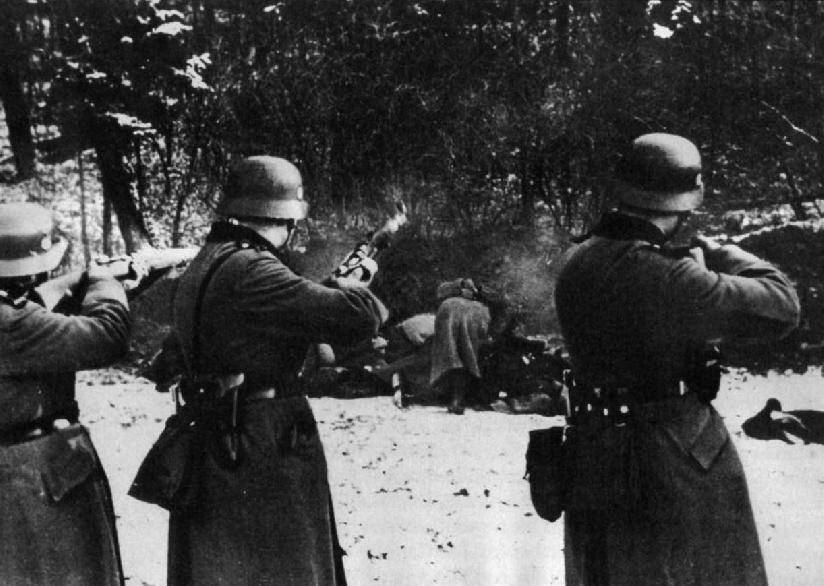
Figure 1.--Here a German firing squad executes a group of Polish men as part of the effort to destroy Polish intelectuals. The Germans are described as a SS-led police. I think that means a SD unit. The SD was Security Servive Police under Heydrich's direct command. This execution took place near Bydgoszcz. The men have their hands tied behind their back. Poland was a major departure for the Germans. This kind of killing did not take place when they occupied Czechoslovakia a few months earlier. The SS was particularly brutal at Bydgoszcz in part because Germans were attacked there. SS Major Manfred Roeder was put in charge of Bydgoszcz, The town was annexed to the Reich as part of Reichsgau Wartheland. We do not know what happened to the wives and children of the men shot here. Source: Central Photo Agency, Warsaw.
The SS was given orders to kill Polish prominent civilians and indiviaduals such as government officials, the nobility, teachers, and priests throughout Poland, any would which could promote Polish nationalism or offer leadership. [Gilbert, p. 265.] Today their are countless memorial stones and plaques througout Poland where these executions took place. And it was not just men, women and children were also killed. The Army Chief of Staff, Genderal Halder discussed the F�hrer's orders with his senior officers. One a Colonel Eduard Wagner wrote in his diary, "It is the F�hrer's and Goering's intentions to destroy and exterminate the Polish nation. More than that cannot even be hinted at in writing." [Gilbert, p. 269.] The instructions were secret. Some SS men carrying these instructions were arrested by the Wehremacht accussed of brutality. [Gilbert, p. 278.] Admiral Canaris, the head of the Abwehr, German military intelligence, visited the Polish front on September 10 and was horrified. He went to Hitler's headquarters planning to protest which he told General Keitel, the Chief of the Armed Forces High Command. Keitel advised him, "If I were you I would not get mixed up in this business. This 'thing' has been decided by the F�hrer himself." Keitel explained that that each army command would have a NAZI civilian chief attached to its military commander. He would have the responsibility for the "racial extermination" effort. [Gilbert, p. 271.] Hitler on October 4, even before the fighting was over, declared an amnesty for the arressted SS men. There were no further arressts of SS men by the Wehremact in Hitler's future campaigns.
A-B Aktion
The NAZI operation to liquidate the Polish intelligentsia between 1940 and 1943 was named Ausserordentlichen Befriedungsaktion (A-B Aktion). This meant Extraordinary Pacification Operation. This was the NAZI plan targeting Polish intellectuals as part of their plan to completely eliminate the Polish nation. The idea was nothing short of barbaric. The NAZIs set out not only to eliminate just current Polish leaders, but whole classes of people from whom any future leaders might rise.
Goal
The goal was to eradicate the Polish political leadership and intelectuals who comprised the countyry's cultural and national leadership. This would not only help destroy Polish national identity, but aid the Germans exploit the Poles without having to deal with any kind of organized resistance.
Targets
Hitler'w dictum waa, "whatever we find in the shape of an upper class in Poland will be liquidated." The SS was given orders to kill Polish prominent civilians and individuals such as government officials, the nobility, lawyers, dictors, university professors, teachers, and priests throughout Poland. The idea was to eliminate anyone who could promote Polish nationalism or offer leadership. [Gilbert, p. 265.] Today their are countless memorial stones and plaques througout Poland where these executions took place. I am not sure precisely how many prominent Poles were killed. There are instances of university professors being invited to meetings suposedly to reopen the universities and then arrested and either immediately shot or sento concentration camps where most perished. One accounts suggests that about 10,000 civilian professionals were rounded up and killed in this manner. I'm not sure yet about the accuracy of this estimate.
Arrests
After focusing on the annexed areas of Poland, the SS during the summer 1940 began rounding up members of the intelligentsia in the General Government as part of A-B Aktion. The NAZIs arrested university professors, teachers, priests, and others. Many had not idea about this NAZI plan. Several thousand targeted individuals were immediately shot. These mass murders occurred outside Warsaw, in the Kampinos forest near Palmiry as well as in Warsaw's Pawiak prison. [U.S. Holocaust Memorial Museum] The Germans in making these arrests often had well prepared lists. We do not know, however, at this time just how these lists were prepared. Some were put in the new concentration camps springing up througout Poland. Otheres were simply executed on the spot. One professor at Krakow University, Mieczyslaw Brozek, writes that he anticipated that the German conquerors would restrit curriculum or possibly dismiss many professors at the University. Instead German soldiers rounded up the professors and savagely beat them with rifle butts before carting them away.
Targets
The assault on Polish intellectuals focused on civil servants, doctors, lawyers, politicians, university professors, clerics (m=both priests and nuns), or anyone with an advanced education. They were identified and arested. Some Jews were also arrested, but most were non-Jewish Poles. Also arrested ironically were patients in mental hospitals.
Piasnika Wielka
The first large-scale NAZI attrocities took involved the intelectuals arrested uder A-B Aktion. The men arrested were taken to a forest near Piasnika Wielka. This was in Pomerania (Gasansk-West). Here the Germans shot 12,000-14,000 Poles. The operation was carried out by the SD and field gendarmerie units (October-December 1939). Most of those killed came from Danzig (Gadansk) and the towns and villages of the Polish Corridor, an ara that was to ammexed to the Reich. The SS also transported patients in Reich pychiatric hospitals to be disposed here. Polisg civilians were paid to dig pits where the people arrested were shot. [Piotrowski, pp. 25-26.]
Piasnika Wielka was just one of the places Poles were shot. There were other killing fields. The Germans seem to have separated the men and women before being shot in numbers. There were also individual shootings. Aristocrats and land owners might not be arrested, but shot on their estates along with wives, relatives, and older children. I am not sure what happened to the younger children. Many of the arrests took place in homes and often wives were arested with the men. Whether this was always the case we do not know. Again we do not yet know what happened to the younger children. Some older girls were sent to the Reich to work as servants. How extensive this was we do not know. Aristocrats were hereditary thus wipeing out the aristocracy meant the family. Most important positions in Poland were filled by men (doctors, lawyers, politicans, ect). We know that wives were arrested, but we are not positive just how common this was. We know that nuns and teachers were among the arrested. We do not know what age dectinctiions were made for children or if the police detained children when they arrested Poles at home. The actual killing operations were mostlly lining people up and shooting them. The operation was not very efficienr\t compared to later SS operations. We notice some poles being escorted individually to where they were to be shot.
NAZI Plans
The NAZI plan was ninitally to destroy the Polish nation by elininating the intelectuals. Hitler thought this would make it impossible for the Poles to organize resistance. Of coursein the long term the goal was to reduce the number of Poles and cother Slavs and convert those who were allowed to live to Helot slave laborers. The Army Chief of Staff, Genderal Halder discussed the F�hrer's orders with his senior officers. One a Colonel Eduard Wagner wrote in his diary, "It is the F�hrer's and Goering's intentions to destroy and exterminate the Polish nation. More than that cannot even be hinted at in writing." [Gilbert, p. 269.] The precise instructions were secret.
Admiral Canaris
Admiral Canaris, the head of the Abwehr, German military intelligence, visited the Polish front on September 10 and was horrified. He went to Hitler's headquarters planning to protest which he told General Keitel, the Chief of the Armed Forces High Command. Keitel advised him, "If I were you I would not get mixed up in this business. This 'thing' has been decided by the F�hrer himself." [Gilbert, p. 271.]
NAZI Civilian Chiefs
Keitel explained that that each army command would have a NAZI civilian chief attached to its military commander. He would have the responsibility for the "racial extermination" effort. [Gilbert, p. 271.]
Amnesty for SS Men
Some SS men carrying these instructions were arrested by the Wehremacht accussed of brutality. [Gilbert, p. 278.] Hitler on October 4, even before the fighting was over, declared an amnesty for the arressted SS men. There were no further arressts of SS men by the Wehremact in Hitler's future campaigns.
Planning
The elimination of the Polish inteligencia was not left to chance. Dr. Josef B�hler who had a law degree in May-June 1940 was put in charge of "special pacification" in the Government General. His assignment was to track down Polish journalists, university professors, philosophers, and writers. About 3,500 of these individuals were arrested by B�hler and murdered. [Gilbert, p. 318.] NAZI policy was to arrest the leaders in villages and towns all over Poland. Priests and school teachers were among those commonly arrested. The NAZIs saw little need for Polish schools or educating Polish children. They were to be the uneducated manual slave labor force for the German Reich.
Gestapo Officials
A HBC reader is reseraching the subject and particularly interested in who were the Gestapo leaders in Danzig and Lodz. He tells us, "Dr. Manfred Schoeneseiffen was a Gestapo official in both cities at different times in that period. I have just located his son and am communicating with him. He knows little of what his father did during the war because his father was hiding in the underground between 1945 and 1960. He is interested in learning more about his father's activities. He knows his father was a sadist, but (at 62) wants to learn more than he knows already. Himmler was going to be his godfather but couldn't make the ceremony." [Downs]
Underground
After the initial arrests, many Poles went underground and tried to hide from the NAZIs.
Galacia
The Germans after seizin Soviet occupied easter Poland (Belorussia and Galacia) began a similar Aktion in these areas as well (June 1941). We have less information on these actions. We note repoets from Lviv / Galacia. We are not sure about Belorussia . Nor are we sure to what extent they ficused on the natiinaklities (Belorussian, Polese and Ukranians) or just occupational groups like university orofessirs.
Results
Estimates suggest that as aresult of NAZI arrests and executiojs or slow death in the camps, Poland lost huge numbers of educated people: teachers (15 percent), clergy (18 percent), technicians (30 percent), university professors (40 percent), doctors (45 percent), and lawyers (57 percent). Notice the especially high portion of doctors, university profesors, and lawyers. Many lawyers were involved in politics
Sources
Downs, Jim. E-mail message, April 15, 2003.
Gilbert, Martin. A History of the Twentieth Century Vol. 2 1933-54 (William Morrow and Company, Inc.: New York, 1998), 1050p.
Padfield, Peter. Himmler: Reichsf�hrer-SS (Henry Holt: New York, 1991), 656p.