|
The next major American campaign was the Marianas and resulted in the Battle of the Phillipine Sea. The major islands were Tinian, Saipan, and Guam. The islands were taken by the Japanese 3 hours after Pearl Harbor (December 8, 1941). The Japanese built important defensive positions on the islands, including air fields. General Takashuina commanded a 19,000 man force. The Japanese planned an all-out naval counter attack in the Central Pacific called "Operation Z.” Vice Admiral Fukudome, Chief of Staff, carring the plan was in a plane crash over the southern Philippines. Filipino guerillas found the documents and relayed it to the Americans. The American offensive to take the islands was Operation Forager. The Marianas was the inner-ring of Japanese defenses. Unlike the earlier Gilbert and Marshall campaigns, the Japane Navy did sally out to oppose the invasions. Saipan and Tinian would bring the Japanese Home Islands within range of new B-29 bombers. In the Philippine Sea. Japanese reconnaissance planes found Task
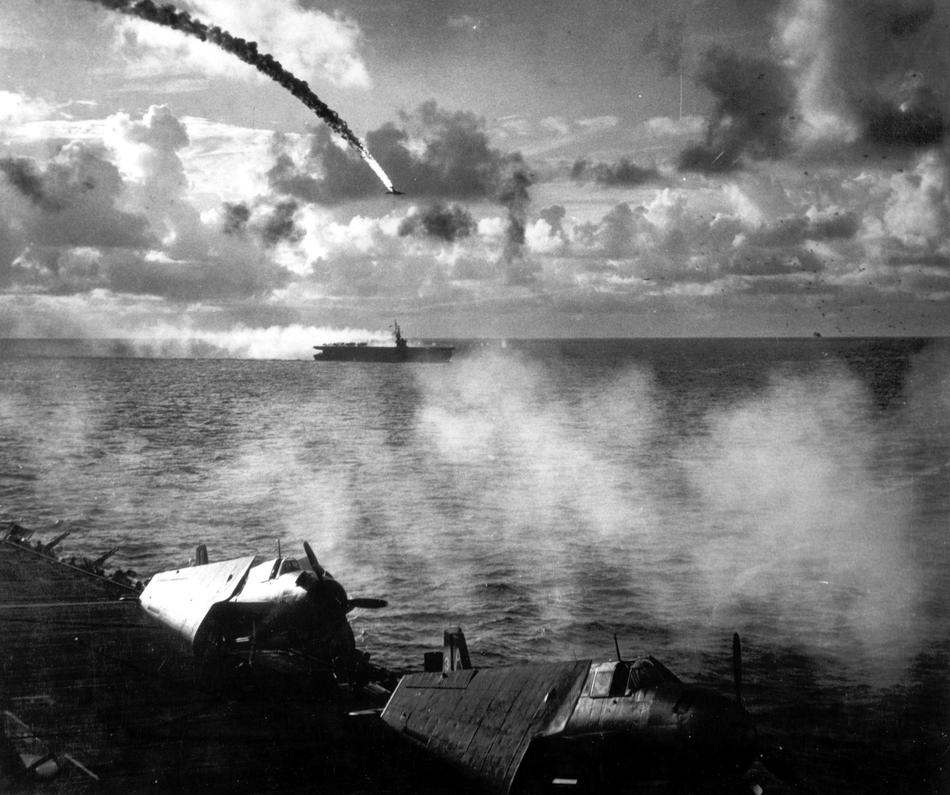
Force 58. The Japanese launched 372 aircraft, in four waves. The American carriers of Task Force 58 have about 950 planes. Radar oprovides advanced waring and the Japanese attacking force is intercepted. Many Japanese planes were shot down and more are destroyed by fleet anti-aircraft fire. The Japanese attack was ineffective. Only the USS South Dakota was hit by a single bomb. The Americans launched an air strike on Guam and a counter strike at the Japanese carriers requiring the Americans pilots to return in the dark. The Japanese lost about 300 aircraft and their invaluable pilots. The Americans lost only 29 pilots. US submarines Cavalla and Albacore sink the Japanese carriers Taiho and Shokaku. The battle is called the Great Marianas Turkey Shoot (June 19). The Japanese losses signaled the extent to which the ballance of power had shifted in the Pacific War. The loses in the Phillipines Sea meant that the Japanese carrier force would not be an important factor in the upcoming battle for the Phillipines
The next major American campaign was the Marianas and resulted in the Battle of the Phillipine Sea. The major islands were Tinian, Saipan, and Guam.
The islands were taken by the Japanese 3 hours after Pearl Harbor (December 8, 1941).
The Japanese built important defensive positions on the islands, including air fields. General Takashuina commanded a 19,000 man force.
The Japanese planned an all-out naval counter attack in the Central Pacific called Operation Z. The Japanese ammased a substantial force of carriers and sallied out from Okinawa. The plan was to destroy the invasion force and the American carriers protecting the fleet. The problen for the Japanese was that the cream of their pilots had been desimated at Coral Sea, Midway, and engagements in the Solomons. Thus their carrier planes were piloted by young very inexperienced men. In addition they were flying the same zeros without any significant modernization. Vice Admiral Fukudome, Chief of Staff, carring the plan was in a plane crash over the southern Philippines. Filipino guerillas found the documents and relayed it to the Americans.
The American Pacific Fleet was a very different force that had defended Midway in 1942. New Essex-class fast carriers were now arriving in numbers from American shipyards. Not only did the mericans now have a much larger carrier fleet with im[roved radar, but the carriers now had the remarkable mew F6F Hellcat fighter to replace the F4 Wild cat. As one American pilot put it, "Without the Hellcat, we would still be fighting the Japanese." The Hellcat outclassed the lightly-armored Zero in almopst all major categories. In addition, it was now the American pilots who were better trained and more experienced. The American 5thbFleet was commnded by AdmiralRay Spruance.
The American offensive to take the islands was Operation Forager.
The Marianas was the inner-ring of Japanese defenses. Saipan and Tinian would bring the Japanese Home Islands within range of new B-29 bombers.
The invasion of Saipn was one of the key confrontations of the Pacific War. Earlier Pacific Island invasions had made it clear that the Jpanes would not surrender no matter how great the forces availed against them. American planners concluded that if the Japanese would fight to the death on isolated Pacific islands, tht they would resist to the end in the defense of the Home Islands. The casualties of an invasion of the Home Islands could be orrendous. It was thus important to bring the Japanese Home Islands within the range of American bombers so that the Japanese war making power could be smashed. Seizure of the Marianas would provide the bases from which America could begin the bombardment of the Home Islands. There was a Japanese civilian population on Saipan. Japanese authorities urged the civilians to kill their children and commit suiside. Many did. After the Americans secured the island, the Jpanese civilians were interned, but in realtively comfortable circumstances.
The Japanese assembled aassive naval force. It was based in Singapore with smaller bases in the Philippines. This was in part because the Japanese were having trouble getting tankers back to the Home Island wghere n oil shortage was developing. The Mobile Fleet was commanded by Adm. Jisaburo Ozawa. As soon as he was infiormed of the American landing, he sallied fiorth. He moved his force through the San Bernardino Strait between Luzon and Samar into the Philippine Sea. A supporting battleship force, led by Vice Adm. Matome Ugaki moved into the OPhilippines Sea and approched the Marinas from the south.
Both the Americans and Japanese had substntial carrier forces. Admiral Ozawa had five fleet carriers and four light carriers. Admiral Sprance had seven fleet carriers, mostly the new Essex class carriets, and eight light carriers. TF-58 wuith the fkleet crriers was commaded by Admiral Mrch Mitchner. Admiral Ozawa felt that the longer range of his lighter, unarmored aircraft and the addition of hundreds of shore-based planes on Saipan and Guam canceled out the American numerical advantage. nd the Americans would be preoccupied with supporting the landing force. Ozawa believed that these factors would enable him to gain a Midway-like victory. American possession of air fields on Midway had played a key role in the battle.
This proved illusionary. The Americans destroyed the Japanese airforces on Saipan before landing. Ozawa was unable to coordinate his attacks with the commanders on Guam. Ozawa also did not fully appreciate th impact of the powerful F6F Hellcat fighter or improvd American anti-aircraft guns. But the key factor in the battle was the quality of the pilots. After withdrawing the Imperial Fleet from the South acific (December 1942), the Imperial Navy had more than ayear to train a new generation of pilots. The U,.S. Navy took full advantage of the time, the Japanese did not. Thus a group of inadequtely trined Japanese piliots in aging planes engaged a well-trained American pilot force flyng the superb new F6F Hellcat.
Unlike the earlier Gilbert and Marshall campaigns, the Japane Navy did sally out to oppose the invasions. Bioth the Japanese and American committed massive fleets. The battle was shaping up to be the largest naval battle of the War, in fact the largest of any war. The surprise approch which the Americans achieved at Miday eluded Ozawa.
American Task Forces 16 and 17 managed to slip through the Japanese submarine screen. In contrast Ozawa’s forces were sighted by American submariners as they entered the the Philippine Sea. Adm. Spruance drcided to delay the Guam landings to concentrate on Saipan and the approaching Japanese naval force. Naval fleet actions, however, never occurred. Admiral Ozawa found the Americans first and launhed carrier aircaft. The results were not what he expected. His aircraft wre decimted by the American pilots in their new F6F Hell cats. The result proved to be the the Great Marianas Turkey Shoot. So devestating was the American carrier aviation that after losing aircradt and carriers, the disperited Admiral Ozawa turned his fleet around and did not commit his surface elements. The American submarines Cavalla and Albacore sank the Japanese carriers Taiho and Shokaku. Emperor Hirihito who had been led to believe that this was to be the climatic naval battle of the War was duspondent. (From the beginning, the Japanese military never informed the Emperor of the gamble Japan was taking in going to War with the United States. Nor had he been fully informed of what had happened at Midway and the Solomans.) With the Bttle of the Philippines Sea, the Emperor was increasinly aware as to how the military has misled him.) The climatic naval battle which the Emperor and Imperial Naval staff had wanted would come later at Leyte.
The Japanese began their air assault in the morning (June 19). Japanese reconnaissance planes in the Philippine Sea found Task Force 58. Admiral Ozawa immediately launched 372 aircraft, in four waves. The American carriers of Task Force 58 had about 950 planes, incuding the powerful F6F Hellcat. The Japanese were using the same increasingly outdate planes with which they lunched the War. The Americans from USS Belleau Wood intercepted the Jpanese Guam strike force while it was stll forming which largely disabled the threat from the south. American radar provided advanced warning of the four waves of Japanese attackers from the west. Each Japanese attacking force was intercepted. Many Japanese planes were shot down by American figters and more were destroyed by fleet anti-aircraft fire. The American victory at Midaway had been achieved against a superior Japanese force in large part because of the use of intelligene intercepts. In the battle of the Philippine Sea it was soon clear that it was the Americans who had developed and deployed a vastly superiot naval force. Thete would be no great Jaoanese naval victory. In fact, the Japanese carrier attack was ineffective. Only the USS South Dakota was hit by a single bomb. The and a counter strike at the Japanese carriers late in the day requiring the Americans pilots to return in the dark. The Japanese lost about 300 aircraft and many of their dwindling number of trained pilots. The Americans lost only 29 pilots. The battle because of the large number of Japanese planes shot down has come to be called the Great Marianas Turkey Shoot.
The Japanese hoped that their offensive would produce the decisive victory over the American fleet. The shattering results was a shock to naval planners who had not realized how significantly American indistry was shifting the strategioc balance in the Pacific. The Japanese losses signaled the extent to which the ballance of power had shifted in the Pacific War. The loses in the Phillipines Sea meant that the Japanese carrier force would not be an important factor in the upcoming battle for the Phillipines

Navigate the CIH World war II Section:
[Return to Main World War II naval campaign page]
[Return to Main World War II page]
[Biographies]
[Campaigns]
[Children]
[Countries]
[Deciding factors]
[Diplomacy]
[Geo-political crisis]
[Economics]
[Home front]
[Intelligence]
[Resistance]
[Race]
[Refugees]
[Technology]
[Bibliographies]
[Contributions]
[FAQs]
[Images]
[Links]
[Registration]
[Tools]
[Return to Main World War II page]
[Return to Main war essay page]