Nationalsozialistische Volkswohlfahrt/People's Welfare Organization (NSV)
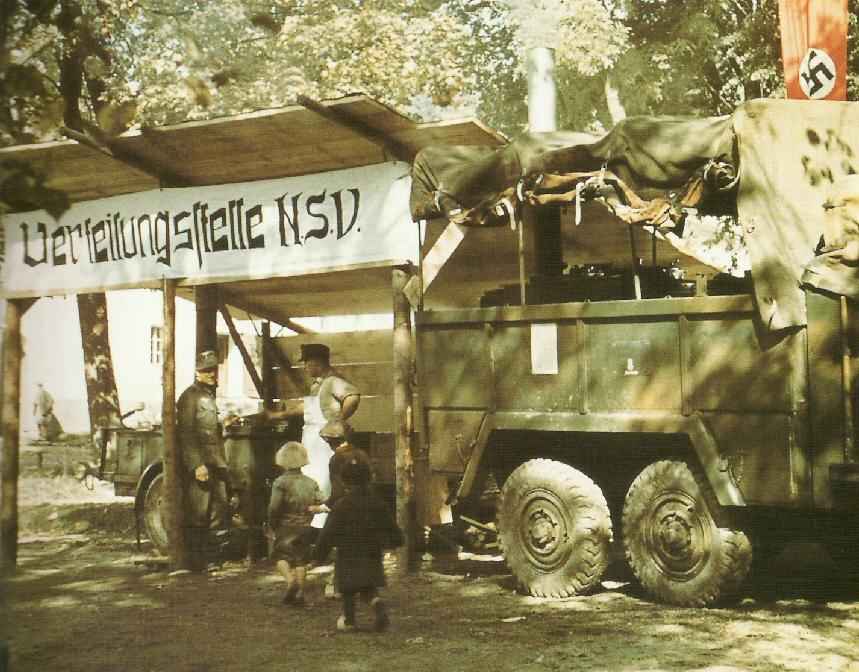
Figure 1.--We thought this was a NSV soup kitchen. The signs read "Verteilungsstelle". That means "apportionment place". We are not sure precisely what was meant by that. The photograph was taken near Horní Planá (Oberplan) in what was the Protectorate of Bohemia and Moravia (NAZI occupied Czechoslovakia). It looks to be about summer 1940. It may be land sized from Czechs was being handed out to ethnic German families. Click on the image for a fuller discussion.
|
|
The NSV at first helped poor families with financial benefits, a kind of welfare. The NSV gradually shifted to performing services aiding poor families like organizing and managing day care centers, caring for children, assistance to youth and pregnant women, and various family health and nutrition programs. The NSV was established (May 3, 1933). There may have been an early program, but until the NAZIs seized power and had the authority of the German Government at its disposal as well as swelling ranks of Party members could the NSV run significant programs. The NSV was the umbrella organization for a range of social and welfare programs. It was organized on the same basis as the NAZI Party. There was a central office in Berlin and then regional offices in each Gau. Germany in 1933 was severely affected by the Depression. With the NAZI rearmament program as well as the RAD program, the unenployment proble disappeared. As a result by 1938 the NSV began shifting from welfare programs to promoting services. A major effort was day care for worker's families. Here there was some competition with day care programs run by churches. A a major slogan at NSV day care centers was "Hände falten, Köpfchen senken - immer an Adolf Hitler denken"--Hands folded, head lowered - always of Adolf Hitler thinking“. With the advent of the War, the NSV became the principal national effort devoted to children and youth welfare efforts. The NSV managed several different programs. One of the best known was the Mutter und Kind program which cared for pregant women. (I believe this was entirely different than the Lebensborn progrm which took the children away from the mothers.) The NSV also supported mothers in various ways, especially in the case of emergencies. One source indicated tht the NSV was financed through voluntary contributions of its members which increased from 1 million in 1938 to 11 million during the War. The NSV began publishing the ??? (National Socialist people service) magazine in 1933. It also began publishing a series of books ???? (Eternal Germany) in 1936. NSV leaders desired to make the organization the exclusive German welfare agency. While they administered a wide range of programs, they never managed to become the only German social welfare organization. There were a range of workers' welfare institution (AWOs). Other important groups were the German Red Cross and Caritas. One source indicates that NAZI racial overtones gradually appeared in the NSV progams, but we do not have details at this time.
German Charities
The Germany Hitler and the NAZIs seized control of had an extensive system pf private charaties. It was one of the most extensive charity system in the world. The system developed before, but mostly during the German Empire (1871-1918) and was continued during the Weimar era (1918-33). There were seven major German charities. 1) There were a range of welfare organizations managed by the Socialist and Communist parties. 2) There was also a Christian Workers charity. This was a unit of the important Catholic Center Party. 3) There were many Jewish charities which had a national ubrella organization. 4) The Protestant Inner Mission was founded in 1846. 5) The Catholic Caritas organization was founded in 1896. 6) The German chapter of the Red Cross was founded in 1864. During the Imperial era the Red Cross was almost exclusively involved with medical aid for the military and POW issues. During the Weimar era it acquired a range of civilian responsibilities such as disaster relief. 7) The best known charity was the the German League for Voluntary Welfare. The confessional charities (Jewish and Christian), the Red Cross, and some smaller carities belonged to the League. The confessional charities operated a very large system of over 15,000 asylums, homes, sanitariums, and hospitals caring for about 1.3 million indivduals (the elderly, sick, and maladjusted children). This was about half of the overall German institutional care system. These charities employed and trained thousands of nurses and care givers.
Early NAZI Welfare Efforts
As the NAZI Party grew in the 1920s, local units began to organize welfare activities. The initial focus was Storm Troopers injured in street brawls. They organized places for often indigent young men to be sheltered abd fed and to have their injuries treated. Stympthetic young women helped bandage them. [Fischer] Gradually the range of activities grew to indigent members and their families. These were ad hoc activities of local units.
Foundation
A Berlin Party unit founded the NSV. Erich Hilgenfeldtwas an early NSV employee. Berlin Party Gauleitr, Josef Goebbels, saw the propaganda potential in a Party welfare unit (1931). Goebbels selected Hilgenfeldt
to manage the then small unit. Hilgenfeldt was a World War I pilot who was a moderately suceesful businessman after the War. He proved to be an excellent manager. He hit upon the idea of launching a fund drive comemorating Hitler's birthday (April 20, 1931).. Hilgenfeldt personlly organized the collection campasign.
The NSV was a still small operation vefore the NAZIs seized power, but the campaign attracted attention.
The NSV focus at this stage was helping poor NAZI families with financial benefits.
Until the NAZIs seized power and had the authority of the German Government at its disposal as well as swelling ranks of Party members could the NSV run significant programs.
The NAZI Party had a great deal to say about the German fanily, including women, children, and the elderly who were at the tome mostly catred for by German families. The overiding concern with the family was population policy. Hitler to fight his wars needed soldiers, yet the birth rate had declined in Germany. How to increase the birth rate was a central policy objctive. How to asccomplish this was a not at all clear. The basic NAZI approach was to improve well being by supporting family stability. Also they wanted to redefine the role of German women by making their primary life goals that of wife, homemaker and mother. And in the NAZI state in was necessary to ensure that the children German mothers had were healthy Aryan children. Theys race policy became part of family policy. Not only were unions with non-Aryans prohibited, but eugenics became important to deal with handicapped children which the NAZIs tend to label as hereditary diseases. Thus the NAZI Party got involved in marriage, divorce, contraception, abortion and welfare measures. Here the Nationalsozialistische Volkswohlfahrt/ (People's Welfare Organization, NSV) played a major role in developing social/family policy and supporting families befor and during the War. Model families were publicized to illutrate the NAZI ideal kinderreich (child rich meaning large families). Undesirable families were also identified and ostracized from the national Volks community.
Organizational Challenge
Hilgenfeldt caught Hitler's eye. Hilgenfeldt's Berlin campaign apparently caught Hitler's eye. Presumably Goebbels discussed it with him. Soon after seizing power, Hitler recognized the NSV as the Party's single national charity organization (May 1933). Until his time the NSV was primarily working in Berlin. Goebbel's wife Madga became the NSV patron. The NSV had two organizational challenges.
The first was intenal, fealing with other NAZI units. The second was external, dealing with the existing German charities. The NSV initial challenge was other Party organizations with welfare units. The most important was Robert Ley's Labor Front (DAF) which was taking over the welfare operations of previously independent trade unions and organizing welfare programs for workers. Tere were many other NAZI organizations that had welfare programs, including the Hitler Youth HJ), Woman's Associatio (NSF), and other units. These units were not too interested in tirning over their welfare activities, in part because money was involved. Hilgenfeldt had to negotiate arrangemnents with the other NAZI units and a variety of arrangments were agreed to with them.
The second major method of growth was to take over the charity and welfare operations of non-NAZI organizations.
Organization
The NSV was organized on the basic NAZI Party model. There were local, county (Kreis) and group offices.
Hilfsfwerk / Welfare Organization
The NAZI welfare rffort was not meant to help individuals in isolation, but rather the serve the nation and Volk. NSV Director Hilgenfeldt explained, "we want to be the financial servers of the health of the German Volk." Thus the NSC assistance to German families included a mmeasure of supervision to oversee German family life. One auythor sees it as the 'strong arm' of the state as concerns family life. [Seiss, p. 23.] Here race was a major concern as puprsued through the Mutter un Kind Hilfsfwerk.
Hitler pleased with his work appointed Hilgenfeldt Reich Commissioner for the NAZI Winterhilfswerk (Winter Relief Support Programme) (September 21, 1933). This was the principal NAZI charity drive. The small NAZI Party charity grew steadily, fueled by the Winterhilfswerk collects taken in by HJ and BDM boys and girls. The NAZIs bosted that it was the "greatest social institution in the world." The NSV grew to be be the second largest NaZI Party organization. Only the German Labor Front was larger.
The NSV not only moved to take over existng German charities, but also created its own new charities. One of the best known is the Mutter und Kind (Mother and Child) organization. It was established to address one of Hitler's major concerns, the falling German birth rate. The Organizatioin undertook to opromoye NAZI population policy. Goebbels himself personally oversaw the innaguratiin of Mutter und Kind. In his address, he stated. "Mother and Child are the pledge for the immortality of the nation" (February 24, 1934). The Organization sought to increase the birth rate by assisting mothers. It was the coincrete realization of Point 21 of the Party's Program issued in 1920--'the state had to care for the raising of the nation's healththrough the protection of mother and child." The organization undertook activities in the area of population policy, health poromotion, and education. They pursue these activities by providing welfare and recuperation services to new mothers, welfare for young children, and setting up help and advise centes. The Weimar Republic had provided aid to mothers without health insurance. The NAZIs through Mutter and Kind greatly expanded this effort, providing milk, other groceries, bed linnen, and much more. BDM girls might help out in the home. The effort was primarily geared to help the mother in the home. There were efforts to aid single mothers without secure. There were also nursery homes set up in rural areas to aid those mothers without supportive families. There were both NAZI Party nurseries and NAZI SS Lebensborn nurseries.
Jugenderholungspflege means Youth Recretion Care. It was an NSV program to get at risk undeprovlidged city kids out into the countryside during school vacations where they got good food and plenty of fresh air and sunshine. We are not sure if this was part of the NSV Hilfsfwerk (Relief) effort or a different section of the NSV. This was not a progran initiated by the NAZIs, but a Weimar program taken over by the NSV as they gained comntrol of welfare prograns and fund raising. We do not yet have much information about the orogram and the number of children involved. We notice large numbers of German in various kinds of group homes. We see these images before, during, and after the NAZI era. Some of them may be associated with the Jugenderholungspflege program. We think there were other programs that also operated group homes for both boys and girls. Most of these would have been operated by the NSV during the NAZI era, but we still have very limited information..
Service Provider
The NSV with Hiler's approval became the umbrella organization for a range of social and welfare programs. It was organized on the same basis as the NAZI Party. There was a central office in Berlin and then regional offices in each Gau. The NSV gradually shifted to performing services aiding poor families like organizing and managing day care centers, caring for children, assistance to youth and pregnant women, and various family health and nutrition programs. Germany in 1933 was severely affected by the Depression. With the NAZI rearmament program as well as the RAD program, the unenployment proble disappeared. As a result by 1938 the NSV began shifting from welfare programs to promoting services. A major effort was day care for worker's families. Here there was some competition with day care programs run by churches. A major slogan at NSV day care centers was "Hände falten, Köpfchen senken - immer an Adolf Hitler denken"--Hands folded, head lowered - always of Adolf Hitler thinking“.
World War II
With the advent of the War, the NSV became the principal national effort devoted to children and youth welfare efforts. The NSV managed several different programs. One of the best known was the Mutter und Kind program which cared for pregant women. (I believe this was entirely different than the Lebensborn progrm which took the children away from the mothers.) The NSV also supported mothers in various ways, especially in the case of emergencies. We note the NSV organizing the evactation of children to safe areas. We notice Vienna children bring ecacuated to Munich. We also notice NSV soup kitches. These could be for national disasters, but they became widespread after the outbreak of the War. I am not sure if the NSV assisted Germans retuning to Germany after Hitler ordered the Baltic Germans and many Romanian Germans "Home to the Reich" (1939-40). As the War began to go against Germany, they were set up after air raids and to help German refugees fleeing west wuth the retreating Wehrmacht.
Financing
One source indicated tht the NSV was financed through voluntary contributions of its members which increased from 1 million in 1938 to 11 million during the War.
Publications
The NSV began publishing the ??? (National Socialist people service) magazine in 1933. It also began publishing a series of books ???? (Eternal Germany) in 1936.
German Welfare
NSV leaders desired to make the organization the exclusive German welfare agency. While they administered a wide range of programs, they never managed to become the only German social welfare organization. There were a range of workers' welfare institution (AWOs). Other important groups were the German Red Cross and Caritas. One source indicates that NAZI racial overtones gradually appeared in the NSV progams, but we do not have details at this time.
Sources
Fischer, C. Stormtroopers: A Social, Ecomomic, and Ideological Analysud (London: 1983).
Seiss, K. Ewiges Deutschlsand (1937).
CIH -- WW II

Navigate the CIH World War II Section:
[Return to Main NAZI organization page]
[Return to Main NAZI page]
[Return to Main World War II German military page]
[Return to Main World War II page]
[About Us]
[Aftermath]
[Biographies]
[Campaigns]
[Children]
[Countries]
[Deciding factors]
[Diplomacy]
[Geo-political crisis]
[Economics]
[Home front]
[Intelligence]
[Military forces]
[POWs]
[Resistance]
[Race]
[Refugees]
[Technology]
[Totalitarian powers]
[Bibliographies]
[Contributions]
[FAQs]
[Images]
[Links]
[Registration]
[Tools]
[Return to Main World War II page]
[Return to Main war essay page]
[Return to CIH Home page]
Created: 5:04 AM 9/20/2009
Last updated: 5:45 AM 11/25/2016