|
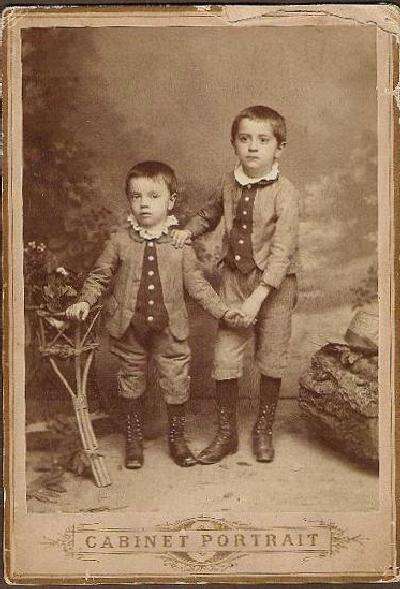
CDVs appeared in the late 1859s and remained popular throughout the rest of the 19th century, at least in Europe. The pattern in America is different. The first cabinet card appeared in America during 1866 and rapidly began to replace the CDV. While we still see some CDVs, the great bulk of the portaits taken in America during the 1870s-1890s were cabinet cards. We almost never see the term cabinet card or cabinet portrait used on these American cards. In Europe, however, we do see some of these cards labeled "caninent portrait" and this included non-English speaking continental countries. We are not sure just why this was. Perhaps cabinet cards were seen as a British or American format, just as the CDV is a French term used because of its French origins.
CDVs appeared in the late-1850s, but did not appear in large numbers until the early-60s. They were the principal photographioc portrair during the 60s continued to be made throughout the rest of the 19th century, at least in Europe. The pattern in America is different. The first cabinet card appeared in America during 1866 and rapidly began to replace the CDV. While we still see quite a number of CDVs in the early-70s, the great bulk of the portaits taken in America during the 1870s-1890s were cabinet cards. CDVs continued to be very common in Europe, but much less so in America. And the formats and mount styles during this period were very similar. Like CDVs the sizes were standard, in part because albums were made to store and display them. And thgey were taken in very large numbers, much larger than in Europe. Unlike Europe, we almost never see the term cabinet card or cabinet portrait used on these American cards. The American cabinet cars are generally easy to identify because along with the name of the studio, the city and state is almost always indicated with a few exceptions. Dating the images is more complicated. The family sometines wrote the date and names on the back, but in most cases the portraits are not dated. The style of clothing, portrait setting, and mount styles can all help date the images. For reasons we do not fully understand, aboyt the turn-of-the 20th century we see radical changes in the mounts and formats used for these cards.
In Europe, however, we do see some of these cards labeled "caninent portrait" and this included non-English speaking continental countries. We are not sure just why this was. Perhaps cabinet cards were seen as a British or American format, just as the CDV is a French term used because of its French origins. The Austrian cabinet card here was taken in 1888 (figure 1).
Many American cities have English names. The English cabinet cards and CDVs can usually be identified because along with the city, no state is identified.
German cabinet cards are generally easy to identify because they include the name of the city which is normally easy to identify as German, although some German towsare now in Ooland and other countries. Curiously, despite the number of German immigrants, there are relatively few American towns and cities with German names. We are not sure at this time when cabinet cards first appeared in Germany. CDVs we believe appeared in the late 1850s and cabinet cards a few years later, probably about 1865, but we do not yet have precise dates. CDVs were the dominant format in the 1860s and 70s. Cabinet cards did not replace the CDV as in America. Both formats were commonly made into the 1890s. Just as the French term CDV was commonly used, Germans commonly used the English-language term "Cabinet Portrait". A German reader tells us, "Today's in Germany, Cabinet would be written Kabinett but in 19th century some spelling rules were different. For example, the C was more in use. So Kabinett would have been written with C." I'm not entirely sure if this meant that the cabinet card format was commonly seen as of foreign origins. A German reader tells us that the word "portrait" became commonly used in German and could mean both a CDV or a cabinet card.
We have very little information about Russian portrait pgotography at this time. We have no information on Daugerreotypes and other early processes like ambrotypes at this time. The CDV was popular as in Europe, but we have 19th century CDVs at this time. We do note many cabinet cards in the late-19th and early 20th centuries. Just when cbinent cards replaced CDVs and the principal format we are not yet sure.

Navigate the Boys' Historical Clothing Web Site:
[Return to:Main cabinet card page]
[Return to:Main photographic print type page]
[Return to:Main photography page]
[About Us]
[Introduction]
[Activities]
[Biographies]
[Chronology]
[Clothing styles]
[Countries]
[Bibliographies]
[Contributions]
[FAQs]
[Glossaries]
[Images]
[Links]
[Registration]
[Tools]
[Boys' Clothing Home]
Navigate the Boys' Historical Clothing Web Site:
[Sailor suits]
[Sailor hats]
[Buster Brown suits]
[Eton suits]
[Rompers]
[Tunics]
[Smocks]
[Pinafores]