

Japanese Royalty: Emperor Hirohito (1901-89)
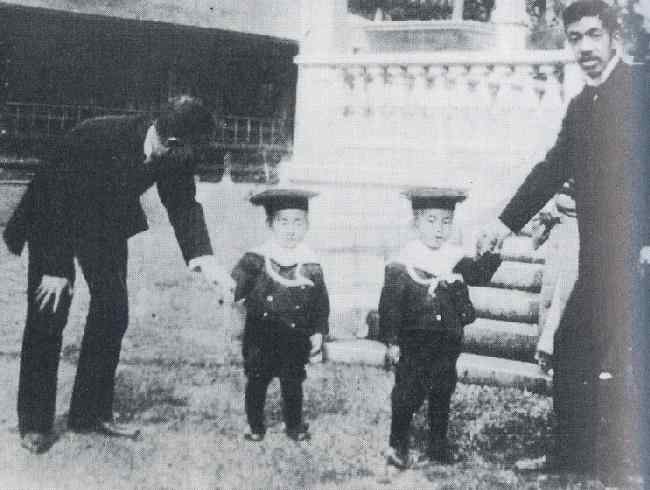
Figure 1.--In the second shot, taken at the Aoyama Palace in Tokyo, he holds the hand of his father, Crown Prince Yoshihito, the future Taisho emperor. Hirohito's younger brother, Chichibu, stands beside him. This photo was taken in 1905 at the time of Russo-Japanese War. The adult holding Chichibu's hand has not been identified. The emperor at the time of the photograph, Hirohito's grandfather, was Emperor Meiji. Hirohito's father Crown Prince Yoshihito became emperor in 1912 at the age of 33. Notice that the two royal princes, only a year apart in age, are dressed (in Western style clothes) in matching dark sailor suits with white lanyards. The boys wear knee pants and long black stockings. They also wear matching sailor hats.
|
|
Emperor Hirohito reigned from 1926-89. He was the last Japanese emperor to uphold the Shinto idea of imperial divinity. Hirohito reigned just over 62 years after acceding to the throne on December 25, 1926. His life of 87 years and 8 months made him Japan's longest-living Emperor. He was also the longest-reigning Emperor in Japanese history. His father was the Taisho Emperor, Yoshihito. His mother, Empress Teimei, was Princess Sadako, the fourth daughter of Prince Michitaka Kujo. The future Emperor Hirohito was their first son, and his name as a child was Michinomiya. A HBC reader reports, "In the rather recent biography on Hirohito, the future emperor is dressed in clothing based upon French styles according to the book." graduated from the Gakushuin (Peers' School) in 1914 and became crown prince in 1916. After graduating from the Crown Prince's School in 1921, he traveled in Europe for 6 months--a tour without precedent for a Japanese crown prince. In November 1921, after his return to Japan, he became regent for his father, who was ill. Emperor Hirohito had four daughters, all of whom married. They are the late Mrs. Morihito Higashikuni (former Princess Teru), the late Mrs. Toshimichi Takatsukasa (former Princess Taka), Mrs. Takamasa Ikeda (former Princess Yori), and Mrs. Hisanaga Shimazu (former Princess Suga). The Taisho Emperor died on Dec. 25, 1926. Crown Prince Hirohito became Emperor of Japan. His enthronement ceremony took place in Kyoto on Nov. 10, 1928. The Showa era, as his reign is called, after Japan's defeat in WEorld War II and the American occupation witnessed dramatic transformations in Japanese life, including the status of the Emperor himself. A militaristic party rose to dominate the Japanese government during the early era of his reign. His complicity with the milatarists is a not well
researched subject. Not every authority agrees with the widespread belief that Hirohito had no hand in Japan's conduct in World War II. Many historians beliebe he was deeply involved in the Japanese war effort. Hirohito cooperated with the Allied occupation forces in converting Japan into a democratic nation, and in 1946 he publicly denied his divinity. Emperor Hirohito and Empress Nagako had seven children--two sons and five daughters--the oldest of whom was born in 1925 and the youngest in 1939.
Parents
His father was the Taisho Emperor, Yoshihito. His mother, Empress Teimei, was Princess Sadako, the fourth daughter of Prince Michitaka Kujo.
Siblings
The future Emperor Hirohito was their first son, and his name as a child was Michinomiya.
Childhood
Hirohito was born in Tokyo in 1901. Following Japanese tradituon, Prince Hirohito was not raised by hus parents or even inthe imperial court. Hirohito as a infant was removed from his parents. He was put in the charge of a vice admiral in the Imperial Navy. He was returnef to his parents a toddlet (November 1904). His parent’s official residence was the Akasaka Palace.
Childhood Clothing
A HBC reader reports, "In the rather recent biography on Hirohito, the future emperor is dressed in clothing based upon French styles according to the book." Notice that in the image here that the two royal princes, only a year apart in age, are dressed (in Western style clothes). Prince Hirohito was 4 years old and his brother 3 years old. They are wearing matching dark sailor suits with white lanyards. The boys wear knee pants and long
black stockings. They also wear matching sailor hats (figure 1).
Education
Prince Hirohito entered Gakushuin, often called Peers School (April 1909). As his father had attended the Gakushuin
(Peers) School, this was not a difficult decesion for the Court to take. A special class of 12 boys including two of his imperial cousins was set up for him. The school's head master was Gen. Maresuke Nogi, who took a special interest in the future Emperor's education. Gen. Nogi devoted special attention to Prince Hirohito, tutoring him and attempting to develop character traits that he thought the Prince would need to rule Japan and its developing empire. This was especially important because of the disabilities of Prince Hirohito's father. Prince Hirohito's grandfather, the Emperor Meiji, died and his father became emperor (September 1912). His reign name was Taisho. Subsequently Prince Hirohito was designated heir apparent to the throne. The events were to prove a great shock to young prince. Gen. Nogi and his wife committed suicide as part of the Japanese ritual of respect to the Emperor they had servd. They did so on the day of the Emperor's funeral. This meant that Prince Hirohito lost his great mentor, the most important person in his life. Prince Hirohito continued his education at Gakushuin now under another military hero--Adm. Heihachiro Togo. Adm. Togo was a competent educator, but the relationship between the two never involved the same bonds of affectrion that had connected Prinxe Hirohito and Gen. Nogi. It was under Adm. Togo that Hirohito first developed an interest in Marine Biology which became a life-long passion. Prince Hirohito graduated from the Gakushuin School (1914). I believe he then attended another school, but do not yet have details. One source indicated that he graduated from the Crown Prince's School (1921).
As a young man, Prince Hirohito made a world tour to introduce him to other countries. Britain was a major port of call. In a photograph taken in London, we see Crown Prince Hirohito riding in a carriage with King George V of England. The youthful prince had just completed his teen years, having turned 20 less than two weeks earlier.
Hirohito was born on the 29th of April, 1901; the London photograph was taken on May 9, 1921. According to Hirohito's most recent biographer, the Crown Prince learned nothing about constitutional monarchy from George V; rather, he got lessons from the English monarch on how to use his royal position as a means of strengthening Japanese nationalism as George V did behind the scenes in England in an age when in Europe monarchical powers were becoming increasingly symbolic rather than poliical. Like his host George V, the crown prince wears an imperial military uniform with a decorated cap, a sash, medals, and white gloves. The occasion was a parade through the streets of London.
Princess Nagako
Prince Hirohito in 1924 married Princess Nagako, the first daughter of Prince Kunihiko Kuninomiya. She whe eldest daughter of His Imperial Highness the late Prince Kuniyoshi of Kuni, was born in Tokyo on March 6, 1903. She studied at Gakushuin Girls' School. She was very fond of music and Japanese-style painting and was considered an accomplished artist in both fields. She also enjoys composing poetry and practicing calligraphy.
Regency (1921-26)
Crown Prince Yoshihito in spite of being regarded as having serious phisical and mental impairments, ascend the throne on his father, the Emperor Meiji's death (1912). He became the Taisho Emperor. Problems began almost immediately. Repersentatives were shocked when he began to make a telescope out of a speech he was susposed to read opening the 1913 Diet. He used it to peer at the Prime Minister, his government and the opposition. After that inauspicious beginning, the new Emperor began more time away from Tokyo and the demands of his office. He spent his time at various imperial retreats. Japanese officials came to the conclusion that Yoshihito simply could not even fulfill the ritualistic demands of office and he disappeared from public view (1919). Crown Prince Hirohito was appointed Regent (1921). The Crown Prince continued in that post until Emperor Yoshihito died (1926).
Accession (1926)
The Taisho Emperor died on December 25, 1926. Crown Prince Hirohito became Emperor of Japan. His enthronement ceremony took place in Kyoto on November 10, 1928. The Showa era, as his reign is called, proved to be momentous. Soon after his accession, Japan intervened first in Manchuria (1931) and then China (1937). This led to the horendous Pacific war with America, Btitain, and eventually the Soviet Union. This came close to ending the Showa Era. General MacArthur decided, however, not to try the Emperor as a war criminal. After Japan's defeat in World War II and the American occupation witnessed dramatic transformations in Japanese life, including the status of the Emperor himself. And it led to the creation of posperous modern Japan.
Emperor Hirohito and Her Imperial Majesty the Empress had six
children, two boys and four girls. The Crown Prince Akihito was born in 1933. Emperor Akihito acceded the throne on January 7, 1989, upon the death of his father, the Emperor Hirohito (posthumously Emperor Showa). Akihito was born in Tokyo on December 23, 1933. Emperor Akihito is the eldest son of Eperor Hirohito and Her Imperial Majesty the Empress Dowager Nagako. He was born Akihito Tsugonimaya in Tokyo. His Imperial Highness the Prince Hitachi graduated from Gakushuin University in 1958 and since then has devoted himself to the study of biology, like his father. He married Miss Hanako Tsugaru, daughter of late Mr. Yoshitaka Tsugaru, former count, in September 1964. The Hitachi couple visits many parts of the country to take part in various ceremonies related to national activities in the fields of culture, education, sports, and social welfare. Emperor Hirohito had four daughters, all of whom married. They are the late Mrs. Morihito Higashikuni (former Princess Teru), the late Mrs. Toshimichi Takatsukasa (former Princess Taka), Mrs. Takamasa Ikeda (former Princess Yori), and Mrs. Hisanaga Shimazu (former Princess Suga).
We do not have a great deal of information about how Emperor Hirohito's children were dressed as children. The few images we have suggest a clear preference for Western clothing. I am not sure if the Emperor every wrotte about this or discussed it publically, but is clearly exhibited in the photographic record. Yhis is interesting as Emperor Hirohito's first two decades as emperor were a period of rising nationalist fervor and hostility with the the West, especially Britain and America. Nor do we know to what extent the Emperess' own personal views were involved. The image we have is of dutiful wife meekly sumitting to her Emperor and husbnd. We notice photographs of the children wearing western clothes. The boys wore sailor suits and button-on short pants outfits. The girls did not wear sailor dresses, at least when younger. We see them wearing prim dresses like their mother. The children did wear traditional outfits for special occassions. In one portrait we note all the children wearing traditional outfits, but the Emperor and Emperess wearing Western clothes (figure 1). This gave the impression that traditional dress was acceptable for children as a knid of nostalgic event, but that stabdard clothing for modern Jpanese adults was Western dress.
We do not know much about family life. There was a great deal of formality involved with court life. We are not entirely sure just how much of that formality carried ovr into family life. We notice some photographs suggesting that the children had many experiences similar to ordinary family life. We see the children playing on the beach like any other children. They had trikes to ride as younger children. We are not sure about pets, but they did have birds. Hopefully we will learn more about this over time.
A militaristic party rose to dominate the Japanese government during the early era of his reign. His complicity with the milatarists is a not well
researched subject. Not every authority agrees with the widespread belief that Hirohito had no hand in Japan's conduct in World War II. Far from it. One example is Imperial Conspiracy written by David Bergamini (1971) who found that Hirohito was behind all the major decisions in the war, but that his role was covered up, and that General MacArthur knew, but went along with the whitewash for pragmatic reasons. Loyal Japanese officials and military commanders, unwilling to see the Emperor soiled by association with crimes committed in his name, saw their honorable duty as taking the punishment. What ever Hirihito's role, the militarists during his reign pursued expansionism, war with China (1937-45), and military alliance with the Axis powers (1940). The alliance led to Japan's participation in World War II and its attack on the United States in 1941. Toward the end of the war Hirohito sought peace, and in August 1945 he broadcast the unconditional surrender of Japan to the Allies.
American Occupation (1945- )
Emperor Hirohito's wartime war is highly controversial. History has been relatively kind to him because of his role in finally ending the War and in his critical role in reshaping Japan during the American occupation. The Emperor was very coincerned about his first meeting with General MacArthur. There was ample evidence fir trying him as a war criminal. MacArthur in what would prove to be the greatest decession, deciced not to try him because he would be invaluable in maintaining order during the occupation. Emperor Hirohito cooperated with the Allied occupation forces in converting Japan into a democratic nation. He publicly denied his divinity (1946). With the Emperor's assistance, the United States helped fashion modern Japan in a relatively short period. This bastiin of militarism became a committed democracy, a development that would have seemed imposdsible before the war. Here there was relatively little resistance from the formerly all powerful nationalistic right. They had been descredited by the War. The primary resistance proved to be the Communists who developed considerable influence in the trade union movement. The prestige of the Emperor and the free-enterprise fueled Japanese economic mirracle firmly turned Japan to a democratic path.
Post-War Japan
HBRC

Navigate the Boys' Historical Royal Costume pages:
[Return to the Modern Japanese monarchy page]
[Return to the Main Japanese royalty page]
[Austria]
[Belgium]
[Denmark]
[France]
[Germany]
[Italy]
[Jordon]
[Luxenburg]
[Monaco]
[Netherlands]
[Norway]
[Romania]
[Russia]
[Spain]
[United Kingdom]
[Yugoslavia]
[Return to the Main royal pages]
Created: April 26, 2004
Last updated: 12:57 AM 5/24/2009