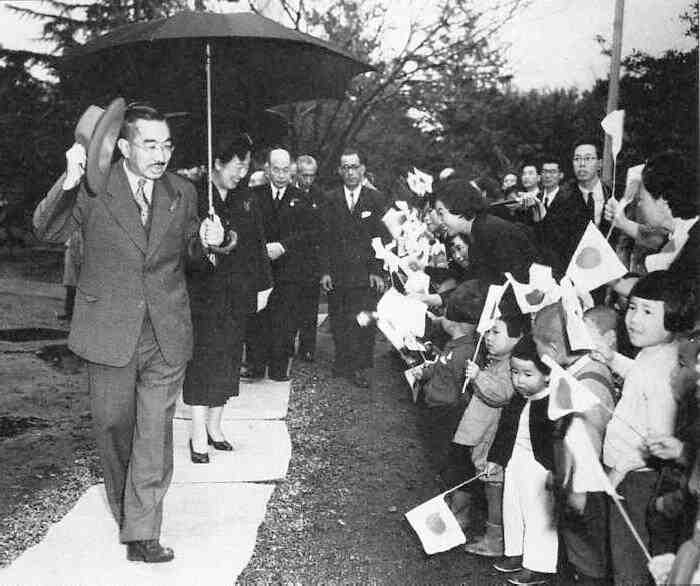
|
A militaristic party rose to dominate the Japanese government during the early era of his reign. His complicity with the milatarists is a not well
researched subject. Not every authority agrees with the widespread belief that Hirohito had no hand in Japan's conduct in World War II. Far from it. One example is Imperial Conspiracy written by David Bergamini (1971) who found that Hirohito was behind all the major decisions in the war, but that his role was covered up, and that General MacArthur knew, but went along with the whitewash for pragmatic reasons. Loyal Japanese officials and military commanders, unwilling to see the Emperor soiled by association with crimes committed in his name, saw their honorable duty as taking the punishment. What ever Hirihito's role, the militarists during his reign pursued expansionism, war with China (1937-45), and military alliance with the Axis powers (1940). The alliance led to Japan's participation in World War II and its attack on the United States in 1941. Toward the end of the war Hirohito sought peace, and in August 1945 he broadcast the unconditional surrender of Japan to the Allies.
A militaristic party rose to dominate the Japanese government during the early era of Emperor Hirohito's page. The Japanese military during the 1930s gained almost complete control over the government. Civilian politicians attempting to resist the military were assassinated. Communists were persecuted. The military introduced a highly nationalistic indoctrination program in
the schools. Censorship of the media was intensified. Navy and army officers occupied most of the key offices in the government, including the office of prime minister. The depression of the 1930s hit Japan hard.
The militarists decided that the solution to the economic crisis was to carve out an empire in Manchuria, China, and southeast Asia. This meant war. The Japanese Kwantung Army occupied Manchuria using as a pretext a faked incident on the main railroad (1931). Japan then decalared "Manchukuo" an independent state, What ever Hirihito's role, the militarists during his reign pursued expansionism, war with China (1937-45), and military alliance with the Axis powers (1940). The alliance led to Japan's participation in World War II and its attack on the United States in 1941.
Japan did not and does not today admit the full extent of its responsibility for launching World War II. Many Japanese attempt to hide the extent of their country's war crimes and prefer to view their country as a victim of the War. The list of Japanese attrocities and war is very long, involving the deaths of millions, mostly innocent civilians. The list in its entirity is too long to list here, but we need to mention some of the most grevious attrocities committed by the Imperial armed forces. The primary war crime is the launching of aggerssive war first against China (1937) and then the United States, Britain, and the Netherlands (1941). Specific examples include the terror bombing of undefended Chinese cities (Shanghai); mascres of Chinese civilians (the Rape of Nanking), use of biologcal and chenical weapons, mistreatment and massacres of Allied POWs (the Batan Death March), abuse of civilain internees, use of slave labor, conscription of civilian women for prostitution (Korean comfort women).
Emperor Hirohito's complicity with the milatarists was not after the War a subject of a well researched historical review. After the War the issue was left to General MacArthur and he chose not to arrest and procecute the Emperor. And unlike Hitler's minions, the Japanese officers and government officials tried after the War, did not blame the terrible war crimes on the Emperor. Nor did the procecutors, under orders from MacArthur, pursue the question. The War ended on a confusing note. While the United States did not back off of its unconditional surender demand, the Japanese surrender insiated that the status of the Emperor be maintained. The American reponse was equivocal. In the end MacArthur decided to allow Emperor Hirohito to remain on the throne, but to convert an absolute monarchy to a constitutional monarchy in a new democratic system. In recent years, however, the Emperor's role in the War has come under increasing consideration, primarily by Western reasearchers. And it has become cristal clear that Emperor Hirohito was involved in all the major decisions leading to the war and the conduct of the War. Nor do we know of any instances in which the Emperor intervened to limit or slow down Japanese aggression or the rutless barbarity of the Japanese military. Japanese historians and journalists have, however, been notably silent on this and other World War II war crimes issues.
Toward the end of the war Hirohito sought peace, and in August 1945 he broadcast the unconditional surrender of Japan to the Allies. While there is considerable controversey concerning the Emperor's war-time role, there is general agreement that he acted with considerable courage to end the War. At the time not only was he endanger from units of the Japanese military determined to resist, but he had ever expectation that he would be arrested and tried for war crimes by the Americans.
The United States after World War II oversaw an occupation which fundamentally changed the nature of both German and Japanese society. The American occupation in Japan rooted out Japanese militarism and fomenting the development of a democratic political regime and social structures. Women were enfranchized and labor unions allowed to organize. The results by all practical measures have been an overwealming success. Japan today is one of the most prosperous and democratic societies in the world. There were, however, major differences in the occupation policies pursued in Germany. The Imperial Government was not dismantled. Emperor Hirahito was allowed to remain on the Crysanthumum Throne. Details on his involvement in the War suggest a participation that was far more extensive than admitted at the time, although he certainly acted with considerable courage to end the War. Japan did not and does not today admit the full extent of its responsibility for launching World War II. Many Japanese attempt to hide the extent of their country's war crimes. Here the list is long, led by the launching of aggerssive war first against China (1937) and then the United States and Britain (1941). Specific examples include the terror bombing of undefended Chinese cities (Shanghai); mascres of Chinese civilians (the Rape of Nanking), use of biologcal and chenical weapons, mistreatment and massacres of Allied POWs (the Batan Death March), abuse of civilain internees, use of slave labor, conscription of civilian women for prostitution (Korean comfort women). Many Japanese today attempt to portray Japn in the role of a victim of the War as a result of the atomic bomb. Right wing groups in Japan today are promoting a new curriculum about the War.
Bergamini, David. Imperial Conspiracy (1971).
Bix, Herbert. Hirohito and the Making of Modern Japan (New York, 2000).

Navigate the CIH World War II Section:
[Return to the Main Emperor Hirohito page]
[Return to the Main Japan's road to war page]
[Return to the Main World War II Japan page]
[About Us]
[Biographies]
[Campaigns]
[Children]
[Countries]
[Deciding factors]
[Diplomacy]
[Geo-political crisis]
[Economics]
[Home front]
[Intelligence]
[POWs]
[Resistance]
[Race]
[Refugees]
[Technology]
[Totalitarian powers]
[Bibliographies]
[Contributions]
[FAQs]
[Images]
[Links]
[Registration]
[Tools]
[Return to Main World War II page]
[Return to Main war essay page]
[Return to CIH Home page]