|
Of all the Hapsburgs, one of the longest ruling was Francis Joseph I (1830-1916). He also proved to be end of the reining monarchs. By uniting himself with the conservative absolutist foces, he preserved the monarchy for over a half century. In the end, however, his refusal to allow basic democratic reforms would eventually lead tonthe end of the monarchy a few years after his death in 1916. Francis Joseph may indeed be the most tragic figure in the twilight of European monarchies. While he reigned for 7 tumultuous decades, his life was filled with tragedy. His brother Maximilian was executed in Mexico. His sonv Rudolf, a man of liberal ideals who might have saved the monarchy, commited suiside in a torrid love affair. His beloved wife Sisi was stabbed by an anarchist. His heir Francis Ferdinand was assasinated. His Empire had alrady begun to crumble in World War I, even before his death. Francis Joseph's rule was both magnificent and at the same time pathetic. The Austrian monarchy was one of the most prestiogious in Europe. The Emperor himself was the most long-lived soverign. Yet he lived to see Austria reduced to a second rate power by Germany, his loved ones die in tragic circumstances, and his Empire begin to desintegrate.
Franz Josef / Francis Joseph was a descendent of one of Europe's most illustrious royal families--the Hapsburgs. Francis Joseph's father was Arch Duke Franz Karl, a brother of the Emperor. His mother was a Bavarian princess--Princess Sophie (Wittelsbach) of Bavaria. There was a close relationship brtween the Austrian an Bavarian royals. He had two brothers, all three relatively close in age. Neither of his brothers ended up well, but for very different reasns. There was some question about Maximillian's parentage. He would be shot by a Mexican firing squad, a rather unlikely end to a Austrian royal. Franz Ludwig caused a scandal, but the succession after the death of Franz Josef's son Rudolf was to pass through Franz Ludwig's son Franz Ferdinand. .
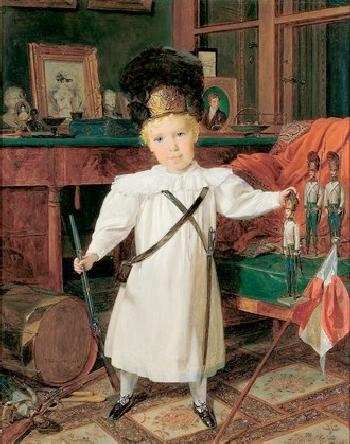
Franz Joseph was born in the Sch�nbrunn Palace in Vienna (1830). We have no information on Francis Joseph's boyyhood. I'm not sure how he was dressed as a boy. As a very little boy he wore dresses as can be seen here (figure 1). The painting suggests he liked to play with toy soldiers. We suspect that royal children were encouraged in such play activities.
We do not know much about how Franz Josef was dressed as a boy. Our information is limited to availble images and we have been able to find very few. As a little boy he seems to have worn dresses. Here we see him in 1832. He would have been about 2-3 years old. The portrait was painted by Ferdinand Georg Waldmueller. He wears a long white dress with a large white collar. At age 18 we note him wearing an elaborate military uniform. This would have been made about 1848 when he became emperor as a young man.
Francis Joseph became Emperor when his father renounced his claims to the throne, which had been abdicated by Ferdinand I, Francis Joseph's uncle--after the Austrian revolution of 1848. For a while the political situation looked desperate. Many believed the Hapsburg monarcy might collapse. The year of 1848 was a year of popular revolution throughout Europe. Many European monarchies stood on a precipice.
Grancis Joseph was to lead the fight against constitutional democracy and liberal ideas in Europe. The first 18 years of Francis Joseph's reign were characterized by strict absolutism and repression of liberal political movements. Francis Joseph worked to check the spread of revolutionary ideas from France, in alliance with the absolutist monarchies of Russia and Prussia, prevent the re-establishment of an independent Poland. Emperor Francis Joseph supressed uprisings an even abrogated the Austrian Constitution in 1851. He signed a concordat with the Vatican giving the clergy jurisdiction over education and powers over the marriage laws.
The one moderating factor in Francis Joseph's court was his beloved wife, the Emperess Sisi. The love story of Emperor Francis Joseph I. and the Bavarian princess began in 1853 at the Upper Austrian spa town Bad Ischl, the summer retreat of the 23-year old Emperor. Francis Joseph was meant to be introduced to his fianc�e-to-be, Princess Helen of Bavaria, at this
scenic Salzkammergut town. However, the Emperor defied his mother's marriage plans and fell in love with Helen's sister Elisabeth, then only 15 years old, who had accompanied the party rather accidentally. Already one day after their first encounter Francis Joseph and Elisabeth celebrated their engagement.
Emperor Francis Joseph and Bavarian Princess Elizabeth on April 24, 1854 married at Vienna's Augustinerkirche. They were the most beautiful and richest couple in the world. Because of her natural charm, the public adored her like a fairy-tale figure. In her private life, however, she was soon confronted with problems. The Empress had exchanged a carefree country life with the strict etiquette of the Imperial Court and could hardly adapt to it. Francis Joseph loved his wife dearly, but he ruled over an empire of 50 million people and had little time to be with "Sisi" who felt lonely. "I wish he were no emperor", she confided her former governess. Elisabeth was also concerned for the poor and sick. Although she disliked official public functions, she often visited hospitals and asylums, and was interested in new treatments and cures for paitents. The normal man on the street saw her as the mother empress comforter of the poor. As a young woman, the Empress Elizabeth had little interest in the "profession" of her husband. She gradually became more poltically active influencing the Emperor. With her liberal and progressive political ideas she supported the Hungarians in their struggle for indepence and contributed considerably to Hungary's equalized status with Austria in 1867.
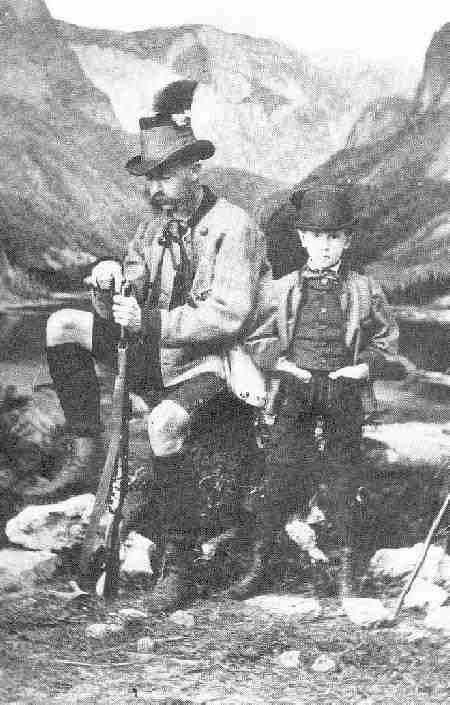
We have little information on the Emperor and Emperess as parents. Availableportraits shoan attemopt to portry a warm relationship between the Emperor and his son Rudolf when the boy was younf. Wether this was actually the case we do not know. We know nothing about the relationship between the Emperor and his daughters, We do know that there were tensions between various members of the royal family. The Emperor and Emperess were deeply involved. His mother continued, however, to have influence in family and court members. And Sisi had not been her first choice. And once Emperess, Sisi had trouble adapting to the very formal court. There were aeries of incidents between her and the Emperor's family. Tragedy visited early with the death of their first child--Sophie. Much later they lost Rudolf, their oldest son. Crown Prince Rudolf allegedly committed suuside in the notorious Mayerling incident (1889). There were problems with the brothers. Archduke Maximilian ignored his brothers warning and took up Napoleon III's offer of a Mexican crown. Archduke Karl Ludwig caused a scandal. He later died. After Rudolf's suiside, the Emperor's nephew Archduke Franz Ferdinand became next in line for the crown. Franz Ferdinand decided to marry a countess which Franz Joseph and the court decided was beneath the imperial dignity. It was permitted only on a morganatic basis. The Emperor refused to even attend the wedding. This destroyed the personal relationship between the two men.
|
Emperor Franz Josef and Emperess Elisabeth had four children. The Emperess gave birth to four children, three in quick order after marriage. She was not, however, a very engaged mother. She has been criticized, however, for her lack of warmth as a mother. This is not just a family matter. Her son Rudolfis a man, who if he had become emperor, night have been able to stop World War I. The Empresses' motherly role may have been affected by her treatment at Court. She was only 16 when she was married and very innocent. Her initail intinmate realtions with her husband appear to have been unpleasant. When the children arrived, Franz Josef's mother the Archduchess Sophia constantly interfered. She prohibited Elizabeth, for example, from breast feeding the children. She ccame to dislike, she used the term "loath" the idea of having children. After the first three children, even though her health was excellent, she insisted to her husband that they have no more children. This proved to be decission if enormous political consequence when their only son, Rudolf committed suiside. This showed a very strong turn of mind for a young woman in the mid-19th century. She in fact encouraged Franz Josef to find a mistress so as not to have further intimate relations with him. This rejection was a considerable scandal in court circles and very painful to Franz Josef as he was so attached to her.
Tsar Nicholas I did not believed that the European freat powers would object to Russian annexation of a few neighbouring Ottoman provinces. This was especially the case of Austria because the Tsae has sent Russian troops to supress the Revolutions of 1848, essentially saving the Austrian monarchy. The Great Powers (Britain, France, Austria and Prussia) met in Vienna and drafted a note which they hoped would resolve the developing problems between the Russians and Ottomans. Tsar Nicholas accepted it, but Sultan Abd�lmecid rejected it. Britain, France and Austria proposed amendments to meet the Sultan's objections. Tsar Nicholas ignored the efforts at further negotiations. Britain and France declined to pursue further negotiations, but Austria and Prussia wanted to continue negotiations. The Sultan declared war (October 23, 1853). The Russian destruction of the Turkish ships at Sinope was the casus belli. After Russia ignored an Anglo-French ultimatum to withdraw from the Danubian Principalities, the Allied powers (Britain and France) formally declared war (March 28, 1854). Nicholas was convinced that because of Russian assistance to Austria during the Revolutions of 1848 that Emperor Franz Josef would support him or at the very least remain neutral. Emperor Franz Josef to the Tsar's surprise not only did not support him, but supported the British-French demand that the Russians withdraw from the contested Danubian provinces. The Austrian position is not fully understood. It seems to have been a fear of allowing the Russians into the Balkns combined with a desire to obtain the Ottoman Balkan territories themselves. Franz Josef did not declare war on Russia, but he refused to guarantee thst Austria would remain neutral. The Tsar withdrew from the Ottoman Danubian principalites, largely to placate Franz Josef. The Crimean War broke out when the Russian refused to comply with further Allied demands. Austrian action was critical because unlike the British and French had to deploying an expeditionary force and support it over a vast diustance. Austria which bordered Russia could have brought the full weight of its army to bear against the Russians. Austria occupied the Danubian principalities (August 1854). After costly fighting, the Russians finally sued for peace after Austria threatened to join the Allies. While Austria did not enter the War, its diplomacy had a huge impact on subsequent European history. The Russian and Austrian monarchies had a long history of cooperation. They fought together against Frederick the Great and later the Emperor Napoleon. The relation between Austria and Russia was at the center of the reorganization of Europe by the Congress of Vienna, Austrian actions under Franz Josef during the Crimean War irrevocably broke the Austrian-Russian alliance. Chancellor Bismarck would try to repair the damage through his diplomacy, but it was never fully restored and this would ultimately be a factor in the outbreak of World War I.
Francis Joseph was forced to accept constitutional reforms after disastrous military defeats. The Austrians were defeated in Italy (1859) leading to a new unified Italian monarchy to the south. In the War of Italian independence, Austria lost all of its Italian possessions except Venetia which was only retained until 1866. Austria's position within Germany was radically altered when it was swiftly defeated by Prussia in the Astro-Prussian War or German Civil War (1866). The defeat by Prussia in 7 week forced Austria to withdraw from the German Confederation and to cede its traditional dominance in Germany to Prussia. This was to lead to the unification of Germany under the Prussians and founding of the German Empire in 1871. The Austrian monarch was converted into a dual crown for Austria and Hungary in the 1867 Ausgleich. Hungary was raised from the status of a Crownland to a joint partnership in the Austro-Hungarian monarchy.
Austria was only a small part of the Austro-Hungarian Empire. And even Austriaas only partly German. Thus the nationalities question was central to the Empire and its rule by the German Hapsburg dynasty. Prussia's defeat of Austria in the Franco-Prussisan War (1866), effectively ousted Austria from the German community. The creation of the Dual Monarchy provided rights to Hungarians. The rights of the Slavic nationalities (Croats, Czechs, Serbs, Slovaks, and Slovenes). The Emperor favored some degree of autonomy or local self-government for different ethnic groups within the Empire. Had he suceededWorld Wat I and II as well as the rise of Fascism and Communist might have been preventedf. Archduke Franz Ferdinand also favored some constitutionl reforms. The Emperor planned to grant some form of self-government to the Slavs, but how to accomlish this was a difficult question. While Fraz Josef was the Emperor, he was not an absolutist leader. He could not impose reforms by fiat. The German and Magar (Hugarian) nobels and other landowners who wielded great influence, generally opposed such reforms and power sharing whoch would have affected their influence and inevitably income. Given the rising nationalist sentiment, it is unclear if constitutional reform could have met the nationalities demands. But the Emperor's failure to enact major reforms led to rising dissatisfaction among the Empire's Slavic nationalities. The resulting disolusionment among theSlavic nationslities weakened the Habsburg Empire. It also resulted in increased problems with with Russia, which championed the cause of Pan Slavism. (In much the same way the Soviets used Communism.) The inability to achieve a compromise would eventually lead to World War I and the end of the Empire. He was a life-long advocate of monarchy. He once wrote to President Roosevelt, "It's my job as emperor to protect my people from elected politicians." While this may sound hopelessly outdated, in fairness to the Emperor, politicans in the early 20th century were stirring up national feelings that woukd bothb lead gto World War and tensions after the war. The Austro-Hungarian Empire did keep those tensions in check.
An Italian anarchist stabbed the Empress Elizabeth in Geneva during one of her trips (1898). Austria at the time controlled nrtheaster Italy and the population wanted to be party of the Italian Kingdom. The Emperess died in her hotel room a few hours after the attack. The Emperor was staggered. Some say he never fully recovered from the tragedy. The Empress-Consort Zita of Bourbon-Parma claims that he told intimates, "You'll never know how important she was for me" or, according to some sources, "She will never know how much I loved her." He is also quoted as saying "Mir bleibt doch gar nichts erspart auf dieser Welt!" (I really don't escape anything in this world!)
The later years of Emperor Franz Josef were marked by a series of family tragedies and policy failures.
His only son and heir, Archduke Rudolf, committed suicide in one of the great love stories of the 19h cebntury (1889). As his daughters could not inherit the throne, the sucessioin passed to his second younger brother, Karl Ludwig. (His first younger brother had died in Mexico.) Karl Ludwif then tragically died after drinking bad water while on a pilgrimage in the Holy Lands (1896). Mext an Italian anarchist assasinated the Emperess Elizabeth in Geneva (1898). In addition to the personal tragedies, there was a critical policy failure.
After reaching a compromise with the Hungarias ad becoming a dual monarch, Franz Josef realized that there would have to be constitutional changes to accomodate the Empire's Slavic nationalitices (Croats, Czechs, Serbs, Slovaks, Slovenes, and Serbs). Ther Emperor announced his intention of granting a degree of self-government to the Slavic nationalities. This proved difficult to achieve in practice. Such a step was opposed by the German and Magyar (Hungarian) politicians who essentially ran the Empire and who fundamentally opposed to any form of power-sharing. This would have ultimately led to land reform which would have undermined their economic interests. This was not only a domestic problem, but had international implications as a result of Tsarist Russia's Pan-Slavic foreign policy. While the Emperor wanted a degree of condtitutional reform, military reverses to Prussia, France, and Austria had trandsformed Austria to a largely Balkan-Central European power. The Emperor fully realized what had occurred during his reign and was opposed to any further territorial concessions. As the borders with Germany ad Russia were fixed, this setermination primarily afected the borders in the Balkans with Serbia. After the Emperess's assasination, the aging Emperor began to withdraw from public life and increasingly left the handling of state issues to his advisers who were unwilling to seriously address the nsationalities issue. Gradually the Emperor more and more lived his life in the palace. The Emperor's last significant personal intervention concerned the sucession. After Archduk Karl Ludwig's death, his eldest son, Franz Ferdinand, emerged as heir. The problem here was that the Emperor did not like Franz Ferdinand. Here there were both personal and policy issues involved which are difficult to seperate. And this climaxed when Franz Ferdinand chose to marry Sophie Chotek von Chotkova. The Emperor saw her as unacceptably below his nephew's rank. Sophie came from a noble Bohemian family. The Emperor wanted a member of the Hapsburg royal family or from one of the ruling Catholic dynasties of Europe which primarily meant German. The Emperor only permitted the marriage when Franz Ferdinand agreed to renounce all rights of sucession for his children (1899). Especially gusaling to the Archduke, Sophie was not permitted to accompany her husband in the royal carriage nor could she sit by his side in the royal box. Negotiations over this engendered extremely rancouros dicussions and were only agreed to after Kaiser Wilhelm II, Tsar Nicholas II, and Pope Leo XIII all interveed. Emperor Franz Jodef refused to attended the marriage cerempny. (He would also years later even refuse to attend Franz Ferdinand's funeral.) Despite the teritoirial losses and failure to resolve the nsationalities issues, the aging Emperor was immensely popular among his subjects, including the various nationalities. This is perhaps in part to a relatively high standard of living prevalent throughout the Empire, although some Slavic groups like the Slovaks were economically disadvantaged.
Austria-Hungary acquired Bosnia as the Ottoman Empire unravelled. The Austrians did not formally annex Bosnia until several years later (1908). Serbs who constituted a part of the populsation were outraged. This set off an international crisis that could well have ignited a European war at the time. It did in fact further inflame Serb sentimet against the Austrians. This of course led to the Franz Ferdinand's assasination while visiting Bosnia (1914). A Serbian nationalist shot him, leading to World War I. It also layed the ground work for the terrible attrocities that occurred in Bosnia during Word War II (1940s) and with the disolution of Yugosalvia (1990s).
|
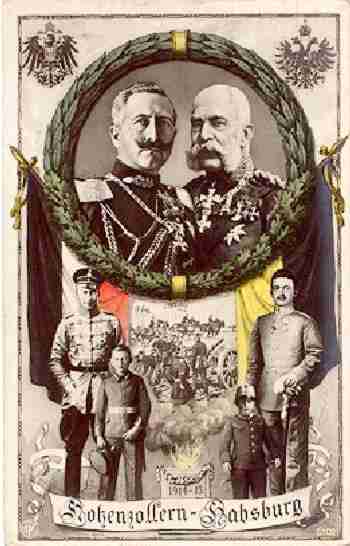
Austria-Hungary was an empire with many contentious minorities, many aspiring for independence. The Austrians annexed Bosnia in 190?, angering Serbian nationalists. Austria-Hungary under Francis Joseph joined Germany and Italy in the Tripple Alliance of 1882. The asasination of Francis Joseph's heir, Archduke Franz Ferdinand, in 1914 by an a Serbian nationalist precipitated World War I. He favored reforms to address some of the nationalist concerns of the subjects of the Empire. His reforms were did no approach the demands of Serbian nationalists nor entirely supported by the Emperor. Austrian prepared an invasion of Serbi where nationalist elements supported terroist groups. I am not sure to the extentto which the Emperor participated in the planning, but he approved the opearation. The Austrians supported by Kaisser Wilhelm II, launched a military campaign to punish Serbia. This brought Russia to support Serbia and France had an alliance with Russia. The Austrians hoped the German alliance would disuade the Russians from intervening and if they did provide the military power to defeat them. Germany as soon as Russia began to mobilize declared War, invading France through neutral Belgium. The British entered the War when the Germans invaded Belgium. Italy did not honor its treaty obligations to Austria and Germny. Rather in 1915 they entered the War on the Allied side, hoping to gain areas in northern Italy still controlled by the Austrians. Francis Joseph died during the War in 1916.
Emperor Franz Joseph was not directly involved in the conduct of the War. He would live for another 2 years after the War began. He relied on his military high command to conduct the War. He stayed mostly in the Schonbrunn Palace. As he began to decline and the war dragged on with devestating results, he began to think his Empire would not survive the War. Emperor Franz Joseph died in the Sch�nbrunn Palace with the War still raging (November 21, 1916). He is reported to have died singing "Gott erhalte, Gott besch�tze, Unsern Kaiser" ("God Save the Emperor"). He was 86 years old, one of the longest serving monarchs in European history. His grand-nephew Karl I succeeded him and had the task of saving the Empire. The War by this stage was largely in German hands. Only a German victory would have saved the Empire.
|
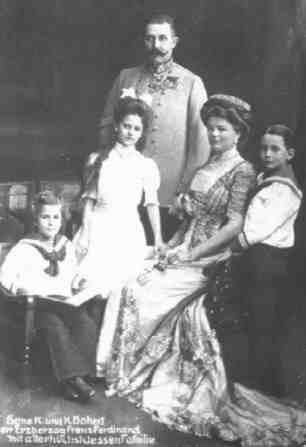
With the sensational suicide of Crown Prince Rudolf, the succession passed to Francis Joseph's brothers and nephews. Francis Joseph's daughters were ineligible to succeed. The Austro-Hungarian crown would therefore pass to the Emperor's brother, Karl-Ludwig, and eventually to this archduke's descendants. Karl-Ludwig had three sons: Franz-Ferdinand, of a sickly complexion, Otto, of a wild and debauched nature, and Ferdinand-Karl, who was only too ready to give up his imperial rights and become a commoner under the name Ferdinand Burg. Franz-Ferdinand contracted a morganatic marriage in 1900 with Countess Sophie Chotek, his children could not inherit the throne. Francis Joseph's nephew Francis Ferdinand was made heir to the throne after the untimely death of Archduke Rudolf. I know little of his childhood or how he was dressed as a boy. Historians have written a great deal about Franz Ferdinand and very little of it has been very positive. Franz Ferdinand has been referred to as a miser, a bigot, and a spoiled child. He was shunned by the elite of Viennese society. One observer called "the loneliest man in Vienna". Francis Ferdinand appears to have lacked the two key elements for success in political life--charm and elegance. Charles Francis Joseph, Charles I or Karl I (Charles IV of Hungary) (1887-1922), was another of Francis Joseph's nephews (figure 1). I have few details about how Charles was dressed as a boy. He seems to have passed out of dresses by about 4 yeas of age as he is pictured in a sailor suit with knee pants rather than a skirt in a photograph taken with his mother about 1891. Karl replaced Francis Joseph when the Emperor died in 1916 (figure 4). Even before his death, Francis Joseph had planned to confer the rights of co-regent on Charles. Karl I was the last of the Hapsburg rulers.

Navigate the Boys' Historical Clothing Web Site royal pages:
[Return to the Main Austria pages]
[Baden]
[Bavaria]
[Belgium]
[France]
[German states]
[German Empire]
[Italy]
[Monaco]
[Netherlands]
[Norway]
[Romania]
[Russia]
[Spain]
[United Kingdom]
[Return to the Main royal pages]