School Uniform: Footwear
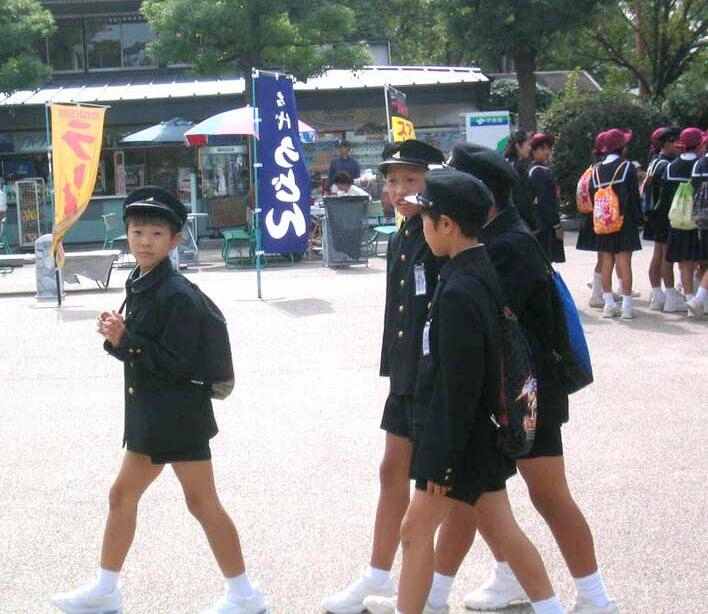
Figure 1.--Japanese primary school children have commonly worn sneakers. At fitst this may have been the low cost of sneakers, but this is no longer the case. Here we see students on a school outing. These Osaka boys wearing white ankle socks and sneakers.
|
|
We notice a lot of boys in the late 19th century wearing heavy boot-like shoes. After World War I, the oxford shoe became a standard shoe style American boys often wore sneakers to elementay schol. This was once most common for children from less affluent families. They were not llowed at secondary schools. Sneakers became standard school footwear in America by the 1970s. In England, elementary-age boys often wore closed-toe brown "t" strap sandals, referred to as school sandals, for normal school wear. Some younger boys or girls wore redish-brown or blue sandals or double strap sandals. Clark's school sandals were a standard. Some private schools required them. Sandals are still
widely worn, but the center strap is now commonly quite thick. Footwear trends have varied significantly over time. We do not yet have much information on the 18th century. We also do not know much about the early 19th century. We know much more about the mid- and late 19th century as a result of the development of photography. And by coincidence this was also the time at which much larger numbers of children begin to attemd school as a result of the development of public education systems. We know much \more about the 20th century. Footwear trends varies widely from country to country. There were major differences between Asia, North America, and Europe. The trends in Europe varied from country to country, but were significantly different from North America until late in the 20th century.
Footwear Types
We notice a lot of boys in the late 19th century wearing heavy boot-like shoes. After World War I, the oxford shoe became a standard shoe style. Saddleshoes and sneakers were also worn. American boys often wore sneakers to elementay schol. This was once most common for children from less affluent families. They were not llowed at secondary schools. Sneakers became standard school footwear in America by the 1970s. In England, elementary-age boys often wore closed-toe brown "t" strap sandals, referred to as school sandals, for normal school wear. Some younger boys or girls wore redish-brown or blue sandals or double strap sandals. Clark's school sandals were a standard. Some private schools required them. Sandals are still
widely worn, but the center strap is now commonly quite thick. Regular black oxfords were used for dress wear or by older boys. During inclemiate weather, English boys might wear wellies. We notice French boys wearing a wide range of footwear, including sandals, oxford shoes, and book-like shoes.
Children going barefoot to school has generally been seen as an indicator of poverty. And this has largely been the case in most countries and over time. Generally in England, France, and Germany it was poor working-class children we see going barefoot. In Germany we see many children going barefoot after in the difficult times after Wirkd War I and II. This was basically the case in Amerca as well. We note, however, that some children in rural areas preferred to go barefoot. Thus in the Southern states we see children going barefoot when the weather warms up at the end of the school year. We note a lot of children in Australia, New Zealand, and South Africa going barefoot without any suggestiin of poverty. African children commonly come to school barefoot, but this is generally an indication of poverty. India and Sri Lnka are more varied. Poverty is a factor, but some children prefer to go barefoot. Over time with increasing affluence, fewer children come to school varefoot, but there are still many countries where children come to school barefoot. This is particularly the case in Africa because if continuing endemic poverty. But there are still a few countries that children come to school barefoot out of prederence (New Zealand and South Africa). Today in Europe few children come to school barefoot. There is an exception in some German-speaking Swiss Cantons. Here we see some children in rural areas coming to school barefoot.
Chronology
Footwear trends have varied significantly over time. We do not yet have much information on the 18th century. We also do not know much about the early 19th century. We know much more about the mid- and late 19th century as a result of the development of photography. And by coincidence this was also the time at which much larger numbers of children begin to attemd school as a result of the development of public education systems. We note many children attending school with heavy boot-like shoes. Quite a number of children attended school barefoot. This varied somewhat by country with climate being an important factor. We have much more detailed information on the 20th century and we note a greater variety of school footwear. Many children wore high-top shoes in the early 20th century, but we see still see barefoot children in several countries. Here both climate and poverty were factors as were social conventions. After World war I we see children in many countries wearing sandals, but not commonly in America. High-top shodes were still common for younger children, but this varied from country to country. Most children wore leather shoes. American children began wearing sneakers after World War II, but this trend did not immediately develop in Europe. It did in Japan.
Footwear trends varies widely from country to country. There were major differences between Asia, North America, and Europe. Footwear was one of the garments that varied most widely, perhaps because it was a potentially expensive item. The trends in Europe varied from country to country, but there were many similarities. Footwear trends were notably significantly different from North America until the late-20th century. We have begun to develop country pages for several countries, including America, England, France, Germany, Italy, and other countries. We note heavy footwear in many countries during the 19th century. Many younger children attended barefoot, here both climate and social class were involved, but also country trends wer important. Barefeet were socially acceptable in the British southern Dominions (Australia, New Zealanf, and South Africa). And if was fairly common in America, at least until Worl War I. In other countries barefeet wereccommon, but were mostly a social class matter.We note lighter footear such as sandals becoming popular in the early-20th century in many Europen countries, especually Englnd. American boys wore leather shoes until well after World war II, lhough sandals and strap shoes were popular for the girls. Interestingly sneakers first became stndardfoot ear in Japan, but also became popular in America by the 1960s.
HBC-SU

Navigate the Boys' Historical Clothing Web Site:
[Return to the Main school uniform garment page]
[Introduction]
[Activities]
[Biographies]
[Chronology]
[Clothing styles]
[Countries]
[Bibliographies]
[Contributions]
[FAQs]
[Glossary]
[Images]
[Links]
[Registration]
[Tools]
[Boys' Clothing Home]
Created: November 5, 2003
Last updated: 8:23 PM 4/6/2014