
Swimming Costumes and Suits: Early Bathing Suits
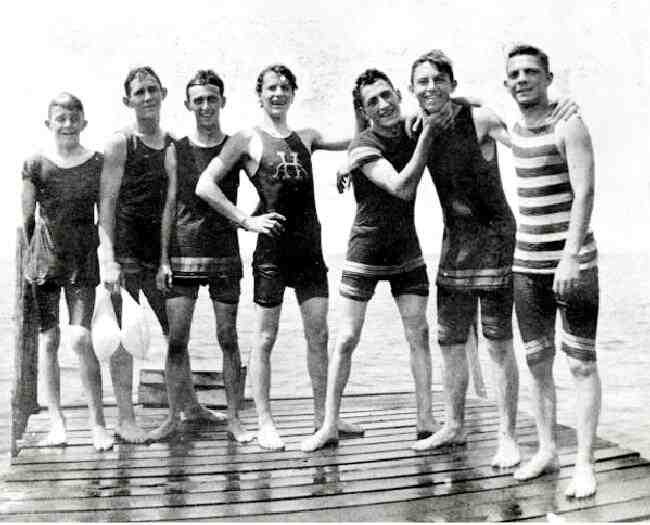
Figure 1.--group of teenage boys in bathing suits. It was taken at some lake in Indiana during 1900. One of the boys has the letter H on his sleeveless shirt, maybe standing for some highschool. Many bathing suits of the period were one-piece, but these seem to be two-piece suits consisting of rather long close-fitting trunks with a sleeveless shirt worn on top.
|
|
Early bathing costumes covered almost everything and were normally made out of wool. The wommen and girls even had caps for their hair. These outfits, especially the ones for girls, seem very corectly described as bathing costumes. It must have been difficult to actually swim in them, especially for any distance. They seem more suited for playing on the beach or paddling in the water. Early bathing costumes include shirt-like garments to cover men's as well as women's torsos. It was a first not considered proper for men to swim without their chests covered. These were often made as two-piece suits. This did not begin to change until after World war I (1914-18), but even in the 1920s and 30s men and boys often had bathing costumes with singlet-type shirts. These wre made as one-piece suits. A good example of a one-piece suit for boys is a Jantzen swim suit in 1931. We do not fully understand shifts in bathing costume styles, especially the shift from two-piece to one-pieve suits. A reader writes, " I think both styles were available very early in the 20th century, but the one-piece style became more common in the 1920s and 30s. But when I was growing up, one could still see both. However, the loose top worn over the trunks (as in the Indiana photo) was not common then. I remember that at the country club where my parents used to take me swimming in the 1930s, it was a
requirement for men and boys to have their chests covered when swimming. I think I remember a style of swim-suit with the singlet-style top attaching to the trunks by buttons and, later, by a zipper. But I wore a simple one-piece bathing suit with the top and bottom continuous like the Jantzen model. The boy's style was just a junior version of what men wore."
Garments
Early bathing costumes covered almost everything and were normally made out of wool. The wommen and girls even had caps for their hair. These outfits, especially the ones for girls, seem very corectly described as bathing costumes. It must have been difficult to actually swim in them, especially for any distance. They seem more suited for playing on the beach or paddling in the water. Early bathing costumes include shirt-like garments to cover men's as well as women's torsos. It was a first not considered proper for men to swim without their chests covered. We do not fully understand shifts in bathing costume styles, especially the shift from two-piece to one-pieve suits. A good example of a one-piece suit for boys is a Jantzen swim suit in 1931.
We have very little information on 19th century bathing suits at this time. What little we know cones from studio portraits. Early bathing suits were often made as two-piece suits. This did not begin to change until after World War I (1914-18), but even in the 1920s and 30s men and boys often had bathing costumes with singlet-type shirts. These wre made as one-piece suits. A reader writes, " I think both styles were available very early in the 20th century, but the one-piece style became more common in the 1920s and 30s. But when I was growing up, one could still see both. However, the loose top worn over the trunks (as in the Indiana photo) was not common then. I remember that at the country club where my parents used to take me swimming in the 1930s, it was a requirement for men and boys to have their chests covered when swimming. I think I remember a style of swim-suit with the singlet-style top attaching to the trunks by buttons and, later, by a zipper. But I wore a simple one-piece bathing suit with the top and bottom continuous like the Jantzen model. The boy's style was just a junior version of what men wore."
The black and white photography of the day provides few clues as to the colors of early bathing suits. since stripes were very common, we are talking here about the colors of the stripes. While there was no color photography in the 19th century, there were some sources of color information. We notice colorized photographs and lithographs. Here we are not always sure about the accuracy. One very important source that we know is accurate is vintage clothing. After World War I we notice post cards wuth bright, some times garish, outlandish colors. This was niot the case before the war. Abnd we think portraits colorized for patrons generally used fairly sccurate colors, although the precise shade may not be precise. we have begun to collect color information, but our archive is still limitedc and we have not yet identified chronological and country trends.
Reader Comments
A reader comments, Notice the swim suits on the attached page are two pieces which may mean that the tops could be worn longer (see boy at the far right)
even if the trunks are replaced. Notice the shirt seems small whereas the trunks are very large. So the shirt may be purchased and worn for several years and the trunks replaced as needed or vice a versa."
HBC

Navigate the Boys' Historical Clothing Web Site:
[Return to the Main swimming clothing page]
[Return to the Main sport uniform page]
[Introduction]
[Activities]
[Biographies]
[Chronology]
[Cloth and textiles]
[Clothing styles]
[Countries]
[Topics]
[Bibliographies]
[Contributions]
[FAQs]
[Glossaries]
[Images]
[Links]
[Registration]
[Tools]
[Boys' Clothing Home]
Created: 2:43 AM 5/31/2005
Last updated: 2:58 AM 4/12/2012