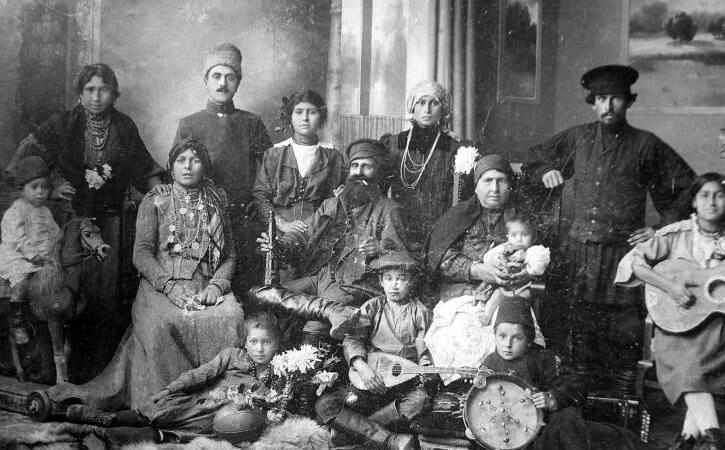
Figure 1.--This portrait of a Gypsie family wasctaken in 1911. The family was from Povolzhye (Volga region) of Russia. Note the mixture of Russian and other styles that they are wearing. Also notice the obvious importance of music. |

|
As Tsarist Russia developed a multi-national empire, Russia also acquired a population of Gypsies. Russia like other European countries had a population of Gypsies or Roma as they preper to call themselves. This was the case in Tsarist Russia, especially as Russia expanded into Poland and toward the Balkans. Gypsies are strongly associated with Romania and Russia ecentually acquired Moldavia, a province also claimed by Romania. Even so, the Russian Gypsey population was fairly small, a small fraction of the Hungarian Gypsey population. The countries in which the Gypsies lived passed a range of measure designed to control or assimilate the Gypsies. Russian Gypsies were often drafted into the army and forbidden to speak Roma. Catherine the Great during the 18th century approved laws which made Gypsies slaves of the Crown. [Clébert, p. 74] One author describes the Gypsies of the era, "In their dress, they lavish all their finery upon their heads. Their costume in Russia is very different to that of the natives. The Russians hold them in great contempt; never speaking of them without abuse; and feel themselves contaminated by their touch, unless it be to have their fortunes told. Formerly they were more scattered over Russia, and paid no tribute; but now they are collected, and all belong to one nobleman, to whom they pay a certain tribute, and work among the number of his slaves" [Clark, p. 208.] Gypsies are a wandering people and as nation states became increasingly strong, Gysies tended to take on the customs and folklore of the countries where they lived. This was especially true as movement accross national borders became increasingly complicated. The Gupsies tended, however, to blend national culture and folklore with their own rich culture. I'm not sure what happened to Russian Gypsies during the Soviet era. Many lived in thewestern areas which became independent, especially Poland and areas acquired by Romania. The Gypsies are one of the few groups that Solzhenitsyn does not mention in . Most Russian Gypsies lived in the Eastern and Southern areas overan by the NAZIs in World War II and may perished in the Holocaust. We have few details at this time.
Clark, Edward Daniel. Travels in various countries of Europe, Asia and Africa (London: 1800).
Clébert, Jean-Paul. The Gypsies (London: Vista Books. 1963).

Navigate the Boys' Historical Clothing Web Site:
[Return to the Main Russian minority page]
[Return to the Main Gypsey country page]
[Introduction]
[Activities]
[Biographies]
[Chronology]
[Countries]
[Styles]
[Bibliographies]
[Contributions]
[FAQs]
[Glossaries]
[Images]
[Links]
[Registration]
[Tools]
[Boys' Clothing Home]
Navigate the Boys' Historical Clothing ethnic pages:
[Main ethnic page]
[German]
[Greek]
[Gypsey]
[Irish]
[Native American]
[Russian]
[Scottish]