
Strap Shoes: United States

Figure 1.--This American boy in a photograph probably taken about 1928 shows Morgan Hebard Jr, born in 1921. He wears a self-belted short set and white kneesocks. These self-belted shorts sets were popular in the 1930s and 40s. I'm not sure what color his strap shoes were. Note that they have button closures.
|
|
Strap shoes were worn by American boys, following much the same pattern as in Europe. They were never as popular, however, in America as in Europe. This was in part because short pants which were generally worn with strap shoes were not as popular in America. The time line for strap shoes in America is similar to that in Europe. While usage patterns varried substantially, especially for boys, the appearance of the strap shoe and stlistic trends were not greatly different. They were worn with skeleton suits in the early 19th century and by the turn of the 20th century with Fauntleroy suits and with other outfits like Buster Brown suits and sailor suits. We notice mosty pre-school American children wearing strap shoes. This vaid somewhat chronologically. We note Strap shoes came in many colors. As far as I know they were always black in the 19th century. I believe that colored shoes appeared in the 1900s, reds, blues, and whites. This is primarily based on the premise that Buster Brown was drawn in colored strap shoes. The photographic evidence is ambiguous as it is black and white. Strap shoes in America were also known as Mary Janes--at least the girls' versions. I'm not sure why, but I think this was a trade mark of the Buster Brown Shoe Company. I think Buster's girl friend was Mary Jane, but of course Buster also wore starap shoes. Strap shoes were worn by children, both boys and girls, in the 19th and early-20th century. They were not seen as a style with a particular use in mind, although they tended to be worn primarily by children from well-to-do families. Thus it gives the impression of a dress shoe. Here a complication was that people tended to dress formally and the concept of play clothes was just beginning to develop. After World War I, strap shoes increasingly began to be seen as a girl's style. They also became to be seen as more of a dress shoe. Strap shoes were available in both dress and play styles. At first both boys and girls wore the same strap shoes, but gradually usage conventions developed and ceventually thec strap shoe became seen as a girls' dress shoe style.
The time line for strap shoes in America is similar to that in Europe. While usage patterns varried substantially, especially for boys, the appearance of the strap shoe and stlistic trends were not greatly different. Strap shoes for children appeared early in 19th century. We have first noted them worn by boys with skeleton suits. We are not sure who developed this style of shoe or just why it was considered suitable for children. It was a European import, probably from France, but was widely worn in Euope in the ealy-19th century. It was not commonly worn by boys, but it is somnetimes seen at mid-century with boys still wearing dresses. Boys in the late-19th century, even boys in dresses often wore high-top shoes, including heavy boo-like shoes. European boys at the time were more likely to wear strap shoes. We are not sure why. Perhaps America probably had fewer amenities like sidewalks and delicate strap shoes were not like to hold upmas well as more substantial footwear. Stap shoes were seen again at the beginning of the 20th century with boys wearing Fautleroy and Buster Brown suits as well as a variety of other outfits. We also notice boys in dressy tunic suits wearing them. A good example is an unidentified boy in the 1910s. This boy wore double-bar strap shoes. Strap shoes were dressy shoes until the 1920s when they were worn by younger boys for play. They were most common in the early 20th century. A good example is Carl Kellison about 1910. We also notice the ankle strap shoe. A good example is the Nethery boys in 1915. Another example is Keith Birkin, we think in the 1910s. Strap shoes were still worn by American boys, mostly boys from affluent families, in the 1930s, but were much less common in the 1940s.
The basic strap shoe is the style most commonly worn by boys. Generally boys wore the style with a fairly wide bar strap. The shoes with particulatly narrow side bars were normally for girls. Boys shoes were usually very plain. Girls strap shoes, especially modern ones, might have embelishments like little bows or patterns cut out of the shoe. There were two basic styles. One had the primary or first two straps set at the instep. There were many variatiins of the instep strap shoe. This included both the number of straps or bars as well as a center post. And the width of the straps also varied. The one- and two-bar straps were the most common, but we have seen strap shoes with multiple straps. A good example is Carl Kellison who wore double staps shoes with out a center strap or post. These multiple straps seem the most common in the early-20th century, but we see them into the 1930s. Sears offered a five strap shoe. avaialble in black and white. Another style of strap shoe had the strap high on the ankle rather than across the inseam. This was commonly worn by both boys before World War I. Unlike the instep strap shoes, there were far fewer variations with the ankle strap shoes.
Age
We notice mosty pre-school American children wearing strap shoes. This vaid somewhat chronologically. We note Carl Kellison wearing strap hoes about 1910 He was 6 years old, but he mat not have begun school yet.
Colors
Strap shoes came in many colors. As far as I know they were always black in the 19th century. I believe that colored shoes appeared in the 1900s, reds, blues, and whites. This is primarily based on the premise that Buster Brown was drawn in olored strap shoes. The photographic evidence is ambiguous as it is black and white. I eventually hope to find some advertisements which will provide details on color. The colored shoes were mostly the play shoe and not the dress strap shoe.
The standard strap shoe had one hoirizontal strap, commonly called a bar. The placement of the bars varied as did the width. The bars were opened to put on or take off the shoe. There were both buckles and buttons. Also common was a center vertical strap connecting the hoizontal bar with the front of the shoe. This center strap is sometimes called a post. These shoes were sometimes called 't'-trap shoes and sndals. They were mde in both dress and play styles. The play styles wer commonly called sandals. While one bar strap shoes became the standard, there were other strap shoes with multiple bars. Quire a number of comparable footwear was made with double bars, often with the center strap. These were for the most part not dress shoes and often called a sandal. It was commonly used as play footwear for younger children. While the single or double bar footwear were by far the mot common, we see strap shoes with multiple hirizontal bars, without center straps during the late 19th and very-early 20th century. We see shoes with three-five bars and less commonly even more.
Brands
Strap shoes in America were also known as Mary Janes--at least the girls' versions. I'm not sure why, but I think this was a trade mark of the Buster Brown Shoe Company. I think Buster's girl friend was Mary Jane, but of course Buster also wore starap shoes.
Strap shoes were worn by children, both boys and girls, in the 19th and early-20th century. They were not seen as a style with a particular use in mind, although they tended to be worn primarily by children from well-to-do families. Thus it gives the impression of a dress shoe. Here a complication was that people tended to dress formally and the concept of play clothes was just beginning to develop. After World War I, strap shoes increasingly began to be seen as a girl's style. They also became to be seen as more of a dress shoe. Strap shoes were available in both dress and play styles. At first both boys and girls wore the same strap shoes, but gradually usage conventions developed and ceventually thec strap shoe became seen as a girls' dress shoe style.
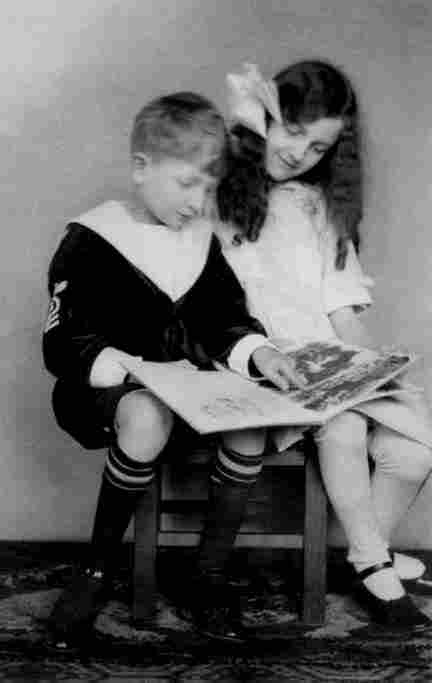
Figure 2.--This American boy wears a velvet sailor suit with dark kneesocks and strapshoes. The banded kneesocks were unusual in America with such an outfit. Notice the difference in the styles of the strap shoes worn by the children. He wears a style more commonly worn by girls. Its a little hard to tell, but he appears to be wearing above the knee knickers.
|
|
Practicality
Strap shoes were a practical choice for yonger children. Tying shoelaces is a complicated task and most pre-school children have diffculty mastering the task. Many do not do so, especially the boys, until they enter prmary school. As a result sandals and strap shoes were praxtical choices for younger children. Handing the buckle closures was easier than learing how to tie laces. and even if the child had difficult with the closure, mom only had to do them up once. They did not come untied like laces. This of course explains why younger children wore them. We are not sure why they were so common with older girls as well.
Material
Strap shoes were made in several different mterials, usually leather. Usually it was genuine cowhide or sometimes pigskin. Stride Rite had some shoes that were made of pigskin leather, including some T-strap shoes. Formal dress shoes were done in patent leather. A few were made from duckskin like Walk-In shoes.
Prices
A lot of these shoes cost $40-50 in the 1980s or early 1990s. They were expensive because they were made in leather.
Outfits
Strap shoes were worn with a variety of different outfits. This varied over time. We see boys wearing them with dresses, but not very commonly with kilt suits. Not many bys wore them with Fauntleroy suits, but they were fairly cmmon with tunic suits. Here a factor was not ony what mother thought went well with the outfits, bt what styles were popular when strap shoes were commonly worn. And we notice that during the summer boys might wear plsay sandals rather than more formal strap shoes.
Dresses: American boys in the 19th centuries did wear strap shoes before breeching, but this was less common than in Europe. Especially after the 1860s, boys usually wore heavier shoes.
Fauntleroy suits: The classic Fauntleroy suit which appeared in 1885-86 was mostly worn with boot like shoes. About the turn of the century boys began wearing Fauntleroy uits with straps shoes, in some cases with long white stockings or white socks. The strap shoes worn with Fauntleroy suits were generally black shoes.
Tunic suits: Wevnote strap shoes worn with various types of tunic suits. Of course they were most common with dressier tunic suit types. A good example is the dressy Russian blouse outfit worn by Carl Kellison about 1910. We notice them worn with the different styles f tunic suits, including Buster Brown suits, sailor tuics and Russian blouses. Buster Brown suits were often worn with strap shoes, in many cases colored strap shoes matching the suit. This included red shoes with red suits. Theblack and white photography of the day mkes it difficult to assess color.
Sailor suits: Some boys beginning in the 1910s wore their sailor suits with strap shoes. This was not common, most boys wore actual shoes with their sailor suits. Some boys (generally from wealthy families) did wear their sailor suits with strap shoes. This was most common with white suits and kneesocks, but some were also worn with sark suits and kneesocks.
Shorts sets: A new style of shorts sets, often with self-belted shorts appeared in the late 1920s. They continued to be worn through the 1940s. These were not commonly worn with strap shoes, but especially in the 1920s and early 1930s boys did wear them with strap shoes. These suits came in various colors. Khaki was particularlu popular. While was not common, but some whitecsuits were worn as an informal dressy suit during the summer.
Smocks: English and European boys commonly wore smocks with strap shoes. This was not unknown, but much less common in America.
Hosiery
Strap shoes have been worn with a wide variety of hosery.
Ankle socks: Strap shoes in the early 19th century were worn with white ankle socks.
Three-quarter socks: Strap shoes in the early 20th century were generally worn with three-quater socks. White was the most common color.
Knee socks: Kneesocks became increasingly common in the 1920s. Both white and dark kneesocks were worn. The most popular were the white kneesocks. American boys commonly wore patterned kneesocks, but not with strap shoes.
Stockings: American boys in the late 19th century commonly wore long stockings. They continued to be worn in the 1900s, but began to decline in the 1910s. They were little worn after the early 1920s. A boy might wear long white or dark stockings for a formal occasion with strap shoes during the 1910s, this declined in popularity during the 1920s. We notice the Tucker boys wearing white long stockings with doub;e-bar strap shoes.
HBC

Navigate the Boys' Historical Clothing Strap Shoe-related Pages:
[Return to the Main strap shoe country page]
[Return to the Main U.S. shoe type page]
[Return to the Main strap shoe page]
[About Us]
[White knee socks]
[Sand shoes]
[Pinafores]
[Smocks]
[Kilts]
[Ringlet curls]
[Fauntleroy suits]
[Buster Brown suits]
[Ring bearers]
Navigate the Boys' Historical Clothing Web Site:
[Introduction]
[Activities]
[Biographies]
[Chronology]
[Cloth and textiles]
[Clothing styles]
[Countries]
[Topics]
[Bibliographies]
[Contributions]
[FAQs]
[Glossaries]
[Images]
[Links]
[Registration]
[Tools]
[Boys' Clothing Home]
Created: 3:50 AM 4/21/2008
Last updated: 7:15 AM 12/5/2015