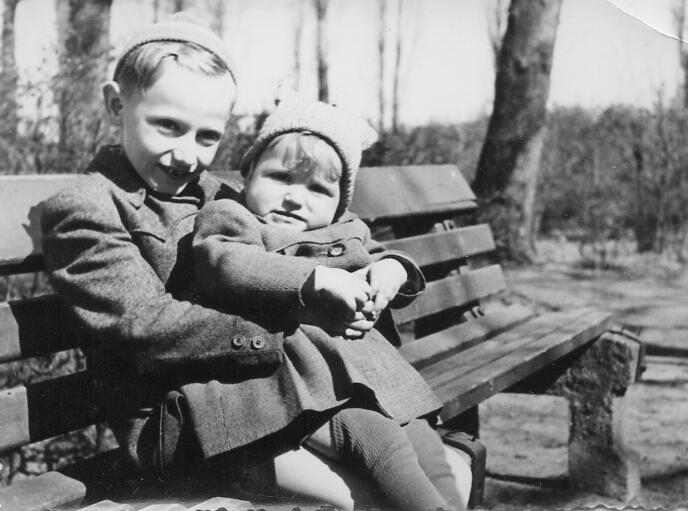
Figure 1.--Here we see a boy and his little sister, we believe in the 1950s. Both are wearing stocking caps. We think the children are German. but we are not positive. |

|
Stocking or watch caps are worn throughout Europe and America. They are a very popular cold weather garment and are thus mostly worn in countries in temperate climates. I am not sure when they were first worn in individual countries, but they never seem to go out of fashion. We see many American and Canadian boys wearing them. Some information is available on stocking caps in Germany. Stocking caps were also common in Scandinavia. We see Swedish children wearing stocking caps and tams. We also see English boys wearing them, but we are not sure how common they were.
Knitted stocking caps are popular cold-weather headwear for both boys and girls in America. They were also widely worn in other countries, mostly Canada an northern Europe. There were several other names used such as ski and watch caps, although therewere style and color characteristics associated with these variants. The knitted vstocking cap was a very popular cap for American children. It was highly seasonal. The stocking cap was popular both because it was warm, but also because it was realtively easy to knit or was inexpensive to purchase. We see many American children wearing stocking caps once temperatures turn cool. Both boys and girls wear them, although colors and styles vary. It was worn by a wide cross section of American children. It was a very popular style for younger children of all social classes. Older boys from affluent families were more likely to wear other caps like flat caps. We notice them being worn in the late-19th century and yhtoughout the 20th century. Girls and younger boys might wear stocking caps with poms. A good example id the Bennett childtren in the 1910s.
We also notice Canadian children wearing stocking caps, folloing the same pattern as in America. Given the climate, they were even nore common in Canada than Ameruca.
We also note English boys wearing knit stocking caps. They do not seem to be nearly as popular as in many other countries. But our information here is limited. This seems to have been basically a casual cold-weather style. We note at least a few boys wearing these stocking caps with sailor suits. Striped stocking caps were considered stylish with sailor suits. We note different styles of stocking caps. Some wee elogated and had tassles.
We note images of German children wearing stocking or watch caps during the 1950s. They presumably wore these caps earlier, but we have no chronological information at the time. The early stocking caps were no doubt wool. Now some are made in synthetic fibers. The earlier images we note are black and white and we are this unsure about the colors. More recent caps are made in many bright colors as well as patterns. The caps are normally worn with poms. They were worn by both boys and girls. I am not sure about age trends, but seem to be most popular with primary school age children. In Germany and Austria stocking caps are called Eine Pudelmütze. "Pudel" is a dog and Mütze is a cap. Sometimes they are just called simply eine Mütze.
We note Dutch children, both boys and girls, wearing stocking caps during the winter. Many were brightly colored. They varied greatly in length. Some were basic watch caps. Others were long, rather like elf caps. We note some children with poms on their stocking caps. These were not destinctly Dutch caps. We see these caps in many northern Europeam countries. They seem especially associated with skating.
We see mamy photographs of Swedosj children wearing stocking caps. A good example is Ingeborg and Holger Agerdal in the 1920s.

Navigate the Boys' Historical Clothing Web Site:
[Return to the Main cap style page]
[Return to the Main cap style page]
[Return to the Main cap page]
[Introduction]
[Activities]
[Bibliographies]
[Biographies]
[Chronology]
[Clothing styles]
[Countries]
[Literary]
[Bibliographies]
[Contributions]
[FAQs]
[Glossaries]
[Images]
[Links]
[Registration]
[Tools]
[Boys' Clothing Home]