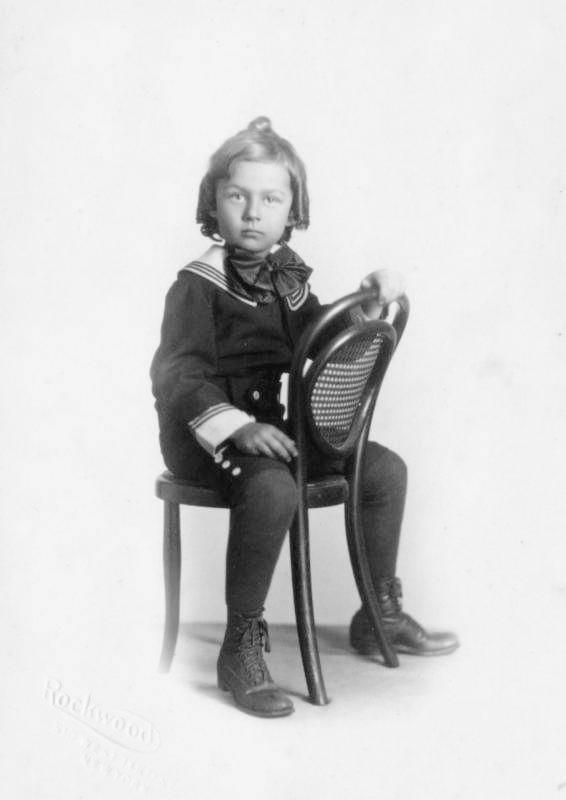
Figure 1.--No where were ringlet cir;s as popular for boys as in America. This unidentified American boys wear ringlet curls and a wide white collar with sailor stripes about 1910. Ringlet curlsere going ojut of style at the time which is probably why his are relatovely short.
Boys' Ringlet Curls: Country Differences
There also appear to have been considerable differences between countries concerning ringlet curls. Many images exist of American boys wearing ringlets, yet relatively few such images for some other countries especially Germany. The style was seen as an English style in France. Ringlets appear to have been even more popular in America. Most of the pprtraits in the ringlet curls section are of American boys. Many American mothers in the 1870s and early 1880s cut, albeit reluctantly, their boys' hair short even
while they were still in dresses. This became
somewhat less common after 1885. French mothers were less apt to curl boys' hair. They often let it grow uncurled to shoulder length, but used hair bows to control it. Elsewhere on the continent mothers might curl a boys long hair.
America, Latin
We have found few examples of Latin American boys with ringlet curls, although admittedly our Latin American archive is limkited. It was esentially a Eropean style which a few from the wealyy elite adopted. Thus it is no ccident ht we mostly see exmples from the Southern Cone (Argebtuna, Chile, and Uruguy) where European influence was the most dominant.
We see some Argentine boys wearing ringlet curls in the late-19th and earlyv 20th century. Ringlets were of course more common for gurls, but as in Europe and North America, we see boys eraing ringlets for a few decades. We are not sure when this began, but suspect the time-line was very similar to that of America and Europe. Nor or we sure which country was most influential. Spain was an important influence on Argentina. The ringlet styles we note seem more influenced by English than Spanish styles. Some of the Argentine boys we see with ringlets may have been European expatriats. This is difficult to assess from the photographic record. As in Europe and America, we know longer see boys of any ages wearing ringlets after World War I in the 1920s.
We have very few Latin American images, but we suspect that the wealthy class adopted European hair styles just as they did clothing styles. American fashions may have also been of some importance, but we suspect that European, including British, styles were more important. The influences varied from country to country. In the case of Uruguay we suspect there was a string Itlalian and Spanish influence, but because of trading patterns there was also a British influence. One portrait rom Montevideo sgows a boy in a sailor suit, probably in the 1890s wearing long, slebder perfectly formed ringlet curls.
The McCord Museum in Montreal has a photograph taken of "Mrs. Taylors Boys" It is from their Notman archive of photographs. Notman was apparently a Canadian photographer. The portrait was taken in Montreal, I think in 1882. It looks two be two brothers close in age dressed in matching Highland kilt outfits. Strangely one boy has ringlet curls and the other straight hair of about the same length. We are not sure why they are dressed alike and their hair done so differently.
Many images exist of American boys wearing ringlets. Ringlets appear to have been even more popular in America. Most of the portraits in the ringlet curls section are of American boys. Many such hair styles were worn in association with the Little Lord Fauntleroy craze which begun in 1885. The ringlet style for boys appeared earlier, but after the publication of Mrs. Burnett's book, it was worn by more boys, including some older boys. Many American mothers in the 1870s and early 1880s cut, albeit reluctantly, their boys' hair short even while they were still in dresses. This became somewhat less common after 1885. The ringlet style for boys continued into the 20th century, but by the 1910s was increasingly less common.
Asia
Japan
As far as we know, Japanese children did not wear ringlets curls. We have a substantial Japanese archive and have not yet noted singlet curls, even for girls. Because stylistic preferences, we wonfer if some charateristic of sian hair made it difficult to curl.
We notice both Belgian boys and girls wearing ringlet curls. A Belgian sourxe calls riglets curls ' Anglaiss coiffure ' meaning English hair style. Of course far more girls had their hair done in ringlets, but we see some boys as well. Our Belgian archive, especially our 19th century achchive, is not large enough to be able to establish prevalence or any chronological trends with any surity. Nor do we have enough images to be able to comment on ringlet styles. Ringlets appear to have been less common than in America, but on a par with France, at least among the Waloon family. We are also unsure as to how many of the children with long hair had it done it ringlets. In American it was the vast majority, but on the continent it was more mixed. It does appear to be associated with social class. The images we have found look to be children from well to do families. This is the impression, for example, we get from the Brussels children here (figure 1).
We know that English boys wore curls and in some cases ringlets. We do not yet, however, have chronological details on the ringlet curl fashion in England. We are not sure, however, how the fashion compared with that in America. England in the 19th century generally was the source of many American fashions. Thus it seems likely that the fashion of ringlet curls as a boys' hair style probably priginated in England and was followed in America, at least until the Mrs. Burnett's publication of Little Lord Fauntleroy gave the fashion a life of its own. The style was seen as an English style in France and in fact called "English curls"--"Cheveux avec des anglaises". As in America, many images exist of English boys weating ringlet curls. Even so, it does no appear to have been as popular as in America. HBC has the impression that ringles were more likely to be worn by aristocratic boys and the wealthy class and not as common by middle-class boys as was the case in America. Actual information on the subject, however, is still limited at this time.
French mothers appear to have liked the fashion of long hair for their sons. We have seen, however, relatively few images of French boys with ringlet curls. French mothers appear, however, to have been less apt to curl boys' hair. Boys' fashions in the 19th century oftem crossed international borders, although not always unchanged. Ringlet curls in France were seen as an Englisgh style. The French in fact referred to it as "Cheveux avec des anglaises" (meaning English-styled hair). It is not yet clear to HBC why French and English hair styles differred so substantially in this regard. French mothers often chose rather fancy clothing styles for their children. We do not know why ringlet curls was never as popular a style for boys in France as it was in England and America. We were somewhat surprised to find that the ringlet fashion was not very popular in France. French mothers did often let their sons' hair grow uncurled to shoulder length, but used hair bows to control it.
Ringlet curls were a fashionable hair style for boys in the late 19th century in America, Britain, and many European countries. We notice very few images of boys with ringlet curls, but some German boy did wear them. We have no means of quantifying this, except the prevalence in the availble photographic record. We are not sure why German hair style trends were different in this regard. We suspect that German parents prefered more masculine hair styles for boys than in many other European countries. So far all of our German ringlet impages are of boys in sailor suits, but our sample is very small to know if this is a significany convention. Relatively few such images exist showing German boys wearing either long hair or curls. The images that do exist tend to show relatively yonger boys. we note a few images of German boys wearing hairbows, some with ringlet curls.
Greece
Some Greek boys like boys in other European countries wore long hair, in some cases ringlet curls. Much more common until after World War II wa close-cropped hair. We have little onformation on this fashion in France. The dominate hair style for boys visible in the photographic record was a very different style--closed cropped or shaved hair.
We note some of the fancy styles like long hair and ringlets that were worn by English boys to the south. We notice a few Scottish boys wearing riunglerts curls in both the 19th and 20th centuries. We see an example from the mid-19th century. On another page we see an example from the early-20th century. Our limited archive makes it impossible to assess just how common ringlet curls were in Scotland. They do not seem to be very common. We think they were less common than in England, certainly less common than in America. We think social class and income levels were major factors. Ringlets were time consuming and were not a style that were worn by working-class boys, even younger boys. The examples we have found so far were relatively short ringlets, sat least avove the shoulders. We are not yet sure of the age range. We think it was mostly pre-school boys wearing them.
Spain
Sweden
Sweden and the other Scandinavian countries are not noted for the ringlet curl style. A portrait of U.N. Secretary General Dag Hammarskj�ld as a boy about 1910 shows that the style was not unknown.
Some Australian boys wore ringlets curls, presumably following English styles. Australian Fashion trends until after World War II were mostly set in Brirain. We have no idea how common this was in Australia. We do not think it was very common. And w have found few examples in the photogrphic record. This unhappy looking Australian boy wear ringlet curls with what appea rs to be front buttoning belted-dress with Fauntleroy styling. The front of the hair was not done in bangs as was common in America. Note the cap on the ground to his right. Strangely for such a formal outfit, the boy looks to be in the middle of a forest with his tricycle. The portrait is dated only to the the 1890s by museum curators. We think the turn-od-the 20th century may be a better estimate.