
Hair Parts: Gender Trends
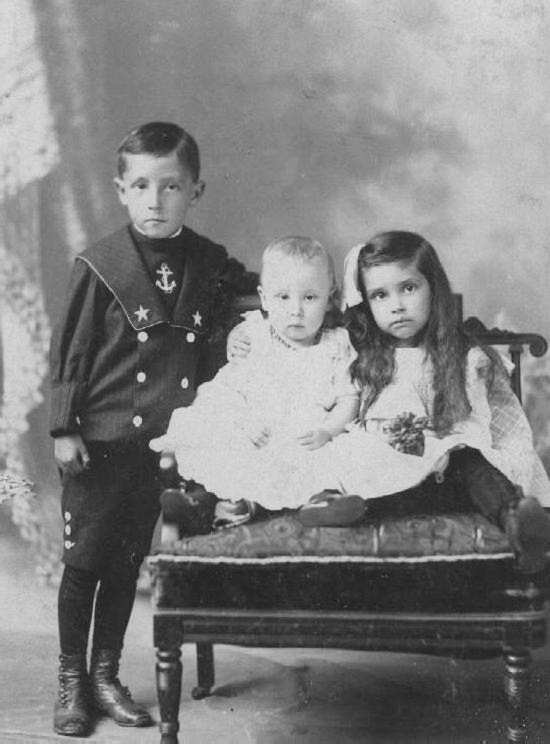
Figure 1.--HBC stresses that while there may have been some conventions concerning hair parts, available images show that many mothers ignored those conventions. The American boy and girl (at least we think the child may be a girl) here both have left parts. This image is undated, but we would estimate that it was taken about 1905.
|
|
In some contries, hair parts have had gender connotations, although this has varied over time and we have not yet developed details on those connotations. In particular we do not have extensive information available on girls' hair sryles which would be useful for comparaive purposes.
We note that in mid-19th century, for example, younger girls often parted their in the middle. It was worn at different lengths, ofren with a ribbon or headband to keep it out of the way. As girls got older before or in her early teens she would usually let her hair grow longer. Boys on the other hand generally wore short hair styles and parted it on the side. I'm not sure if the choice of which side was important, but as most people are left handed the left side was probably the most common. Of course it was mother who generally did the parting until the boy was well into his school years. By the turn of the century, center parts had become very fashionable for boys. We should stress that while there may have been some conventions concerning hair parts, available images show that many mothers ignored those conventions. Not infrequently mothers would just comb all of their children's hair with the same part.
19th Century
We note that in mid-19th century, for example, younger girls often parted their in the middle. It was worn at different lengths, ofren with a ribbon or headband to keep it out of the way. As girls got older before or in her early teems she would usually let her hair grow longer. Boys on the other hand generally wore short hair styles and parted it on the side. We see countless examples of this. An early example is an unidentified American family in 1855. We see many images of children with side parted hair. Unfortunately many are not identified as to gender. A good example is the Ross children. I'm not sure if the choice of which side was important, but as most people are left handed the left side was probably the most common. Of course it was mother who generally did the parting until the boy was well into his school years. A reader writes, "I attended a lecture at Sturbridge Village over the weekend by Joan Severa who has written two books on dress as seen in early photographs. One thing that she emphasized is that girls always had their hair parted in the middle and boys on the side. When looking at early photos that does seem to hold absolutely true and it make sense because if you look at men and women of the same periods, women parted their hair in the middle and men on the side so children’s hair would have been dealt with in the same manner even though dress was not totally mimicked in very young children." HBc would agreee that the center hair part is am important gebder indicator. A good example of center parts for girls is an unidentified American girl anout 1850. Numerous images shoe girls with center pats and boys with side parts. A good example is an unidentified brother and sister at about the same time.
We would not agree, however that it is an absolute indicator. The one thing that we have noted from working with 19th century images is the variation. Because media was not as developed today, conventions on dress, hair, colors, ect are not as uniform as is the case today. Mothers thus had much more latitude as to how they dressed their children. Thus we see in the photographic record great variations from family to family on hair styles and when a boys' curls were cut. The same is true as to clothing. Thus we see not reason why the hair part would be the one hair styling aspect that did not change. There were magazines and books with advise on child raising, including fashion. I have no information to indicate that the hair part was the one hair style element that everyone agree about.
Side parts continued to be the primary hair styling convention for boys in the 20th century. There was one major exception. Hair styling, including the part, varied somewhat chronologically Center parts became popular for boys of all ages during the early-20th century, at least once their curls were cut. This seems even more popular for teenagers than boys. Meaning it was a fashionable style adopted by the youth themselves rather than imposed by mother. A good example is an American boy, Clarence Rogers in the 1900s.
We are still wirking out the chronology here. These center parts seem very popular in the 1910s, but we see them during the 1900s and 20s as well. The 'Our Gang' star Alfalfa not with standing, the center parts were much less common by the 1930s. Hirls after World War I commonly bobbed their hair. Even so it tended to be longer than boys;' hair and because their clothing was so gender specialized, it is usually eay to identify gender. Although center parts were fashionable, even when popular, they were not the primary hair part for boys shown in the photographic record. The hair part as a gender indicator becomes less important after World war I as children's clothing became more gender specialized. After World War II many returning servicemen helped to create a fashion for short cropped hair (butch, crew, flar top, ect.) from the late-40s to the early-60s. The hair was to short to part in these styles, but boys with somewhat longer hair, always parted in in the left. We begin to see longer hair in the late-60s ndquite long styles in the 70s. With these styles the part is hard to detect, but center parts were a rarity. By the80s, hair stules began to become shorter and were almost always side parts. We see very short hair, sometimes even cropped hair in the 90s, but hair long enough to comb was still popular. Some boys as a fashionable statement parted their hair in the center. It was nit the most commoin approach, but we see a mumber of examples.
HBC

Navigate the Boys' Historical Clothing Web Site:
[Return to the Main boys' hair style page]
[Return to the Main hair style page]
[Introduction]
[Activities]
[Biographies]
[Chronology]
[Clothing styles]
[Countries]
[Essays]
[Literary]
[Bibliographies]
[Contributions]
[FAQs]
[Glossaries]
[Images]
[Links]
[Registration]
[Tools]
[Boys' Clothing Home]
Created: October 7, 2002
Last updated: 8:43 PM 8/25/2011