|
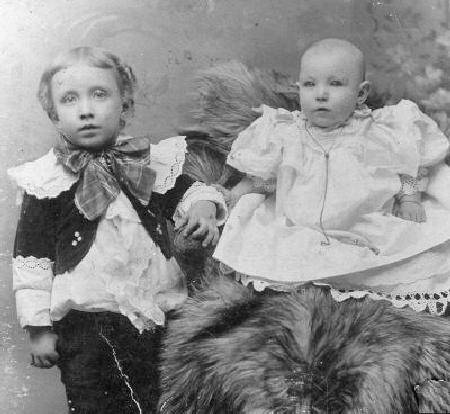
We notice a variety of fanvy blouses worn by boys. The best known here was the Fauntlerou blouse. Mrs. Burnett's book Little Lord Fauntleroy created a crze for velvet suits wirn with elaborate blouses. .With the Fauntleroy craze of the 1880s, extremely elaborate, frilly blouses appeared for boys. The Fauntleroy blouse came in many styles. Some of the blouses had extremely large lace collars as wll as lace edging at the front and even waist as wll as lace trimed cuffs. Initially Fauntleroy jackets were small, made so as not cover the beautifully crafted blouses. The jackets were often made to be worn
open so as to display the lace trim and ruffkes for fullest effect. During the summer the blouses might be worn without the jacket. Lace collars were very popular, but blouses with large ruffled collars gradually replaced the lace collars The blouses were worn with and without bows, sometimes quite large
bows, of various colors, but often black or white. This usually had little to do with the design of the blouse was morn up to the discerning tastes of the mother. The Funtleroy blouse was not the only style of fancy blouses for boys.
We note boys wearing blouses with balooon sleeves in the mid-19th century. We have only limuted information on this style which was also populaerwith girls and women. It seems to have been popular during the 1830s-50. A good example of a boy with baloon sleves is an unidentified American boy, we think in the 1850s. Because of the time frame of when this style was popular, we have relatively few photographic images of the style.
The best known type of fancy blouse is of course the Fauntleroy blouse. The Fauntleroy blouse was almost suely the fanciest, frilly blouse or shirt ever worn by boys. It was also probably the most disliked blouse or shirt in the history of boys' clothing--at leat by the boys. The classic Little Lord Fauntleroy suit was worn with a small velvet jacket to make up the full Fauntleroy suit. The classic Fauntleroy suit had a small cut-away jacket which was worn open at the front to best display the elaborate ruffled and lace trimed blouses. It could be worn with other suits or even without a suit jacket. The blouses came in a miriad of materials and styles.
We notice boys wearing large-collar blouses in the late 19th and very-early 20th century. These were similar in some ways to Fauntleroy blouses, but were not made to be worn with velvet Fauntleroy suits. The principal difference was that they did not have fancy fronts like many Fauntleroy blouses. They tended to have back flaps like middy blouses, but often with ruffled trim. Tbese blouses were always worn buttoned at the collar, often with floppy bows. They were normally made in sizes up to about 13 years. They were exclusively made for boys. They were done in different material and we note different colors and buttons. These blouses were especially popular in America. We see large numbers of boys wearing them when dressing up for chitech or other occassions. Younger boys might wear them to school. Many different styles were offered in period mail-order catalogs.
Most of the blouses boys wore were closed-collar blouses. They buttoned at the collar and were sometimes, bit not always worn with neckwear. We notice two periods when open-collar blouses were popular. The first was in the early-19th century. The second was duruing the early-20th century. These were fancy blouses in both instances. As they were open-beck vlouses they were made to be worn without neckwear. These seem to have been mostly white blouses. These do not seem to have been major fashion stryles. Rather they were worn by a small minority of boys from affluent families. We have only limited information on the early-19th century. We do note them being worn with skeleton suits. We know much more about the early-20th century. We see boys from aristocratic families wearing these blouses. They might also have been worn at special events like formal weddings, but again this involved only a small number of boys. Large-collar blouses that buttoned were much more common.
The sailor middy blouse was generally speaking a plain blouse. This was in part one of its attractive features which appealed ti boys and tge pracgical side of mothers. Some mothers, however, were less practical. They preferred non-traditional styling which might include added lace or ruffles. This was especially the case during the Fauntleroy craze era (about 1885-1905). This styling was also added to sailor garments or at least garments with sailor suts meaning the classic V-collar and rectanular back flap. We note two similar garments with a basic sailor cut, but with dded decoration. One was the basic sailor blouse. Here thecdecoration is sometinmes so extensicve that the sailor cut does not a first jump put of you. It is sometimes lost in all the lace and ruffles and somrtimes large floppy bow. The fancy sailor cut blouses were most likely to be worn as blouses without jackets as they did not have a collar that fit nicely over a jacket. The other garment was a sailor styled tunic. This looked somewht like a fncy blouse but instead was a tunic. This was also an essentially plain garment that mothers decided to make more appealing by adding lace, ruffles, abd other decorative elements. These fancy sailot blouses and tunics seem particularly popular in A,etica and France, but the chronology differed somewhat.

Navigate the Boys' Historical Clothing Web Site:
[Return to the Main blouse type page]
[Return to the Main blouse page]
[Introduction]
[Activities]
[Biographies]
[Chronology]
[Clothing styles]
[Countries]
[Bibliographies]
[Contributions]
[FAQs]
[Glossaries]
[Images]
[Links]
[Registration]
[Tools]
[Boys' Clothing Home]