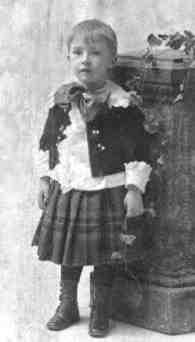
Figure 1.--This American boy from Orange, New Jersey, wears a dress kilt with Highland regalia. HBC does not know if he actually comes from a Scottish family. The photograph was taken in 1902. |

|
Actual Scottish kilts were not extensively worn in America. Some wealthy American families like the Rossevelts did dress their boys in kilts complete with sporrans. This was most common in the late 19th and early 20th centuries, but did not entirely disappear after World War I. Malcolmn Forbes was dressing his boys in kilts even in the 1950s. His son and presidential candidate, Steve Forbes didn't like it one little bit. Kilts are seen in American at Highland gatherings
and other ethic events, including Greek and Irish events. While only wealthy American boys in the 19th and early 20th centuries
wore proper Scottish kilts with Highland regalia, many more boys wore the kilt suits that were popular in the late 19th Century, not only for wealthy boys but for middleclass families of modest means. American mothers began using the kilt suit as an intermediate step between dresses and outfits with kneepants, such as Fauntleroy suits and sailor suits. These mothers were not yet ready to fully breech their sons, but felt that they were becoming to old to still wear dresses. This may have been more acceptable to fathers than actual dresses.
America was a major destination for Scottish emmigration. Much of this emmigratiin occurred in the 18th century. The Industrial Revolution and the Higland clearances were factors in the substantial emigration, of Scotts to the American colonies, especially immigration to America. Also involved at this time was the suppression of thee Scottish Higlanders after the the Rising of '45 and the English victory over Bonny Prince Charlie at Culloden (1746). The numbers involved were not massive, primarily because the overall Scottish population was not large. The impact on America, however, was significant, in part because the American population in the 17th century was also small. Many of these Scotts and Irish families would play important roles in the American Revolution (1776-83). What HBC does not know is how Scottish emmigrants, adults and children dressed. The kilt was supressed in Scottland after Culloden, but what did they wear when they got to America.
English settlers dominated the United States during the colonial period. This formed the mold in which the other ntionloitis thar subsequentky immigrated fitted into. Now because of the Revolutuin, there was a grear deal of anti-British setiment and this was true ofsome immigrabt groups like the Irish anbd Scotts, But the American upper class by thr second half of the 19th century was deciudely British in orienttion--basically Anglophiles. This showed up in a numnver of ways, Wealthy American herisses set off dor Britain to find down-on-their luck Britain nobels. Eduth Wharton even wrote a book abourt it--The Bucaneers. No less a figure than Winston Churchill was a priduct of these marriges. Fashion was another Clothing was a--including clothimg. And at the time iy was the upper-class that set xlothing styles. This was rspecilly true fir mebn and boys. This the sailor syit and kilt suit becme popular boys' styles. This was especially the case for middle-class boys, less so for working-cass boys.
|
Many American boys wore kilt outfits. They were primarily kilt suits for younger boys. These were not precisely kilts, but the term was commonly used. Actual Highland kilt outfits were less common. The Highland Kilt outfits were made up of a varietyy of garments. Boys were Scottish headwear. The Glengary caps were most common, sometimes worn with an eagle feather. Balmoral bonnets were also worn. Black, military styled jackets were popular, often worn with Eton collars. The kilts tended to have brighter patterns than the kilt suits. They were worn with sporrans and argyle knee socks. We believe Highland kilt outfits were mostly worn by boys from wealthy families like Franklin Roosevelt might wear them. Even kilt suits were primarily worn by children from affluent fmilies, but Highland kilt outfits we believe were indicators of very well-to-do families. Both the image projected and the cost of items like sporrans suggest to us that thry were mostly worn by boys from well healed families. While Highland outfits were not very common, they were worn. We have found several portraits of American boys wearing full Higland regalia, most commonly in the late 19th century up to about the turn-of-the 20th century. We even note one Highland outfit that one mother seems to have brought home from London, only with knee pants rather than a kilt. This was not very common. The age range for these Highland kilts is wider than for the kilt suits.
While few American boys in the 19th Century wore proper Scottish kilts with Highland regalia, many more boys wore the kilt suits that were popular in the late 19th Century. American mothers used the kilt suit as an intermediate step between dresses and outfits with kneepants, such as Fauntleroy suits and sailor suits. These mothers were not yet ready to fully breech their sons, but felt that they were becoming to old to still wear dresses. White Higland kilts were most popular with families that had Scottish conections, there does not seem to have been any relationship between kilt suits and Scotland. Mothers of many varied ethnic backgrounds chose klit suits for their boys. These suits were only worn by boys. Girls in the 19th Century wore dresses and not kilt suits. These kilt suits came in many different styles and were worn with a variety of caps and hair styles. Unlike Higland kilts, they were always worn with long stockinfs, never with kneesocks. These suits were typically made for boys from about 3 to 6 years of age. Sometimes boys as old as 7 or 8 might still wear them, perhaps a few boys even older. Many mothers considered a boys size rather than his age to be the determining factor. Often the boy continued to wear the jacket after he was breeched. Many suits were worn with matching vests. Hair styles varied from short hair to long ringlet curls.
|
One popular style during the late 19th Century was the Fauntleroy kilt. The Fauntleroy kilt consisted of a velvet jacket similar or usually identical to the jackets worn with a standard Faunteroy suit. While Fauntleroy suits came in several dark colors, the black jackets were mostly worn with Fauntleroy kilts. The Fauntleroy kilt jacket was identical to the ones worn with kneepants. They tended to be small so as to show off the fancy lace and ruffle trimmed blouse to best affect. Boys in Fauntleroy
kilts also wore the large lace collars and floppy bows that were worn with Fauntleroy suits. The destinguishing characteristic of the Fauntleroy kilt was of course the kilt. Unlike kilt suits, the kilt worn with a Fauntleroy kilt was usually a bright plaid of te Highland kilt. Unlike Highland kilts, however, boys mostly wore dark long stockings rather than kneesocks. The Fauntleroy kilt was the perfect garment for the mother who was enamored by the Fauntleroy style of lace collar and dark velvet, but did not think
her son was old enough yet to wear knee pants. The Fauntleroy kilt had the added advantage that the kilt could be replaced with knee pants when the boy was breeched and he could continue wearing the same jacket.
|
The late 19th Century was a formal era. Mant iddle class men did not appear in public in shirt sleeves. Mothers also dressed their boys formally. Most American images of kilted boys show them wearing a jacket. Summer can, however, be quite had. Thus it was acceptable
for boys to just wear a blouse, usually a fanvy blouse, with their kilt if the event was not to formal. A bright plaid was a popular choice for such outfits. Some mothers simply chose the kilt that went with a boy's kilt suit which were generally plain colors or muted
plaids. Even though it was a summer fashion, almost always long
stockings and not knesocks. This was a fashion during the late 19th Century and perhaps into the 1900s, but was little seen by the 1910s.
Museum and personal collections of vintage clothing make it possible to analize clothing in more detaila than is possible with only old photographs. The clarity of the old photographs vary and only show one side. In addition all the old photographs are in black and white. See the example of Hiram Van Vliet Braman for a Highland kilt outfit. There are several other vintage kilts on HBC, but we have just begun this section and thus have not yet had an opportunity to cross reference them.
Kilts in America are of course most assocaited with Scottish Americans. The Scots are, however, not the only ethnic group that count the kilt as part of their traditional national costume. Kilts are seen in American at Highland gatherings and other ethic events, including Greek and Irish events. The style of the kilts, of course,
varies as do the conventions for wearing them.
Greeks are one of the smaller American ethnic groups. Greek ethnic activities are popular annual events throughout America. The events are usually sponsored by Greek Orthadox churches and include Greek food, crafts, jumble sales, dancing and other events. The dancing is usually not costumed, but some of the larger events do
have costumed dancing. Boys participating in these events rarely dress in ethnic costumes. One important annual event for which the children do wear ethnic costumes is the annual Greek Day parade down New York's 5th Avenue in March. Greek costumes vary greatlty depending on the area of Greece. The most common costume worn by boys is a white kilt worn with white tights.
One of the largest and most important American ethnic groups is the Irish. Unlike the Scotts, there was not a large Irish immigratiin in the 18th Century. This was in part because colonial America was largely protestant and most colonies, like England, had establishe protestant churches. Large numbers of Irish only began immigrating after the disatrous potato famin of the 1840s. America was still largely protestant, but legally, if not always in practice, there was a guarantee of religious liberty. Today about 30 million Americans (anout 10 times the population of the Irish Republic) identify as being Irish American.
Irish and Celtic events are popular summer activities throughout American. Boys at these events, unlike Scottish events, do not normally wear kilts. Some boys do wear kilt costumes for dancing competitions, but only while performing.
The Scotts are one of the primary ethnic groups which helped to found modern America. The Scotts began to come in large numbers after the battle of Culloden (1746) and resulting suppression by the English. The Scottish enclosures further drove desperate Scotts to leave their homeland. Highland Gatherings are now held throughout America and include a ethnic food, sheep shearing, sheep dog trials, caber tosses, dancing, and many other
activities. Boys at Highland gatherings may wear kilts for the event.
American boys participate in various dance programs in which
kilted dance costumes were involved. These included Greek, Irish, and
Sottish dancing programs.
Greek dance costumes consists of a caps, a variety of often elaborately embroidered jackets, white pleated kilts, white stockings, and fancy shoes. A kilt like costume was worn mainly in the central and southern regions of Greece. The costume derives its name from the pleated white skirt (foustanela) made of many triangular shaped pieces of cloth sewn together diagonally. The
foustanela was worn by the Greek fighters of the 1821 revolution and today it serves as the official uniform of the Evzones, Greece's Presidential Guard, who can be seen guarding the Tomb of the Unknown Soldier in Athens.
A costume is required of each dancer entering a competition or performing with the school. Individual school's policies vary as to obtaining a school costume. In the third or fourth year, a dancer may earn the right to wear his/her own "solo" costume. Modern costumes are quite different from those worn historically at feises. The dance costume has changed greatly from traditional garb. Boys doing I rish dance wear either long black pants or kilts. The girls wear dresses, never kilts for performances. Some schools do allow the girls to wear kilts for practice. Reserving the kilts for boys is done in part because the kilt was the ancient Celtic male garment and in part so
the boys aren't dressed like the girls. This would probably discourage many younger boys from
participating in Irish dancing.
Higland dancing along with the kilt are two beloved symbols of Scotland. Its origins lie in the art of the ancient Celtic Scots. Modern Higland dancing is usually performed solo and is characterized by its typically sharp movements and the accompanying music. It's typically dance to the tune of the bagpipes. The dances are made up of different parts, called steps. There are usually four or six steps to a dance. Traditional Highland Dancing generally refers to a relatively few dances, especially the Highland Fling, Sword Dance, Seann Truibhas, and the Strathspey and Highland Reel or Reel of Tulloch. The basic movements in Higland dance are both strong and graceful. The hands are used expresively, quite different from the traditional dance of the neigboring Celtic people, the Irish. Higland dance was traditionally performed by Scottish men. Highland dancing is now performed by both men and women.
|
Boys performing in bands or theartical groups might wear kilt costumes.
This was most common in the late 19th and early 20th Century. I do not
have much information on this, but available images show that Highland
regalia was usually chosen for the kilt costume. There does not appear to have
beem a Scottish connection, but rather the kilt was simply
considered a stylish eye-catching costume. Often there were not even
bagpipes envolved.
Many American boys participate in pipe bands. The Scottish bands are
the most common, but there are also many Irish pipe bands. Pipebands are
very popular in America. They not only participate in ethnic events, but in a
variety of public and private events. Pipe bands were once entirely
composed of men and boys, but girls now also participate.
American high schools have uniformed marching bands which perform at
football games and other events. The costumes can be quite elaborate. A
few of these schools have Scottish conections or are named
after Sciotts. Some of these bands have Scottish styled uniforms. In most
cases they do not include kilts--as the boys are shy about wearing them. A
small number of bands, however, do wear a kilt uniform.
Some information on personal experiences of American boys abd Scottish kilts is as follows:
This CSV portrait shows Robert Stanley Mitcheson. (The handwriting is indestinct.) The portrait is undated, but the pose and furniture/background looks like the early-1870s to us. Rober has an elaborate Highland outfit, complete with a feather in his Glengary cap--although it does not look like an eagle feather. Robert even has aagger. Only his socks are not appropriate, they are striped rather than plaid. We suspect plaid socks were hard to get in America at the time. The portrait was taken in Philadelphia by Studdards & Fennemore. Robert looks to be about 5 years old. Note the ringlet curls.
A New York boy Hiram Van Vliet Braman wore a Highland kilt. The kilt was donated to the ??? Museum and is in the New York City collection. Hiram wore the kilt about 1883, although for ewhat occassions and how commonly we do not know. The Museum calls it a "Scotch Suit", but it is clearly a full Highland kilt outfit in the Black Watch plaid, complete with sporran. According to the Museum, Upon Queen Victoria's "coronation, the influence of Victoria's reign and the ensuing predilection for all things British were strongly felt on the New York side of the Atlantic. A popular souvenir from a trip to the British Isles was the ubiquitous Scotch suit that was worn by fashionable children of either gender." This undoubtedly true, although we are not sure to what extent girls wore Hoghland kilts. Americans traveling to England and Europe in the late 19th century mean families of means. We also wonder if they might not have been able to purchase them in New York City shops.
A young Franklin Roosevelt was photographed in a Higkand kilt outfit with his aging father. This is another example of the Hghland kilt being worn by wealthy, non-Scottish American boys.
I was 11 years old when my dad got a job in Scotland in 1983. I was a typical American boy in the 1980s. I grew up in jeans and "T" shirts. I did occasionally wear short
pants during the summer, but I never had a short pants suit or ever wore kneesocks. I had never even heard of a kilt. I grew up in Houston, Texas and knew nothing
about living abroad. My dad worked for an oil services firm and the North Sea oil boom created a lot of job opportunities in' Scotland. Was I in for a surprise when we moved. It all sounded kind of exciting to me, moving to a foreign country. We had never even traveled abroad for vacations. I was a bit unhappy about leaving my friends, but off we went to Scotland.

Navigate the Boys' Historical Clothing Web national kilt pages:
[Return to the Main national kilt page]
[Return to the Main Highland kilt page]
[American kilts]
[English kilts]
[French kilts]
[Greek kilts]
[Irish kilts]
[Scottish kilts]
[Main kilt page]
Navigate the Boys' Historical Clothing Web Site:
[Introduction]
[Activities]
[Biographies]
[Chronology]
[Clothing styles]
[Countries]
[Topics]
[Bibliographies]
[Contributions]
[FAQs]
[Glossaries]
[Images]
[Links]
[Registration]
[Tools]
[Boys' Clothing Home]