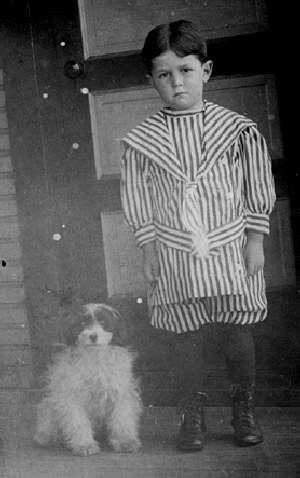
Tunics suits were worn in the early and mid 19th century and then became popular at the turn-od-the 20th centyry. Most of our information comes from the 20th century. We are not entirely sure about 19th century age conventioins yey. We have, however, a very good idea about age conventionds in the early 20th century. Tunic suits were worn by American boys from about 2-7 or 8 years of age. They were made in larger sizes, but for the most part the boys were mostly 2-7 or 8 years of age. This does not seem to have varied much over time. That means that boys would have worn them to school in grades 1-2, perhaps grade 3. Here the sizes indicated by catalog stores provide a fairly definite age range. A good example is the Montgomery Wards 1914 pages on tunic suits which are offered in sizes for boys from 2 1/2 to 7 years of age. Catalogs provide somewhat varied age ranges, but the general range is very similar. This is generally confirmed by the photographic record. We notice, however, more photographs of boys wearing tunic suits in the pre-school years. There are numerous images of boys archived on HBC to show the age range. Unfortunately only a few of the photographs indicate the age of the child. Here we see a boy wearing a tunic suit in the sailor style (figure 1). A hand written inscription on the back reads: "Detroit Mich. 17 Gardoni My little boy Stanly when he was 7 years & one month taken March 30/1918." This looks to be a outfit Stanley may have worn to school. He would have been in the first grade.
|
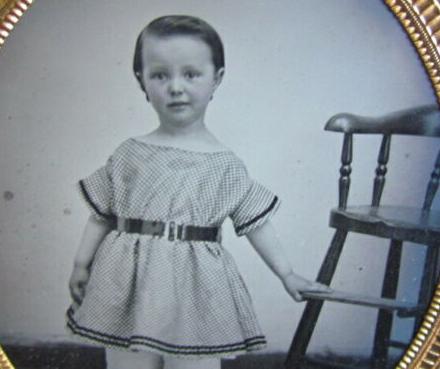
We do not have much information on the age of boys wearing tunics in the 19th century. We suspect that most boys 2 years old would have not yet been breeched and still wearing dresses in the 19th century. Thus we think tunics were less common for 2-year old during most of the 19th century than was the age in the early-20th century. We do not have much information for the 19th century, especially the early-19th century. But we know that boys commonly wore dresses at 2 years of age during the 19th century. By the 1890s, howver, it was beginning to be less common for boys to wear dresses. Thus we see 2-year olds wearing tunics in the early 20th century. By the 1890s, however, it was beginning to be less common for boys to wear dresses. Thus we see 2 year olds wearing tunics in the early 20th century. Many catalogs specified 2 1/2 years as the beginning of the age range for tunic suits. Tunic suits were popular outfits for American pre-school boys beginning about age 2 or 2 1/2. Some families dressed all their pre-school boys in tunic suits. The sizes indicated by catalog stores provide a fairly definite age range. We notice tunics suits made in size 2s, often 2 1/2. Thuis is the youngest we have noticed for these outfits. A good example is a variety of tunic suits offered by Montgomery Ward in 1914. The age range was 2 1/2 to 7 years. An even more common range was 2 1/2 to 8 years in the 1900s. This wide age range gradually became less favored because many 8-year olds who were in school did not want to wear the same styles 2 and 3 year olds were wearing. Rather they preferred the styles being worn by the older boys. This was a common beginning age for these suits. Almost all tunic suits we have noted were done in size ranges beginning at 2 or 2 1/2 years. Some began with size 3, but the size conventioin was much more common. Even when tunic suits began to go out of style in the late 1910s and early 20s, we still see them being done in size 2s. What is not entirely clear to us is what else the boys wearing tunics wore at age 2 years. Were all their garments tunics or did they have other garments. We suspect that some of the boys my have worn rompers in the early-20th century.
|
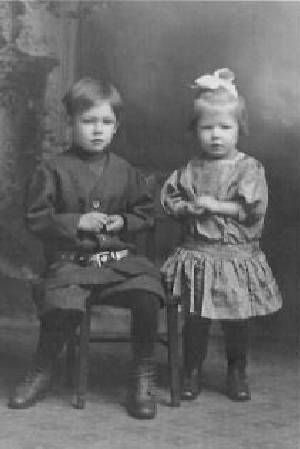
We have found many photographs of American boys wearing tunics at 3 years of age. This varies significantly over time. Our information on early 19th century tunics is limited. We suspect, however, that not too many 3 years old wore tunics in the early- and mid-19th century. Although age 3 was the age that some families breeched boys, so there may have been some boys wearing them. We know much more about the early 20th century. At the turn-of-the 20th century we notice quite a number of boys who were 3 years old or looked about 3 wearing tunic suits. Here both the photograph record and clothing catalogs provide useful information. The popularity of tunic suits for 3 year olds is confirmed by clothing catalogs. Almost all catalogs included 3 year olds within the age range for the tunic sights they offered. We note Ellis Gray Holden wearing a sailor tunic at age 3 in 1908. This is confirmed by clothing catalogs. A good example is the Montgomery Wards 1914 pages on tunic suits which are offered in sizes for boys from 2 1/2 to 7 years of age. Catalogs provide somewhat varied age ranges, but the general range is very similar. This is generally confirmed by the photographic record. We notice, however, more photographs of boys wearing tunic suits in the pre-school years, especially boys from about 3-5 years of age. New Ideas Magazine show a fancy boy's tunic suit. The illustration suggest a boy about 3 years old. We have, however, seen older boys to about age 5 wearing this style. While clothing catalogs show that tunic suits were made in styles up to the younger primary ages, the photographic record suggests that they were most common for pre-school boys. We notice many more photographs of boys wearing tunic suits in the pre-school years, especially boys from about 3-5 years of age. Here we see a 3 year old wearing a white tunic suit in 1904 (figure 1). We see very few boys wearing tunic suits to school in available school photographs, at least in the early 20th century. And these photographs are widely available.
|
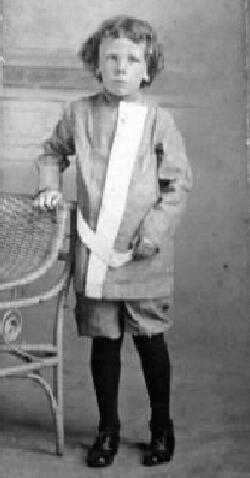
We see many boys who look to be about 4 years old wearing tunic suits. It was one of the most popular ages for tunic suits. Most catalog offerings included 4 year olds in the size range. Both the photographic record and store catalogs show that 4 year olds commonly wore tunic suits. It was a very common style for 4 year olds during the early 20th century. Even in the early 20s when tunic suits were no longer being offerd for school sge boys, we still see them being made for 4 year olds. The studio portraits mostly show boys wearing more formal tunics. Snap shots tend to boys wearing more play styles. Many boys at age 4 might have wirn dresses in the 19th century. This was less common after the turn-of-the 20th century. Tunics seved as a kind of transitionsal garment. Thus they were widely worn by 4-year old. We see an unidentified boy wearing play suit. We notice 4-year old Martin Murphy in 1912 wearing a sailot tunic for play, but it could have also been worn for smart casual wear as well. We see them being done in many different styles. A good example is period catalogs the Montgomery Ward Catalog in 1914. The Sears 1902 catalog shows a boy about 4 years old in a dark winter tunic suit. And another McCalls tunic suit for 4 year olds done with sailor styling. We note a McCall's pattern for a sailor tunic suit, called a Russian suit, size 4 years. We note an unidentified newspaper advertisement for a sailor tunic suit in 1907. It referred to bloomer suits and offered a wide range of fancy and plain suits in the standard size range of 2 to 8 years. Sruarts in 1914 offered tunic suits they called a romper suit only in sizes to age 4. Stuarts in 1915 also offered outfits which more correctly might be called rompers, but showing tunic suit styling such as ornamental belts. They were akso done in the 2-4 year age range. Best in 1918 offered a wide selection of juvenile outfits, including tunic suits, but mostly with knee pants rather than bloomer knickers. They were done to size 4. We see an American boy in 1918 wearing a tunic suit.). The flag with 48n stars confirms that it was a 1910s portrait. The unidentified boy looks to be about 4 years old. America's entry into World War I (1917) resulted in an outburst of patriotic feeling. We continue to see boys wearing tunic suits in the 1920s, but the popularity was rapidly going out of style. We still a few offerings in catalogs. Altmams in 1921 was still offering tunic suits in 1921, but the more popular button-on Oliver Twist style dominated the offerings for younger boys. The sizes here look to be 2-4 years. We see far fewer examples in family snapshots and portraits in the 1920s.
|
We have little information about age conventions during the early 19th century. We note 5-year olds wearing tunics in the mid-19th century. A good example was Russel Parsons in 1869. The tunic was realatively short. Tunics were also very common for 5 year olds at the turn-of-the 20th century. This of course reflects the popularity of tunics for pre-school boys. We note quite a large number of boys who look to be about 5 years old. The catalogs confirm that the age range commonly included 5 year olds. Only in the late 1910s and early 20s as the tunic suit was going outvof style do we see the age range being narowed yo 4 year olds. We see boys wearing them both in formal studio portraits and in family snapshots. We also see tunics being done in many different styles for 5 year old. When a range of styles are offered, that suggests that the garment was especially popular. Most tunic suits we have noted include 5 year olds within the age range. A New York store Siegal Cooper in 1904 offered a standard tunic suit called a Russian blouse suit in sizes 2 1/2 to 7 years. It was the same style for the entire age range. This seems to have been a common convention. We notice Sprage's "Allin-1" Play suit in 1909 which looks rather like a tunic suit with the tunic blouse tucked in. It was made in the standard 2 1/2 yo 8 size range. Another example is an unidentified Reading boy. He wears an added bow tie. We still see a lot of American boys at age 5 years wearing tiunic suits. This is because most boys that age are not yet attending school. Once school starts, usually at 6 years of age, we see fewer boys wearing tunics. The early primary years are still within the age range of tunics , but notably we do not see lot of boys weaing tunics to school. We do see boys 6-7 years of age weariung tunics in snapshots and srudio portraits, but not very many wear the tunics to school even among the 6-year old first graders. This is very clear in school porttaits which were were taken in large number by the 1900s. Some boys attended pre-school and kindergarden, but child care anf eraly educationm was not nearly as common in the early 20th century as it is now.
|
Most tunic suits in the 1900s and early 1910s were made in age ranges that included 6 year olds. This surprised us a little because this is the age American boys begin school. And we do not note them commonly being worn to school. We think boys in grades 1-2 may have worn them. But we do not notice them very commonly in school portraits during the early-20th century. Grade 1 means children 6 years old. A good example is Carl Kellison about 1910. He was 6 years old, but may not have begun school yet. We believe that tunics were less common for 6 year olds that had begun school because most boys stopped wearing them when they began school, at least for schoolwear. We have an exensive school section which can be very useful in the age section for school age children. Here readers can look at school portraits for the 1900s and 1910s to see that tunic suits were not common school garments, although they were worn by a few boys to school. Tunics were very popular for both decaedes. Another factor is that not all 6 year olds were in school. They only began school if they had their birthdays by September. Which means that boys who turned 6 after September began school the following year. Here we think there may have been social class differences which is why they do not show up at many public schools. Apparently many boys had tunic suits, but more for play or for dressing up rather than to wear to school. We think there may have been social class differences which is may be one reason why they do not show up at many public chools. This can, however, be over stated because we see many images of boys in what look like rural areas with what looks like a rather poor housing in the background. This is not to say the poverty-stricken consitionds, but clearly not a widely affluent family. What we are less likely to see is children from urban workung-class families wearing tunic outfits, at leat that is our preliminary assessment. Apparently many boys had tunic suits, but more for play or for dressing up rather than to wear to school. Many of the images e have found seem to b e the boys dressed up in tunic outfits. Suggsting that the tunuic was a dress up garment. We think this may reflect the fact that there are fewer images of the children at play. After the turn of the 20th century we have nany family snap shots, even so not all that many snapshots are candid images of the children at play. Maby are actually ohotographs of the children dressed up for a photograph, so the photographic record does not provide us a real true representation of just what circumstances in which the children wore tunics. For example photographs might be taken for outings or with the children all dressed up for church. School for whatever reason was a different matter. We have only a few photographs for which the age was specified. We are forced to estimare the ages. This there are possible errors here, but we doubt we are off by more than a year or so. Here family portraits showing age grading are very useful. We note many different styles of tunics. Two popular styles were sailor styles and Rusian blouses. We do not notice age conventions associated with the different ages. We notice that Sears offered several different tunic suits in 1912, but only to size 6. Clothing catalogs were a good indicator of age conventions and widely available by the late-19th century. Interestingly some sack suits for little boys were cut rather long looking somewhat similar to tunic suits.
We note a substantial decline in the number of American boys wearing tunic suits at age 7 years. This would mnean 2nd grade. The number of images er have found in the photographic record is substantially redfuced. We still see sdome, but not very many. And we see this reflkected in the sized offered in mail,order catalogs. Here we see a boy wearing a tunic suit in the sailor style. A hand written inscription on the back reads: "Detroit Mich. 17 Gardoni My little boy Stanly when he was 7 years & one month taken March 30/1918." This looks to us to be a outfit Stanley may have worn to school. He would have probably been in the 1st grade because he would have been 6 years old when school began. Stanly's tunic suit seems shorter than most we have seen. And he seems to be wearing knee pants rather than bloomer knickers. Clothing catalogs also confirm that tunics were made in size 7 years. We notice fewer offerings for size 8s. Clothing catalogs also confirm that tunics were made in size 7. A good example is a variety of tunic suits offered by Montgomery Ward in 1914. They offered tunic suits mostly only to age 7. Many stores sized tunic suits from 2 1/2 to 7 or 8. So age 7 was at the upper end of the size range for many of these suits, although they were made in larger sizes. We have found a portrait of unidentified brothers who look to be about 6-7 years old. They are wearing matching tunic suits with Norfolk styling.
We see fewer 8 years olds wearing tunics, but we do see a few. The catalogs indicate that tunics were offered for 8 years olds, but it was on the upper limits of the sizing. We note an unidentified newsper advertisement offereing a wide variety of tunic suits which they call bloomer suits for boys up to age 8. This was fairly common in the 1900s. We notice fewer offerings of tunic suits for 8 year old by the 1910s. One tunic suit called a sailor blouse suit was offered in sizes up to 8s. Montgomery Wards had them in two styles in 1914. Se have found only a few examples in the photographic record of 8 year old boys actually wearing them. We note one unidentified American boy who had a white tunic suit for formal occassion.
The age of boys wearing tunics has clearly varied over time. We are not sure about age trends in the early-19th century. We suspect that boys may have worn tunics upt to 9-10 years of age, although we can not yet substantiate this in the era before photograpy. Tunics were not yet yet, hiwever, widely worn in the wide population beyond the fashiobable urban centers. By the mid-19th century we note boys up to about 9-years old wearing tunics. A good example is 9-year old Tom K. Christie. Notice the diagonal styling that became popular in the mid-1860s. We have found few tunics seized for size 9s in the early-20th century. We have found only one wholesaler who offered tunic suits in size 9s. Actually the sizes went up to 10s. We do note family portraits showing a few boys at the upper end if the age range wearing tunic suits. We have not found many, but we have found a few. We think that tunics were a rather middle- or uper-class outfir, less commonly worn by boys from working class families. And this was especially the case for the older boys wearing the garment. This can sometimes be determined by the context of the photogrpgs even if the boys are unidentified.
We believe that boys at age 10 commonly wore tunics in the early and mid-19th century. A good example is Edward Edwards in the mid-1840s. Younger boys wore them in the late-19th and early-20th century. Most of the ads for tunics suits only went up to 7 or 8 years. We found a selection of sailor suits offered by Strous (a wholesaler) in 1914. Most of the tunic suits offered were sized 2 1/2 to 7 years. But some of the sailor styled tunics were sized up to 10 years of age. I don't think this was very common, in part because so few stores offered size 10s. Also the photograohic record primary shows younger boys wearing them.
WE are not entirely sure what age boys wore tunics in the early and mid-19th century. WE suspect that boys wore tunics up to 12 or 13 years of age, but this needs yo be confirmed. By the late-19th and early-20th century we no longer see boys this age wearing tunics.

Navigate the Boys' Historical Clothing hair style pages:
[Return to the Main long hair page]
[Return to the Main curl hair page]
[Bangs]
[Ringlet curls]
[Hair bows]
[Caps]
[Collar bows]
Navigate the Boys' Historical Clothing Web Site:
[Return to the Main American tunic page]
[Introduction]
[Activities]
[Biographies]
[Chronology]
[Clothing styles]
[Countries]
[Topics]
[Bibliographies]
[Contributions]
[FAQs]
[Glossaries]
[Images]
[Links]
[Registration]
[Tools]
[Boys' Clothing Home]