|
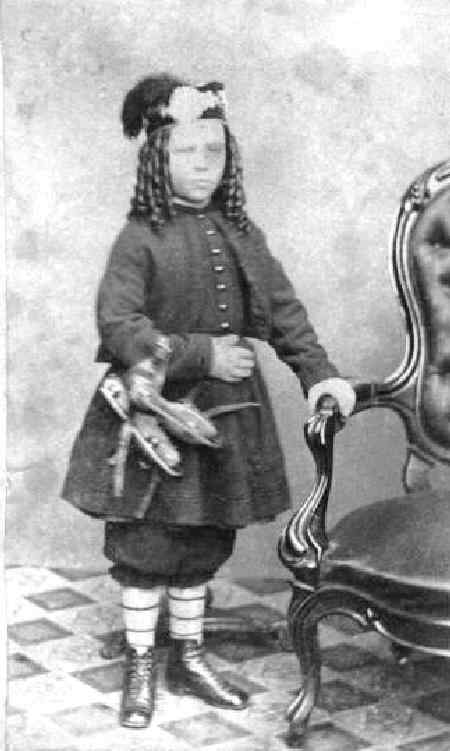
Tunics were normally worn as a kind of suit. Both the tunics and the style and types of pants have changed over time. Thus in addition to the tunic itself there was some kind of pants worn with the tunic. Different terma were used for these pants. Tunics were mostly worn with knickers, long pants, or to a lesser extent kneepants. A related style, the Russian blouse suit was occasionally worn with long pants--mostly in the long pants variant. We notice tunics in the earlky 19th century being worn with both pants or panytalettes. By the mid-19th century we notice tunics being worn with knickers, commonly above-the-knee bloomer knickers. When tunics became popular again at the turn-of-the-20th century, they were commonly worn with above-the-knee bloomer knickers. Less common were knee pants. We are not sure at this time precisely how the different garments compared to those worn in Europe.
Tunics were normally worn as a kind of suit. The two principal garments were the tunic itself and the matching pants--often bloomer knickers. We also note some tunic suits that had matching headwear. Boys mostly wore a variety of headwear that did not match. The excepion was sailor-styled tunics. These basic garments, however, were done in many different styles. The major garment in addition to the tunic itself were the matching plants thsat wnt with them. We have noted knee pants, but bloomer knickers were more common.
The popular Buster Brown comic strip character has rather set in the public mind what boys wore with tunic suits. But this image while not entirely incorrect was what boys wore when dressing up in a tunic suit. The actual garments worn with tunic suits are more varied. The tunic suit was the primary garment and there was not much else that a boy needed along with the suit. In fact many boys went barefoot and wore nothing else. But there were other garments worn with tunic suits. Some boys wore headwear, but most based on the photographic record did not. There is an association with broad-brimmed sailor hats because of Buster Brown, but most images we have found show boys withour headwear. A few boys wore these broad-brimmed sailor hats, but this was not common--Nuster Brown not withstanding. We do not note matching headwear made in the same material. Dome mothers sid match colors. Hosiery varied. We see boys going barefoot. There were two basic options for hosiery. Most boys wore either three-quater socks or long stockings. Knee socks were not common. Footwear also varied. We see quite a few boys wearing strap shoes when wearing dressy tunic suits. A range of other shoe types were also worn, especially when the boys were not dressing up.
The tunic was primarily a 19th century grment, although tunics suits were popular in the early-20th century. Both the tunics and the style and types of pants have changed over time. We have only limited information on tunics in the early-19th century. Our information becomes more complete after the development of photography. Our interest here is how the various garments changed over time. The basis U.S. tunic chronilogy cn be acessed via the main U.S. tunic page.
We are not sure at this time precisely how the different tunic suit garments worn in America compared to those worn in Europe. A problem here is that our American archive is much larger than our European archives.
Some readers have written to ask when studying these garments, what the difference between a tunic and a dress was. Well of course both tunics and dresses were both skirted garments and thus there were some similarities. And some dresses do look similar to tunics, especially plain dresses. There are several guidelines which can be used. these are not always perfect indicators, but strong are very strong characteristics differentiaring the two garments. First, tunics were only worn by boys. This helps differente the garments worn by girls, but of course niot by boys. Second, the sleeve style is very important. Tunics were usually made with long sleeves. Dresses might have long sleeves, but there were many other sleeve stypes that were common. Third, tunics always had necklines around the actual neck. Dresses on the other habnd had many varied neclikes, including low necklines. Fourth, tunics commonly had side ior front buttoning. Dresses very commonly were back buttoning. Fifth, tunics did not have back bows which many dresses did. Sixth, tunics were often worn as tunic suits, mening they were dine with matching pants (including long pants, straight-keg knee pants, or bloomer knickers). This was very common in the early-19th century and after mid-century. Dresses on the other hand were not done with pants or trousers. The complication herre is that in the 19th century they were often worn with pantalettes. They are often easy to descriminate as they often had frills and were dine in white. Plain colored pantalettes are, however, somewhat to differebtiate with pants.

Navigate the Boys' Historical Clothing hair style pages:
[Return to the Main long hair page]
[Return to the Main curl hair page]
[Bangs]
[Ringlet curls]
[Hair bows]
[Caps]
[Collar bows]
Navigate the Boys' Historical Clothing Web Site:
[Return to the Main American tunic page]
[Introduction]
[Activities]
[Biographies]
[Chronology]
[Clothing styles]
[Countries]
[Topics]
[Bibliographies]
[Contributions]
[FAQs]
[Glossaries]
[Images]
[Links]
[Registration]
[Tools]
[Boys' Clothing Home]