|
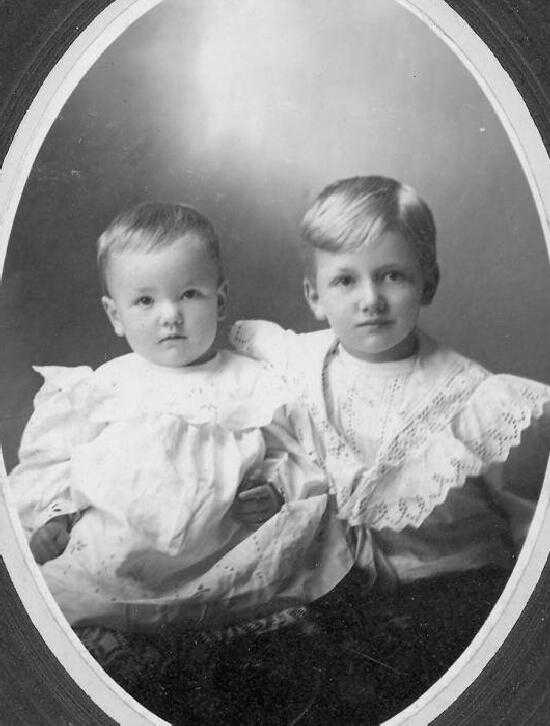
American boys commonly wore tunics throughout the 19th century and early 20th century. Unfortunately we do not have much information on the styling of the tunics worn during the early 19th century. They seem to have been longish tunics worn to knee level. With the development of photography at mid-century we have much more infomation. They seem to be shorter than those worn early in the century. These were not tunic suits. We do not notice matching pants, but our archive is still reltively limited. Some look rather like shirts. We notice tunics with diagonal styling during the 1870s. These were tunic suis with mtching pants, commonly knee pants. Tunics seem to have declined in popularity during the late-19th century, but they become very popular at the turn of the century. We notice three basic types of tunic sits at the turn of the 20th-century. The sailor style was the most popular, but the Russian blouse and Buster Brown styles were also popular. The Buster Brown suits appear to have been destinctively American. Others like the one here do not fit into any of the three basic types. The detailing of the tunics could vary widely. It was basically the collar style that determined the tunic style. Sailor collars had the prominent "V" front and back flap and were very popular. There were substantial variations in the styling of the sailor tunics. Some were done with traditional styling or some resemlance to it. We also note sailor tunics done with elaborate lace and ruffle trim. These tunics were of course dressy garments reserved for special occassions. They wee often made in larger sizes than the other tunic styles. Russian blouse tunic did no have collars. Buster Brown tunics had a wide white collar. Many tunics had prominent belts. They were oramental without any real purpose.
We notice tunics in many different lengths. There were short tunics that fell just below the waistline and longer tunics that fell well below the knees to calf level. Tunics cut at knee level were by far the most common length during the more than a cenury-long period that tunics were an important boys' style. Many of the tunics we have noted were cut at or just above the knee. Tunic length primarily varied chronologically. We are not sure about the early-19th centurty. A few images suggest that they could be quite long. By the mid-19th century and the advent of photography we know a great deal. Tunics at mid-century cold be short, but we see boys wearing garments looking more like shirts than tunics. Actual short-cut tunic suits were the rarest length. Then by the 1860s a kind of standard length appeared, about knee-legth, but we some longer tunics. This was not common in the early-20th century hen there was a kind of tunic revival, the ear actiually that tunics were the most popular. Almost all were cut at knee level. We do not see many shorter tunics until the late-1910s when tunics had begun going out of style.
The tunic was a very basic garment. Except for the sleeves, it could not be more simple. Even so, we note tunics done in a wide range of differet styles. Much of the styling is commonly associate with the neck area. There were decoration and detailing in other aeas such as the sleeves, but the basic sgyling is largely determined by the collartreatment. This has varied over the wide chronological period in which tunics were worn. We know a great deal about the stylkes worn aftr the apperance of the CDV, about1860, but much less about the tunicvs worn earlier in the 19h century. we notice everal prominent styles, including Buster Brown, Fauntleroy, Russian blouses, sailor, vestee, and other styles. This is a little difficult to assess because in period catalogs the style of the tunic is often not indicated. A problem here is that the detailing and decoration can visually vewealm the basic style. While we Some of the styles are simple to identify, especially sailor and Fantlery tunics. Other styles are more complicated to identify. know a good deal about the styles worn in the late-19th and early-20th cntury, we know much less about the tunics worn earlier. As far as we can tell, there is little or not mentin of styles in the tunics worn in the early-19th century. And catalogs were not common. We do notice what look like what might be called shirt tunics in Dags.
Tunics were made with a varity of different fetures. The most important were the collar, buttons, and waistline treatment. The styling of these various elements varied over time, We do not know much about early-19th century tunics, but by mid-centuety as a result of the development of photgraphy, we know much more. Tunics were done with a wide range of collars. The most destinctive were the sailor collars. Some tunics were done without collars others had collars of different styles and sizes. Eton and Peter Pan collars were popular styles, but we notice other styles as well. The syyle of collar is not always easy to tell because some were worn with large floppy bows. There were also a wide range of sizes. We notice tunics done with and without pockets. And we notice the pockets placed in different places.
The tunic was basically a plain, utilitarian garment without a lot of decorative trim. While we are not sure about the origins, the tunic was an imprtant boy's garment for more than a century. Although it seems to have been more of a garment worn by middle-class than working-class boys. There were some exceptions concerning the plain styling of these garments. Mothers being mothers, many could not restrrrain thenselves from adding some decorative trim. This is a little difficult to assess, because in the early-19th century when tunics seem to have been particularly popular, photography had not yet been developed. Thus we have very few images to work with. So we are not sure about decortion during this period. We see some examples that were very plain. We note them bring worn to school, but this was at a time when public schools systems in which working-class children could attend were not yet fully established. We do note two periods of decotative styling for tunics. One was the 1870s when diagonal styling providing opportunities for decoration. Then there was the early-20th century (1900-20) when mothers began adding lace and ruffles to dress tunics. Clearly this was the impact of the Fauntleroy craze. We also see embroidery used to decorate the tunics. A good example is the Wisconsin boy here (figure 1). We also notice Illinois boy Dayton Sizer, Jr. Mother has added a flower embroidery to a diagnonal element. And we note various other decoative trim added. Another example is an unidentified boy in 1908. Notably many of the examples we have found do not come from the fashionanle northeastern cities.

Navigate the Boys' Historical Clothing Web Site:
[Return to the Main American tunic page]
[Introduction]
[Activities]
[Biographies]
[Chronology]
[Clothing styles]
[Countries]
[Topics]
[Bibliographies]
[Contributions]
[FAQs]
[Glossaries]
[Images]
[Links]
[Registration]
[Tools]
[Boys' Clothing Home]