|
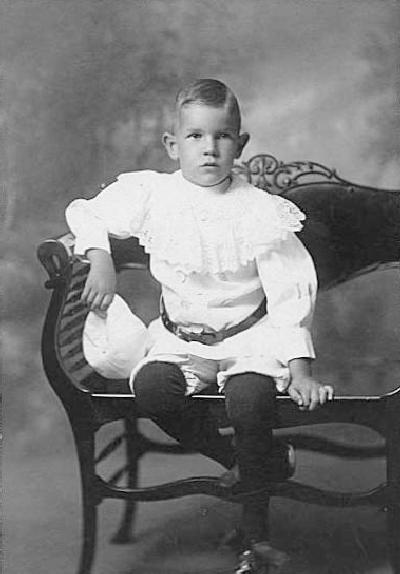
The tunic was not only popular, it was also an all-purpose garment. Some were worn as utilitarian play suits. This is interesting because until the appearance of tunic suits we do not really see play suits. Some tunic suits were quite inexpensive and made in basic materials. Children clothes were fairly standard and mothers used old clothes as play clothes for children. Girls would wear pinafores to protect their clothes. The tunic was a garment which could be used fir play, but could also be worn for more formal events by younger boys. We also see fancy, dress tunics that were made for formmal occassion. Often the basic garment was the same, only with fancy trim added to create dressy tunics. These may have been the boy's party outfit or dressiest grment. We see basic tunic suits trimmed with copious amounts of lace. This seems rather popular for white tunic suits. Thus boys could wear tunic suits for a wide range of activities and events.
Some tunic suits were worn as utilitarian play suits. Of course this should be viewed in the comntext thzt dress in the early 20th century was still more formal than later in the century. Play tunics would normslly be simpler with out the fancy frills of dressy tunics and in sturdy easy to launder fabrics. This is interesting because until the appearance of tunic suits we do not really see play suits. Some tunic suits were quite inexpensive and made in basic materials. Children clothes were fairly standard and mothers used old clothes as play clothes for children. Girls would wear pinafores to protect their clothes. Most images we have found of boys wearing play tunics seem to be summer tunics. We are less sure what children wore for play during cold weather. The play suits were worn with both socks and long stockings.
The tunic was a garment which could be used for play, but could also be worn for more formal events by younger boys. THis depended kargely on the gabric used and the trim. We see fancy, dress tunics that were clearly made for formmal occassion. Often the basic garment was the same, only with fancy trim added to create dressy tunics. Some tunics had copius ruffeled and lace trimed decorative elements. The fabric used could also be different. These may have been the boy's party outfit or dressiest grment. We see basic tunic suits trimmed with copious amounts of lace. This seems rather popular for white tunic suits made in light-weight fabrics for summer wear. We also see tunics done in heavier, dark materiaks, but they do not seem as common as the white ones. We note the dressy white tunic suits commonly worn with long stockings, both black and white long stockings. Both were considered appropriate for formal dress at the time. Socks were less common for formal wear.
We do not see boys commonly wearing tunic suits to school. This is not to say boys never wore them ro school. We do see a few younger boys wearing them, but not very many. This is apparent in the photographic record. The reason was probably because the tunic suit came to be seen as a garment for younger boys. We note a boy identified only as Stanley who was 7 years old wearing a tunic suit to school. This was not, however, very common.

Navigate the Boys' Historical Clothing hair style pages:
[Return to the Main long hair page]
[Return to the Main curl hair page]
[Bangs]
[Ringlet curls]
[Hair bows]
[Caps]
[Collar bows]
Navigate the Boys' Historical Clothing Web Site:
[Return to the Main American tunic page]
[Introduction]
[Activities]
[Biographies]
[Chronology]
[Clothing styles]
[Countries]
[Topics]
[Bibliographies]
[Contributions]
[FAQs]
[Glossaries]
[Images]
[Links]
[Registration]
[Tools]
[Boys' Clothing Home]