|
Almost all Jewish in Poland perished in the Holocaust. It was difficult for adults, virtually impossible for children unless someone hid them. Children are more subject to illness and more easily affected by stesses like malnutrition. Some adults in rural areas managed to escape and hide in wildreness arwas. Children unavle to fend for themselves or hike long dustances were unable to do this. But even beyond their biological vulnerability, children were especially targeted by the NAZIs who saw them as non-producers. Healthy adult Jews or youths were sometimes spared for a time for labor. Children on the otherhand were not useful for work. This is why children and mothers with children were selected for immediate murder when they arrived at camps like Auschwitz-Birkenau. A children few did and have left of moving accounts as to their childhood experiences. We also know about Poles who protected Jews. But the vast majority of Polish Jewish children were murdered. In many cases we know where they were murdered and when. Often they just disappeared, leaving no trace except a few haunting photographic images.
The Holoaust is full of incrediblke stories. Edwad's story is one of them. We know that Edward was a Polish refugee, although the name does not sound Jewish or Polish, more German I think. Germany had a substantial Polish minority, which may explain the name. We know that he was separated from his parents. We do not know how. Nor do we know where they were living at the time of the war. His mother made it to america, probably before the war. Edward was in Poland when Hitler and stalin launched the War. He may have been in the Soviet-occupied zone of eastern Poland. Somejhow he managed to cross the Soviet Union by train and reach Japanese occupied Manhukuo and eventually Tokyo. We do not know know how he did it. Perhaps he got some kind of visa like tones issued in Lithuanoa. Or perhaps bcause he was a boy, Soviet and Japanese officials just did not give some attention to him. Unforttunately we do not have all these details--just how he got to San Francisco.
Holocaust survivor Henry Greenbaum tells us, "I was 11 years old when the Nazis invaded my hometown in Poland (1939). My mother and two of my sisters were deported to the death camp at Treblinka (1942), where they were murdered with thousands of other innocent men, women, and children. I was sent with my other three sisters to a labor camp. I was the only one still alive (1844). And I was deported to Auschwitz. From there, I endured brutal conditions, including a death march, before being liberated by American soldiers (April 1945).
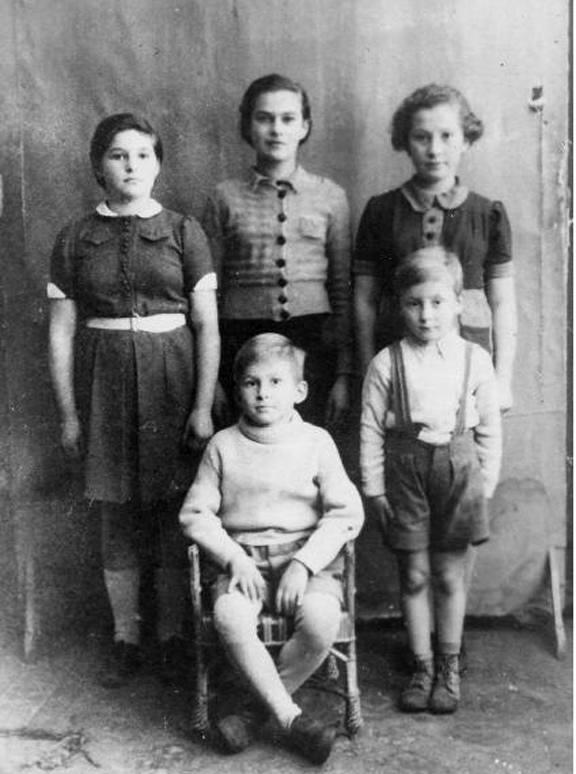
Three Jewish families are represented here--Jawic, Majerowicz, and Debinski. The portrait is undated, but looks like the late-1930s, just before the German invasion. The three girls standing at the rear are (from left to right) Teresa, Stefa, and Lulu. The boys are Jurek Jawic (sitting) and Jurek Debinski (standing). One of the girls is wearing three-quarter socks with her dark dress (back left). The Debinski boy, about seven, is wearing suspender shorts and
ankle socks. The Jawic boy, about nine or ten, in the chair wears a pullover sweater, short trousers, and long beige stockings with supporters (attached to a Leibchen obviously). Almost nothing is known of these children. They are listed as "displaced" and are probably victims of the Holocaust since they disappeared during the Nazi occupation of Poland. Almost the only thing we know about them is their names. Since the children were all photographed together, they were probably friends or at least from families who were friendly with each other in a Polish Jewish community. This portrait comes from the U.S. Holocaust Museum which is trying to to learn what happened to these and other children depicted in its vast photographic archive.
We are not sure where Charles was born. He was the son of Moszeck (Maurice) Karo and Dwoyra (Dota) Karo. They were Polish Jewish refugees in France During World war II. Charles had a sister Helene, a year younger who also survived the Holocaust. She was born in Paris days before the French surender to the Germans. we do not yet have the details of their survival. Apparently their parents managed to find people to hide their children before they were rounded up by the French police or Germans. Their father was murdered. Their mother was starved to death. The children managed to survive. We see Charles in New York after the war. He was brought to New York with another Holocaust survivor by Busy Buddies--an American charity supportng French orphanages which were careing for Holocaust and other war orphans. The children assisted in a fund raising drive.
We have only one personal account from Belarus, but it is perhaps the strangest of all the individual accounts we have found. It is about a little Jewish boy--Alex Kurzem. After the murder of his parents, he was adopted by a Latvian soldier and hiding the fact he was Jewish became a kind of NAZI mascot. He managed to survive the Holocaust and emigrated from Latvia to Australia in 1949. Alex's story is so fantastic that it sounds like an imaginative World War novel. But we knowit is true because when Ale as a young man arrived in Australia with only a small brown briefcase, he had photographs of himself as boy in his NAZI uniform. And NAZI newreals featuring him playing with German children have sence been discovered. Nationality is complicated here. Alex's village is in what is now Belarus, but at the time this was first Soviet and then German occupied eastern Poland. And Alex would be taken in by Latvian soldiers.
Roma was born in Krakow on November 13, 1938, only 4 days after Kristallnacht in Germany. She was not old enough to understand who the Germans were when they invafed about a year later. Infants and the elderly wwre the most endangered individuals. Not did she understand what at wearing the yellow star of David signified or what her parents meant when they discussed 'aussiedlung'" (resettlement). She knew something was wrong when her father's business was taken away, along with his car, money, apartment, and even the family dog before he was taken away. Her mother had to scrub streets and toilets to survive. They constantly moved. She saw people shot by the NAZIs on various occassions, including her aunt, a family friend, and playmate. Her grandmother was dragged down a road by the NAZIs causing her to loose her speech for a time. [Ligocka]
This is Fredzia Marmur, a Polish Jew born in Lodz. She and her family was Born in Lodz and incarcerated in The Lodz Ghetto and later the Ravensbr�ck Concentration camp. She and her mother survived and were rescued from Ravensbr�ck by the Swedish Red Cross in the final weeks of the War. Here she is landing at Malm�, the Swedish port near Copenhagen (April 28, 1945). Malm� became known as the Harbor of Hope. Fredzia was a rare child survivor of Lodz. The comment "Oh, that was me!" was what Fredzia exclaimed when she first saw this press footage years later. Then she immediately said, Where is my mother?" She explained that throughout their ordeal she was never far from her mother, except when she was committed to the camp hospital for Scarrlet fever. Most of the hospital patients were cartered away and murdered, but somehow Fredzia survived.
The NAZis did not like photographs taken in the Gettos or the Concentration camps or of the actual killing of the Jews. The Holocaust was, however, conducted on such a vast scale by such enthusiastic NAZIs that many photographic images were taken and quite a few survived the War. This photograph more than any other has come to represent the Holocaust. The little Jewish boy was arrested in Warsaw during 1943. By this time, most Polish Jews had already been murdered by the NAIZs, including most of his family. Somehow he survived. This was unusual as
children and the eldely were the first ones the Germans killed at the death camps. His name was Tsvi Nussbaum.
Irene Opdyke was a Polish Catholic forced to work in a munitions factory. She eventually became a housekeeper for a SS oficer, Eduard Rugemer. She hid Jews, helping them go into hiding. This was extremely dangerous, especially in Poland where the penalty was death. The SS officer found out and blackmailed her into becoming his mistress. She remained quiet after the War, but wrote her memoir after student asked her if the Holocaust really happened. [Opdyke]
Irena Sendler is one of the heros of the Holocaust. Irena during the German occupation somehow got permission from NAZI authorities to work in the Warsaw ghetto, as a plumbing/sewer specialist. She was one of the few Poles permitted to denter the Ghetto. She had a huge motivation tgo get this job--saving Jewish children. Irena began smuggled Jewish infants out in the bottom of her tool box. She also began smuggling bout larger kids in a burlap sack at the back of her truck. She carried a large dog in the truck which she trained to bark when the German guards let her in and out of the Ghetto. This discouraged close inspection of the truck as well as helped desguise noises ffom the children, especially the infants. She is believed to have saved some 2,500 children. The Germans utimately uncovered her child crescue operation. They tortured her, breaking her armsamd legs, but did not execute her. Irma recorded the names of the children she mansaged cto save. She buried the nmes in a glass jar under atree in the rear of her home. After the War she tried to find parents which may have survived to reunite them with therir children. Tragically, very few survived. The surviving children were placed in foster homes or adopted.
Martin was born in Vienna to Polish parents (1921). They were Jewish, but not religious. He had a younger sister (Hedwig Charlotte). His father was Alexander Ratz and his mother was Sophie. They came to Vienna from Brody, Galicia which had been part of the Austrian Empire. Movement within the Empire was unrestricted. Martin's father was a businessman. He worked for a Vienna company that sold pencils and associate writing products. The portrait was taken in Vienna (1927). Martin was 7 years old. The family 2 years later moved to Crakow. The family had relatives and better job opportunities there. His father died of a heart attack (1931/32). Their mother kept the family together in Crakow. When Martin entered grammar school (meaning an academically oriented secondary school), his mother decided to send him to her sister in Vienna, probably to improve his German. This would help getting better final exams in Crackow. Martin moved to his aunt's home in Vienna (1937). The NAZIs as part of the Anschluss expelled him from Austria for being a Polish Jew (1938). Martin and his future wife, Emilia, managed to survive the Holocaust. Their families did not fully understand the danger posed by the NAZIs when they invaded (1939). Especially Emilia's father who wanted her to stay with the family. Martin and Emila better understood the danger and headed east separately before the Ghettoization process was fully implemented. They met at Lwow where they were able to begin university studies. getting into Soviet occupied Poland was not easy. Soviet border guards had orders to shoot at anyone trying to cross the new border. When the NAZIs invaded the Soviet Union (1941) and whole new set of dangers emerged. They kept moving east, winding up in Sverdlovsk (formerly Yekaterinburg). It was located on the eastern slopes of the Urals far enough to stay out of NAZI hands. The Soviets had deported many poles to Central Asia and Siberia. After the NAZI invasion, however, Soviet policy toward the Poles changed. And Martin and Emilia were able to return to a much reduced Poland. Polish antisemitism was still prevalent and after the War they finally settled in Austria. .
Opdyke, Irene. In My Hands.

Navigate the CIH Holocaust Section
[Return to Main Polish Holocaust page]
[Return to Main German Blitzkrieg on Poland page]
[About Us]
[Allies]
[Biographies]
[Children]
[Concentration camps]
[Countries]
[Decision]
[Denyers/Apologists]
[Displaced persons]
[Economics]
[Eisatzgruppen]
[Eugenics]
[German Jews]
[Ghettoes]
[Impact]
[Justice]
[Literature]
[Movies]
[NAZIs]
[Occupied Poland]
[Process]
[Propagada]
[Resistance]
[Restitution]
[Questions]
[SA]
[SS]
[Special situations]
[Targets]
[Wansee Conference]
[Return to the World War II]
[Return to Main Holocaust page]
[Return to the Main mass killing page]
[Return to CIH Home page]