|
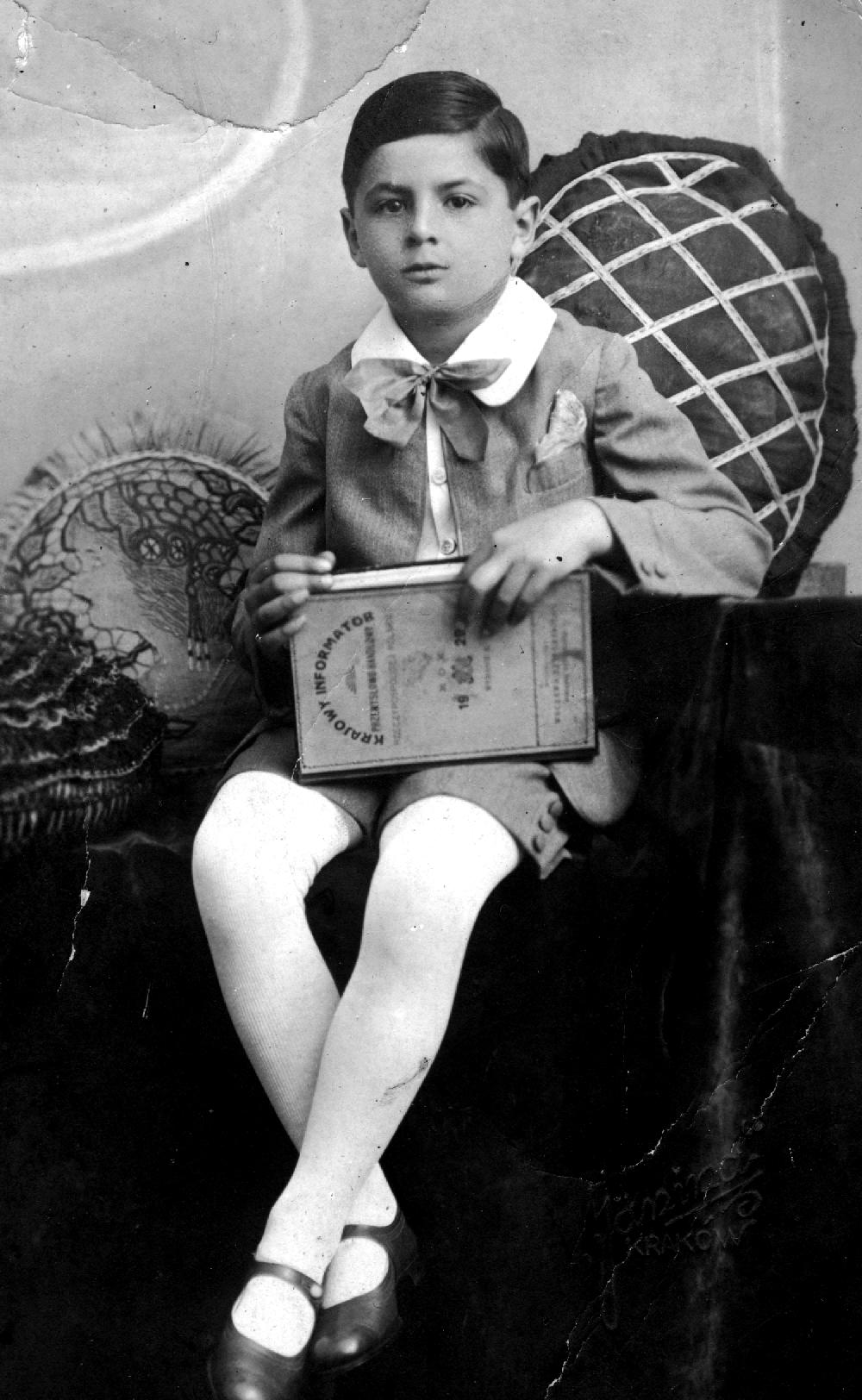
Martin was born in Vienna to Polish parents (1921). They were Jewish, but not religious. He had a younger sister (Hedwig Charlotte). His father was Alexander Ratz and his mother was Sophie. They came to Vienna from Brody, Galicia which had been part of the Austrian Empire. Movement within the Empire was unrestricted. Martin's father was a businessman. He worked for a Vienna company that sold pencils and associate writing products. The portrait here was reportedly taken in Vienna (1928). Martin was 7 years old. We are guessing that he was dressed up for some special occassion, but we are not sure what it is, perhaps his birthday or first day of school. A reader asks about the book that he is holding (figure 1). It looks like a book or ledger to us. Note taht it lookss rather weatherd (that bmay be because the cover is colored), but it is dated 192?--about when the photo was taken. According to the internet 'Krajowy' is a Polish adjective that means 'national', 'domestic', or 'inland' (of or pertaining to a particular country in this case Poland). Because 'krajowy' is a descriptive word rather than a specific service or entity, it appears in the names of many official Polish institutions, systems, and platforms. So it may be a book with information about Poland. Perhaps a present for whatever special occasion this was. The family 2 years later moved to Crakow. The family had relatives and better job opportunities there. His father died of a heart attack (1931/32). Their mother kept the family together in Crakow. When Martin entered grammar school (meaning an academically oriented secondary school), his mother decided to send him to her sister in Vienna, probably to improve his German. This would help getting better final exams in Crackow. Martin moved to his aunt's home in Vienna (1937). The NAZIs as part of the Anschluss expelled him from Austria for being a Polish Jew (1938). Martin and his future wife, Emilia, managed to survive the Holocaust. Their families did not fully understand the danger posed by the NAZIs when they invaded (1939). Especially Emilia's father who wanted her to stay with the family. Martin and Emila better understood the danger and headed east separately before the Ghettoization process was fully implemented. They met at Lwow where they were able to begin university studies. getting into Soviet occupied Poland was not easy. Soviet border guards had orders to shoot at anyone trying to cross the new border. The largest such groups were usually Jewish. When the NAZIs invaded the Soviet Union (1941) a whole new set of dangers emerged. They kept moving east, winding up in Sverdlovsk (formerly Yekaterinburg). It was located on the eastern slopes of the Urals far enough to stay out of NAZI hands. The Soviets had deported many poles to Central Asia and Siberia. After the NAZI invasion, however, Soviet policy toward the Poles changed. And Martin and Emilia were able to return to a much reduced Poland. Polish antisemitism was still prevalent and after the War they finally settled in Austria.

Navigate the CIH Holocaust Section
[Return to Main Individu; Polish Holocaust page]
[Return to Main Polish Holocaust page]
[Return to Main German Blitzkrieg on Poland page]
[About Us]
[Allies]
[Biographies]
[Children]
[Concentration camps]
[Countries]
[Decision]
[Denyers/Apologists]
[Displaced persons]
[Economics]
[Eisatzgruppen]
[Eugenics]
[German Jews]
[Ghettoes]
[Impact]
[Justice]
[Literature]
[Movies]
[NAZIs]
[Occupied Poland]
[Process]
[Propagada]
[Resistance]
[Restitution]
[Questions]
[SA]
[SS]
[Special situations]
[Targets]
[Wansee Conference]
[Return to the World War II]
[Return to Main Holocaust page]
[Return to the Main mass killing page]
[Return to CIH Home page]