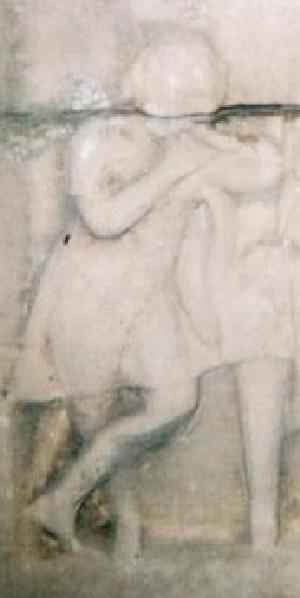
Figure 1.--This Roman carving is belevied to depict St. Nicholas as a child. Image courtesy of the Willam Fergusson archive. |


|
Nicholas was one of those children who come along once in a while who are clever than most others in some way or another. For many their extraordinary ability is something which they have throughout their life. For others it lasts until the end of their childhood. Other children, such as Nicholas have a gift which is nurtured through childhood and reaches its full potential in adulthood. History often contains well documented stories about the doings and achievements of children. Nicholas was born long ago so the historical record of his achievement is buried in tradition and legend. The facts associated with Nicholas are merged into a fanciful story that has been embellished by time. Paintings of his image exist but only from his adulthood. I have not been able to discover the boy?s family name only his first name in my searches about him.
His parents were very rich. His father had a grain business
that exported grain all over the Roman world.
Nicholas was born about 300 A.D. He was born in the town of Patara in Asia Minor, now Turkey. Nicholas was the apple of his parent?s eye. They longed for a child and it was only later in their married life that they were able to conceive. Their new born baby brought them extra joy because it was a boy child. They were full of joy and had great expectation for the future of their son. He probably played at wrestling with other boys. He would have fished on the seashore and swam in the sea.
Not only was Nicholas the apple of his parents eye but the boy's qualities also made him well loved and liked in the town. His gift was social interaction. He had an ability to make friends with both children and adults. Many children have this ability but Nicholas had a superior developed social conscious. Children and adults noticed his caring and helpfulness towards others. I have experienced only once in my teaching career, a child gifted in this way. It was noticeable how the boy cared for younger children. In many
other ways he was a normal boy who liked sport and his school work was not exceptional. He was also mischievous. It was his caring which was extraordinary. Normally these skills have to be taught. I have seen lots of children receiving this type of instruction from their parents. It happens in this way. Children, out with their mum and dad come across a poor person begging. The parents give a gift to the child who takes to the poor person. We have all experienced Christmas expectations by nieces and nephews but it has never crossed their
mind to give to family members. This would appear to be normal childish behaviour. Nicholas was not like this. Quite early on he had developed an extraordinary social conscious. Nicholas was a child who did not need to be told to give. He did it on his own accord in a special way. It was secret giving. The recipients wondered who had given and it took them awhile to work out that it was Nicholas.
His parents would have dressed Nicholas in the fashionable clothes of the
time. White robes and footwear. Nicholas would have worn leather sandals,
tied at the ankle with thin leather straps. He would have looked like a
typical Roman boy. Patara is in a very warm region and I expect that in summer Nicholas wore the minimum of clothes. He would have run about bare footed in the summer.
The boy was most likely schooled at home. He would have had a tutor. Reading, writing and arithmetic would have been the core curriculum because his father would have envisaged him joining the family in their wheat business.
Nicholas was a normal boy. He got into as much mischief as his friends did. Nicholas as well as other children often played where they should not. Building sites are seen by children as unauthorised playgrounds. They find these places exciting. There is much danger and many children are accidentally hurt from playing in such places. Nicholas played with his friends on building sites. Unfortunately it was Nicholas who had the accident. The building they were playing on collapsed and Nicholas was buried under the rubble. On hearing what had happened his parents rushed to the scene. The scene that met them was one in which rescuers were carefully removing the stones in a rescue attempt. Suddenly the rescuers had to run for their lives because the rubble started to move. Legend says that the stones parted to reveal an unhurt Nicholas. More likely what had saved the boy was that part of the building had remained upright, creating a space, trapping Nicholas but saving him from injury. When the rubble moved it opened this pocket and thus the boy was able to escape. To those watching it would have seemed a miracle and none believed it more so than his mother.
After this experience Nicholas's father may have felt it time to show his son the world around their town. It is believed that he visited Egypt and Palestine. He travelled by sea to these places. Sometimes the Mediterranean Sea can get rough. It did on Nicholas' journey. The ferocity of the storm made the sailors afraid and they lost heart in their ability to save the ship. Something about Nicholas' behaviour during the ordeal changed them. It may have been the calmness Nicholas showed that gave the crew new hope and courage to sail the vessel through the rough seas. Sailors are superstitious and upon reaching port claimed that Nicholas had miraculously saved them.
When he was about 19 his parents died. He took over the wheat business for a while but his heart was not in it. Meanwhile the family business was probably operated by others.
Nicholas joined the new Christian religion. At the time Christianity was still illegal in the Roman Empire. The punishment for being a Christian was death. Nicholas was imprisoned by Diocletian for being a Christians. Diocletian conducted the last and one of the most horrific percecutions of Christians. Nicholas was released by Constantine the Great after his military victory abd success in seizing control of the Empire.
Here was an outlet for his well developed social conscience. He gave money to the poor and to those in need. He continued to give in anonymously because he thought thanks or credit for the benevolent action should not be expected. It was in secret that he helped a nobleman by secretly giving him money to provide weddings for the nobleman?s three daughters. Nicholas took money to the house. He threw two bags of gold through an open window and then disappeared into the night. He returned later and dropped the third bag
of money down the chimney. It landed in the stockings the girls had hung by the fire to dry.
Nicholas sought holy orders and entered the monastery of Sion. He moved away from Patara when he became the Bishop of Myra (310 AD). Myra was an the Aegean seaport town in Lycia, of some importance during Roman times. It is now the small Turkish town of Kale (Demre). It was at this stage in his life that he became a truly great person. Myra was the location of the temple of Artimis--center of an important cult. Myra ;ed the effortv to destroy the templel. A range of legends are associated with Nicholas. One concerns a famine in the area and Myra was fast running out of food. Nicholas was concerned and wondered what to do. News reached him that a fleet of grain ships sailing from Alexandra to Byzantium had arrived in port. The bishop immediately went to the harbour and spoke with the captains. They very reluctantly unloaded wheat from each of their ships for Myra. In Byzantium they complained about what the Bishop had forced them to do. The cargo was carefully measured and it was found to be intact. News spread that Nicolas had performed another miracle. The truth is likely to be that the scales, possibly at Alexandra were inaccurate. More grain was loaded than the manifest said. Nicholas would have known that the scales gave an inaccurate weight. Thus removing the difference would still leave the weight which was on the ship's manifest. He also was know for using the money that came with being a bishop for buying people out of slavery. He was reportedly especially concerned with children.
When Constantine seized control of the Roman Empire he gave official sanction to Christianity. He was frustrated, however, by the fact that there was really no Christian religion in the sense of an organized religion. Rather there were churches organized throughout the Empire with widely different beliefs. Some of the different belifs had regional bases, but often a single city might have congregations with great differences in their theology. As a result, Constantine promoted the Council of Nicaea to make basic decisions on Christian theology. It was the Church's first ecumenical council, attended by more than 300 bishops from the major cities of the Christian world. Constantine presided over the Counci, but had no real bias as to the theological decesions taken. He just wanted there to be a standard theology. There were many issues at stake, but the most important was the nature of the Holy Trinity. Here there were enormous differences among churches. One infuentual theologian, Arias in Alexandria, taught that the Son Jesus was not equal to God the Father. This became known as the Arian controversy (after the Council the Arian Hersey) and the intensity of the differences shook Christianity to its very foundations. Athanasius was the chief opponent of Arius. Nicholas is believed to have attended the Council. One legend depicts Nicholas violently diagreing with Arias and slapping him. Constantine according to the legend arrested Nicholas, but later released him, according to legend by the intercession of Jesus abnd Mary. There is considerable doubt about this legend as it does not appear in the detailed contemporary sccountsof the Council. Another legend concerns the kidnapping of three boys. Nicholas found out where the boys were being held. Unfortunately, by the time he arrived the kidnapper had smothered them. Nicholas was able to revive the boys. Everyone thought he had performed yet another miracle. Surely the boys represent the Holy Trinity.
Bishop Nicholas developed a reputation for doing good. He was 65 when he died in Myra. A great deal is known about Bishop Nicholas, but thecdetails of his death have been lost. It is known that he died in 342. He was at the time one of the most higly regarded bishops of the Church. And his reputation even continued to grow after his death beyond Turkey, Greece, and Italy. Eventually he consegrated a saint. An December 6 became St, Nicholas Day.
Bari became involved in the Nicholas story. His legend would have been well known in Italy. Bari is a port located across the Aegean in Italy. Myra was part of the long term struggle between the Byzantine Empire and Muslim invaders. The Seljuk Turks threatened the port. Just before they entered the city, Italian sailors from Bari carried off the the relics of Saint Nicholas. Most accounts say this was over the objections of the monks caring for them. In medieval Europe, these relics had both religious and economic importance. Important relics lent prestige to a church and drew pilgrims which meant money to a church and town. The Italian sailors arrived in Bari with the relics (1087). And they soon brought visitors and pilgrims to Bari desiring to see the relics of Saint Nicholas. The Basilica di San Nicola was founded to house the relics. Bari is today a major Italian urban center, exceded only by Naples in southern Italy. The main feast day is Saint Nicholas Day (December 6). And because of Nicholas' love of children, many parents began the tradition of giving presents to their childten
Today St. Nicholas church in Turkey stands as a testament to a most remarkable person. St. Nicholas is a rare Catholic bishop who has survived the condemnation of the Reformation. Thhus you see St. Nicholas honored throughout Europe in both Catholic and Protesant countries. Even more interestingly, even in Protesant countries like the Netherlands, he continues to decpictured in the very identifiable trapings of a Catholic bishop. It was through the Dutch in New Amsterdam that Sinterclaus was transferred to a still very Protestant America, alhough he became known as Sanya Claus. St. Nicholas is still widely thought of as a saint even though his sainthood was reappraised in 1969. He is the patron saint of Russia. His doings have made him the patron saint of unmarried women, of sailors, merchants, pawnbrokers and teachers. Best of all he is the patron saint of children. It was in Nicholas's childhood that he had the idea of secret giving. He continued with this idea in his adulthood which led to our tradition of secretly giving gifts to children in December. This is a tradition that still continues. Nicholas was a child with an extraordinary social conscience which reached its maturity in adulthood. Saint Nicholas is best known by his other name of Santa Claus.
Martin Luthur initiated the Protestant Reformation which shook the Christian Church to its foundation. One of the the issues that Luthur and other Protestants raised was the emphasis the Catholic Church placed on saints. This is a non-Biblical tradition of the Church. As a result, the Protestants rejected the Catholic pabntheon of saints. St. Nicholas was, however, such a popular saint that new figures emerged to replace the saint such as Father Christmas, Sinterklaas, and Père Noel. Depictions of these figures even in Protestant countries commonly shown him attired as a Catholic bishop.

Navigate the Boys' Historical Clothing Web holiday pages:
[Return to the Main Santa page]
[Return to the Main Chrisrtmas page]
[Return to the Main holiday page]
[New Years]
[Valetines]
[St. Patrick's Day]
[Easter]
[Fourth of July]
[Haloween]
[Thanksgiving]
Navigate the Boys' Historical Clothing Web Site:
[Introduction]
[Activities]
[Biographies]
[Chronology]
[Clothing styles]
[Countries]
[Topics]
[Bibliographies]
[Contributions]
[FAQs]
[Glossaries]
[Images]
[Links]
[Registration]
[Tools]
[Boys' Clothing Home]