|
The basis for Santa Claus was St. Nicholas. St. Nick took on different forms and no where did he change more than in America. It was the Dutch who brought Santa Claus to America. New York was first settled by the Dutch as New Amsterdam. Children there as Dutch children still do, prepare for St. Nicholas eve. The children once filled their shoes with straw for St. Nicholas' horse, hoping that the Bishop then known as Sinter Klaas, would fill them with gifts. (See "Holland" for more details about Sinter Klaas and the hanging of stockings by the fireplace.) American children begin grasping the concept of Santa Clause at about 2-3 years of age. Virtually all children are thrill with the mystery and surprise of Christmas. Thius does not begin to change for most until they begin school. There they begin to here rumors from older children. Their developing concept of mathematics enables some to do the numors. One rather rotund old fellow can only go down so many chimleys--not to mention that many do not even have chimleys. Others wonder about seeing multiple shoping mall Santas. Some observant little sharpy might notice that mom and dad's wraping paper is the same as Santa's. I remember asking how Santa got my new desk down the chimley. Often children during their first year of school cling teaciously to Santa. By age 7 and second grade many begin to become increasingly skeptical. This is probably a younger age than was common at the turn of the 20th century. It is no only adults thart participate in the information age. As one editorial writer explains, "You know your kid is a doubter if he comes in holding a globe and calculator and wearing an expression that says, 'We have to talk." There are two American Christmas classics addressing the doubts of growing children. One was an editorial written in respnse to an 8-year old girl, Virginia O'Hanlon. It was written by Francis P. hurch for the New York Sun in 1897. It begins with the now classic, "Yes, Virginia. There is a Santa Clause." The other classic is the wonderful 1937 movie, Miricle on 34th Stree staring a young Natalie Wood.
The basis for Santa Claus was St. Nicholas. Nicholas was one of those children who come along once in a while who are more clever than most others in some way or another. For many their extraordinary ability is something which they have throughout their life. For others it lasts until the end of their childhood. Other children, such as Nicholas have a gift which is nurtured through childhood and reaches its full potential in adulthood. History often contains well documented stories about the doings and achievements of children. Nicholas was born long ago so the historical record of his achievement is buried in tradition and legend. The facts associated with Nicholas are merged into a fanciful stories that has been embelished over time. Paintings of his image exist but only from his adulthood. I have not been able to discover the boy?s family name only his first name in my searches about him.
Martin Luthur initiated the Protestant Reformation which shook the Christian Church to its foundation. One of the the issues that Luthur and other Protestants raised was the emphasis the Catholic Church placed on saints. This is a non-Biblical tradition of the Church. As a result, the Protestants rejected the Catholic pantheon of saints. St. Nicholas was, however, such a popular saint that new figures emerged to replace the saint such as Father Christmas, Sinterklaas, and P�re Noel. Depictions of these figures even in Protestant countries commonly shown him attired as a Catholic bishop. Stories about St. Nicholas and there local manifestations tended to diverge, but no where did his appearnce change nore than in America.
Christmas was not part of Pilgrim religious observation. The Pilgrims considerd with some reason that the English celebration of Chritmas was too ribald. They actually outlawed the celebrtion of Christmas. This pilgrim influence was to influence American religious celebration well into the 19th century. This was one factor in the development of Christmas in America as more of a secular than a religious holiday.
The Germans were the major non-English immigrant group, but neither the Engklish or Germans were responsible for Santa. It was the Dutch who came in relatively small numbers that brought Santa Claus to America. Of course America, especially American business, has done a good deal with Santa since the Dutch first brought him here. New York was first settled by the Dutch as New Amsterdam. Children there as Dutch children still do, prepare for St. Nicholas eve. The children once filled their shoes with straw for St. Nicholas' horse, hoping that the Bishop then known as Sinter Klaas, would fill them with gifts. (See Holland" for more details about Sinter Klaas and the hanging of stockings by the fireplace.) Sinter Klaas was gradually Americanized as Santa Claus.
Famed American novelist Washington Irving (1783-1859) published a book of political satire (1809). He mentioned Sinta Claes and made up stories. He was depicted as flying in a waggon to dispense presents.
Christmas in America, discouraged by most American Protestants, was built on the Dutch and and other European traditions. It was Clemet Moore who is most responsible for the destinctive American celebration of Christmas. His poem "A visit from St. Nicholas" (1822) created most of the familar aspects of the American celebration. He took Irving's Sabnta abnd added a number of his own embelishments, His poem described the Reindeer (except Rudolph) and St. Nick bringing presents down the chimley. He did not, however, describe St Nick, excepot that he was jolly and had a bowl full of jelly. Moore was a very staid minister and was afraid for a while that his poem was too flipant and therefore attempted to hide the fact that he wrote it. The poem definitely made Christmas into a celebration for children. It also fit perfectly into the changing imge of children that was to develop in the Victorian era. Publishing illustrations was still very limited in the 1820s.
The modern image of Santa Claus began to appear during the American Civil War. And with advances in lithography, it was an illustrator and not an author who played a major role. It was created by famed Amerian political cartoonist Thomas Nast. He is often described as the 'Father of the American Cartoon'. One of Nast's projects was to do an annual Christmas cartoon for Harper's Weekly, one of the most important American publications at the time. The first Nast Christmas cartoon appeared in 1863 and he continued doing them until 1886. Santa first appeared as an ugly elf. He gradually evolved into the pot-bellied, full beared character known by every American child today. Nast helped create the Santa tradition by explaining that he spent the entire year making toys with his elves at the North Pole. Other traditions such as checking on how children were behaving, keeping lists of who has been naughty and nice, and receiving Christmas lists all emerged from Nast's cartoons. Nast was born in Landau, Bavaria--Germany (1840) and emigrated to America as a young boy. He first became known to the American public for his Santa Clause cartoons and Civil War illustrations which were published by Harpers as wood cuts. He had alove for American Democeract and a hatred for slavery. President Lincoln coln called Nast “Our Best recruiting sergeant”. He is best known as opponent of political graft after the War when he attackedBoss Tweed and Tamaney Hall in New York City. He died in Guayaquil, Ecuador (1902).
Commercial artist Haddon 'Sunny' Sundblom (1899-1976) created the definitive Santa. He was working for Coca-Cola. He created Christmas posters and advertisements for Coke. He turned to Moore's poem for inspiration. Sundblom's Santa was done up in a red velvet suit with white fur trim. And he was definitely no elf. He was a ruddy faced, grandfatherly figure with a waist-line problem. And for over 30 years Sundblom spun out versions of Santa for Coke. No one has since challenged Sundblom's concept of Santa. Sundblom was arguably the most important commercial artist of the 20th century. Coke was just one of the major American compsnies who hired him, but it is Santa images for which he is best renembered.
American children begin grasping the concept of Santa Clause at about 2-3 years of age. Virtually all children are thrill with the mystery and surprise of Christmas. Thius does not begin to change for most until they begin school. There they begin to here rumors from older children. Their developing concept of mathematics enables some to do the numors. One rather rotund old fellow can only go down so many chimleys--not to mention that many do not even have chimleys. Others wonder about seeing multiple shoping mall Santas. Some observant little sharpy might notice that mom and dad's wraping paper is the same as Santa's. I remember asking how Santa got my new desk down the chimley. Often children during their first year of school cling teaciously to Santa. By age 7 and second grade many begin to become increasingly skeptical. This is probably a younger age than was common at the turn of the 20th century. It is no only adults that participate in the information age. As one editorial writer explains, "You know your kid is a doubter if he comes in holding a globe and calculator and wearing an expression that says, 'We have to talk."
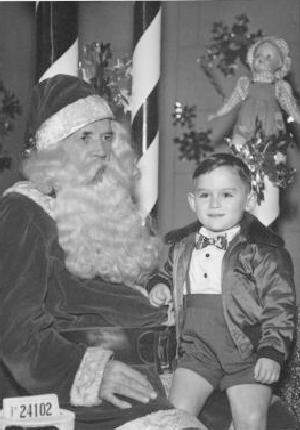
Department store Santas have become another Chritmas tradition. While images of Santa appeared in the 19th century, we do not see photographic portraits with Santa being taken until well into the 20th century. We are not sure just when this tradition began, but we do not note it in the photographic record until after World War I in the 1920s. A good example is Jack in 1930.
There are two American Christmas classics depicting Santa and addressing the doubts of growing children. One was an editorial written in respnse to an 8-year old girl, Virginia O'Hanlon. It was written by Francis P. hurch for the New York Sun (1897). It begins with the now classic, "Yes, Virginia. There is a Santa Clause." Another classic is the wonderful 1937 movie, 'Miricle on 34th Street' (1947) staring a young Natalie Wood. Ralphie faced a not so nice Santa in 'A Christmas Story' (1983).
None other than Ben Franklin began developing a postal network in the Thirteen Colonies before the Revolution. The Second Continental Congress created the United States Post Office (USPO) (1775). Franklin briefly headed it. For nearly a century people came to their local post office to pick up and send mail. It ws at first not cheap. The Civil War (1861-65) transformed the USPO. With millions of soldiers away from home, both the soldiers and their loved ones began writing letters and sending packages as never before. Postal workers began hand-delivering mail in major cities rather than allowing them to pile up. And Americans began viewing mail in a new way. It became seen as a daily treat arriving at one�s front door, rather than a burdensome trudge to the post office where a letter may or may not be awaiting them. Eventually there would be two deliveries daily. Letter slots became standard in every American front door. The USPO became increasingly efficient and the cost of postage began to drop. Parents had no problem in paying for stamps. Children were of course were watching all of this. And at the time older children believed in Santa than is the case today. At the same time the legend of Santa Clause was growing. Pictures, poems, and illustrations of Santa, at the time more commonly called St. Nick, began to flood the developing print media. Thomas Nast was a cartoonist in the popular Harper�s Weekly a had a huge impact in both how Americans viewed Santa and on letter writing. It was Nast that came up with the idea that Santa lived and worked in the North Pole -- a famous illustration that named 'Santaclausville, N.P' (1866). This was crucal because it provided an address. Then Nast went further, he depicted Santa sorting letters from 'Good Children�s Parents' and 'Naughty Children�s Parents'. This all helped spark the idea of letters to Santa. Now we are not sure just who came up with the idea of the children rather than the parents writing to Santa. Kids are not dummies and seeing the mailman every day and their parents writing lettrs, it was probanly the kids themselves who decided they wanted to go write to the source and write Santa themselves. This all began in America. Only apprently enterprising American children figured this all out. Scottish children contunued to shout their wishes up the chimney. Most Europeans children just left out stockings or shoes for their gifts. And before the age of mass media, writing to Santa became a major Christmas ritual. It also created a problem for the USPO -- what to do with the moutains of letters that began arriving.
Santa Claus, Indiana famous for its Christmas theme and is today a year round venue for family Christmas fun. It is located in southwestern Indiana close to the Ohio River. Attractions include Holiday World, Santa's Candy Castle, Santa Claus Museum, Santa Claus Church, Santa Claus Post Office, a Santa Claus statue, Holiday World & Splashin' Safari, Frosty's Fun Center, Christmas Lake Golf Course, and Santa's Stables. Accomodations include Santa's Lodge and Lake Rudolph Campground & RV Resort. The origin of the name is lost to history. The town was founded as Santa Fe (1854). They immeditely applied for a post office, but the U.S. Post Office (USPO) insisted they choose another name because there was already a Santa Fe, Indiana. A town meeting was held and after some deliberation they decided on keeping the Santa and replacunf Fe with Claus. No one today knows why, but we suspect it was to irritate the USPO. The USPO, however, did not bat an eye. What was not on anyone's mind was to create a theme attraction--such things did not exist in the 1850s. And for decides. Santa Claus was just another, unexceptionl small town in Indiana. Over time as children began writing to Santa Claus in the late-19th century, some of those letters began arriving at the Santa Claus, Indiana post office. Eventually vounteers in the town organized to begin answering back. This was a tradition that was established by the time of World War I. Postmaster James Martin began promoting a Santa Claus postmark (1928). (Local high school students design a new post mark every year.) Beause of the volume of mail, the USPS decided not to approve another Santa Claus post office in any other state. It is at this point that that cxartoonist Robert Ripley featured the town's post office in his nationally syndicated 'Ripley's Believe It or Not!' (1929). This of course increased the volume of Christmas letters. And outside entrepreneuers began building the attractions we see today. Santa Claus is located near another major attraction--the Abraham Lincoln boyhood home.

Navigate the Boys' Historical Clothing Web holiday pages:
[Return to the Main American Chrisrtmas page]
[Return to the Main holiday page]
[New Years]
[Valetines]
[St. Patrick's Day]
[Easter]
[Fourth of July]
[Haloween]
[Thanksgiving]
Navigate the Boys' Historical Clothing Web Site:
[Introduction]
[Activities]
[Biographies]
[Chronology]
[Clothing styles]
[Countries]
[Topics]
[Bibliographies]
[Contributions]
[FAQs]
[Glossaries]
[Images]
[Links]
[Registration]
[Tools]
[Boys' Clothing Home]