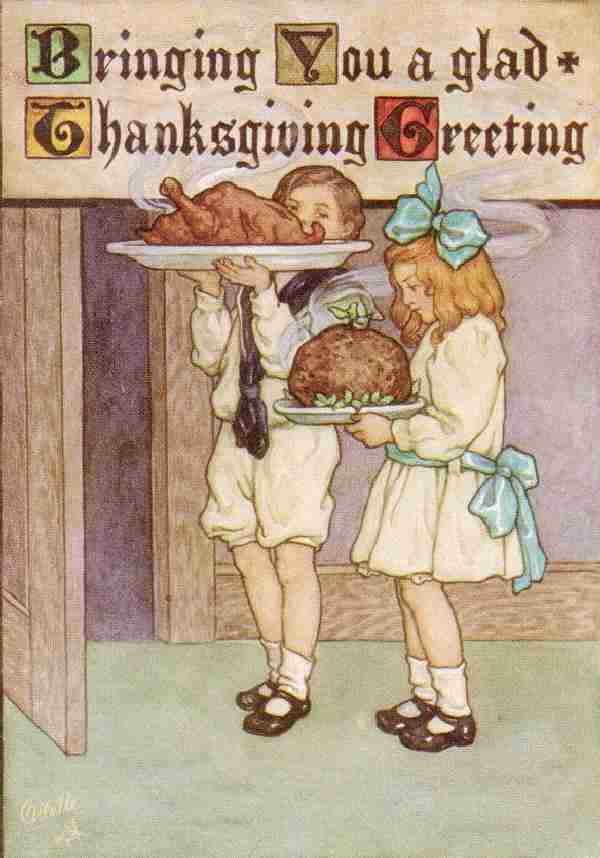
Figure 1.--Here we have a Thanksgiving post card. We suspect it was published before World war I, presumably in America, but are not sure. |

|
Thanksgiving and the Fourth of July are the two major American national celebrations not shared with the rest of the world. Unlike the independence days which many countries just celebrate on a national basis, Thanksgiving is a destinctly American celebration. It is a holiday that has threaded together the Pilgrims, President Washington, and President Liincoln a;ong with his son Tad. Like Independence Day. Thanksgiving is a holiday that combines all Americans together with little controversy. This was not at first the case. The Thankgiving proclsaimed by President Washington became seen by the Democratic-Republicans as a politically motivated Federalist holiday. And when President Lincoln proclaimed aThanksgiving during the Civil War, the celebrationbnwas taenished in the South for a generation. While an quinsentially American holiday, there is one other country which celebrates Thangiving. Canada which wasanother North American English colony, also celebrates Thanksgiving.
Thankgiving is a uniquely American celebration, although its antecedents go back to the Spanish colony of New Spain )16th century). The American celebration had its own unique origins in the English coloies of Plymouth and Virginia (17th century). The holiday is most associated with the Pilgrims of Plymouth Colony, but was apparently celebrated a fewvyears earlier in Virginia. Thanksgiving did not, however, become an official national holiday until President Lincoln proclaimed it after the Civil War battle of Gettysburg (1863). The final dates were not set, however, until President Roosevelt attemted to move it up as a Depression fighting measure (1930s). He was forced to move it back and Congress finally fixed the date, ironically shortly before the Japanese attack on Pearl Harbor and the resukting American entry into World War II (1941)
Historians report that there are examples of single celebrations of Thanksgiving. Tghey occurred in the new Spanish colony of New Spain--modern Mexico. The first known celebration in whgat is now the United States occured in Texas, at the time part of New Spain (1541).
The first call for an annual Thanksgiving was at Berkeley Plantation, Virginia (1619). Captain John Woodlief and 38 settlers aboard the ship Margaret, proclaimed, "Wee ordaine that the day of our ships arrivall at the place assigned for plantacion in the land of Virginia shall be yearly and perpetually keept holy as a day of thanksgiving to Almighty God."
The Pilgrims are credited with originating Thanksgiving. The Pilgrims landed at Plymouth Rock on December 11, 1620. They were not the first English colonists in North America, but they generally are better covered in the popular literature. Their first winter was devastating. By the beginning of the following
fall, they had lost 46 of the original 102 who sailed on the Mayflower. The harvest of 1621 was a bountiful one, largely to the support nad assistance from the Native Ameicans. The remaining colonists decided to celebrate with a feast--including 91 Indians who had helped the Pilgrims survive their first year. The feast was more of a traditional English harvest festival than a true "thanksgiving" observance. The harvest festival was well established in England, combining both devotional observations and a rolicking good village festival. The pilgrims of course frowned on the party-like atmosphere of the harvest festival. Yet they were truely releaved over the reversal of their fortunes and the first Thanksgiving did last 3 days.
The actual meal was substantially different than that generally assumed today. Governor William Bradford sent "four men fowling" after wild ducks and geese. It is not certain that wild turkey was part of their feast. However, it is certain that they had venison. The term "turkey" was used by the Pilgrims to mean any sort of wild fowl. Another modern staple at almost every Thanksgiving table is pumpkin pie as sugar and mollases was in short supply. But it is unlikely that the first feast included that treat. The supply of
flour had been long diminished, so there was no bread or pastries of any kind. All the flour they had was brought from England, they did not yet have a successfulmwheat harvest. They did have several vegetables which they called herbsm including onions, carrots, parsnips, lettuce, spinach, pumpkins, and maize (corn). They ate the pumpkin and many other vegetables boiled. They also produced a type of fried bread from their corn crop. There was also no milk, cider, potatoes, or butter. There was no domestic cattle for dairy products, and the newly-discovered potato was still considered by many Europeans to be poisonous. But the feast did include fish, berries, watercress, lobster, dried fruit, clams, venison, and plums.
This "thanksgiving" feast was not repeated the following year. But in 1623, during a severe drought, the pilgrims gathered in a prayer service, praying for rain. When a long, steady rain followed the very next day, Governor Bradford proclaimed another day of
Thanksgiving, again inviting their Indian friends. It wasn't until June of 1676 that another Day of Thanksgiving was proclaimed.
The appropriate date for Thanksgiving was not at first fixed. The governing council of harlestown, Massachusetts, on June 20, 1676, held a meeting to determine how best to express thanks for the good fortune that had seen their community securely established. By unanimous vote they instructed Edward Rawson, the clerk, to roclaim June 29 as a day of thanksgiving. The tradition of Thursday was established at an early date. The Pilgrims believed in a mid-week sermon or devotional and this was usually selected as the appropriate day for Thanksgiving. Gradually November, after the crop was in, became the most common month.
Thanksgiving was in the 18th century still not an exclusively harvest celebration. Local officials might proclaim a day of thanksgiving to mark some notable event. The first national Thanksgiving day was proclaimed by General George Washington to mark possibly the most important American victory of the war--the Battle of Saratoga. Washington's proclamation marked the first time that all 13 colonies joined in a Thanksgiving celebration (October 1777). Saratoga ultimately broughttheFrench intothe War as allies, critical to the American cause. Washington's proclamation was a one-time affair. George Washington two decaded later was elected the first president of the American Republic. The first president proclaimed a National Day of Thanksgiving (1789). Some Americans at the time were opposed to it. There was discord among the coloniesand the modern American political system of competing parties was beginning to take shape. The idea of thanbksgiving became a political missue associated with the Federalists and New England. Many felt that the hardships of a few Pilgrims did not warrant a national holiday. Later, President Thomas Jefferson scoffed at the idea of having a day of thanksgiving.
It was Sarah Josepha Hale, a magazine editor, whose efforts eventually led to what we recognize as Thanksgiving. Hale was the most widely read woman journalist of her day. She wrote many editorials championing her cause in her Boston Ladies' Magazine, and later, in Godey's Lady's Book. Goodey's was the most influential woman's magazine of the day aand was extremely influential in shaping the opinion of American women, especially with fashions, but many other areas as well. She engaged in a 40-year campaign to make Thanksgiving a national holiday. Interestingly it was not a commercial enterprise, but she was convinced that a single national day of thanksgiving might be a powerful unifying factor in an America that in by the 1840s was steadily spiraling toward regional dissension and Civil War. She conducted a steady campaign of writing editorials and letters to governors and presidents. Many Southerners were, however, even before the Civil War skeptical of this strong-willed northern lady.
Hale's obsession became a reality when after the Battle of Gettysburg, President Lincoln proclaimed the last Thursday in November as a national day of national Thanksgiving (1863). Lincoln saw such a holiday as a ray of hope for a country mired in a horendous Civil War. Lincoln's proclamation helped establish Thanksgiving in the North, but probably impeded the acceptance of the holiday in the South for several years. President Lincoln initiated another time-honored Thanksgiving tradition. Apparently his son Tad who was attached to the many animals kept at the White House was upset when he realized that the turkey he liked to play with was slated for the family Thanksgiving dunner table. The President, decided to grant a pardon, much to Tad's relief.
Thanksgiving was proclaimed by every president after Lincoln. The date was changed a couple of times, most recently by Franklin Roosevelt, who at the request of merchant groups, set it up one week to the next-to-last Thursday to create a longer Christmas shopping season which he hoped might help stimulate the economy. This was oneof many New Deal efforts to fight the Depression. The American public by the 1930s had, however, widely accepted the last Thursday in November. Public uproar against this decision caused the president to move Thanksgiving back to its original date only 2 years later. Congress in 1941 finally sanctioned Thanksgiving as a legal national holiday, as the fourth Thursday in November. ironically this was shortly before the Japanese attack on Pearl Harbor and the resukting American entry into World War II
The view of that first thanksgiving evolved over time. It is clear that the success of the first English colony at Plimouth Plantation in Masssachusetts was in large part to the good will of the indians. A Wampanoag man, Squanto, taught the pilgtims how to plant maize using fish to fertalize the soil. The pilgrims did not have a lot of manure to fertilize the soil since they were able to bring so few animals with them on the Mayflower. But as bitter conflicts were fought with the indians through the 19th century, the figure of the beneloent Squanto and friendly indians in general has been played down. In the 20th century the role of the indians has been given much more positive treatment.
There is one other country which celebrates Thanksgiving--Canada. The dates, however, are different.

Navigate the Boys' Historical Clothing Web holiday sites:
[Return to the Main holliday page]
[New Years]
[Valentine Day]
[St. Patrick's Day]
[Easter]
[Fourth of July]
[Haloween]
[]
[Christmas]
Navigate the Boys' Historical Clothing Web Site:
[Introduction]
[Activities]
[Biographies]
[Chronology]
[Cloth and textiles]
[Clothing styles]
[Countries]
[Girls]
[Topics]
[Bibliographies]
[Contributions]
[FAQs]
[Glossaries]
[Images]
[Links]
[Registration]
[Tools]
[Boys' Clothing Home]