|
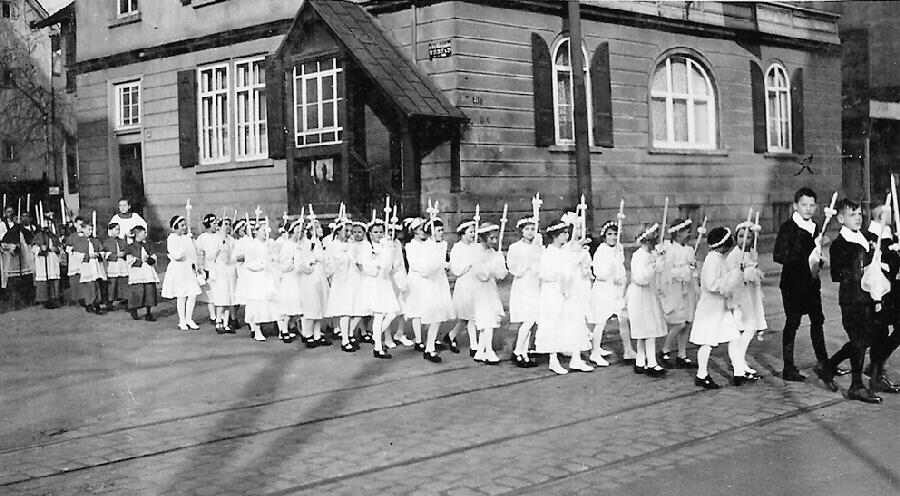
Hitler and the NAZIs initiated an assault both on traditional Christian values, but religions institutions as well. The NAZI assault on Judism is best known. But here the focus were the Jews themselves and not the religion. One religion seen in more positive terms was Islam, in part because it was helful in the effort against Jews. It was Christianity that suffered most from the NAZIs, primarily because it posed the greatest danger to the NAZIs. Sects like the 7th Day Adventists were attacked because they opposed military conscriptiom. The mainstream church that suffered the greatest was the Catholics. Despite signing a Concordant with the Vatican in 1933, the NAZIs steadily undermined the power and influence of the Church in Germany and arrested many priests. Once World War II began, German policies toward religions varied from country to country. The Church in Poland was a symbol of Polish nationalism and relentlessly persecuted. Priests were arressted and thousand died in the concentration camps. The Church in France because of the anticlerical nature of the Revolution was less important as anational symbol and the NAZIs did not seek to totally destroy French national and cultural institutions, so it was not targetted by the NAZI occupiers.
Hitler was circumspect in his statements on religion, but essentially he wanted to fundamentally change the concept of morality taught by the Christian churches. The question of morality for Hitler was much less nuanced than the Judeo-Christian traditions of Western Europe. For Hitler morality became a racial matter--the racial strength and purity of the German Volk. Any thing which strengthened the racial purity of the German Volk was moral. This meant a serious of social programs which focus social services on healthy Aryan Germans. Under Hitler's thinking, eugenic notions of sterilizing or even killing the handicapped or mentally ill was the height of morality because in strngthened the Aryan racial stick. By the same token, non-Aryans esoecially the Jews were forced out of German society and ultimately denied life itself. All this was seen as moral because it was aimed at strengrhen the racil strength of the German Volk.
Hitler's vision was a united Germany volk. Hoebbels assignment as minisdter of propasganda was to insure that the German people were not confused with different, competing ideas and inconvient facts. The NAZIs moved swiftltly to eliminate potential sources of non-MAZI ideas, such as political parties, trade unions, and youth groups. Conflict with the established churches was inevitable because they offered competing moral codes. With the churches, Hitler was more circumspect. Nut eventually they had to be either elininated or transformed. Hirler chose a middle path as a temporary expedient, one of weakening and descrediting the mainline churches. Eventually, howeverm there would hsve been a reckoning.
Even before the French Revolution with the Enlightenment, a stoung anti-clerial movement developed in Europe. This grew with the French Revolution. The Liberal movement has atrong abti-clerical element. And Marxist thought which was at the heart of the Socialist movement was not only anti-clerical, but often openly atheistic. The NAZIs went far beyons the bounds of the anti-clericism that had been expressed in Germany. NAZI officials openly denounced Christianity and MAZIs publications contained vituperative attacks on both Christianity and the established churches. The charges were especially sharp on Catholics. There were charges of not only homoseuaslkity, but abuse of children. Charges were publihed that Christianty was aojan Horse for bothb Jews and Bolseviks. [Ackermann, p.90.] Other articles cited historic examples of Christian percecution, burning of heritics, and witchraft campaigns, and much else. Here NAZIs plumming the historical record has to be careful. Much of the more negative aspects of Christianity were efforts the NAZIs wanted to return to German life.
The Germany which the NAZIs seized control of was a largely Christian country with strong Protestant and Catholic communities. The Soviet assault on religion is much better known, but the NAZIs also saw religion as a threat and began to undermine established churches in a number of ways. Hitler and the NAZIs initiated an assault on not only Germany's traditional Christian values, but religions institutions as well. Christianity itself was suspect because of its Jewish roots. At first NAZI anti-religion policy was subtle, but it increseased in intensity once the NAZIs were firmly established in power. The war on the Jews was biological in nature, religion having little to do with it. Conversion to Cristianity was no protection. The NAZIs began to undercut both Protestant churches and the Roman Catholic Church. The Catholic Chirch proved the biggest challenge for the NAZIs, in part because it was international in character. The NAZIs launched a spurious morals campaign to discredit Catholic prelates and laymen. Resistance to the T-4 Eithenasia program came largely from the Catholic community. Large numbers of priests in Germany were arrested and perished in concentration camps. The Protestant churches with some notable exceptions proved easier to control. Seven Say Ascentists were singled out because of their anti-War beliefs and objection to conscriptions. One religion seen in more positive terms by the NAZIs was Islam.
Religion came under attack by the NAZIs when they seized power in 1933. Christianity in Hitler's view served no purpose other than to undermine and limit what he wanted to accomplish in Germany. Himmler explained, "How different is yonder pale figure on the Cross, whose passivity and emphasized mien of suffering express only humility and self-abnegation, qualities which, we, conscious of our heroic blood, utterly deny... The corruption of our blood caused by the intrusion of this alien philosophy must be ended." [Blackburn, p. 155.] Religion was a difficult question for the NAZIs. Germany was a Christian nation. Most Germans thought of themselves as Christains, even many NAZI Party members. Hitler and his inner circle, however, were dismissive of Christianity. They wanted a new NAZI religion with national and racial connotations. The problem for the NAZIs was how to wean the German people from Christianity. Hitler had a very good sence about timing such matters, thus actions aganinst religious groups were only taken incrementally as the NAZIs eastablished their hold over Germany. In his assault on religion, Hitler used both the education system and the Hitler Youth. Educatng the children in schools was one approach. In this regards the German education system varied from state to state, but religious education was part of the curriculum in many German states. During the Third Reich many of the differences in the educational system in differnt regions of Germay were ended. The campaign against religion was also conducted in the Hitler Youth. Here often away from their parents, the campaign may have even been more effective than in the schools. There were alo many other actions taken against religion. The NAZIs in 1936 no longer allowed Christians to celebrate religious holidays on weekdays. [Koch, p. 172.]
Within only a few months after the NAZI seizure of power, Franz von Papen and Hermann G�ring went to Rome and met with Pope Pius XI (April 1933). The NAZIs negotiated a Concordat with the papacy (summer 1933). Papal official Eugenio Maria Giuseppe Giovanni Pacelli (the future Pope Pius XII was a major factor in the negotiations). Cardinal Faulhaber congradulated Hitler after the signing of the Reich Concordat. The Catholic Center Party fell in with other parties to support the regime and was then along with other political parties disbanded. Pacelli and other papal officials hoped that the Concordat would serve as a shield for the church. This was of course based on the assumtion that Hitler would adhere to agreements he signed. As one historian writes, "the agreement lent Hitler international credibility, criminalized Catholic political activity, and demoralized bishops and priests who opposed Nazi rule." [Loconte] The Reich Concordat conceded to Pacelli the right to impose the new Code of Canon Law on German Catholics and promised several actions to safeguard Catholic education, including possible new schools. Pacelli and the papacy in return assented to the withdrawal of Catholics from political and social activity. [Cornwell] The NAZIs subsequently launched the Currency and Immorality trials which reached a highpoint in 1935 and 1936 led to the fining and imprisonment of hundreds of clergy. The NAZIs desired to de-Chritisnize Germany, but did not want to openly attack churches. They began by attcking the reputation of Catholic clerics, especially those working in primary and secondary schools. The NAZIs by the onset of World War II had managed to closed down or take over confessional schools as well as private schools, both day schools and boarding schools. This essentially ended the diversity in education that had existed before the NAZI take over.
German charities before the NAZI takeover were primarily funded and adminitered by the religious community. It was one of the most extensive charity system in the world. The system developed before, but mostly during the German Empire (1871-1918) and was continued during the Weimar era (1918-33). There were seven major German charities. 1) There were a range of welfare organizations managed by the Socialist and Communist parties. 2) There was also a Christian Workers charity. This was a unit of the important Catholic Center Party. 3) There were many Jewish charities which had a national ubrella organization. 4) The Protestant Inner Mission was founded in 1846. 5) The Catholic Caritas organization was founded in 1896. 6) The German chapter of the Red Cross was founded in 1864. During the Imperial era the Red Cross was almost exclusively involved with medical aid for the military and POW issues. During the Weimar era it acquired a range of civilian responsibilities such as disaster relief. 7) The best known charity was the the German League for Voluntary Welfare. The confessional charities (Jewish and Christian), the Red Cross, and some smaller carities belonged to the League. The confessional charities operated a very large system of over 15,000 asylums, homes, sanitariums, and hospitals caring for about 1.3 million indivduals (the elderly, sick, and maladjusted children). This was about half of the overall German institutional care system. These charities employed and trained thousands of nurses and care givers.
As the NAZI Party grew in the 1920s, local units began to organize welfare activities. The initial focus was Storm Troopers injured in street brawls. They organized places for often indigent young men to be sheltered abd fed and to have their injuries treated. Stympthetic young women helped bandage them. [Fischer] Gradually the range of activities grew to indigent members and their families. These were ad hoc activities of local units.
This not unlike groups like Hamas and Hebolah in the Middle EAst today. This changed as pat of the NAZI assault on religion. Religious control of charities was unacceptable because it provided an area of influence beyond the control of the Party. And there were Jewish charities with considerable assetts. A Berlin Party unit founded the NSV. Erich Hilgenfeldtwas an early NSV employee. Berlin Party Gauleitr, Josef Goebbels, saw the propaganda potential in a Party welfare unit (1931). Goebbels selected Hilgenfeldt to manage the then small unit. Hilgenfeldt was a World War I pilot who was a moderately suceesful businessman after the War. He proved to be an excellent manager. He hit upon the idea of launching a fund drive comemorating Hitler's birthday (April 20, 1931). Hilgenfeldt personlly organized the collection campasign. The NSV was a still small operation vefore the NAZIs seized power, but the campaign attracted attention. The NSV focus at this stage was helping poor NAZI families with financial benefits.
While the NAZIs adopted a wide range of policies to undermind traditional religion, they did not ban the mainline denominations or close churches. This would have been disruptive in a country as thoroughly Christian as Germany. And especially after launchiung the War, Hitler wanted nothing that would disrupt the war effort. There were those planning a new NAZI religion for Germany and this would have occured had the NAZIs won the War. Hitler and other leading NAZIs were contemptuos of Christianity, viewing it as a religion for weaklings. The NAZIs rejected beatiudes like "Blessed are the meek, for they will inherit the earth." [Matthew 5:5] This was not what they wanted young people taught. Where Germany was headed can be seen in the SS. We see secular SS weddings outside of churches without clerical officiating. SS weddings were offiated by the men's commnders. And we see baptisms being replaced with a name giving ceremomy in front of an altar with Hitler's portrait. Many families would have wanted Christian cremonies, especially the middle class families from which SS-men came. I am not sure to what extent these ceremonies were required, but it is where Germany was heased if the NAZIs had won.
Hitler and his NAZI hyerarchy had many plans for Germany and Europe fter the War. Much of this was not shared with the German people. Most Germans were uaware of the radical revolutin Hitler had instore for them. One of these was supress the existig religious structure. By this time Judaism and the Jews themselves woud have been eliminated. Hitler was unwilling to openly assult the religious establishment, although that attack had begun by actions against clerics who could not be cowed and undrmining the financial supports of the churces and their charity work. Hitler realized that after winning the War that his position wiould be unasailable and that he could accomplish most of wht he wanted by fiat with little concern about opisition or criticusm. He also realized that given the still strong religious loyalties that a overt attack on churches would be very dusruptive to both preparations for warfare ad the war itself. And while the SA (after the Night of the Long Knives)
and SS was composed of men whose primary loyalties were to Hitler and the Party, the Whermacht was much more divided. There was support for the NAZIs within the Whermacht, but there was also strong traditional support for religion, It is difficult to assess the relative strength of these loyalties. Support for Hiler and the NAZIs undeniable increased during the NAZI era. Even so, openly attacking churches would have been a disruption and distration that adversely affected the war effort. It was an effort which could be potpond until after the War.
Once World War II began, German policies toward religions varied from country to country. The Church in Poland was a symbol of Polish nationalism and relentlessly persecuted. Priests were arressted and thousand died in the concentration camps. The Church in France because of the anticlerical nature of the Revolution was less important as anational symbol and the NAZIs did not seek to totally destroy French national and cultural institutions, so it was not targetted by the NAZI occupiers.
Austria was in many ways an active participant rather than an occupied country. A reader writes, "It is necessary to say that the NAZI policies agains the Catholic church ran up against the deeply felt religious faith, thus in Bavaria and Austria the church continued to function almost normally. I have been told that the prisoners in Austria were even authorized to attend the Sunday mass. The Austrian babies had being continued to be baptised and probably in Germany too." Here we agree that the NAZIs did encounter difficulties with the religious faith in Austria and Bavaria. We do not beliece that the Church was able to function normally. This is a subject that we will persue in greater detail.
The Church in France because of the anticlerical nature of the Revolution was less important as anational symbol and the NAZIs did not seek to totally destroy French national and cultural institutions, so it was not targetted by the NAZI occupiers. A French reader tells us, "In the cities and villages of the occupied France, the mass of Sunday was celebrated normally. Catholic institution in France were not targetted by the NAZIs. Many jew were hiden or recieved a false baptism to escape the NAZI and French collaborationist Milice roundups. The Wehrmacht was not specialy against the Catholic religion, in part because many officers were Catholics themselves. The SS was a different matter". The acclaimed French film Au revoir les enfants is the story of one Jewish boy a French priest attempted to protect.
The Church in Poland was a symbol of Polish nationalism and relentlessly persecuted. Priests were arressted and thousand died in the concentration camps.
Ackermann, J. Heinrich Himmler als Ideologe (G�ttingen, 1970).
Blackburn, Gilmer W. Education in the Third Reich: Race and History in Nazi Textbooks (State University of New York Press: Albany, 1985).
Fischer, C. Stormtroopers: A Social, Ecomomic, and Ideological Analysis (London: 1983).
Gilbert, Martin. A History of the Twentieth Century Vol. 2 1933-54 (William Morrow and Company, Inc.: New York, 1998), 1050p.
Koch, H. W. The Hitler Youth: Origins and Development 1922-1945 (Stein and Day: New York, 1975).

Navigate the Boys' Historical Clothing Web Page
[Return to the Main NAZI Government: Religion page]
[Return to the Main NAZI religious education page]
[Return to the Main religion page]
[Biographies]
[Campaigns]
[Children]
[Countries]
[Deciding factors]
[Diplomacy]
[Geo-political crisis]
[Economics]
[Home front]
[Intelligence]
[POWs]
[Resistance]
[Race]
[Refugees]
[Technology]
[Bibliographies]
[Contributions]
[FAQs]
[Images]
[Links]
[Registration]
[Tools]
[Return to Main World War II page]
[Return to Main war essay page]