The African Slave Trade: The Indian Ocean--Markets
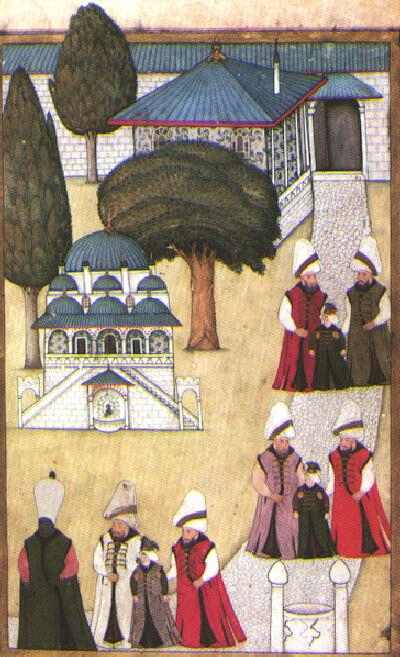
Figure 1.--This 18th century Ottoman painting was done about 1720-32. We do not know who the artist was. The chief black eunuch at court in Istambul (Constantinople) is escorting the princes to the circumcision ceremony. The different outfits seem to suggest that three different princes were involved in the ceremony. I believe that the princes until this ceremony would have been raised in the harems.
Indian Ocean slavers had a range of markets in which to sell their captives. The markets varied over time. Is it generally thought that the primary market was the Arab world (Saudi Arabia, Yemen, Oman, and Iraq). Limited documentation makes this only a probability at this time. We are less sure about Persia. Such shipments may at times have been substantial. There appear to have been sales to India, but these seem to have been limited. The Ottomans were another market, but weare unsure as to the dimensions of this trade and here the desert caravan routes throughthe Sahara may have been more important. The French Indian Ocean islands seem to have been important in the 18 and 19th century. Brazil also seems to have been an important market. The market shifted significantly in the 19th century with East Africa and Indian Ocean islands becoming more important than ever before (Pemba, Madagascar, Reunion, and Zanzibar).
Arab World
Is it generally thought that the primary market was the Arab world, but limited documentation makes this only a probability at this time. The general thinking is that the demand for slaves in the Arab world was relatively limited. There was awell established peasant class and thus unlike the Sestern Hemishere there was no large demand for agrcicultural labor. There seem to havecbeen two exceptions to this general pattern. The Caliphate appears through irrigation work in what is now southern Iraq brought substantial reas of marsh land under cultivation (8th-9th centuries). This did create a demand for slaves. Another exception was in the lasr century of the trade. The Sultan of Oman/Zanzibar began establishing highly profitable palm oil plantations in what is now souhern Somalia and Kenya and spice (cloves) plantations on Zanzibar and Pemba. With these exceptions there is very little information about the dimensions of the shipments of Africans into the Arab world. Most authors suggest that the trade existed throrought, but was usually sporadic and fairly limited in scope.
Zanzibar developed as a powerful Arab tading base along the coast of East Africa. The Omznis developed a network of trading connectuiions deep into East Africa. The trade ikn gold, ivory, wood, and slaves developed. Cloves were grown on the island. Little is kmnown about the dimensions of the slave trade through most of the time after the Omanis established political control.
The peak of the slsve trade through Zanzibar appears to hsve been when clove and sugsr plantations were founded on Mauritius and Reunion (18th century). The Royal Navy moved against the Arab Indian Ocean slave trade after the Napleonic Wars (1820s). The Indian Ocean slave ttade was largely in the hands of the Sultanate of Zanzibar. The Sultanate's expanding plantation operations in the early 19th century were worked mostly with slave labor. The profits fom the East African plantations induced the Sultan of Oman, Sayyid Said, to relocated his capital from Oman to the east African island of Zanzibar (1832). The Sultan's sovereignty at the time extended from southern Somalia to northern Mozambique.
Persia
We are less sure about Persia. The trade in slaves with Persia seems smaler than the shipments to the Arab world, but such shipments may at times have been substantial. But our knowledge about Persian demand for slaves is very limited at this time.
Ottomon Empire
The Ottomans were another market, but weare unsure as to the domensions of this trade and here the desert caravan routes through the Sahara may have been more important. Shipments to the Ottoman Empire would have first had to pass through Arab lands, either North Africa or the Middle East. Later the Ottomans conquered the Middle East and North Africa and had more directvaccess to African slaves. Slavery in the Ottoman Empire is a topic tht we have still not addressed in detail. We have not yet found any data on the number of African slaves in the Ottoman Empire. We do notice numerous references to black enuchs. Note the 18th century Ottoman paihting here (figure 1). I think that the Arab slave traders would have performed the operatin on captive African boys and then sold the castrated or emasculated boys to the Turks.
India
There appear to have been sales of slaves to India, but these seem to have been limited. There were plentiful and cheap labor in India and thus no need to import slaves. In fact the colonial powers exported labor from India to their colonies (Bali, South Africa, Suriname, Trinidad. and other locations). The British with the advent of the Raj, ended the slave trade in India. We do not yet have deails with this such as dfifferences among Muslim and Hindu communities in India.
French Islands
The French Indian Ocean islands seem to have been important in the 18th and 19th century. The French as part of their colonial effort in India set up colonies on the islands of Reunion and Mauritius (18th century). The primary crops were cloves and sugar. These highly profitable plantations required imported labor. This was provided by slaves, mostly from Portuguese Mozambique and Zanzibar.
Mauritius was a small island in the Indian Ocean located east of Madagascar and Reunion. Unlike Oceania, several Indian Ocean islands were not reached by humans before the modern era. We have some information on Mauritius history. The island was unpopulated when the Portuguese discovered it. The Dutch seized the islands and brought in Africa slaves, but failed to establish a profitable colony. The French acquired it and established a flourishing sugar industry based on slave labor. Reunion thus became part of the Indian Ocean slave trade. Most of the slaves were obtained from Madagascar. The British seized the island during the Napoleonic Wars, but allowed it to remain culturally French.
Réunion has a similar history to Mauritius. It was visited, but not settled by a series of seafarers (Malay, Arab, and finally European mariners beginning with the Portuguese). The small archipelago, cononsists of Mauritius, Rodrigues and Réunion. Portuguese navigator Pedro de Mascarenhas christened the islands the Mascarenes (1512). ,
The French began the settlement (1642). La Compagnie des Indes Orientales (the French East India Company) sent the the St-Louis. The King of France named the island ile Bourbon. The French settlement created a poopulation of white French landowners and African and Malagasy (Madagascar) slaves (late-17th century). The population was vry small and only a few slaces were imported. The French did not show a great interest in Reunion. There was no great rush to populate and develop the island. Few wanted ti=o invest capital or time in the enterprise. The French presence was so tenuous that pirates began using Ile Bourbon as a base for their operagtions and trade there (about 1685). The French East India Company for decades was content to produce provisions only for its own needs and those of any passing ships. This changed when coffee was introduced (1715). Coffee quickly became the island's principlal cash crop which fundamentally changed the economy. The French enslaved more Africans to carry out the intensive labour required for growing and harvesting coffee. The French also introduced other cash crops (cereal grains, spices and cotton).
The islands changed hands during the Napoleonic Wars from French to British.
Brazil
Brazil also seems to have been an important market. It seems to have been a primary market for Mozambique captives, in part because Brazil was also a Portuguese colony and there was a huge demand for labor with the development of the sugar industry. Ee have no information uet of shipments of caotives gtaken nlorth of Mozambique to Brazil.